Learn everything about Indian elephants—their habitat, behaviour, population, conservation, migration, threats, and the best places to see them in India.
Complete Guide to Indian Elephants (2026): Habitat, Behaviour, Population, Conservation & Best Places to See Them
Indian elephants are among the most influential animals in India’s forests. As the largest land mammals in Asia, they shape vegetation, disperse seeds over long distances, create pathways through dense forests, and influence the habitats used by countless other species. Their presence is often considered an indicator of healthy, connected ecosystems.
For many wildlife travellers, seeing a herd of wild elephants is one of the highlights of visiting India’s national parks and forest reserves. For researchers and conservationists, however, elephants represent something much larger: the challenge of protecting wide-ranging animals in landscapes increasingly shared with people.
Unlike species that can survive within a single protected area, elephants routinely move across forests, grasslands, agricultural land, and community-managed landscapes. Their seasonal movements make connected habitats and elephant corridors just as important as national parks. When these routes are disrupted by roads, railways, settlements, or fragmented forests, encounters between people and elephants become more frequent, increasing risks for both.
Another reason Indian elephants receive so much attention is their conservation status. While India supports the world’s largest population of wild Asian elephants, estimates vary depending on the survey method and reporting year. Recent DNA-based population estimation has introduced a new approach to understanding elephant numbers, highlighting why population figures should always be interpreted in the context of the methods used rather than viewed as exact counts.
This guide brings together current knowledge about Indian elephants, including their biology, behaviour, habitat, distribution, population status, conservation challenges, and the best places to observe them responsibly in the wild. Whether you’re planning a safari, studying wildlife, or simply curious about one of India’s best-known mammals, the aim is to provide practical, well-supported information grounded in current conservation understanding.
What is an Indian Elephant?
The Indian elephant is the subspecies of the Asian elephant found across much of the Indian subcontinent. Its scientific name is Elephas maximus indicus. Although many people casually refer to it as a separate species, conservation organisations generally treat it as one of the recognised subspecies of the Asian elephant (Elephas maximus). Understanding this distinction helps avoid confusion when reading scientific literature or conservation reports.
India is home to the largest remaining population of wild Asian elephants, making the country central to the species’ long-term conservation. Wild populations occur across four broad regions: southern India, northeastern India, northern India, and parts of central India. These populations are separated by fragmented habitats rather than forming one continuous range, making landscape connectivity an important conservation priority.
Indian elephants occupy a wider variety of habitats than many people realise. While they are often associated with tropical forests, they also use moist deciduous forests, dry deciduous forests, grasslands, scrublands, and even semi-arid thorn habitats where food and water remain available. Their ability to adapt to different environments has helped them survive across diverse landscapes, but they still depend on extensive areas and reliable movement corridors between seasonal feeding grounds.
Ecologically, elephants are considered mega-herbivores and ecosystem engineers. They consume large quantities of vegetation every day, disperse seeds through their dung, and alter forest structure by feeding on shrubs, saplings, and trees. Many plant species benefit from this natural seed dispersal, while the trails elephants create are used by numerous other animals moving through dense forests.
Field Note: An elephant’s importance extends well beyond its own survival. Protecting elephants often means protecting entire landscapes that support tigers, leopards, gaur, deer, birds, and many other species that share the same forests.
Indian Elephant vs African Elephant
Although both belong to the elephant family, Indian and African elephants differ noticeably in appearance, behaviour, and distribution.
| Feature | Indian Elephant | African Elephant |
| Scientific classification | Elephas maximus indicus (Asian elephant subspecies) | African elephant species |
| Geographic range | Indian subcontinent | Sub-Saharan Africa |
| Size | Generally smaller | Generally larger |
| Ears | Smaller, rounded | Much larger, fan-shaped |
| Back profile | Slightly arched or level | More concave |
| Head | Twin-domed forehead | Single rounded forehead |
| Trunk tip | One finger-like projection | Two finger-like projections |
| Females with tusks | Usually absent or very small | Present in many populations |
| Habitat | Forests, grasslands, scrublands | Savannas, forests, wetlands, deserts |
These differences are useful for identification, but both species share many behavioural traits. They live in complex social groups, possess strong memories, communicate through a variety of vocal and non-vocal signals, and play similar ecological roles as large herbivores within their respective environments.
Physical Characteristics of the Indian Elephant
Indian elephants are among the largest land mammals in Asia. Their size, strength, and adaptability allow them to move through a wide range of habitats, from tropical evergreen forests to open grasslands and scrublands. While males are generally much larger than females, both sexes share several distinctive features that set Asian elephants apart from their African relatives.
Indian Elephant Facts at a Glance
| Feature | Details |
| Scientific name | Elephas maximus indicus |
| Common name | Indian elephant |
| Conservation status | Endangered |
| Height | Approximately 2.3–3.3 metres at the shoulder |
| Body length | Approximately 5.5–6.4 metres |
| Male weight | Around 3,500–6,000 kg |
| Female weight | Around 2,500–4,000 kg |
| Diet | Herbivore |
| Daily food intake | About 150–200 kg |
| Daily water requirement | Up to 200 litres |
| Lifespan | Several decades under natural conditions |
Population estimates vary by source and survey methodology, so conservation reports should always be read with the reporting year and method in mind.
Size and Weight
Adult males are considerably larger than females and can weigh between 3,500 and 6,000 kilograms, while females generally weigh 2,500 to 4,000 kilograms. Adults typically stand 2.3 to 3.3 metres at the shoulder and may reach 5.5 to 6.4 metres in body length.
Despite their immense size, elephants move with surprising agility. They can quietly navigate dense forests, climb moderate slopes, cross rivers, and travel long distances in search of food and water. Their broad, cushioned feet distribute their weight efficiently, helping them move across soft forest floors with relatively little noise.
For wildlife photographers and safari visitors, apparent size can be misleading. A lone bull standing beside tall grass may appear smaller than expected, whereas a herd emerging onto an open meadow reveals the true scale of these animals.
Tusks, Trunk, Ears and Feet
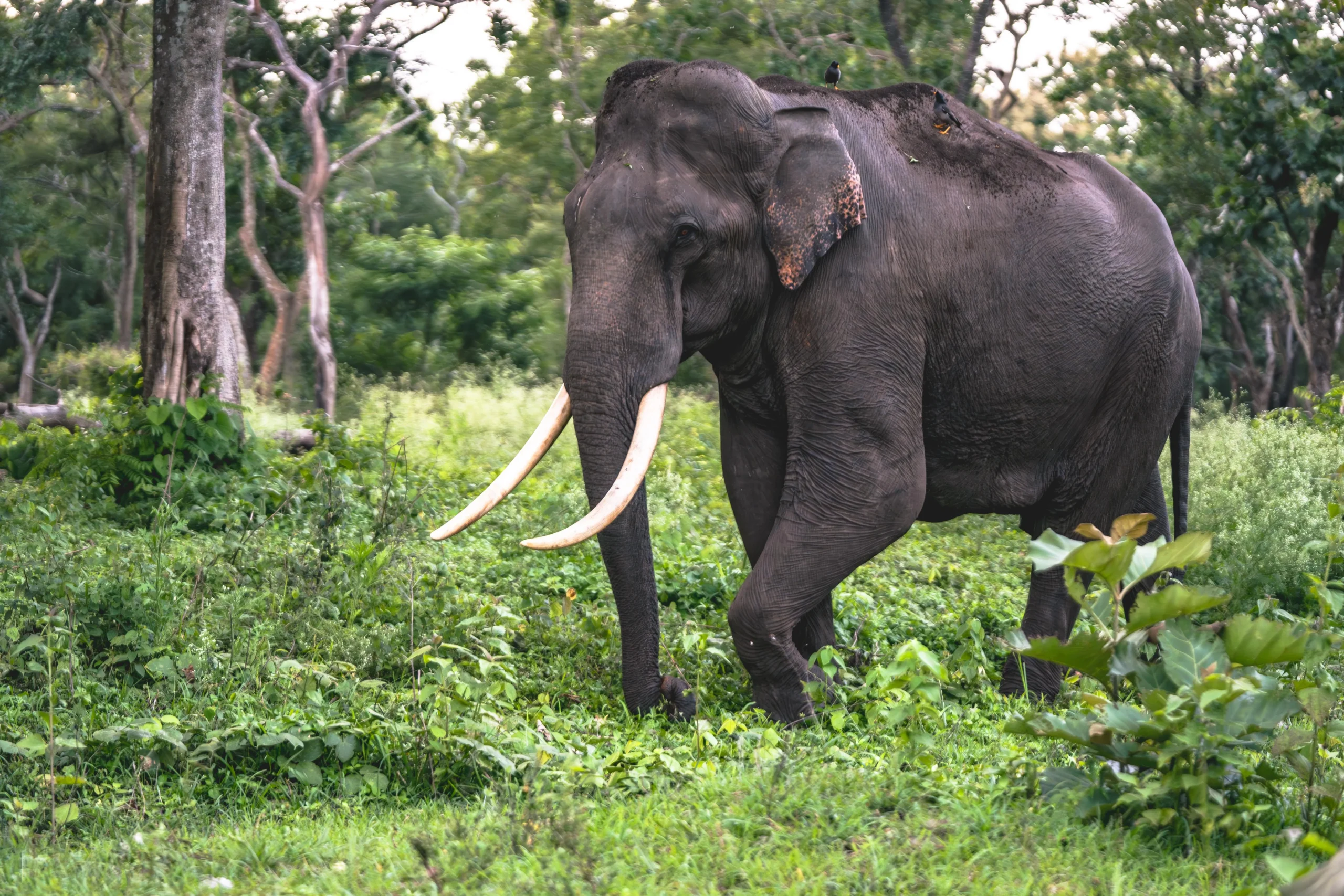
One of the easiest ways to identify an Indian elephant is by its smaller, rounded ears, which differ noticeably from the much larger ears of African elephants.
Tusks
Not every Indian elephant has visible tusks.
Adult males commonly develop long ivory tusks, although their size varies considerably between individuals and populations. Many females either lack visible tusks altogether or possess only small peg-like tusks that remain largely hidden.
Another interesting feature of Indian elephant populations is the presence of makhnas—adult males that naturally have no tusks. These individuals are perfectly healthy and occur naturally in several regions of India.
The Trunk
The trunk is an elongated fusion of the nose and upper lip containing thousands of muscles. It functions as an exceptionally versatile tool used for:
- Breathing
- Smelling
- Drinking
- Feeding
- Touch
- Communication
- Lifting objects
- Dusting and bathing
- Greeting other elephants
Unlike African elephants, Indian elephants have one finger-like projection at the tip of the trunk, which they use to grasp leaves, fruits, grasses, and even surprisingly small objects.
Feet
Each foot acts like a natural shock absorber. Thick fatty pads beneath the feet reduce impact while walking, allowing elephants to travel many kilometres every day across uneven terrain.
These broad footprints also help wildlife trackers identify herd movement, estimate direction of travel, and distinguish between adults and calves.
Photography Tip: If you want to capture the true scale of an elephant, include surrounding trees, vehicles, or people (only where safe and appropriate). Without a reference point, photographs often underestimate just how large these animals are.
Lifespan
Indian elephants are long-lived mammals. In natural conditions they may live for several decades, although lifespan varies depending on habitat quality, food availability, disease, accidents, and interactions with people.
Older females often become repositories of knowledge within their herds, remembering traditional migration routes, seasonal water sources, and safe feeding areas. This accumulated experience can be critical during droughts or other challenging periods.
Diet and Water Requirements
Indian elephants are herbivores with enormous daily food requirements. Adults typically consume 150 to 200 kilograms of vegetation each day and may drink up to 200 litres of water depending on weather and availability.
Their diet varies throughout the year and may include:
- Grasses
- Bamboo
- Leaves
- Bark
- Fruits
- Roots
- Shrubs
- Young tree shoots
Rather than feeding on a single plant species, elephants consume a wide variety of vegetation. This flexibility allows them to adapt to changing seasons and different habitats across India.
Because they require such large quantities of food, elephants spend much of their day moving between feeding areas.
Social Structure and Behaviour
One of the reasons elephants fascinate researchers is their highly developed social lives. Unlike many large mammals, elephant societies are built around long-term family relationships, cooperation, learning, and memory.
Their behaviour is neither random nor driven solely by instinct. Family members recognise one another, communicate over long distances, care for calves together, and collectively respond to changes in their environment. These complex social bonds are one reason habitat fragmentation can have effects beyond simply reducing available forest.
Matriarchal Family Herds
Indian elephant society is centred on female-led family groups.
Each herd is usually led by an experienced matriarch, often the oldest female in the group. Her role extends well beyond leadership during daily movement. She helps guide the herd to seasonal food sources, remembers traditional migration routes, recognises potential dangers, and makes decisions during encounters with other elephants or people.
A typical family herd may include:
- Adult females
- Young calves
- Juveniles
- Adolescent females
- Occasionally young males before they leave the herd
These family units often maintain close relationships with neighbouring herds, forming larger social networks sometimes referred to as clans.
Social Structure of an Elephant Herd
| Herd Member | Primary Role |
| Matriarch | Leads movement and decision-making |
| Adult females | Care for calves and maintain herd cohesion |
| Juveniles | Learn feeding, movement and social behaviour |
| Calves | Remain protected within the herd |
| Young males | Stay until adolescence before becoming more independent |
Bull Elephants and Solitary Life
Male elephants follow a different social path.
As they mature, young bulls gradually leave their natal herds. Adult males usually live alone or form loose temporary associations with other males rather than permanent family groups.
This lifestyle allows bulls to move over larger areas while seeking food and breeding opportunities.
Although solitary, adult bulls regularly interact with female herds during the breeding season.
What Is Musth?
One of the most distinctive features of mature male elephants is musth.
Musth is a temporary physiological condition during which testosterone levels rise dramatically. Bulls in musth often become more active, travel longer distances, and compete more intensely for access to receptive females. Visible signs may include temporal gland secretions and continuous urine dribbling.
For wildlife visitors, understanding musth is important because bulls in this condition may behave less predictably than usual.
Field Note: Safari guides pay close attention to the behaviour of bulls showing signs of musth. Responsible wildlife viewing always prioritises maintaining a safe distance and allowing elephants plenty of space.
Communication and Memory
Elephants communicate using an impressive combination of:
- Low-frequency vocalisations
- Trumpeting
- Touch
- Body posture
- Ear movements
- Trunk contact
- Chemical signals
Some low-frequency sounds travel long distances, allowing separated family groups to remain in contact across dense forests or open landscapes.
Equally remarkable is their memory. Older elephants can remember seasonal migration routes, traditional water sources, and areas where previous encounters with humans have occurred. This social memory is one reason experienced matriarchs are considered vital to herd survival.
Feeding Behaviour and Daily Activity
Indian elephants devote a large proportion of each day to feeding. Conservation sources estimate they may spend 16 to 19 hours daily searching for and consuming vegetation.
Their daily routine generally includes:
- Feeding for extended periods
- Walking between feeding areas
- Drinking and bathing
- Dust bathing to protect the skin
- Resting during the hottest part of the day
- Social interactions within the herd
As they move, elephants disperse seeds through their dung, helping regenerate forests over large areas. This natural seed dispersal is one reason they are often described as ecosystem engineers—their feeding behaviour directly influences forest composition and supports many other plant and animal species.
Expert Tip: If you observe a wild elephant feeding, avoid expecting dramatic behaviour. Most elephant sightings involve quiet grazing, browsing, social interactions, or slow movement through the forest. Watching these everyday behaviours often provides a deeper understanding of how elephant societies function.
Habitat and Distribution of Indian Elephants
Indian elephants are highly adaptable animals, but they are not confined to a single type of forest. They occur across a wide range of habitats, provided there is enough food, water, shelter, and space to move between seasonal feeding areas. Although protected areas remain important, many elephant populations regularly use reserve forests, community lands, agricultural landscapes, and wildlife corridors outside national parks. This broad habitat use explains why conserving elephants requires landscape-level planning rather than protecting isolated reserves alone.
Habitats Used by Indian Elephants
Contrary to a common misconception, elephants do not live only in dense tropical forests. They are habitat generalists capable of adapting to several vegetation types across India.
Major Habitat Types
| Habitat Type | How Elephants Use It |
| Tropical evergreen forests | Shelter, browsing, and year-round food |
| Moist deciduous forests | Seasonal feeding and movement |
| Dry deciduous forests | Grazing and browsing during suitable seasons |
| Grasslands | Important feeding areas |
| Thorn and scrub forests | Used where food and water remain available |
| Forest edges and mixed landscapes | Seasonal movement between habitats |
These habitats often occur within the same landscape, allowing elephants to shift their feeding patterns throughout the year as vegetation changes. Rather than depending on one plant community, elephants exploit a wide variety of grasses, shrubs, bamboo, fruits, bark, and tree leaves.
Why Water Matters
Water strongly influences elephant movement.
Large herds regularly travel between feeding grounds and reliable water sources, particularly during the dry season. Rivers, streams, reservoirs, and natural waterholes often become focal points of elephant activity, which is why visitors frequently encounter elephants near water during safaris.
Because adults may drink up to 200 litres of water each day, access to dependable water sources is essential for their survival.
Field Note: During summer safaris, guides often monitor waterholes and river crossings because elephants frequently visit them during the hotter parts of the day. However, sightings are never guaranteed, as elephant movements depend on local conditions and natural behaviour.
The Four Fragmented Elephant Populations of India
Instead of occupying one continuous range, India’s wild elephants are distributed across four broad fragmented populations. These regions are separated by human settlements, agriculture, roads, and other barriers that restrict natural movement between landscapes.
1. Southern India
Southern India supports the country’s largest and most continuous elephant landscapes.
This region includes parts of:
- Karnataka
- Kerala
- Tamil Nadu
Well-known conservation landscapes include the Nilgiris–Eastern Ghats Landscape, where protected areas such as Bandipur, Nagarhole, Mudumalai, Wayanad, and adjoining forests together support one of Asia’s most significant elephant populations.
The connected nature of these forests allows elephants to undertake seasonal movements while maintaining healthy genetic exchange between populations.
2. Northeast India
Northeast India contains some of the country’s most productive elephant habitats.
Important landscapes include:
- Kaziranga–Karbi Anglong Landscape
- North Bank Landscape
- Other forested regions across the northeastern states
These landscapes combine forests, floodplains, grasslands, and hill forests, creating diverse habitats that support elephants alongside many other large mammals.
Seasonal flooding and changing vegetation influence elephant movements throughout the region.
3. Northern India
Northern elephant populations occur mainly within the Terai Arc Landscape, which stretches along the Himalayan foothills and extends into neighbouring Nepal.
This landscape consists of:
- Sal forests
- Grasslands
- Riverine habitats
- Agricultural interfaces
Because elephant ranges frequently cross international boundaries, conservation efforts increasingly require cooperation across states and countries.
4. Central India
Central India’s elephant populations are smaller and more fragmented than those in the south or northeast.
In recent decades, elephants have expanded into or reoccupied some parts of central India, but these populations often remain isolated and depend heavily on habitat connectivity for long-term viability.
Major Elephant Landscapes in India
| Landscape | Importance |
| Nilgiris–Eastern Ghats | Largest connected elephant landscape in southern India |
| Kaziranga–Karbi Anglong | Forest and grassland landscape supporting seasonal movement |
| North Bank Landscape | Significant northeastern elephant habitat |
| Terai Arc Landscape | Cross-border conservation landscape along the Himalayan foothills |
Each landscape presents different conservation challenges, from infrastructure development to agricultural expansion and habitat fragmentation.
Why Do Indian Elephants Migrate?
Elephants are naturally mobile animals.
Rather than remaining within a single forest throughout the year, herds move between feeding grounds, water sources, breeding areas, and seasonal habitats. These movements have developed over generations and are often guided by experienced matriarchs who remember traditional routes.
Migration is influenced by several factors, including:
- Seasonal rainfall
- Availability of fresh vegetation
- Water availability
- Breeding opportunities
- Historical movement patterns
These journeys may involve travelling through protected forests, community forests, agricultural land, and village boundaries, highlighting why conservation cannot focus solely on protected areas.
Why Elephant Corridors Matter
One of the most important concepts in modern elephant conservation is the elephant corridor.
An elephant corridor is a strip of habitat that connects larger forest areas, allowing elephants to move safely between them. Corridors help maintain natural migration, enable gene flow between populations, and reduce the isolation caused by fragmented habitats.
Without functioning corridors, elephants may be forced to travel through farms, roads, railways, or settlements, increasing the likelihood of conflict with people.
Benefits of Elephant Corridors
Well-protected corridors help:
- Maintain seasonal migration routes.
- Support healthy genetic diversity.
- Reduce habitat fragmentation.
- Improve access to food and water.
- Lower the risk of human-elephant encounters.
- Strengthen long-term population resilience.
For this reason, conservation organisations increasingly emphasise reconnecting landscapes rather than simply expanding individual protected areas.
Expert Tip: A national park alone is rarely enough to conserve elephants. Long-term survival depends on preserving the connections between forests so herds can continue their traditional movements.
Population Status and Recent Census Updates
Estimating India’s elephant population is more complicated than counting animals inside a single protected area. Elephants move across vast landscapes, often crossing state boundaries and using areas outside forests. As a result, population figures are estimates based on specific survey methods rather than exact counts. Understanding how those estimates are produced is just as important as knowing the numbers themselves.
Are Indian Elephants Endangered?
Yes.
Conservation organisations such as WWF classify the Indian elephant, as part of the Asian elephant, as Endangered. This reflects continuing pressures from habitat loss, fragmentation, poaching, and increasing conflict between people and elephants.
Being listed as Endangered does not mean elephants are disappearing everywhere at the same rate. Some landscapes support relatively stable populations, while others face greater pressure because forests have become fragmented or movement routes have been blocked.
Why Do Population Estimates Differ?
Readers often encounter different estimates for India’s elephant population. This does not necessarily mean one figure is right and another is wrong.
Different organisations report numbers based on:
- Different survey years
- Different census methods
- Different geographical coverage
- Updated scientific techniques
The research brief highlights several widely cited estimates:
| Source | Population Estimate | Notes |
| WWF India | Around 26,000 | Widely cited conservation estimate |
| WWF Global | 20,000–25,000 | Global conservation reference |
| India’s 2025 DNA-based estimation | 22,446 wild Asian elephants | Based on improved genetic survey methodology |
These figures should be viewed as reference points rather than directly comparable totals, because the underlying methods differ.
The Importance of DNA-Based Population Estimation
One of the most significant recent developments in elephant conservation has been the adoption of DNA-based population estimation.
Instead of relying solely on direct sightings or indirect field observations, genetic methods provide an additional tool for estimating wild elephant populations across large landscapes. The 2025 DNA-based estimate of 22,446 wild Asian elephants established a new reference point for future monitoring and reflects ongoing improvements in census methodology rather than a simple replacement of previous estimates.
As survey techniques continue to evolve, future estimates may also change. For this reason, conservation scientists generally focus on long-term trends and methodology rather than interpreting any single figure in isolation.
Decision Guide: When comparing elephant population numbers, always check who published the estimate, when it was produced, and how the survey was conducted. Numbers without this context can easily be misunderstood.
Threats Facing Indian Elephants
Despite being one of India’s best-known wildlife species, Indian elephants face increasing pressure across much of their range. Most conservation challenges today are not caused by a single factor but by the combined effects of habitat loss, fragmented landscapes, expanding infrastructure, and growing interactions between people and wildlife.
Unlike smaller mammals that may survive within relatively compact protected areas, elephants require large, connected landscapes. When those landscapes become fragmented, elephants continue to follow traditional movement routes, often bringing them into contact with farms, villages, roads, and railways. As a result, conservation increasingly focuses on enabling people and elephants to coexist rather than attempting to separate them completely.
Habitat Loss and Fragmentation
Habitat loss remains one of the greatest long-term threats to Indian elephants.
As forests are converted or divided by human activities, elephants lose access to feeding areas, water sources, and traditional migration routes. Even where forest cover remains, fragmentation can isolate elephant populations and reduce opportunities for movement between landscapes.
Fragmented habitats can lead to:
- Smaller, isolated elephant populations.
- Reduced genetic exchange between herds.
- Increased dependence on narrow movement corridors.
- More frequent movement through agricultural land.
- Greater likelihood of encounters with people.
For a species that naturally travels long distances, maintaining connectivity between habitats is often just as important as protecting the habitats themselves.
Human-Elephant Conflict
One of the most complex conservation challenges is human-elephant conflict.
This term refers to situations where elephants and people negatively affect one another. It can involve crop damage, property loss, injuries, or fatalities, while elephants themselves may also be injured or killed during such encounters.
Conflict often arises because elephants continue to use historical movement routes that now pass through cultivated land or settlements. Rather than recognising human boundaries, elephants respond to the availability of food, water, and familiar travel paths.
Common factors contributing to conflict include:
- Expansion of agriculture into elephant habitats.
- Loss of natural migration routes.
- Fragmented forests.
- Increasing infrastructure development.
- Attractive food sources such as crops near forest edges.
It is important to recognise that conflict does not mean elephants are inherently aggressive. Their behaviour depends on context, available escape routes, the presence of calves, and the degree of disturbance.
Why Conflict Is Increasing
Several changes across India’s landscapes have made coexistence more challenging.
As forests become fragmented, elephants are more likely to encounter:
- Villages
- Agricultural fields
- Highways
- Railway lines
- Fencing
- Expanding towns
At the same time, traditional migration routes may no longer provide safe passage between seasonal habitats.
Because elephants have strong spatial memory and often follow routes used for generations, blocking these pathways rarely stops movement altogether. Instead, herds may be forced to navigate increasingly complex human-dominated landscapes.
Poaching
Although habitat-related threats dominate current conservation discussions, poaching remains a concern in some regions.
Historically, elephants have been targeted for ivory, particularly adult tusked males. Loss of breeding bulls can affect the structure of local populations over time. Continued law enforcement and habitat protection remain important components of elephant conservation.
Infrastructure Development
Modern infrastructure can unintentionally create barriers to elephant movement.
Examples include:
- Roads
- Railway lines
- Power infrastructure
- Industrial development
- Expanding settlements
These features may divide habitats or intersect traditional migration routes. When planning infrastructure in elephant landscapes, conservation agencies increasingly emphasise maintaining ecological connectivity wherever possible.
Threats and Conservation Responses
| Conservation Challenge | Why It Matters | Common Conservation Response |
| Habitat loss | Reduces available forest | Protect remaining habitats |
| Habitat fragmentation | Isolates elephant populations | Restore landscape connectivity |
| Corridor disruption | Blocks seasonal movement | Secure and manage elephant corridors |
| Human-elephant conflict | Risks to both people and elephants | Conflict mitigation and coexistence measures |
| Poaching | Reduces breeding adults | Stronger protection and enforcement |
| Infrastructure barriers | Restricts movement | Wildlife-friendly planning and connectivity |
Conservation Efforts and Coexistence
Protecting elephants today involves much more than safeguarding individual animals. Conservation increasingly focuses on maintaining healthy landscapes where elephants can continue their natural movements while reducing risks to nearby communities.
The research brief highlights several priorities that are now central to elephant conservation in India, including habitat connectivity, corridor protection, improved population monitoring, and practical conflict mitigation.
Protected Areas Are Only Part of the Solution
National parks, wildlife sanctuaries, and tiger reserves provide important refuges for elephants, but many herds spend considerable time outside these protected areas.
Elephants regularly move between forests using reserve forests, community-managed lands, and other natural habitats. As a result, conservation strategies increasingly extend beyond protected area boundaries to include the wider landscape.
Protecting Elephant Corridors
Among the most effective long-term conservation measures is safeguarding elephant corridors.
These habitat links allow elephants to:
- Move between seasonal feeding areas.
- Reach reliable water sources.
- Maintain genetic exchange between populations.
- Reduce the need to travel through villages or farmland.
Current conservation messaging consistently identifies reconnecting fragmented habitats as one of the highest priorities for securing the future of India’s elephants.
Community-Based Conservation
People living in elephant landscapes play an essential role in conservation.
Rather than relying solely on enforcement, many conservation approaches encourage cooperation between local communities, forest departments, and conservation organisations.
Examples include:
- Local awareness programmes.
- Community participation in conservation.
- Early warning systems that alert residents to elephant movements.
- Measures that help reduce conflict while allowing elephants to continue their natural movements.
These approaches recognise that long-term conservation depends on improving coexistence rather than simply preventing encounters.
Improved Population Monitoring
Reliable conservation decisions depend on accurate information.
Recent DNA-based population estimation represents an important step towards improving how elephant populations are monitored across large landscapes. Genetic methods complement traditional field surveys and provide additional information that can improve future conservation planning.
Responsible Wildlife Tourism
Wildlife tourism can contribute to elephant conservation when conducted responsibly.
Visitors can help minimise disturbance by:
- Following instructions from trained guides.
- Maintaining appropriate viewing distances.
- Remaining quiet near wildlife.
- Never attempting to attract elephants for photographs.
- Avoiding actions that block an elephant’s movement.
Responsible tourism benefits both wildlife and visitors by encouraging natural behaviour rather than stressful interactions.
Responsible Tourism Tip: If an elephant changes its behaviour because of your vehicle or presence, you are probably too close. Ethical wildlife viewing means allowing elephants to continue feeding, resting, or moving without interference.
Best Places to See Indian Elephants in the Wild
Indian elephants occur across several regions of the country, but sighting opportunities vary depending on habitat, season, and local elephant movements. No destination can guarantee sightings, and elephant behaviour remains unpredictable.
The following landscapes are among the best known for observing wild elephants in natural habitats.
Southern India
Southern India supports the country’s largest connected elephant landscapes.
Popular destinations include protected forests within the Nilgiris–Eastern Ghats landscape, where elephants move between adjoining reserves across Karnataka, Kerala, and Tamil Nadu.
These landscapes are also well known for supporting other large mammals such as tigers, leopards, and gaur.
Northeast India
The forests and floodplains of Northeast India provide excellent elephant habitat.
Landscapes such as Kaziranga–Karbi Anglong and the North Bank Landscape support important elephant populations and demonstrate how forests, grasslands, and river systems function together as connected ecosystems.
Northern India
The Terai Arc Landscape along the Himalayan foothills is another significant elephant region.
Its mosaic of forests, grasslands, and riverine habitats supports seasonal elephant movements and highlights the importance of cross-border conservation.
Central India
Although central India’s elephant populations are generally smaller and more fragmented, the region remains important for understanding how elephant ranges continue to change over time.
Comparing India’s Major Elephant Landscapes
| Landscape | Region | Why It Matters |
| Nilgiris–Eastern Ghats | South India | Largest connected elephant landscape in the country |
| Kaziranga–Karbi Anglong | Northeast India | Important seasonal movement and diverse habitats |
| North Bank Landscape | Northeast India | Significant elephant conservation area |
| Terai Arc Landscape | North India | Cross-border landscape with connected habitats |
Photography Tip: Early morning and late afternoon often provide softer light and more active wildlife, but elephant sightings always depend on natural movement rather than fixed schedules. Patience and quiet observation usually produce more rewarding experiences than searching for dramatic behaviour.
Common Misconceptions About Indian Elephants
Many popular beliefs about elephants are only partly true or are outdated. Understanding these misconceptions helps build a more accurate picture of the species and the conservation challenges it faces.
“The Indian elephant is a separate species.”
Not exactly.
The Indian elephant is generally recognised as the Indian subspecies of the Asian elephant (Elephas maximus indicus), rather than a separate species. This distinction is important because conservation efforts are directed at protecting the Asian elephant across its range while recognising regional differences.
“Elephants only live in dense forests.”
This is a common misconception.
Indian elephants use a wide variety of habitats, including:
- Evergreen forests
- Moist deciduous forests
- Dry deciduous forests
- Grasslands
- Thorn and scrub forests
Their habitat choice depends on the availability of food, water, and safe movement routes rather than forest type alone.
“All male elephants live in herds.”
Adult bulls usually do not remain with family groups.
As they mature, males generally become solitary or form loose temporary associations with other bulls, while female-led family herds remain stable over many years.
“Elephants are always dangerous.”
Wild elephants are powerful animals that deserve respect, but they are not naturally aggressive in every situation.
Many conflict incidents occur where elephants are forced to move through human-dominated landscapes or where they feel threatened. Responsible behaviour by both people and wildlife managers plays an important role in reducing risks.
“Population figures are exact.”
Elephant population numbers are estimates, not exact counts.
Survey methods continue to improve, and different organisations may publish different figures depending on the year, survey coverage, and methodology. Understanding the context behind a population estimate is more useful than comparing numbers alone.
“Protected areas alone can save elephants.”
National parks are essential, but they are only one part of elephant conservation.
Because elephants move over large areas, landscape connectivity, elephant corridors, and coexistence with local communities are equally important for the species’ long-term survival.
Frequently Asked Questions
What is an Indian elephant?
The Indian elephant is the Indian subspecies of the Asian elephant, scientifically known as Elephas maximus indicus. India supports the world’s largest population of wild Asian elephants.
Are Indian elephants endangered?
Yes. Conservation organisations classify the Asian elephant, including the Indian subspecies, as Endangered because of ongoing threats such as habitat loss, fragmentation, poaching, and human-elephant conflict.
How many Indian elephants are there?
Different organisations report different estimates based on the survey method and year.
For example:
- WWF India reports around 26,000 elephants.
- WWF Global cites 20,000–25,000.
- India’s 2025 DNA-based estimation reported 22,446 wild Asian elephants.
These figures should be interpreted in the context of the methods used rather than viewed as contradictory.
What do Indian elephants eat?
Indian elephants are herbivores that feed on grasses, bamboo, leaves, bark, fruits, shrubs, and other vegetation. Adults typically consume 150–200 kilograms of food each day.
How much water does an elephant drink?
Depending on weather and availability, an adult elephant may drink up to 200 litres of water daily.
What is a matriarch?
A matriarch is the experienced female that leads an elephant family herd. She guides movement, remembers migration routes and water sources, and helps protect younger members of the group.
What is musth?
Musth is a temporary physiological condition experienced by mature male elephants, characterised by increased testosterone levels and changes in behaviour associated with breeding.
Why do elephants migrate?
Elephants move seasonally to reach food, water, and breeding areas. These movements often follow routes that have been used by generations of elephant herds.
What is an elephant corridor?
An elephant corridor is a natural habitat link connecting larger forest areas. Corridors allow elephants to move safely between habitats, maintain genetic diversity, and reduce the need to travel through villages or farmland.
Why is human-elephant conflict increasing?
Conflict often increases where habitat fragmentation, blocked migration routes, agriculture, and expanding infrastructure overlap with traditional elephant movement. Conservation increasingly focuses on reducing conflict while allowing elephants to continue their natural movements.
Where can I see Indian elephants in the wild?
Some of India’s best-known elephant landscapes include:
- Nilgiris–Eastern Ghats Landscape (South India)
- Kaziranga–Karbi Anglong Landscape (Northeast India)
- North Bank Landscape (Northeast India)
- Terai Arc Landscape (Northern India)
Wildlife sightings are always influenced by season, habitat conditions, and the animals’ natural movements, so no destination can guarantee elephant encounters.
How are elephant populations counted?
Modern estimates combine field surveys with improved scientific approaches. The research brief highlights India’s 2025 DNA-based elephant estimation, which provides an updated reference point for monitoring wild populations. As survey methods continue to evolve, future estimates may also change.
Practical Checklist for Wildlife Travellers
If your goal is to observe elephants responsibly in the wild, keep these points in mind:
- ✓ Choose destinations known for wild elephant populations rather than captive attractions.
- ✓ Follow instructions from your safari guide or forest department staff.
- ✓ Keep a respectful distance from elephants at all times.
- ✓ Avoid loud noises or sudden movements that may disturb wildlife.
- ✓ Never attempt to feed or attract elephants.
- ✓ Be patient—natural behaviour is often more rewarding than close encounters.
- ✓ Remember that elephant movements are seasonal and unpredictable.
- ✓ Support tourism operators that follow responsible wildlife viewing practices.
Final Thoughts
Indian elephants are far more than one of India’s most recognisable mammals. As Asia’s largest land animals, they influence the structure and health of entire ecosystems through their feeding habits, seed dispersal, and seasonal movements. Their survival is closely tied to the health of the landscapes they inhabit, making them an important indicator of broader ecological well-being.
The future of India’s elephants will depend not only on protecting national parks but also on maintaining connected habitats, securing elephant corridors, improving scientific monitoring, and supporting practical coexistence between people and wildlife. Recent advances such as DNA-based population estimation offer valuable tools for conservation, but they also remind us that population figures should always be interpreted carefully and in the context of survey methods.
For wildlife travellers, observing wild elephants is a privilege rather than a guaranteed attraction. The most meaningful encounters often come from watching a family herd move quietly through a forest, a matriarch leading her group along a traditional route, or a solitary bull feeding undisturbed at the edge of a grassland. These moments reflect behaviours that have shaped India’s forests for thousands of years.
Protecting Indian elephants ultimately means protecting the connected landscapes that sustain not only elephants but also countless other species and the people who share these environments. By understanding their ecology, respecting their space, and supporting evidence-based conservation, we can help ensure that future generations continue to experience one of India’s most important wild animals in its natural habitat.
- Wildlife Corridors in India
- Human-Elephant Conflict Explained
- Best National Parks for Elephant Sightings
- Asian Elephant vs African Elephant
- Kaziranga National Park
- Bandipur National Park
- Nagarhole National Park
- Nilgiri Biosphere Reserve
- Indian vs African Elephant comparison
- India’s four elephant landscapes map
- Elephant social hierarchy diagram
Safari Planning : Topics Cluster
- How to book a wildlife safari in India?
- Park by Park Online Safari Booking Guide
- Tiger Safari India Planning Workbook
- Park by Park Safari Permits Guide
- National Parks Permit Guide – Park by Park Guide
- Tatkal Safari Booking Guide – Last Minute Safari Permits Booking
- Tiger Safari in India Cost
- Indian Wildlife Safari Budget Planner
- Jeep vs Canter Safari
- Best time for Tiger Sightings in India
- How far advanced should you book safari permits?
- Can foreigners book Indian Wildlife Safari online?
- Special Permits Guide for Foreigners and Domestic Visitors
- How to book a Safari Permit online in India? 2026 step by step guide
- Senior Citizens Friendly Safari Planning
- Multi Generation Family Safari Planning
- 50 things to know before your first safari in India
Top Wildlife Destinations : Topics Cluster
- Top 10 Tiger Reserves Ranked by Tiger Sightings
- Top 25 National Parks in India
- Indian Wildlife Bucket List : Top 25 Experiences
- India Wildlife : Top 20 Destinations
- Why India is a world class safari destination?
- Corbett vs Ranthambore
- Kanha vs Bandhavgarh
- Tadoba vs Pench Parks Comparison
- Best Family-friendly Wildlife Destinations
- Best Wildlife Destinations for Couples