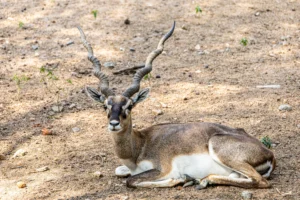
Discover the barasingha deer of India, its habitat, subspecies, conservation story, and the best national parks to see this remarkable swamp deer on safari.
Barasingha Deer (Swamp Deer) Guide
The barasingha is one of India’s most distinctive deer, but it is known for much more than its impressive antlers. Also called the swamp deer, this species has become a symbol of successful wildlife conservation, particularly in Kanha National Park, where decades of habitat management and protection helped save the hard-ground barasingha from the brink of extinction.
Unlike deer that thrive in dense forests, barasingha depend on a mix of grasslands, marshes, wetlands, and river floodplains. Their close relationship with these habitats makes them an important indicator of healthy grassland ecosystems. Protecting barasingha also benefits many other species that share the same landscape, from wetland birds to large herbivores and predators.
For wildlife travellers, barasingha are among the highlights of safaris in Kanha, Dudhwa, Kaziranga, and a growing number of protected areas where conservation programmes have helped establish new populations. For students and nature enthusiasts, they offer an excellent example of how science-based conservation, habitat restoration, and careful wildlife management can reverse decades of decline.
This guide explains what makes the barasingha unique, how to identify it, where it lives, the differences between its regional populations, and why its recovery is regarded as one of India’s most encouraging wildlife conservation stories.
What Is a Barasingha Deer?
The barasingha, commonly known as the swamp deer, is a large herbivorous deer native to the Indian subcontinent. It is scientifically referred to as Cervus duvauceli in traditional references, while many modern taxonomic authorities classify it as Rucervus duvaucelii. Both scientific names may appear in books, research papers, and park publications, referring to the same species.
Barasingha are recognised by their large bodies, long legs, and especially the elaborate antlers of mature males. Although they are often associated with marshes and wetlands, one population has adapted to firm grasslands, giving rise to the well-known hard-ground barasingha found in Madhya Pradesh.
Today, barasingha occur in a limited number of protected landscapes across India and Nepal. Their distribution is far smaller than it once was, making protected grasslands and wetlands essential for the species’ long-term survival.
What Does “Barasingha” Mean?
The name barasingha comes from two Hindi words:
- Bara — twelve
- Singha (Singh) — horn or antler
The name is commonly translated as “twelve-horned deer” or “twelve-antlered deer.” It refers to the many branches, or tines, that develop on the antlers of mature males.
Despite the name, a barasingha does not always have exactly twelve points. Healthy adult males may develop more or fewer tines depending on age, genetics, nutrition, and overall condition. The name should therefore be understood as a traditional description rather than a fixed biological rule.
Field Note: Counting antler points is not a reliable way to estimate a barasingha’s age. Antler size and branching vary naturally between individuals.
Is Barasingha the Same as Swamp Deer?
Yes. In common usage, barasingha and swamp deer refer to the same species. The two names are simply used in different contexts.
- Barasingha is the widely used Indian name.
- Swamp deer is the common English name.
Confusion sometimes arises because people associate all swamp deer with marshes, while the famous hard-ground barasingha of Kanha occupies grasslands with much firmer soils. Although their preferred habitats differ, they belong to the same species, with regional populations adapted to different environments.
Scientific Name and Classification
The barasingha presents an interesting example of how wildlife classification evolves as scientific understanding improves.
Traditional references, including Encyclopaedia Britannica, identify the species as Cervus duvauceli, reflecting an older classification that grouped several large deer within the genus Cervus. More recent taxonomic work places the species in the genus Rucervus, making the scientific name Rucervus duvaucelii. Both names continue to appear in scientific literature, conservation reports, and educational resources.
For most wildlife travellers, the distinction has little practical impact. Whether a guidebook uses Cervus duvauceli or Rucervus duvaucelii, it is referring to the same deer species.
The species also includes several regional populations that differ in habitat and distribution. Among them, the hard-ground barasingha (Rucervus duvaucelii branderi) is particularly significant because it survives only through sustained conservation efforts centred on Kanha National Park.
Expert Tip: When reading wildlife books or research papers, don’t be surprised if you encounter both scientific names. This reflects changes in taxonomy rather than different species.
How to Identify a Barasingha
The barasingha is one of the largest deer found in the Indian subcontinent. While it shares some similarities with other deer species, a combination of its size, body shape, coat colour, and distinctive antlers makes it relatively easy to identify once you know what to look for.
For safari visitors, the easiest identification clues are the animal’s preference for open grasslands and wetlands, its sturdy build, and the elaborate branching antlers carried by mature males.
Quick Facts
| Feature | Details |
| Common name | Barasingha or Swamp Deer |
| Scientific name | Rucervus duvaucelii (also listed as Cervus duvauceli in older references) |
| Shoulder height | Around 1.1 metres |
| Habitat | Grasslands, marshes, wetlands, floodplains and moist forests |
| Distribution | India and Nepal |
| Conservation status | Vulnerable at the species level; some regional populations face greater conservation challenges |
| Distinctive feature | Large, many-branched antlers in adult males |
Table based on information provided in the research brief.
Size and General Appearance
Barasingha are heavily built deer with relatively long legs that help them move through marshes, tall grasses, and seasonally flooded landscapes. Adults stand approximately 1.1 metres at the shoulder, making them noticeably larger than chital but generally smaller and lighter than mature sambar.
Their body colour varies with season but is generally golden-brown to yellowish-brown. During cooler months, the coat often becomes thicker and slightly darker. Young animals may show faint spotting, although these disappear as they mature.
Unlike the more delicately built chital, barasingha have a deeper chest, longer face, and a stronger, more muscular appearance.
The Famous Multi-Tined Antlers
The feature that gives the species its name is the impressive antler structure of adult males.
Unlike the relatively simple antlers of many deer species, barasingha antlers develop numerous branches or tines. Mature males often display twelve or more points, although the exact number varies considerably between individuals. Healthy, older stags may carry even more branches under favourable conditions.
Like other deer, barasingha shed and regrow their antlers annually. Growing antlers are covered with a soft, blood-rich skin known as velvet, which supplies nutrients during development. Once fully grown, the velvet is shed, revealing hard bone that males use during displays and competition in the breeding season.
Because antlers are renewed every year, they provide an excellent example of one of the fastest-growing forms of bone in the animal kingdom.
Photography Tip: During the breeding season, mature stags carrying fully developed antlers make particularly striking subjects in open grasslands where clean backgrounds help highlight the antler structure.
Males, Females and Young
Adult males are noticeably larger than females and are the only individuals that grow antlers.
Females have a slimmer build, lack antlers, and usually remain within family groups alongside young calves. Juveniles resemble adults in overall shape but are much smaller and often stay close to their mothers, particularly during their first months of life.
When watching a herd on safari, the largest antlered male is not always the dominant individual, but mature stags often occupy prominent positions during the breeding season.
Habitat and Ecology
Understanding where barasingha live explains much about their behaviour and conservation needs.
Unlike many deer that thrive in dense woodland, barasingha depend on landscapes where grasses, water, and open visibility occur together. This close relationship with wetland ecosystems is why they are commonly known as swamp deer.
One of the biggest misconceptions is that they simply require forest. In reality, healthy populations depend on carefully maintained mosaics of grasslands, marshes, reed beds, and seasonal wetlands.
Wetlands, Grasslands and Marshes
Across much of their range, barasingha are closely associated with:
- Floodplain grasslands
- Marshes
- Wetlands
- Reed beds
- Riverbanks
- Moist forests bordering grasslands
These habitats provide abundant grasses, aquatic vegetation, shelter from predators, and suitable breeding areas.
Seasonal flooding also plays an important ecological role by maintaining productive grasslands and preventing woody vegetation from taking over. As water levels change throughout the year, barasingha adjust their movements to remain close to fresh forage.
Because they rely on these specialised habitats, the loss or degradation of wetlands has historically been one of the biggest threats to their survival.
Field Note: A healthy grassland is much more than open space. It supports insects, birds, herbivores, predators, and numerous plant species. Protecting barasingha habitat therefore benefits an entire ecological community.
The Unique Hard-Ground Barasingha
Among India’s deer, the hard-ground barasingha is especially unusual.
While most swamp deer occupy marshes and floodplains, this population adapted to the relatively firm grasslands of central India. Today, it is most closely associated with Kanha National Park, where decades of conservation work prevented its disappearance.
Although these animals use drier ground than their wetland relatives, they still depend heavily on productive grasslands and nearby water sources. Their survival demonstrates how wildlife populations can adapt to local environmental conditions while remaining dependent on carefully managed habitat.
The hard-ground barasingha has become one of India’s best-known examples of species recovery and is now a flagship animal for Kanha’s conservation efforts.
Diet and Behaviour
Barasingha are herbivores that spend much of their day feeding on grasses and other vegetation found in wetlands and grasslands.
Their specialised diet makes them well suited to floodplain ecosystems where fresh plant growth is available for much of the year. Depending on habitat and season, they may feed on:
- Various grasses
- Aquatic plants
- Young shoots
- Sedges
- Other marsh vegetation
Their feeding habits help shape grassland structure while contributing to nutrient cycling within wetland ecosystems.
Daily Activity
Like many large herbivores, barasingha are generally most active during the cooler parts of the day.
Safari visitors are therefore more likely to encounter them:
- Early morning
- Late afternoon
- Shortly before sunset
During hotter hours, herds often rest in taller vegetation or shaded areas near water before resuming feeding later in the day.
For photographers, these periods also offer softer light and more natural behaviour.
Herd Structure
Barasingha are social animals that usually occur in groups rather than alone.
Depending on the season, visitors may observe:
- Small family groups
- Female herds with calves
- Bachelor groups of males
- Larger mixed aggregations in productive feeding areas
Group size varies with habitat, food availability, and the breeding season. Remaining in herds improves vigilance against predators while allowing individuals to exploit open grasslands more safely.
Breeding Behaviour
During the breeding season, mature stags become more active in competing for access to females.
Their large antlers serve several purposes:
- Displaying physical condition
- Establishing dominance
- Competing with rival males
These interactions are usually preceded by visual displays and posturing, reducing the need for serious fights.
After breeding, females rear their calves within the protection of the herd, where young animals benefit from collective vigilance.
Expert Tip: If your goal is to observe natural behaviour rather than simply tick a species off your wildlife list, spend time watching a herd through binoculars. You’ll often notice subtle interactions—feeding patterns, alert postures, grooming, and communication—that are easy to miss during a quick safari drive.
Subspecies and Distribution
Although barasingha are a single species, they are not identical across their range. Over time, populations have adapted to different landscapes, resulting in regional forms that vary in habitat preferences and conservation priorities.
Understanding these differences helps explain why conservation strategies in Kanha differ from those in Dudhwa or Kaziranga. It also highlights why protecting a variety of grassland and wetland ecosystems is essential for the species’ long-term survival.
Barasingha Subspecies at a Glance
| Population | Typical Habitat | Main Strongholds | Conservation Notes |
| Hard-ground barasingha (Rucervus duvaucelii branderi) | Grasslands on firm ground | Kanha National Park; reintroduced to Satpura | One of India’s best-known wildlife recovery stories |
| Northern barasingha | Floodplain grasslands, marshes and wetlands | Dudhwa landscape and Nepal | Important populations remain fragmented |
| Eastern swamp deer | Marshes, river floodplains and wetlands | Kaziranga and adjoining landscapes | Closely associated with extensive wetland ecosystems |
This table summarizes the broad ecological differences described in the research brief rather than providing exhaustive taxonomic detail.
Hard-Ground Barasingha
The hard-ground barasingha is the most famous regional population because of its remarkable recovery in Kanha National Park.
Unlike most swamp deer, these animals inhabit relatively dry grasslands instead of permanently marshy terrain. This ecological adaptation makes them unique among the barasingha populations found across the Indian subcontinent.
By the late twentieth century, the population had declined dramatically, prompting intensive conservation efforts focused on habitat management, breeding success, and long-term protection. Today, the hard-ground barasingha is regarded as one of India’s flagship conservation species and has become closely associated with Kanha’s identity.
Northern Barasingha
Northern barasingha occupy floodplain grasslands and wetlands in northern India and neighbouring Nepal.
One of their most important strongholds is the Dudhwa landscape, where extensive grasslands and marshes provide suitable habitat. Recent conservation literature continues to recognise Dudhwa as one of the most important areas for this population.
These deer remain strongly dependent on seasonal flooding, healthy wetland vegetation, and protected grasslands.
Eastern Swamp Deer
The eastern population is associated with the vast floodplains and wetlands of northeastern India.
Kaziranga National Park supports one of the country’s most important populations, where swamp deer share the landscape with species such as one-horned rhinoceroses, wild buffalo, elephants, and numerous wetland birds.
The ecological requirements of these deer differ from those of the hard-ground barasingha, illustrating how the same species has adapted to contrasting environments.
Distribution Across India
Today, significant barasingha populations occur mainly within protected landscapes rather than across their historical range.
Important locations include:
- Kanha National Park (Madhya Pradesh)
- Dudhwa National Park (Uttar Pradesh)
- Kaziranga National Park (Assam)
- Satpura Tiger Reserve (reintroduced population)
- Selected neighbouring protected landscapes in India and Nepal
Historically, barasingha occupied a much wider area, but habitat conversion, wetland loss, and hunting greatly reduced their distribution. Modern conservation therefore focuses on protecting existing populations while establishing new ones where suitable habitat exists.
Conservation Status and Recovery
The story of the barasingha is not simply about preventing extinction. It demonstrates how habitat restoration, scientific management, and long-term protection can help recover a species whose future once appeared uncertain.
At the species level, barasingha are currently classified as Vulnerable, although the conservation situation varies between regional populations. Some populations have recovered significantly, while others remain small, fragmented, or dependent on continued management.
This distinction is important because conservation status should not be viewed as uniform across the species’ entire range.
Why Did Barasingha Decline?
Several factors contributed to historical population declines.
The most significant included:
- Loss of wetlands and natural grasslands
- Conversion of floodplains for agriculture
- Habitat fragmentation
- Hunting in earlier decades
- Reduction of suitable breeding habitat
Unlike adaptable deer that readily occupy different environments, barasingha require specialised habitats. Once wetlands disappear or grasslands become degraded, suitable habitat shrinks rapidly.
Why Kanha Matters
Kanha National Park occupies a special place in the conservation history of the species.
The park’s carefully managed grasslands, protection from hunting, and long-term habitat restoration helped rescue the hard-ground barasingha when numbers had fallen to critically low levels.
Rather than relying on a single intervention, conservation managers combined several approaches, including habitat improvement, scientific monitoring, and strict protection. Over time, these efforts allowed the population to recover and become stable enough to support further conservation initiatives.
Today, the hard-ground barasingha is regarded as one of the flagship species of Kanha and an example frequently cited in discussions of successful wildlife restoration.
Field Note: The recovery of the hard-ground barasingha shows that conserving a species often begins with conserving its habitat. Healthy grasslands, controlled disturbance, and long-term management were as important as protecting the deer themselves.
Reintroduction and Expansion Beyond Kanha
Conservation has not stopped with protecting a single population.
To reduce the risks associated with keeping all hard-ground barasingha in one location, wildlife managers have worked on establishing additional populations through carefully planned reintroductions.
One important example is Satpura Tiger Reserve, where reintroduced animals, supported by captive-breeding and free-ranging populations, represent an important step toward expanding the species’ distribution beyond Kanha.
Creating multiple populations improves the species’ long-term resilience because a single disease outbreak, wildfire, or local catastrophe is less likely to threaten its entire future.
Conservation Actions and Their Purpose
| Conservation Action | Why It Matters |
| Habitat restoration | Restores productive grasslands and wetlands needed for feeding and breeding |
| Strong legal protection | Reduces hunting and human disturbance |
| Scientific monitoring | Tracks population health and habitat quality |
| Captive breeding | Provides animals for carefully managed conservation programmes |
| Reintroduction and translocation | Establishes additional wild populations and reduces extinction risk |
| Protected area management | Maintains suitable habitat over the long term |
This combination of measures has been central to the recovery of the hard-ground barasingha while supporting conservation efforts in other landscapes.
Why the Conservation Story Is Not Finished
Although the recovery of the hard-ground barasingha is encouraging, conservationists do not regard the species as completely secure.
The research brief emphasises that:
- Populations remain fragmented.
- Different regional populations face different challenges.
- Habitat management must continue.
- Wetlands and grasslands still require long-term protection.
- Recovery should not be interpreted as the end of conservation efforts.
Protecting barasingha therefore means protecting entire ecosystems that support countless other plants and animals.
Responsible Tourism Tip: When observing barasingha, remain inside your safari vehicle, keep noise to a minimum, and avoid encouraging drivers to approach too closely for photographs. Watching natural behaviour from a respectful distance provides a better wildlife experience while reducing disturbance.
Best Places to See Barasingha in India
Barasingha can only be seen reliably in a handful of protected landscapes, each offering a different ecological setting and conservation story. Rather than choosing a park solely for the species, consider what kind of safari experience you want—grassland wildlife, wetland ecosystems, or a broader mix of mammals and birds.
Park Comparison
| National Park | Why Visit | Barasingha Population | What Else You Can Expect |
| Kanha National Park | Best destination to understand the hard-ground barasingha recovery | Hard-ground barasingha | Tigers, gaur, chital, sambar, diverse grassland habitats |
| Dudhwa National Park | Stronghold of the northern barasingha in extensive wetlands | Northern barasingha | Wetland birds, rhinos (reintroduced), elephants and rich floodplain habitats |
| Kaziranga National Park | Excellent example of swamp deer living in floodplain ecosystems | Eastern swamp deer | One-horned rhinoceros, wild buffalo, elephants and abundant birdlife |
| Satpura Tiger Reserve | Opportunity to see a reintroduced conservation population | Reintroduced hard-ground barasingha | Tigers, leopards, sloth bears and varied forest landscapes |
Each park offers a different conservation and habitat context rather than identical safari experiences.
Kanha National Park
For most wildlife travellers, Kanha National Park is the best place to learn about barasingha conservation.
The park’s carefully managed meadows provide ideal habitat for the hard-ground barasingha, whose recovery has become closely associated with Kanha’s conservation programme. Sightings are often possible in open grasslands, making the species easier to observe than in densely wooded habitats.
Kanha is also one of India’s premier tiger reserves, allowing visitors to experience both grassland specialists and large predators during the same safari.
Dudhwa National Park
Dudhwa offers a very different landscape.
Instead of central India’s open meadows, visitors encounter floodplain grasslands, marshes and wetlands that support the northern barasingha. The park is particularly rewarding for travellers interested in wetland ecology and birdlife alongside large mammals.
Its importance extends beyond tourism, as current conservation references continue to recognise Dudhwa as one of the major strongholds for this regional population.
Kaziranga National Park
Kaziranga is best known for the greater one-horned rhinoceros, but it is also an important landscape for eastern swamp deer.
Its seasonally flooded grasslands demonstrate the type of habitat from which the species gets its English name. Observing barasingha here provides insight into how floodplain ecosystems support a wide variety of herbivores and water-dependent wildlife.
Satpura Tiger Reserve
Satpura represents the next chapter in the conservation story.
Rather than being a historic stronghold, it is a landscape where carefully planned reintroductions have helped establish new populations outside Kanha. For visitors, seeing barasingha here highlights how conservation increasingly focuses on creating multiple secure populations instead of relying on a single protected area.
Barasingha vs Chital vs Sambar
Many safari visitors encounter several deer species during the same trip. Understanding their differences makes wildlife viewing much more rewarding.
| Feature | Barasingha | Chital | Sambar |
| Size | Large | Medium | Largest deer commonly seen in Indian forests |
| Coat | Golden to brown | Reddish-brown with white spots | Dark brown to grey |
| Antlers | Large, many-branched antlers | Three-tined antlers | Heavy three-tined antlers |
| Preferred Habitat | Grasslands, wetlands and marshes | Open forests and woodland edges | Dense forests, hills and woodland |
| Social Behaviour | Usually seen in herds | Often forms large herds | Frequently solitary or in small groups |
This comparison is intended as a practical field guide rather than a taxonomic comparison.
Safari and Photography Tips
Seeing barasingha often depends more on understanding their habitat than simply choosing the right park.
Best Time to Look
Barasingha are generally easiest to observe:
- Early morning
- Late afternoon
- In open grasslands after sunrise
- Around wetlands and meadow edges where they feed
They are often easier to spot than forest-dwelling deer because they spend much of their time in relatively open habitats.
Photography Tips
- Scan grassland edges before focusing on distant tree lines.
- Use binoculars first to locate herds.
- Watch for mature stags standing slightly apart during the breeding season.
- Photograph animals naturally rather than requesting the driver to approach closely.
- Include the surrounding grassland or wetland to tell the ecological story, not just the animal.
Photography Tip: Wide habitat shots can be just as valuable as close portraits because they show the relationship between barasingha and the grassland ecosystems on which they depend.
Practical Safari Checklist
Before your safari:
- ✓ Carry binoculars.
- ✓ Bring a telephoto lens if photographing wildlife.
- ✓ Wear muted, earth-toned clothing.
- ✓ Listen carefully to your naturalist’s interpretation.
- ✓ Spend time observing behaviour instead of searching only for predators.
- ✓ Respect park rules and maintain silence near wildlife.
Common Misconceptions
Several misunderstandings about barasingha continue to appear in travel articles and online discussions.
“Barasingha and swamp deer are different animals.”
They are two common names for the same species. “Barasingha” is the widely used Indian name, while “swamp deer” is the English common name.
“Every barasingha has exactly twelve antler points.”
No. The name refers to the characteristic many-branched antlers rather than a fixed number of tines. Mature males may have more or fewer depending on age and condition.
“Barasingha only live in Kanha.”
Kanha is the best-known destination for the hard-ground barasingha, but important populations also occur in Dudhwa, Kaziranga and other protected landscapes.
“Barasingha are ordinary forest deer.”
Unlike many deer species, barasingha are closely associated with grasslands, wetlands and floodplains. Their habitat requirements are much more specialised than those of several other Indian deer.
“Their conservation problems have been solved.”
The recovery of the hard-ground barasingha is encouraging, but populations remain fragmented and require continued habitat management and protection.
Frequently Asked Questions
What is a barasingha deer?
The barasingha, or swamp deer, is a large deer species native to India and Nepal. It is best known for the elaborate, many-branched antlers of adult males.
Is barasingha the same as swamp deer?
Yes. They are two common names for the same species.
What does barasingha mean?
The Hindi name means “twelve-horned” or “twelve-antlered,” referring to the many branches of a mature stag’s antlers rather than an exact count.
What is the scientific name of barasingha?
Older references use Cervus duvauceli, while many modern taxonomic authorities use Rucervus duvaucelii.
Where is barasingha found in India?
The principal populations occur in Kanha National Park, Dudhwa National Park, Kaziranga National Park and selected other protected landscapes, including Satpura following reintroduction efforts.
What is hard-ground barasingha?
It is a regional population adapted to firm grasslands rather than marshes and is most closely associated with Kanha National Park.
Is barasingha endangered?
The species is currently classified as Vulnerable globally, although the conservation status and challenges differ among regional populations.
What do barasingha eat?
They are herbivores that feed mainly on grasses, sedges, aquatic vegetation and other wetland plants.
When is the best time to see barasingha on safari?
Early morning and late afternoon generally offer the best opportunities, especially in open grasslands and wetland edges.
Why is Kanha famous for barasingha?
Kanha is internationally recognised for successfully recovering the hard-ground barasingha through habitat restoration, protection and long-term conservation management.
Conclusion
The barasingha is far more than a deer with impressive antlers. It is a species whose survival reflects the health of India’s wetlands and grasslands and demonstrates what sustained conservation can achieve.
Its recovery in Kanha National Park stands as one of India’s most significant wildlife conservation successes, while populations in Dudhwa, Kaziranga and Satpura highlight the importance of protecting a range of habitats across the country. At the same time, the species remains dependent on careful habitat management, continued scientific monitoring and the preservation of fragmented grassland and wetland ecosystems.
For wildlife travellers, watching a herd of barasingha grazing across an open meadow is an opportunity to appreciate not only one of India’s most distinctive deer but also the landscapes that sustain countless other species. Understanding that connection adds depth to every safari and reinforces why conserving grasslands and wetlands matters long after the wildlife sighting is over.
- Kanha National Park Guide
- Dudhwa National Park Guide
- Kaziranga National Park Guide
- Indian Deer Species Guide
- Wildlife Conservation Success Stories
- Responsible Safari Etiquette
Kanha National Park : Topics Cluster
- Kanha Complete Guide
- Kanha National Park Quick Guide
- Kanha Best Zones and Gates
- How to reach Kanha National Park?
- Kanha Zones Guide
- Kanha Safari Cost
- Kanha Tiger Sighting Guide
- Kanha Safari Booking Guide
- Best Resorts near Kanha National Park
- Kanha Best Resorts by Gates
- Kanha luxury safari
- Biodiversity of Central India
- Rewilding and Wildlife Recovery in India
- Barasingha
- Wildlife in Madhya Pradesh
- Madhya Pradesh Wildlife Tourism
- How far advanced should you book safari permits?