
Learn about the Bengal Florican, one of Asia’s rarest grassland birds. Discover its habitat, behaviour, conservation status, threats, and the best places to see it responsibly.
Introduction, Species Overview & Identification
Introduction
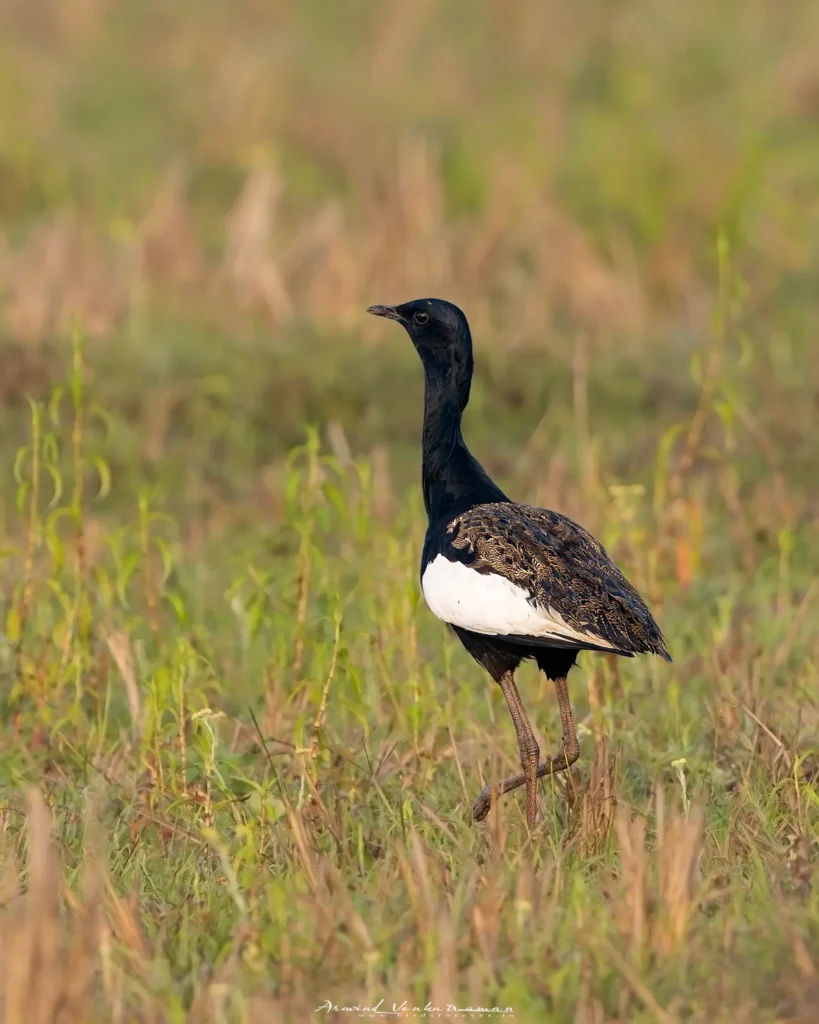
Few birds represent the decline of Asia’s natural grasslands as clearly as the Bengal Florican (Houbaropsis bengalensis). Once found across extensive floodplain grasslands from the Indian subcontinent to Southeast Asia, this elusive bustard has become one of the world’s rarest grassland birds. Today, only small and fragmented populations survive in India, Nepal, and Cambodia, making every remaining breeding site important for the species’ future.
Unlike forest birds that attract attention through colourful plumage or constant calls, the Bengal Florican spends much of its life hidden among tall grasses. During the breeding season, however, males perform spectacular vertical display flights above open grasslands, briefly revealing themselves before disappearing back into the vegetation. These displays are among the most distinctive courtship behaviours seen in Asian birds.
The Bengal Florican is more than a rare bird. Conservationists regard it as a flagship species for alluvial grasslands because protecting its habitat also benefits many other plants and animals that depend on these increasingly threatened ecosystems. Its continued decline reflects the broader loss of natural floodplain grasslands across South Asia.
For wildlife travellers, seeing a Bengal Florican is never guaranteed. Careful planning, responsible behaviour, and realistic expectations are essential. This guide explains how to identify the species, where it survives today, why it is declining, and how visitors can support its conservation while minimising disturbance.
What Is the Bengal Florican?
The Bengal Florican is a medium-sized bustard belonging to the family Otididae. Its scientific name is Houbaropsis bengalensis, and it is the only living member of its genus. The species has evolved to live almost entirely within seasonally flooded grasslands rather than forests or wetlands, making it highly specialised and particularly vulnerable to habitat loss.
Because of its rapidly shrinking population and fragmented distribution, the International Union for Conservation of Nature (IUCN) classifies the Bengal Florican as Critically Endangered. Current estimates indicate that fewer than 1,000 mature individuals remain worldwide, although precise numbers continue to be refined through ongoing surveys.
Scientific Classification
| Classification | Details |
| Common Name | Bengal Florican |
| Scientific Name | Houbaropsis bengalensis |
| Family | Otididae |
| Order | Otidiformes |
| Conservation Status | Critically Endangered |
| Primary Habitat | Floodplain and alluvial grasslands |
Male and Female Identification
The sexes differ noticeably, especially during the breeding season.
Adult males develop striking black-and-white breeding plumage. Their black neck, head, and underparts contrast sharply with bright white wings, creating a highly visible display during courtship flights over open grasslands. This dramatic appearance is visible only for brief moments because males quickly return to cover after each display.
Females are much better camouflaged. Their brown, buff, and streaked plumage blends almost perfectly with dry grasses, providing protection while nesting and raising chicks. This cryptic colouring makes females considerably harder to detect than males throughout most of the year.
Comparison: Male vs Female Bengal Florican
| Feature | Male | Female |
| Overall Colour | Black and white breeding plumage | Brown and buff camouflage |
| Visibility | Easily seen during display flights | Usually concealed in grass |
| Courtship Role | Performs aerial displays | Selects nesting areas and incubates eggs |
| Best Time to Observe | Breeding season | Rarely seen even during breeding season |
Field Note
Many first-time birdwatchers expect to see Bengal Floricans walking openly through grasslands. In reality, sightings usually consist of a few seconds of flight or display before the bird disappears back into dense vegetation. Patience, experienced guides, and well-timed visits are far more important than spending long hours driving through grasslands.
Why the Bengal Florican Matters
The Bengal Florican serves as an indicator of healthy floodplain grasslands. Areas capable of supporting breeding floricans also provide habitat for numerous other grassland birds, mammals, reptiles, and pollinating insects. Protecting these landscapes therefore contributes to conserving an entire ecosystem rather than a single species.
Its conservation has also encouraged greater recognition of grasslands, which have historically received less protection than forests despite supporting many specialised and threatened species across South Asia.
Distribution, Population & Habitat
Distribution and Current Population

The Bengal Florican once occupied an extensive belt of seasonally flooded grasslands stretching across the Indian subcontinent and parts of Southeast Asia. Historical records indicate that the species occurred in India, Nepal, Bangladesh, Cambodia, and Vietnam. Today, however, its distribution has become highly fragmented, with viable breeding populations surviving mainly in India, Nepal, and Cambodia. Bangladesh is generally considered to have lost its resident population, while the species is believed to be extirpated from Vietnam.
This contraction reflects the widespread disappearance of natural floodplain grasslands rather than a change in the bird’s habitat preference. As grasslands have been converted for agriculture, plantations, infrastructure, and other land uses, isolated populations have become increasingly vulnerable.
Current Population Status
The Bengal Florican is classified as Critically Endangered, with fewer than 1,000 mature individuals believed to remain globally. Exact numbers are difficult to determine because the species is secretive, occupies inaccessible grasslands, and occurs in scattered populations. Most population estimates are based on breeding-season display counts, systematic field surveys, and long-term monitoring programmes rather than complete censuses.
Distribution by Country
| Country | Current Status | Key Areas |
| India | Fragmented breeding populations | Manas, Dudhwa, Kishanpur, Kaziranga, Orang, Dibru-Saikhowa, D’Ering Wildlife Sanctuary |
| Nepal | Small breeding populations | Terai grasslands under the national conservation programme |
| Cambodia | Largest Southeast Asian population | Tonle Sap floodplain grasslands and Bengal Florican Conservation Areas |
| Bangladesh | Probably extirpated | Historical records only |
| Vietnam | Believed extirpated | Historical range |
Important Strongholds in India
India supports several of the species’ remaining breeding populations, although each survives in relatively small and isolated grassland landscapes.
Manas National Park, Assam
Manas is widely recognised as one of India’s most important Bengal Florican landscapes. Its extensive alluvial grasslands provide suitable breeding habitat, and the surrounding region has also become a focus for community-based conservation initiatives. Recent conservation work includes improved mapping of display sites and landscape-level habitat management.
Dudhwa National Park and Kishanpur Wildlife Sanctuary
The grasslands of Dudhwa and Kishanpur in Uttar Pradesh continue to support breeding birds. These protected areas preserve important Terai grasslands that have become increasingly rare elsewhere across northern India. They also remain among the most realistic destinations for wildlife enthusiasts hoping to observe the species responsibly.
Kaziranga National Park
Although internationally famous for the Greater One-horned Rhinoceros, Kaziranga also protects extensive floodplain grasslands suitable for Bengal Floricans. Seasonal flooding by the Brahmaputra River helps maintain the open habitats that the species requires.
Orang National Park
Often overshadowed by Kaziranga and Manas, Orang contains patches of riverine grassland that contribute to the species’ remaining range in Assam. Continued habitat management is important because these grasslands require regular ecological processes to prevent woodland encroachment.
Dibru-Saikhowa National Park
Located in eastern Assam, Dibru-Saikhowa protects dynamic river islands and floodplain habitats. Although sightings are uncommon, the park remains part of the Bengal Florican’s surviving distribution in India.
D’Ering Wildlife Sanctuary
This sanctuary in Arunachal Pradesh preserves extensive grasslands along the Siang River and represents another important refuge for the species within northeastern India.
Nepal and Cambodia
Nepal
Nepal’s remaining Bengal Floricans occur mainly in the Terai grasslands, where the government has introduced the Bengal Florican Conservation Action Plan (2024–2033) to coordinate habitat restoration, monitoring, research, and community participation. The plan recognises that conserving grasslands at the landscape scale is essential for the bird’s long-term survival.
Cambodia
Cambodia supports the species primarily around the Tonle Sap floodplain, where dedicated Bengal Florican Conservation Areas protect breeding habitat. Conservation organisations and local communities work together to safeguard nesting sites, manage grasslands, and reduce disturbance during the breeding season. These initiatives represent one of Asia’s most significant grassland bird conservation programmes.
Habitat and Grassland Ecology
The Bengal Florican is a specialist of seasonally inundated alluvial grasslands. Unlike many birds that adapt to different habitats, it depends on a relatively narrow range of ecological conditions, making habitat loss especially damaging.
Its preferred landscapes are characterised by:
- Tall native grasses
- Open patches used for display
- Seasonal flooding
- Riverine floodplains
- Large, connected grassland blocks
Native grasses such as Imperata, Saccharum, and Desmostachya dominate many breeding areas. Seasonal flooding helps maintain these grasslands by limiting tree growth and creating the varied vegetation structure required by the species.
Breeding Ecology
The breeding season is when the Bengal Florican becomes most visible.
Males establish display territories in relatively open sections of grassland. They perform repeated vertical display flights, rising rapidly above the grass before descending back into cover. These displays advertise territory ownership and attract females.
Females remain far more secretive. After selecting a nesting site within dense vegetation, they lay eggs directly on the ground, relying on camouflage rather than active nest defence. This strategy works well in undisturbed grasslands but becomes vulnerable when habitats are burned, heavily grazed, or converted for agriculture.
Diet
Although difficult to observe feeding, the Bengal Florican is known to consume a varied diet that includes:
- Seeds
- Grass shoots
- Insects
- Beetles
- Grasshoppers
- Other small invertebrates
This mixed diet reflects the ecological richness of healthy floodplain grasslands, where seasonal changes influence the availability of plant material and insects.
Expert Tip
If your goal is to see a Bengal Florican, choose a destination with established monitoring programmes and experienced local naturalists rather than simply visiting a park where the species is recorded. Because sightings are naturally rare, knowledgeable guides who understand display sites and seasonal behaviour can make a significant difference while ensuring that birds are observed responsibly and without disturbance.
Threats, Conservation & Research
Why the Bengal Florican Is Declining
The Bengal Florican’s decline is not driven by a single factor. Instead, several pressures have combined over decades to reduce and fragment the grasslands on which the species depends. Because the bird requires extensive, seasonally managed floodplain grasslands for breeding, even relatively small habitat changes can have significant consequences.
Habitat Conversion
The greatest long-term threat is the conversion of natural grasslands into agricultural land, plantations, settlements, and other forms of development. Many floodplain grasslands that once supported breeding floricans have disappeared or been fragmented into isolated patches too small to sustain viable populations.
Unlike forests, grasslands have historically received less conservation attention, making them particularly vulnerable to land-use change. As these habitats shrink, remaining populations become increasingly isolated, reducing opportunities for breeding and genetic exchange.
Fire Management
Fire plays a complex role in grassland ecosystems.
Well-planned, low-intensity burning at appropriate times can help maintain open grassland structure by preventing excessive woody vegetation. However, uncontrolled or poorly timed fires can destroy nests, eggs, and chicks during the breeding season while also reducing vegetation cover needed for protection.
This distinction is important because fire itself is not necessarily harmful; its timing and intensity largely determine whether it benefits or harms Bengal Florican habitat.
Grazing Pressure
Moderate grazing can contribute to maintaining habitat diversity, but excessive livestock grazing may reduce grass height, damage nests, and alter vegetation structure. Heavy grazing during the breeding season is particularly problematic because females rely on dense grass cover to conceal their ground nests.
Hydrological Changes
Floodplain grasslands depend on natural river systems and seasonal flooding. Dams, embankments, drainage projects, and other alterations to river flow can disrupt these natural cycles.
When seasonal flooding changes, grassland composition also changes. Areas that once supported suitable breeding habitat may gradually become unsuitable because vegetation structure and plant communities shift over time.
Invasive Plant Species
The spread of invasive vegetation can transform open grasslands into dense stands that no longer provide suitable display areas or nesting habitat. Managing invasive plants has therefore become an increasingly important component of grassland restoration programmes.
Hunting and Egg Collection
Although legal protection has reduced direct persecution in many areas, hunting and egg collection have contributed to historical declines and may still affect some local populations. Because the species already exists in small, fragmented groups, even occasional losses can have disproportionate impacts.
Climate Change
Researchers also recognise climate change as a growing concern. Changes in rainfall patterns, flooding regimes, and grassland productivity may further alter the floodplain ecosystems on which Bengal Floricans depend. While the precise long-term impacts remain under study, climate-related changes are expected to increase existing conservation challenges rather than replace them.
Comparison: Major Threats and Their Impact
| Threat | How It Affects Bengal Floricans |
| Habitat conversion | Reduces breeding habitat and fragments populations |
| Poorly timed fires | Destroys nests and breeding cover |
| Excessive grazing | Damages nesting habitat and vegetation structure |
| Hydrological changes | Alters natural floodplain grasslands |
| Invasive plants | Reduces suitable open breeding areas |
| Hunting and egg collection | Directly lowers already small populations |
| Climate change | Alters flooding patterns and habitat quality |
Conservation Efforts Across Asia
Saving the Bengal Florican requires more than protecting individual birds. Conservation increasingly focuses on restoring entire grassland landscapes, improving habitat management, involving local communities, and monitoring populations over many years.
India
India’s conservation efforts centre on protecting remaining breeding sites within national parks and wildlife sanctuaries while improving grassland management outside protected areas.
Recent initiatives in the Manas landscape and the Bodoland Territorial Region have focused on:
- Mapping breeding display sites
- GPS-based habitat surveys
- GIS mapping of important grasslands
- Long-term monitoring
- Community participation in habitat protection
These projects aim to generate better scientific information while helping managers prioritise habitat restoration.
Nepal
Nepal published the Bengal Florican Conservation Action Plan (2024–2033) to guide recovery efforts over the coming decade.
The plan emphasises:
- Landscape-level conservation
- Grassland restoration
- Scientific monitoring
- Better coordination among agencies
- Community engagement
- Long-term research
Rather than focusing only on individual protected areas, it recognises that connected landscapes are essential for the species’ future.
Cambodia
Cambodia’s Bengal Florican Conservation Areas (BFCAs) around Tonle Sap represent one of the world’s most important conservation programmes for the species.
Management combines:
- Protected breeding areas
- Habitat restoration
- Community partnerships
- Nest protection
- Sustainable land-use practices
- Ongoing population monitoring
The Cambodian programme demonstrates that conservation can be more effective when local communities participate directly in protecting grassland habitats.
Community Conservation
One of the strongest themes emerging from recent conservation work is the importance of community participation.
Projects around Manas, Kokilabari, Bhairabkunda, and other landscapes show that long-term conservation depends not only on protected areas but also on cooperation with people living alongside these grasslands.
Community-based initiatives have included:
- Awareness programmes
- Grassland stewardship
- Monitoring support
- Sustainable land-use planning
- Reduced disturbance during breeding season
Such approaches help balance conservation with local livelihoods while encouraging long-term protection of remaining habitat.
Research and Monitoring
Reliable scientific information is essential because Bengal Floricans are naturally difficult to detect.
Researchers currently use several complementary methods, including:
- Breeding display counts
- Systematic field surveys
- Habitat mapping
- Satellite and GPS studies
- Long-term population monitoring
- GIS-based landscape analysis
These techniques improve understanding of population trends, breeding ecology, habitat use, and movement patterns, allowing conservation managers to make more informed decisions. The research brief also emphasises the need for continued cross-border cooperation among India, Nepal, and Cambodia because the species’ future depends on coordinated conservation across its remaining range.
Responsible Tourism Tip
If you are fortunate enough to encounter a Bengal Florican, observe it from a respectful distance and avoid approaching display grounds or suspected nesting areas. Never leave designated tracks, use playback calls, or encourage guides to move closer for photographs. Responsible wildlife viewing reduces disturbance and supports long-term conservation of this highly sensitive species.
Field Note
Unlike many popular safari species, the Bengal Florican should never be considered a “target sighting.” Many experienced birdwatchers spend several visits to suitable grasslands before observing one. Appreciating the wider grassland ecosystem—and the many specialised birds it supports—often makes the experience more rewarding, whether or not a florican is seen.
Wildlife Tourism, Responsible Viewing, Common Mistakes, FAQs & Conclusion
Where Wildlife Travellers Can See Bengal Floricans
For most wildlife enthusiasts, seeing a Bengal Florican is a bonus rather than the primary objective of a safari. The species is naturally elusive, occupies dense grasslands, and is most visible only during the breeding season. Choosing destinations with experienced naturalists and well-managed grassland habitats offers the best opportunity for an ethical sighting.
Best Places in India
| Protected Area | Why It Is Important |
| Manas National Park (Assam) | One of India’s most significant remaining breeding landscapes and the focus of several conservation initiatives. |
| Dudhwa National Park (Uttar Pradesh) | Protects extensive Terai grasslands that continue to support breeding birds. |
| Kishanpur Wildlife Sanctuary (Uttar Pradesh) | Important Terai grassland habitat associated with the Dudhwa landscape. |
| Kaziranga National Park (Assam) | Known primarily for rhinos but also protects valuable floodplain grasslands. |
| Orang National Park (Assam) | Supports riverine grassland ecosystems suitable for Bengal Floricans. |
| Dibru-Saikhowa National Park (Assam) | Important floodplain landscape with suitable habitat. |
| D’Ering Wildlife Sanctuary (Arunachal Pradesh) | Conserves grasslands along the Siang River that remain part of the species’ range. |
Nepal
Protected grasslands in the Terai remain the country’s most important Bengal Florican habitat and are central to Nepal’s long-term conservation strategy.
Cambodia
The Tonle Sap floodplain supports Southeast Asia’s most important remaining population, with Bengal Florican Conservation Areas playing a central role in habitat protection.
When Is the Best Time to Look for Bengal Floricans?
The breeding season generally provides the highest chance of observing males because they perform their characteristic display flights over open grasslands. Outside this period, both males and females spend much of their time concealed within vegetation, making sightings considerably less likely. Exact timing varies by region and seasonal conditions, so visitors should check with local park authorities or experienced naturalists before planning a trip.
Responsible Wildlife Watching
Because Bengal Floricans are highly sensitive to disturbance, ethical wildlife viewing is especially important.
Practical Checklist
- ✔ Stay on designated roads and tracks.
- ✔ Maintain a respectful distance from displaying birds.
- ✔ Follow your guide’s instructions at all times.
- ✔ Use binoculars or telephoto lenses instead of approaching birds.
- ✔ Keep noise to a minimum.
- ✔ Report unusual sightings to park authorities if requested.
Avoid
- ✘ Walking into breeding grasslands.
- ✘ Using recorded bird calls to attract individuals.
- ✘ Flying drones near wildlife.
- ✘ Encouraging guides to leave authorised routes.
- ✘ Disturbing suspected nesting areas for photographs.
How Travellers Can Support Conservation
Even visitors who never see a Bengal Florican can contribute to its conservation.
You can help by:
- Choosing responsible safari operators that follow park regulations.
- Supporting protected areas through entry fees.
- Respecting seasonal access restrictions.
- Contributing to reputable conservation organisations working on grassland restoration.
- Reporting observations through recognised citizen science platforms where appropriate.
- Learning about grassland ecosystems and sharing accurate information with others.
Common Mistakes
Expecting Tiger-Style Sightings
Unlike large mammals, Bengal Floricans are naturally secretive. Even experienced birdwatchers may not see one during a visit.
Assuming Grasslands Are Empty
Floodplain grasslands support many specialised birds and mammals. Appreciating the entire ecosystem makes every visit rewarding, regardless of whether a florican appears.
Disturbing Display Areas
Approaching displaying males or suspected nesting sites can interfere with breeding behaviour. Responsible observation should always take priority over photography.
Visiting Without Local Expertise
Experienced guides understand seasonal movements, suitable viewing locations, and ethical observation practices that minimise disturbance.
Underestimating Grassland Conservation
Many visitors focus on forests while overlooking grasslands. The Bengal Florican highlights why these ecosystems deserve equal conservation attention.
Frequently Asked Questions
What is the Bengal Florican?
The Bengal Florican (Houbaropsis bengalensis) is a large grassland bird belonging to the bustard family and is one of Asia’s rarest bird species.
Why is it Critically Endangered?
Its decline is primarily driven by habitat loss, fragmentation, inappropriate grassland management, hydrological changes, and other human pressures that have reduced suitable breeding habitat.
Where is it found today?
Viable populations survive mainly in India, Nepal, and Cambodia, with several historical populations now believed to have disappeared.
How many Bengal Floricans remain?
Current estimates suggest that fewer than 1,000 mature individuals survive worldwide, although precise numbers continue to be refined through ongoing surveys.
Which Indian national parks protect the species?
Important protected areas include Manas, Dudhwa, Kishanpur, Kaziranga, Orang, Dibru-Saikhowa, and D’Ering Wildlife Sanctuary.
What does the Bengal Florican eat?
Its diet includes seeds, shoots, insects, beetles, grasshoppers, and other small invertebrates.
Can tourists easily see one?
No. The Bengal Florican is one of the most difficult birds to observe because it spends much of its life hidden in tall grass. Sightings are never guaranteed.
Why are grasslands so important?
The species depends on seasonally flooded alluvial grasslands. Conserving these habitats also protects many other specialised grassland plants and animals.
Are conservation efforts making a difference?
Conservation programmes in India, Nepal, and Cambodia have improved habitat management, monitoring, and community participation. While some local successes have been reported, the species remains Critically Endangered and requires continued long-term conservation.
How can ordinary people help?
Support responsible wildlife tourism, contribute to reputable conservation organisations, respect protected areas, and raise awareness about the importance of conserving natural grasslands.
Conclusion
The Bengal Florican is one of Asia’s most threatened birds and a powerful symbol of the importance of conserving natural grasslands. Its future depends not only on protecting individual birds but also on safeguarding the floodplain ecosystems that support breeding populations across India, Nepal, and Cambodia.
For wildlife travellers, the species offers a reminder that meaningful safaris are not measured solely by the number of animals seen. Watching a Bengal Florican display above a quiet grassland—even for a few seconds—is a privilege earned through patience, careful planning, and respect for nature.
Whether your interest lies in birdwatching, conservation, or understanding India’s lesser-known wildlife, the Bengal Florican demonstrates why grasslands deserve the same attention and protection as forests. Conserving these landscapes will benefit not only this remarkable bird but also countless other species that share one of Asia’s most overlooked ecosystems.