Plan your journey from Guwahati to Kaziranga National Park. Discover the best transport options, travel times, seasonal planning, and practical safari logistics.
Guwahati serves as the primary travel gateway for the vast majority of visitors heading to Kaziranga National Park. The journey from the state capital into the floodplains of the Brahmaputra River is highly accessible, moving along well-maintained national highways.
Planning this transfer effectively requires matching your transport choice with your safari timings, ensuring you arrive at your base camp with enough time to secure permits and organize logistics. This guide outlines the key options for transit, optimal routing, and real-world travel timings to help you structure a reliable itinerary.
Guwahati to Kaziranga at a Glance
For a quick reference before evaluating individual transport modes, the core logistics of the journey are structured below:
- Road Distance: Approximately 217 km from Guwahati city center to the park base.
- Average Travel Time: 4 to 5 hours by road under normal traffic conditions.
- Primary Tourist Base: Kohora, which serves as the central hub for safaris and accommodations.
- Core High Season: November to April, when all terrestrial ranges are fully operational.
- Total Protected Area: 858.98 sq. km including its various annexures.
- Administrative Borders: Spans across the Golaghat, Nagaon, and Biswanath districts of Assam.
How to Reach Kaziranga from Guwahati
Hiring a private taxi or choosing a self-drive vehicle is the most practical option for most travelers because it provides direct, door-to-door transit to your lodge and allows complete control over your departure times. However, regular bus services and train-to-cab combinations offer reliable alternatives depending on your budget and starting point.
Guwahati to Kaziranga by Car
Taking a car gives you the flexibility to stop along the highway and ensures you have dedicated transport to navigate between different safari ranges once you arrive.
- Private Taxis: You can readily hire chauffeured cabs from downtown Guwahati or the main transportation hubs. One-way fares vary based on vehicle size (hatchback, sedan, or SUV), and it is standard practice to negotiate an all-inclusive rate that covers highway tolls and driver allowances.
- Self-Drive Options: Several rental agencies operate out of Guwahati. If choosing this route, ensure you are comfortable with highway driving, particularly as you approach the animal corridors where strict speed limits are enforced by local authorities.
- Driving Conditions: The road is predominantly a multi-lane highway, though local congestion around major towns along the route can introduce slight delays.
Guwahati to Kaziranga by Bus
Taking a scheduled bus is the most economical choice for solo travelers and those with flexible schedules, though it requires managing your own last-mile transport from the drop-off point.
- Departure Points: Both state-run Assam State Transport Corporation (ASTC) buses and privately operated coaches depart frequently from the Inter-State Bus Terminus (ISBT) in Guwahati.
- Routes & Drop-offs: Look for buses bound for Upper Assam destinations such as Jorhat, Sivasagar, Dibrugarh, or Tinsukia. These scheduled services pass directly through the main highway corridor running alongside the park.
- The Kohora Stop: You should explicitly request a drop-off at the Kohora bus stop. Kohora serves as the main entry point for the Central Range and sits immediately adjacent to the primary cluster of hotels, guest houses, and local taxi stands.
Guwahati to Kaziranga by Train plus Cab
Using the railway system requires a multi-modal switch but allows you to cut down on road travel time by utilizing the rail network for the first leg of the journey.
- The Nearest Railhead: Jakhalabandha is technically the closest railway station to the park, located roughly 50 km west of the Kohora tourist hub. However, it has limited long-distance connectivity and acts primarily as a localized stop.
- The Practical Choice: Most travelers using rail options book tickets to larger junctions like Furkating or Guwahati itself, but for those wanting to get as close as possible via rail, local passenger trains connect Guwahati to Jakhalabandha.
- Last-Mile Connection: Upon arriving at the closer regional stations, you must arrange a local taxi to transfer you the remaining distance via the highway to your accommodation.
Guwahati Airport to Kaziranga
If you are flying into the region, starting your road trip directly from Lokpriya Gopinath Bordoloi International Airport (GAU) in Guwahati avoids the heavy traffic of the city center entirely.
- Logistical Advantage: The airport sits on the western edge of Guwahati. Taxis hired straight from the airport terminal can immediately join the bypass routes, avoiding the urban bottleneck of downtown Guwahati and saving up to an hour of travel time during peak hours.
- Airport Prepaid vs. App Taxis: Prepaid taxi booths and app-based cab aggregators operate out of the arrival terminal. Ensure you clarify that your destination is the Kohora area of Kaziranga when booking to get an accurate fixed fare.
- Alternative Airports: While Guwahati is the primary entry hub with the highest flight density, travelers should note that Jorhat Airport is geographically much closer—located roughly 95 km east of the park. However, flights into Jorhat are limited and less frequent than those into Guwahati.
| Transport Mode | Average Duration | Flexibility Tier | Best Suited For |
| Private Taxi / Car | 4 to 5 Hours | High | Families, photographers, and those with tight safari schedules |
| Scheduled Bus | 5 to 6 Hours | Low | Budget travelers and solo tourists with flexible arrival windows |
| Train + Local Cab | Variable (Rail time + 1 hour drive) | Medium | Travelers looking to minimize continuous highway driving |
The drive from Guwahati to Kaziranga is one of the most straightforward and reliable highway routes in Northeast India. Because the park sits directly along a major arterial road, navigation is simple, but understanding the highway conditions and the park’s strict seasonal calendar is essential for a successful trip.
Best Route from Guwahati to Kaziranga
The primary and most efficient path from Guwahati to Kaziranga follows NH 27 and transitions onto NH 715 (formerly known as NH 37). This route takes you straight into the heart of the park’s tourist zone.
- The Highway Route: Departing Guwahati, the road passes through Sonapur, Jagiroad, and the Nagaon bypass. At the Kaliabor Tiniali junction, the highway continues straight toward Jakhlabandha and eventually enters the Burapahar range of Kaziranga.
- Road Conditions: For the majority of the 217 km journey, you will travel on a well-paved, four-lane divided carriageway. Traffic flows smoothly, though you should expect occasional congestion around major towns and near toll plazas.
- The Wildlife Corridor Speed Limits: Once you pass Jakhlabandha and approach the park boundaries, the highway cuts directly through critical animal corridors. The terrain shifts, and strict speed limits are enforced by the forest department and local authorities. Maximum speeds drop to between 20 kmph and 40 kmph on these specific stretches to prevent animal collisions. Heavy fines apply for speeding.
- Rest Stops: The stretch between Nagaon and Jakhlabandha offers reliable wayside amenities, dhabas (local diners), and clean restroom facilities, making it the practical halfway point to take a break.
Best Time to Visit Kaziranga
Kaziranga is not a year-round destination. Your experience—and what animals you are likely to see—depends entirely on the month you choose to travel.
Seasonal Flooding and Park Closures
The ecology of Kaziranga is driven by the Brahmaputra River. During the summer monsoon season, the river breaches its banks, and the vast majority of the park submerges underwater.
- The Closed Season: Because of this annual flooding, the park completely closes to all tourist activities from May through October. During this time, safaris do not operate, and animals move to higher ground outside the core tourism zones.
- The Open Season: The park officially reopens in November and remains operational until the end of April.
Best Months for Wildlife Photography
Wildlife behavior and landscape visibility change drastically throughout the open season.
- November to December (The Green Season): Immediately following the monsoon, the park is incredibly lush and scenic. Water bodies are full, and migratory birds begin to arrive. However, the elephant grass is at its tallest, which can make spotting ground-dwelling animals more challenging. Morning safaris often experience heavy fog that limits visibility until mid-morning.
- January to February (The Winter Peak): The weather is cool and comfortable. During this period, the forest department conducts controlled burning of the dry elephant grass. This clearing drastically improves sightlines, making it much easier to spot rhinos and wild buffalo grazing in the open.
- March to April (The Summer Dry Season): As temperatures rise and smaller water sources dry up, animals are forced to congregate around the larger, permanent lakes (beels). This is the most reliable time of year for spotting tigers and large elephant herds. The weather is hot and humid, but the wildlife viewing is at its absolute peak.
Table 2: Month-by-Month Seasonal Guide
| Month | Park Status | Weather & Visibility | Key Highlights | Crowd Level |
| Nov – Dec | Open | Cool; thick morning fog; tall grass limits ground visibility | Lush landscapes; excellent for resident and early migratory birds | High |
| Jan – Feb | Open | Cold mornings; visibility improves rapidly with controlled grass burning | Clear skies; ideal for elephant safaris; peak birdwatching | Peak |
| Mar – Apr | Open | Hot and humid; short grass provides excellent, long-range visibility | Best chance for tiger sightings; animals gather at waterholes | Moderate |
| May – Oct | Closed | Heavy rains and extreme flooding; infrastructure submerged | Crucial ecological reset; no tourism allowed | N/A |
The safari experience in Kaziranga is highly structured, and understanding how the park operates is the difference between a frustrating morning and a successful wildlife outing.
Kaziranga Safari Guide
Securing your safari well before arrival is critical. With recent reporting indicating a record 4.68 lakh visitors during the 2025-26 season, last-minute availability is increasingly rare, particularly on weekends and holidays. The park operates strict entry quotas for each zone, making advance booking essential for both vehicle and elephant access.
Safaris run in distinct morning and afternoon shifts, coordinated by the forest department. Recently, the park has also expanded visitor options beyond traditional vehicle drives, adding hiking, birdwatching walks, cycling tracks, and themed eco-tourism experiences in the fringe areas.
Jeep Safari vs Elephant Safari
Choosing between a jeep and an elephant safari depends entirely on what you want to achieve during your time in the park.
- Jeep Safaris: This is the most practical choice for wildlife photographers and general visitors. Jeeps are available across all operational ranges and cover significantly more ground than elephants. You will see a wider variety of habitats—from wetlands to dense canopy—increasing your chances of spotting a diverse range of species, including tigers, migratory birdlife, and large elephant herds.
- Elephant Safaris: These are highly regulated and only operate in specific zones during the early morning hours. The primary advantage is the ability to navigate safely through the tall, dense elephant grass where vehicles cannot go. This provides an excellent, silent approach for close-up viewing of the one-horned rhinoceros. However, you cover very little distance, making it less ideal for broad species spotting.
- Boat Safaris: Offered in specific riverine sections, boat safaris provide a distinct vantage point for observing the Brahmaputra’s delta ecology and aquatic life.
Which Kaziranga Range to Choose
Kaziranga is vast, covering 858.98 sq. km across multiple districts. To manage the ecology and tourism effectively, it is divided into five distinct ranges. You cannot drive between them internally; you must use the public highway to move from one entry gate to another.
If you are a first-time visitor with a limited schedule, prioritize the Central or Western ranges. If you have three or more days, allocate time to the Eastern or Burapahar ranges to experience different terrain.
Table 3: Kaziranga Safari Ranges Breakdown
| Safari Range | Local Name | Landscape & Ecology | Best Suited For |
| Central | Kohora | Mixed grasslands, wetlands, and woodlands | First-time visitors; excellent overall wildlife diversity |
| Western | Bagori | Open grassy plains and shallow water bodies | High-density rhino sightings; open landscape photography |
| Eastern | Agaratoli | Extensive wetlands, riverine forests, and lakes | Birdwatching; spotting migratory species; swamp deer |
| Burapahar | Ghorakati | Hilly terrain and dense canopy | Exploring diverse topography; primate sightings |
| Northern | Biswanath | Brahmaputra river channels and sandbanks | Boat safaris; aquatic and riverine ecology |
Kohora as the Main Tourist Hub
Kohora is the most logical base for the vast majority of travelers. It serves as the primary tourist hub and the main gateway to the Central Range.
If you travel by scheduled bus from Guwahati, Kohora is the specific drop-off point you must request. The area features the highest concentration of infrastructure, including government lodges, private resorts, local restaurants, and the main taxi stand. Staying in Kohora minimizes your morning commute to the Central and Western ranges, allowing you to maximize your time inside the park rather than driving on the highway before dawn.
Wildlife You Can See in Kaziranga
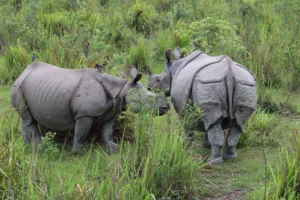
Kaziranga is globally recognized for its successful conservation of the great Indian one-horned rhinoceros, protecting a significant majority of the world’s remaining population. The park’s alluvial grasslands, wetlands, and tropical forests support a high density of large herbivores and predators, often categorized as the park’s “Big Five”.
While the rhino is the most visible resident, the park’s riverine ecosystem also functions as a critical Tiger Reserve, though the dense vegetation makes feline sightings a matter of timing and patience rather than a guarantee.
Table 4: Key Wildlife Species Expectations
| Species | Primary Habitats | Sighting Baseline | Best Range Context |
| One-horned Rhinoceros | Open alluvial grasslands, shallow marshes | Highly common across open plains | Bagori (Western) and Kohora (Central) |
| Asian Elephant | Tall elephant grass, woodland borders | Regular; frequently seen in large family herds | Central and Western Ranges |
| Wild Water Buffalo | Deep marshes, reed beds, and river edges | Common; usually found wallowing in wetlands | Central and Eastern Ranges |
| Swamp Deer (Barasingha) | Wet grasslands and lakeside fringes | Regular; found in specific localized herds | Agaratoli (Eastern Range) |
| Royal Bengal Tiger | Dense reed beds, forest tracks, waterhole edges | Elusive; requires patience and open sightlines | Central and Western Ranges during the dry season |
| Migratory & Resident Birds | Large water bodies (beels) and river channels | High density during the winter months | Agaratoli (Eastern Range) |
Where to Stay in Kaziranga
Choosing your accommodation base directly impacts how much time you spend commuting to your safari gates each morning.
- Kohora (The Central Cluster): This is the most practical base for the majority of travelers. It contains the highest concentration of Assam Tourism department lodges, private luxury eco-resorts, and budget guest houses. Staying here gives you immediate access to the Central Range entry gate and puts you within a short drive of the Western and Eastern ranges.
- Bagori (The Western Cluster): Located a short drive west of Kohora, this area features a smaller selection of standalone resorts and eco-camps. It is highly convenient if your primary focus is booking multiple early-morning elephant safaris, which frequently operate out of the Western Range.
- Agaratoli & Burapahar Fringes: Accommodations here are fewer and more spread out. They cater mostly to birdwatchers, photographers, and returning travelers who want a secluded experience away from the main tourist traffic. Dining and transport options outside of your chosen resort are limited in these outlying areas.
Sample Kaziranga Itineraries
2-Day Itinerary (Standard Weekend Transfer)
- Day 1: Depart early from Guwahati city or airport to clear the city traffic early. Complete the 4-to-5-hour highway drive to Kohora, checking into your lodge by midday. In the afternoon, take a Jeep safari through the Central Range to get an overview of the park’s core wetlands and grasslands.
- Day 2: Wake up early for a morning safari—either an elephant safari in the Western Range for close-up views or an early Jeep drive. Return to the lodge for breakfast, check out, and begin the return road journey back to Guwahati.
3-Day Itinerary (Comprehensive Wildlife Focus)
- Day 1: Drive from Guwahati to Kohora, arriving in time for lunch. Undertake an afternoon Jeep safari in the Central Range to secure your baseline wildlife sightings.
- Day 2: Dedicate the morning to the Western (Bagori) Range, focusing on the open plains and herbivore tracking. In the afternoon, transfer via the highway to the Eastern (Agaratoli) Range, which offers a completely different landscape dominated by large lakes and seasonal migratory waterfowl.
- Day 3: Spend the morning exploring the hilly terrain of the Burapahar Range, looking for distinct primate species and tracking wildlife through the canopy. Return to your base, check out, and drive back to Guwahati.
Common Mistakes to Avoid
- Attempting a Rushed Day Trip: Trying to drive from Guwahati to Kaziranga, complete a safari, and return in a single day results in nearly 10 hours of highway travel. It leaves you exhausted and provides very little time to actually experience the park. Allocate at least one overnight stay.
- Ignoring Highway Speed Limits: The highway running alongside the park features strictly monitored animal corridors. Speed cameras capture violators, and local authorities issue heavy fines to protect wildlife crossing between the hills and the plains.
- Arriving Without Pre-Booked Safaris: With visitor numbers growing rapidly, showing up at the range offices expecting last-minute vehicle or elephant slots frequently leads to disappointment, particularly on weekends. Book your slots well in advance.
- Traveling During the Monsoon Window: The park does not operate standard safaris between May and October due to major seasonal flooding from the Brahmaputra River. Always verify the official reopening dates if planning a trip close to the shoulder months of May or October.
FAQs About Guwahati to Kaziranga Travel
1. How far is Kaziranga from Guwahati by road?
The road distance from Guwahati city center to the main tourist hub of Kohora is approximately 217 km.
2. How many hours does it take to travel from Guwahati to Kaziranga?
It typically takes between 4 and 5 hours of driving time under standard traffic conditions.
3. What is the best route from Guwahati to Kaziranga?
The most reliable route is taking NH 27 out of Guwahati, bypassing Nagaon, and transitioning onto NH 715 straight to the park.
4. Can I reach Kaziranga from Guwahati by bus?
Yes, regular state-run (ASTC) and private coaches bound for Upper Assam depart from the Guwahati Inter-State Bus Terminus (ISBT) and drop passengers off at Kohora.
5. Can I go by train to Kaziranga?
You can take a local train to Jakhalabandha station, located about 50 km from the park, and hire a local cab for the final leg. However, most travelers find a direct road transfer from Guwahati more practical.
6. What is the nearest airport to Kaziranga?
Jorhat Airport is the closest geographically (roughly 95 km away), but Guwahati Airport serves as the primary practical gateway due to its significantly higher flight volume and reliable highway connections.
7. What is the nearest railway station to Kaziranga?
The closest station is Jakhalabandha (50 km west of Kohora), though it has limited long-distance train connectivity.
8. Is Kaziranga open all year?
No, the park closes completely during the wet summer months due to seasonal flooding.
9. When is Kaziranga closed for monsoon?
The park is closed from May through October each year.
10. What is the best time to visit Kaziranga?
The official tourism season runs from November to April, offering pleasant weather and fully operational safari tracks.
11. Which months are best for rhino sightings?
January through April are the most reliable months, as the annual burning of the tall elephant grass vastly improves long-range visibility.
12. Are elephant safaris available in Kaziranga?
Yes, the forest department organizes highly regulated elephant safaris during the early morning hours in specific ranges.
13. Are jeep safaris available in all ranges?
Yes, all terrestrial ranges (Central, Western, Eastern, and Burapahar) support Jeep safari operations.
14. Which Kaziranga range is best for first-time visitors?
The Central (Kohora) and Western (Bagori) ranges are highly recommended for first-time visitors due to their high wildlife densities and accessible tracks.
15. Can I do a Kaziranga day trip from Guwahati?
While technically possible if you leave before dawn, it is highly discouraged due to the extreme driving distance and limited safari windows.
16. How many days are enough for Kaziranga?
A 2-to-3-day stay provides an ideal balance, giving you enough time to explore multiple safari ranges and accommodate changing weather conditions.
17. What animals can I see in Kaziranga?
You can reliably see the one-horned rhinoceros, Asian elephant, wild water buffalo, swamp deer, and a vast array of bird species. Royal Bengal tigers and leopards are also present but rarely encountered.
18. Is Kaziranga a tiger reserve?
Yes, it is an officially designated Tiger Reserve and holds a highly significant population density of Bengal tigers.
19. Do I need safari booking in advance?
Yes, advance booking is critical because daily vehicle and elephant entry caps are strictly enforced by the forest department.
20. What should I pack for a Kaziranga trip from Guwahati?
Pack dark, neutral-colored clothing (avoid bright whites and yellows), warm layers for chilly early morning safaris, a reliable pair of binoculars, sun protection, and a dust mask or scarf to protect against dry dirt tracks during Jeep drives.
Conclusion
The journey from Guwahati to Kaziranga National Park connects Assam’s busiest transit hub with one of the most successful conservation landscapes in Asia. Because the park is bisected by a major national highway, the logistics of reaching the destination are remarkably simple.
The success of your trip relies entirely on respecting the park’s seasonal calendar, securing your safari slots well before your departure date, and pacing your itinerary to experience the distinct ecology of the various ranges. By setting Kohora as your logistical anchor and choosing the right transport mode for your timeframe, you can ensure a reliable, well-organized wildlife safari.
Author Note & Update Log: Written by the WildlifeSafaris.in Editorial Team. Last Updated: August 2026.
Kaziranga National Park : Topics Cluster
- Complete Guide to Kaziranga Detailed Guide
- Kaziranga Safari Quick Guide
- Guwahati to Kaziranga Travel Guide
- Best Resorts near Kaziranga National Park
- 4 Days Assam Wildlife itinerary
- Rhinos conservation
- One Horned Rhinoceros
- Grasslands Ecology
- Wildlife in Assam
- Birding Hotspots in Assam
- Wildlife Tourism in Assam
- Wildlife Tourism in Northeast India
- Biodiversity of Northeast India
- UNESCO World Heritage Sites India Wildlife
- Biodiversity hotspots of India
- Kaziranga Elephant Safaris (upcoming)
- Kaziranga Photography Guide (upcoming)