
Read our comprehensive guide to India’s four native bear species, their distinct habitats across the subcontinent, and practical tips for wildlife travel.
Introduction, Global Significance & Overview
If you are planning a wildlife trip or researching large mammals in South Asia, understanding India’s unique position in ursid conservation is essential. India is one of only two countries in the world that shelters four distinct bear species. These four species—the sloth bear, the Asiatic black bear, the Himalayan brown bear, and the Malayan sun bear—occupy highly varied ecological zones ranging from southern tropical dry deciduous forests to the highest alpine meadows of the western Himalaya.
For travelers and researchers alike, seeing or tracking these animals requires a clear understanding of their specific habitat preferences, regional populations, and behavioral traits.
How Many Bear Species Live in India?
The Four Species at a Glance
To plan an effective safari or field study, you must first clear up a common misconception: India does not just host a single, generic type of forest bear. Instead, its varied geography supports four distinct evolutionary lineages.
The table below outlines the basic taxonomy, geographic parameters, and primary threats facing each species according to official conservation assessments and the National Bear Conservation and Welfare Action Plan.
Table 1: India’s Four Bear Species Overview
| Common Name | Scientific Name | Primary Indian Range | Preferred Habitat | Primary Threats |
| Sloth Bear | Melursus ursinus | Peninsular India up to the Himalayan foothills | Dry deciduous forests, scrublands, rough terrain | Habitat fragmentation, human-bear conflict |
| Asiatic Black Bear | Ursus thibetanus | Himalayan and sub-Himalayan mountain belts | Forested mountains and valley edges | Habitat loss, human conflict, poaching |
| Himalayan Brown Bear | Ursus arctos | High-altitude Western Himalaya | Alpine meadows and upper forest edges | Rugged terrain pressures, localized disturbance |
| Malayan Sun Bear | Helarctos malayanus | Northeast border region | Tropical wet evergreen forests | Severe range restriction, data scarcity |
Why India is Globally Important for Bears
Understanding why India supports such high bear diversity helps clarify the country’s conservation priorities. The presence of four species across 26 of India’s 28 states is a direct result of the subcontinent’s dramatic altitudinal gradients and climatic variations.
- The Sloth Bear acts as the lowland anchor, serving as an endemic species of the Indian subcontinent that handles the hot, arid, and seasonal deciduous tracts of central and southern India.
- The Asiatic Black Bear and Himalayan Brown Bear divide the mountain ecosystems. The black bear uses the forested middle-elevation belts, while the brown bear specializes in the extreme alpine terrain above the tree line.
- The Malayan Sun Bear represents a distinct Indo-Malayan biological link, reaching the absolute western limit of its global range in the dense, wet forests of the northeastern border states.
Because these species rely on diverse landscapes, their long-term survival is deeply tied to how India manages its remaining wild spaces. Notably, field research shows that these populations do not survive solely inside strictly protected national parks. Large numbers of Indian bears regularly utilize unprotected, multi-use forests and corridor landscapes. This makes managing human tolerance and rural land use just as critical as enforcing standard wildlife sanctuary boundaries.
Sloth Bear (Melursus ursinus): Distribution and Ecology
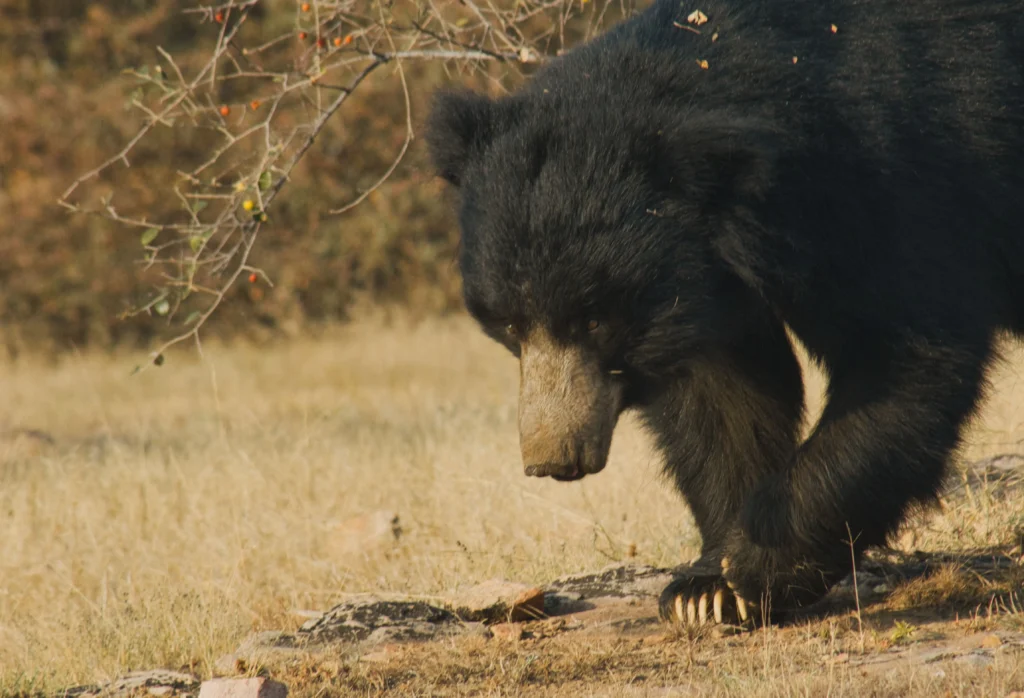
The sloth bear is the most widespread bear species in India. Endemic to the Indian subcontinent, its range stretches from the Himalayan foothills all the way down to the southern peninsula. Because of its wide distribution, this is the species you are most likely to encounter on a standard Indian wildlife safari.
Habitat Range and the Role of Multi-Use Forests
Unlike India’s high-altitude bears, sloth bears thrive in lowland environments. They show a strong preference for dry deciduous forests, scrublands, and landscapes characterized by rough, rocky terrain.
When planning a field trip or analyzing conservation data, it is important to recognize that sloth bears do not only live strictly within the boundaries of national parks. A major distribution study estimated that sloth bears currently occupy about 67% of their potential habitat across the country. Much of this distribution relies heavily on unprotected, multi-use forests.
The species’ ability to persist in these shared, human-dominated landscapes is largely due to the cultural tolerance of local communities. Despite this tolerance, growing population pressure, changing land use, and habitat fragmentation pose significant threats to their long-term survival, particularly by cutting off critical movement corridors.
Behavior, Diet, and Identification Features
The sloth bear has evolved highly specialized physical traits for foraging, making its ecological footprint distinct from other large mammals.
- Insectivorous Diet: Sloth bears are primarily myrmecophagous, meaning they rely heavily on consuming ants and termites. They use their long, specialized claws to break into hard insect mounds.
- Seed Dispersal: During the summer months, they shift their diet to consume large quantities of seasonal fruits, making them vital seed dispersers that help regenerate dry forest ecosystems.
Field Note: Tracking Sloth Bears
Direct sightings in dense brush can be difficult, but sloth bears leave obvious signs of their presence. When tracking them in central Indian or peninsular forests, experienced naturalists look for heavily excavated termite mounds and deep claw marks on fruit-bearing trees rather than relying solely on pugmarks.
For wildlife travelers and researchers aiming to observe sloth bear ecology firsthand, the dry deciduous tracts of central India and the varied landscapes of the Western Ghats offer some of the most consistent study and observation areas.
Asiatic Black Bear: Mountain Forests and Coexistence
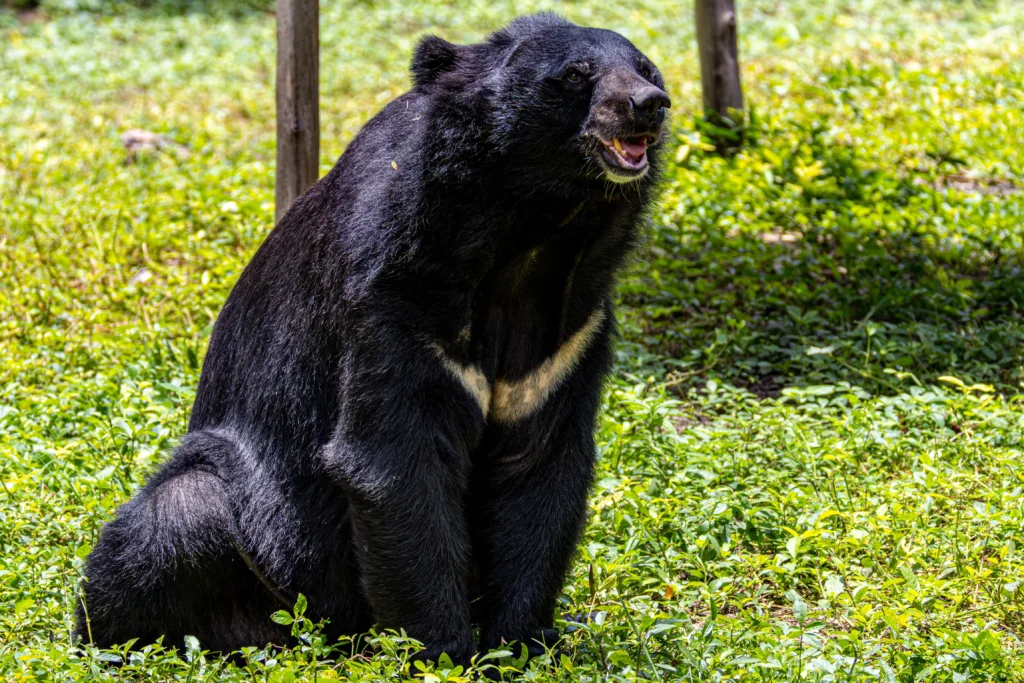
If you are trekking or tracking wildlife in the middle elevations of the Indian Himalaya, the Asiatic black bear (Ursus thibetanus) is the species you are most likely to encounter.
Himalayan and Sub-Himalayan Distribution
Wildlife literature and local guides often refer to this species as the Himalayan black bear. It is important to understand that this is a regional form or subspecies of the broader Asiatic black bear family. In India, its presence is heavily concentrated across the forested mountain belts of the Himalayan and sub-Himalayan regions.
Unlike the sloth bear of the southern plains, the Asiatic black bear relies on temperate and steep mountain forests. It is highly adapted to this environment, shifting its elevation based on seasonal food availability.
Forest Dynamics, Seasonal Movements, and Conflict Patterns
Understanding the seasonal movement of the Asiatic black bear is critical for both viewing and safety. During the warmer months, these bears utilize higher forest zones, but as weather dynamics shift and wild food becomes scarce in late autumn and winter, they frequently move to lower elevations.
This seasonal migration brings them closer to human settlements. They regularly utilize forest edges and are known to enter villages and agricultural areas to feed in fruit orchards. Because of this overlap, the Asiatic black bear is the species most frequently associated with human-bear conflict in India.
Safety Tip for Trekkers
Black bear encounters often occur on narrow forest trails or near village edges. When trekking in the middle Himalaya, travel in groups, make consistent ambient noise so you do not startle a feeding animal, and never position yourself between a bear and its escape route.
Himalayan Brown Bear: The High-Altitude Specialist
To find the Himalayan brown bear (Ursus arctos), you must travel well above the tree line. This is the highest-altitude bear species in India, uniquely adapted to harsh, freezing environments.
Alpine Ecology of the Western Himalaya
The Himalayan brown bear is geographically restricted to the western Himalaya. It occupies a highly specialized ecological niche, primarily utilizing alpine meadows, the uppermost fringes of the tree line, and remote mountain valleys.
Because of the extreme altitudes and brief summer windows in these regions, brown bears spend a significant portion of the year in hibernation. Their ecology is deeply tied to the fragile alpine vegetation and the small mammals that share these high-altitude meadows.
Tracking and Conservation Challenges in Rugged Terrain
Direct sightings of Himalayan brown bears are notoriously difficult. The terrain is vast, steep, and largely inaccessible for routine wildlife tourism. For most researchers and travelers, observing tracks, scat, and relying heavily on the localized knowledge of forest rangers is a far more realistic way to confirm their presence.
The remote nature of their habitat creates unique conservation challenges. Operating in such rugged terrain makes monitoring population numbers and tracking individual animals exceptionally difficult. Despite their isolation, they still face human pressure from high-altitude grazing, infrastructure development, and localized disturbances in their fragile summer feeding grounds.
Field Identification: Mountain and Forest Bears
Because the ranges of the Asiatic black bear, Himalayan brown bear, and lowland sloth bear occasionally abut or confuse travelers, knowing how to quickly distinguish them in the field is a fundamental skill.
Table 3: Identification Matrix
| Feature | Asiatic Black Bear (Himalayan) | Himalayan Brown Bear | Sloth Bear (Lowland) |
| Primary Color | Jet black with a distinct white/cream “V” on the chest. | Reddish-brown to pale sandy brown. | Shaggy black, often with a U or Y-shaped pale chest mark. |
| Physical Build | Robust and stocky; large, rounded ears. | Heavy build with a distinct shoulder hump; smaller ears. | Lanky build; long, shaggy coat; distinctively long muzzle. |
| Typical Terrain | Dense mountain forests, steep wooded slopes, orchards. | Open alpine meadows, rocky slopes above the tree line. | Dry deciduous forests, scrublands, lowland rocky outcrops. |
| Field Signs | Claw marks on fruit trees, stripped bark, orchard damage. | Excavated marmot/rodent burrows in alpine soil. | Heavily excavated termite mounds, deep claw marks in hard earth. |
Malayan Sun Bear: India’s Rarest Ursid
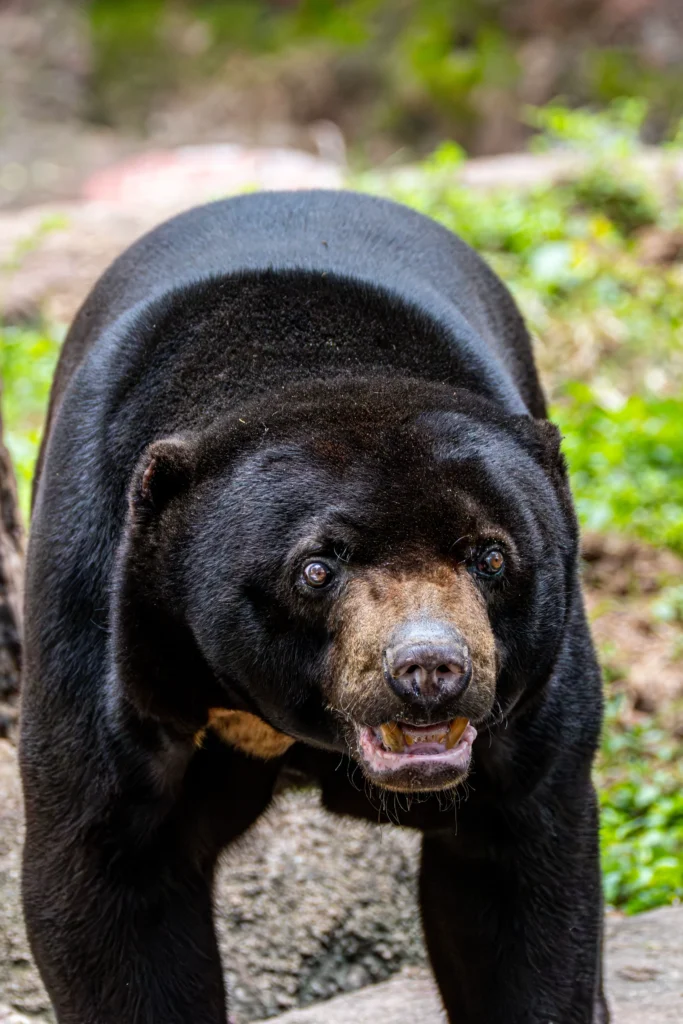
The Malayan sun bear (Helarctos malayanus) is the smallest of all bear species globally and, within India, the most difficult to locate. For most travelers and wildlife photographers, a sun bear sighting in the wild is extremely unlikely and should not be factored into standard travel planning.
The Northeast Border Presence
According to the National Bear Conservation and Welfare Action Plan, the sun bear’s presence in India is severely restricted. It occurs only in very small numbers in the dense tropical forests of the extreme northeast border region, where its range barely crosses into Indian territory.
Conservation Context and Monitoring Realities
Because sun bears are largely arboreal and occupy dense, inaccessible forests, data regarding their population in India is scarce. They are included in the national species count to highlight India’s geographic significance—bridging Himalayan ecosystems and Indo-Malayan tropical forests—but they remain an elusive subject even for dedicated field biologists.
Safari Planning: Where to See Bears in India
When planning a bear-focused wildlife trip, it is vital to align your destination with the correct species and set realistic expectations for the type of sighting possible.
Central Indian and Southern Peninsular Landscapes
If your primary goal is to see a sloth bear, look toward the dry deciduous forests of central India and the varied landscapes of the Western Ghats. Because sloth bears are highly active during termite foraging and the summer fruit drop, early morning and late evening safaris in these zones yield the best results. Remember that sloth bears frequently utilize unprotected multi-use forests, so expert local guides who monitor seasonal movements are invaluable.
Himalayan Forest Zones and Alpine Tracks
For the Asiatic black bear, travel planning should focus on the mid-elevation forested mountain belts of the Himalaya and sub-Himalaya. Sightings often occur near forest edges and occasionally near agricultural orchards.
The Himalayan brown bear requires specialized, high-altitude trekking in the western Himalaya. Because they inhabit remote alpine meadows and upper forest edges, direct sightings are rare. Expeditions here should focus on tracking ecology—identifying scat, excavated burrows, and pugmarks—rather than expecting close-range encounters.
Table 2: Best Tracking Landscapes and Sighting Profiles by Species
| Species | Primary Landscape | Best Sighting Method | Probability of Direct Sighting |
| Sloth Bear | Central India & Western Ghats | Jeep safaris at dawn/dusk; tracking claw marks on trees. | High (in specific dry deciduous zones). |
| Asiatic Black Bear | Himalayan/Sub-Himalayan Forests | Forest edge monitoring; tracking orchard incursions. | Moderate (highly seasonal). |
| Himalayan Brown Bear | Western Himalayan Alpine Zones | High-altitude trekking; analyzing excavated alpine soil. | Low (relies heavily on tracks and signs). |
| Malayan Sun Bear | Northeast Border Forests | Camera-trap monitoring by researchers. | Extremely Low (travelers are highly unlikely to see one). |
Photography Tip
When photographing sloth bears in central India, expect challenging lighting. Because they are most active at twilight and covered in thick, light-absorbing black fur, use a fast lens and prioritize a higher ISO rather than risking motion blur on a slow shutter speed.
Conservation Threats, Policy, and Safety Protocols
India’s bear species face a complex matrix of threats that vary by altitude and region.
Fragmentation and the National Bear Conservation Action Plan
The 2012 National Bear Conservation and Welfare Action Plan remains the core policy framework for managing these four species. The plan highlights that habitat loss, road-building, over-extraction of forest resources, and poaching (often for the body-part trade) are severely stressing populations.
For the sloth bear, habitat fragmentation is the primary concern because agricultural expansion cuts off critical movement corridors between multi-use forests and protected reserves. For the Asiatic black bear, human-bear conflict drives mortality, as the animals move into village orchards when wild food sources decline.
Safety Guidelines for Trekkers and Forest Travelers
Most bear incidents in India are preventable with situational awareness. Asiatic black bears and sloth bears can act defensively if surprised at close quarters, particularly if a female is traveling with cubs.
Table 4: Emergency Safety Checklist for Trekkers and Wilderness Guides
| Action | Protocol | Rationale |
| Noise Management | Make consistent ambient noise on blind corners. | Prevents startling a feeding or resting animal. |
| Distance | Never approach for a photograph. Maintain at least 100 meters. | Gives the animal space to retreat without feeling trapped. |
| Escape Routes | Never stand between a bear and dense cover. | Bears typically charge only when their escape route is blocked. |
| Food Storage | Secure all food and waste away from campsites. | Prevents habituating bears to human food sources. |
| Encounter Response | Do not run. Back away slowly while facing the animal. | Running triggers a predatory pursuit response. |
Common Mistakes in Wildlife Travel
- Expecting tigers and ignoring bears: Many tourists rush past active sloth bear tracking areas while fixating solely on tiger sightings. Slowing down to analyze termite mounds and tree bark offers a richer wildlife experience.
- Confusing the Himalayan species: Travelers frequently confuse the high-altitude Himalayan brown bear with the forest-dwelling Asiatic (Himalayan) black bear. They occupy distinct ecological niches and require different tracking strategies.
- Assuming national parks are the only habitat: Assuming bears only live inside formal wildlife sanctuaries ignores the reality that large populations of sloth and black bears rely on unprotected rural corridors and multi-use forests.
Frequently Asked Questions
1. How many bear species are found in India? India is home to four bear species: the sloth bear, the Asiatic black bear, the Himalayan brown bear, and the Malayan sun bear.
2. Which bear species is the most widespread in India? The sloth bear is the most widely distributed, found from the Himalayan foothills through central India and down to the southern peninsula.
3. Is the sloth bear endemic to the Indian subcontinent? Yes, the sloth bear is an endemic species restricted to the Indian subcontinent.
4. Where can you find the Asiatic black bear in India? The Asiatic black bear primarily inhabits the forested mountain belts of the Himalayan and sub-Himalayan regions.
5. What is the difference between the Himalayan black bear and the Asiatic black bear? The term “Himalayan black bear” is commonly used to describe the regional form or subspecies of the broader Asiatic black bear family found in India’s northern mountains.
6. Where does the Himalayan brown bear live? The Himalayan brown bear is a high-altitude specialist restricted to the alpine meadows and upper forest edges of the western Himalaya.
7. Are sun bears actually found in India? Yes, but they are extremely rare. A very small population exists in the dense forests of India’s extreme northeast border region.
8. Which Indian bear species is most frequently involved in human conflict? The Asiatic black bear is most often involved in conflict due to its seasonal reliance on forest edges and village orchards in the Himalaya.
9. Are bears in India protected under national wildlife laws? Yes, all four bear species are legally protected, and their management is guided by frameworks like the National Bear Conservation and Welfare Action Plan.
10. Can you see bears outside of designated national parks in India? Yes. Studies show that species like the sloth bear heavily utilize unprotected, multi-use forests and corridors outside formal protected areas.
Conclusion
India’s distinction as one of the few countries to host four distinct bear species is a testament to its vast ecological diversity. From the ant-eating sloth bears of the southern peninsula to the high-alpine brown bears of the western Himalaya, these animals are vital indicators of landscape health.
For travelers, tracking bears offers a profound alternative to standard big-cat safaris. For conservationists, protecting these species requires looking beyond the boundaries of national parks to manage the multi-use forests, rural corridors, and human tolerance that ultimately sustain them. The future of India’s bears relies entirely on protecting the varied habitats they call home.
Author Note & Update Log: Written by the WildlifeSafaris.in Editorial Team. Last Updated: August 2026.