
Plan your visit to Gujarat’s Wild Ass Sanctuary with this complete guide covering safari, wildlife, best time to visit, conservation, travel tips, and FAQs.
Introduction
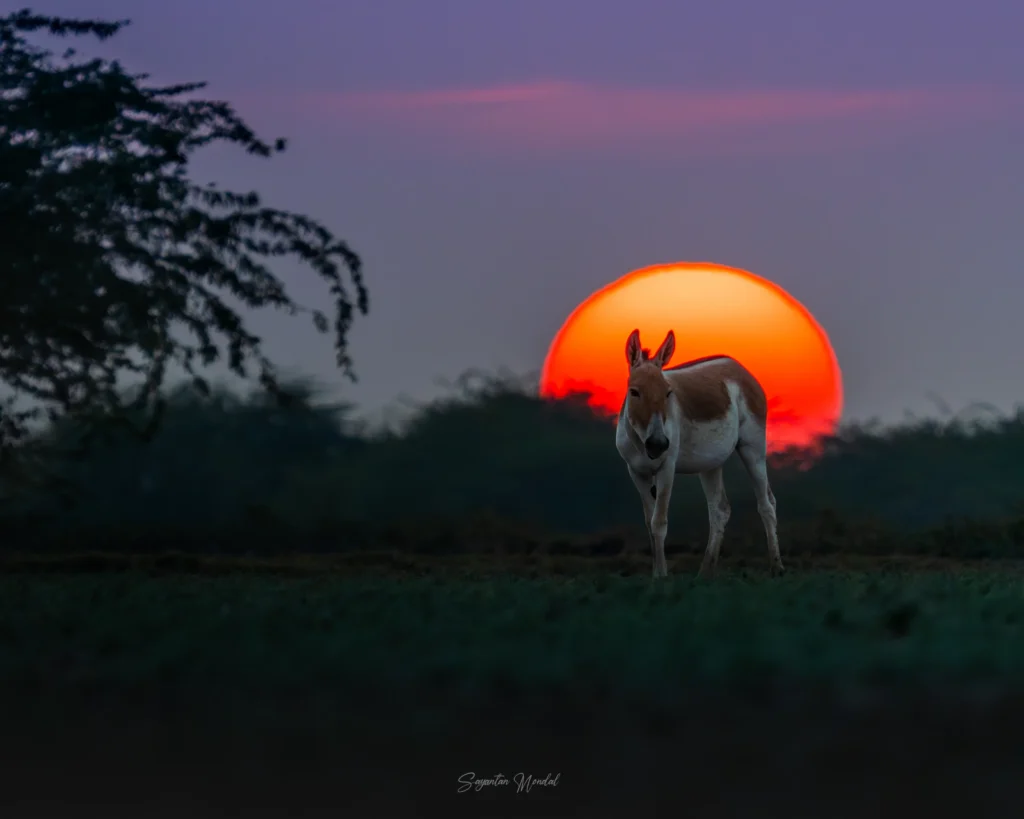
The Wild Ass Sanctuary in Gujarat protects the world’s last surviving wild population of the Indian wild ass (Equus hemionus khur). Located across the vast salt flats of the Little Rann of Kutch, it is one of India’s most distinctive protected landscapes, combining saline deserts, seasonal wetlands, grass-covered islands known as bets, and an impressive variety of wildlife.
Although the sanctuary is named after the Indian wild ass, it offers much more than a chance to see this rare equid. Winter brings thousands of migratory birds, including flamingos, pelicans, cranes, harriers, and raptors, while mammals such as desert foxes, wolves, jackals, nilgai, and chinkara also inhabit the region. The landscape itself changes dramatically through the seasons, transforming from flooded wetlands during the monsoon into expansive salt flats during the dry months.
For visitors, the sanctuary offers a different kind of wildlife experience from India’s forest-based tiger reserves. Instead of dense woodland, wildlife is spotted across open plains where patience, observation, and understanding of the landscape become part of the experience.
Whether you are planning a safari, interested in birdwatching, curious about the Indian wild ass, or simply looking to understand one of India’s most unusual ecosystems, this guide brings together practical travel advice and the latest conservation information in one place.
What Is the Wild Ass Sanctuary?
The Wild Ass Sanctuary is a protected area located within the Little Rann of Kutch in Gujarat. Covering approximately 4,953.70 square kilometres, it is among India’s largest wildlife sanctuaries and serves as the principal stronghold of the Indian wild ass.
Unlike most wildlife reserves that protect forests or grasslands, this sanctuary conserves a saline desert ecosystem shaped by seasonal flooding, high salinity, and extreme climatic conditions. These harsh environmental conditions have created habitats that support wildlife specially adapted to life in open arid landscapes.
The sanctuary extends across multiple districts, including Surendranagar, Rajkot, Patan, Banaskantha, Kachchh, and parts of Morbi, with Dhrangadhra serving as an important administrative and tourism gateway.
Why this sanctuary is globally significant
The sanctuary holds exceptional conservation value because it protects the only surviving wild population of the Indian wild ass. Once found across parts of western Asia and north-western India, the species experienced a severe decline due to habitat loss, disease, hunting, and expanding human activity.
Today, Gujarat remains the species’ primary refuge. Recent population surveys indicate encouraging recovery, but conservationists continue to monitor habitat fragmentation, invasive plant species, mining, grazing pressure, and changing land use to ensure this recovery continues.
The sanctuary has also been included on UNESCO’s Tentative List for World Heritage recognition, highlighting its international ecological importance. However, it is important to note that it is not currently a UNESCO World Heritage Site.
Quick Facts
| Feature | Details |
| Location | Little Rann of Kutch, Gujarat |
| Area | 4,953.70 sq km |
| Established | 1973 |
| Headquarters | Dhrangadhra |
| Signature species | Indian Wild Ass (Equus hemionus khur) |
| Habitat | Saline desert, seasonal wetlands and grass-covered bets |
| UNESCO Status | Tentative List |
Field Note: Despite its barren appearance during the dry season, the sanctuary supports a surprisingly diverse community of mammals, birds, reptiles, and specialised desert plants adapted to highly saline conditions.
Understanding the Little Rann of Kutch
The Wild Ass Sanctuary cannot be understood without first understanding the Little Rann of Kutch itself. Rather than being a conventional desert, it is a dynamic landscape that changes dramatically with the seasons.
For much of the dry season, visitors see wide salt-encrusted plains stretching to the horizon. During the monsoon, however, large parts of the region become shallow wetlands as rainwater and river systems inundate the low-lying terrain. This seasonal cycle shapes the movement of wildlife, the distribution of vegetation, and the timing of bird migrations.
This constant transformation is one of the defining ecological characteristics of the sanctuary.
A saline desert unlike most landscapes in India
The Little Rann is characterised by:
- Vast salt flats.
- Seasonal marshes and wetlands.
- Sparse desert vegetation.
- Open grasslands.
- Elevated islands known as bets.
The combination of saline soils and seasonal flooding creates conditions that relatively few species can tolerate. Those that do have evolved remarkable adaptations for conserving water, travelling long distances, and surviving high summer temperatures.
What are bets?
One of the most distinctive features of the Little Rann is the presence of bets—slightly elevated islands that remain above floodwaters during much of the monsoon.
These islands play a vital ecological role because they:
- provide grazing grounds for Indian wild asses;
- support grasses and shrubs unavailable on the surrounding salt flats;
- offer refuge for wildlife during seasonal flooding; and
- serve as important resting and nesting areas for several bird species.
Without these elevated habitats, many animals would struggle to survive the annual transformation of the landscape.
History of the Sanctuary
Concern over the declining population of the Indian wild ass led to the creation of the Wild Ass Sanctuary in 1973. At the time, the species had disappeared from much of its former range, making the Little Rann of Kutch its final stronghold in the wild.
Since then, conservation efforts by the Gujarat Forest Department, combined with legal protection under India’s Wildlife (Protection) Act, have helped the species recover significantly. Modern monitoring techniques, including drone surveys and camera traps, now complement traditional wildlife censuses to improve population assessment and habitat management.
Beyond protecting a single species, the sanctuary safeguards one of India’s most unusual ecosystems—an environment where seasonal wetlands, saline deserts, grasslands, and wildlife coexist in a constantly changing landscape.
Meet the Indian Wild Ass (Khur)
The Indian wild ass (Equus hemionus khur) is the defining species of the Wild Ass Sanctuary and the main reason the protected area was established. It is the last surviving wild population of its kind anywhere in the world, making Gujarat central to the species’ long-term conservation.
Unlike domestic donkeys, the Indian wild ass is a truly wild equid adapted to life in harsh, open landscapes where temperatures, water availability, and food resources vary dramatically through the year.
Scientific Classification
| Category | Details |
| Common name | Indian Wild Ass |
| Local names | Khur, Ghudkhur |
| Scientific name | Equus hemionus khur |
| Family | Equidae |
| IUCN Status | Near Threatened |
| Legal Protection (India) | Schedule I, Wildlife (Protection) Act |
| CITES | Appendix II |
Physical Characteristics
The Indian wild ass has evolved for speed, endurance, and survival in open terrain.
Typical features include:
- Sandy or reddish-brown coat during most of the year.
- White underparts.
- A dark brown stripe running from the mane to the tail.
- Long legs adapted for covering large distances.
- Strong eyesight that helps detect predators across open landscapes.
Adults appear larger and more muscular than domestic donkeys and can move rapidly across the salt flats when disturbed.
Behaviour and Adaptations
Life in the Little Rann demands constant adaptation.
The Indian wild ass is well suited to this environment because it can:
- travel long distances in search of grazing;
- tolerate high temperatures;
- survive in areas with limited freshwater;
- use open terrain to detect danger early.
Small groups are commonly seen grazing together, although group size varies depending on food availability, breeding behaviour, and season.
Distribution
Historically, the Indian wild ass occupied a much larger range across north-western India and neighbouring regions.
Today, the Little Rann of Kutch remains its principal stronghold.
Recent surveys indicate that the species is also expanding beyond the sanctuary into nearby revenue lands and districts such as Ahmedabad, Sanand, and areas around Nalsarovar. While this reflects population recovery, it also increases interactions with people and raises new conservation challenges.
Conservation Status
The Indian wild ass is classified as Near Threatened on the IUCN Red List.
Although its population has recovered substantially over recent decades, the species still faces pressures including:
- habitat fragmentation;
- expanding infrastructure;
- mining activities;
- invasive plant species;
- grazing competition;
- changing land use.
A 2024 Gujarat census estimated the population at 7,672 individuals, representing a significant increase from the previous census conducted in 2020. The latest survey also introduced drones and camera traps to improve monitoring accuracy.
Field Note: Population growth is encouraging, but conservation success depends on maintaining suitable habitat both inside and outside the protected sanctuary as the species expands into surrounding landscapes.
Wildlife You Can See
Although the Indian wild ass is the sanctuary’s best-known resident, the Little Rann supports a surprisingly diverse range of wildlife. The changing seasons, open landscapes, wetlands, and grass-covered bets create habitats for mammals, birds, reptiles, and numerous smaller species.
Visitors interested in birdwatching often find the sanctuary just as rewarding as those hoping to see the Indian wild ass.
Mammals
Several mammals adapted to dry grasslands and semi-arid habitats occur within the sanctuary.
Indian Wild Ass
The flagship species is also the most frequently observed large mammal during safaris.
Blackbuck
These graceful antelopes inhabit suitable grassland areas around the sanctuary and surrounding landscapes.
Chinkara
Also known as the Indian gazelle, chinkara are well adapted to arid environments and are occasionally seen during safaris.
Desert Fox
The Indian desert fox is one of the smaller carnivores found here. Early mornings and evenings provide the best chance of sightings.
Indian Wolf
Although rarely encountered, wolves remain among the sanctuary’s most important predators.
Other Mammals
Depending on location and season, visitors may also encounter:
- Nilgai
- Golden jackal
- Striped hyena
- Wild boar
- Caracal (rare)
Mammals at a Glance
| Species | Likelihood | Why It Is Notable |
| Indian Wild Ass | High | Flagship species |
| Nilgai | Moderate | India’s largest antelope |
| Desert Fox | Moderate | Desert specialist |
| Chinkara | Moderate | Adapted to arid habitats |
| Blackbuck | Localised | Elegant grassland antelope |
| Golden Jackal | Moderate | Common carnivore |
| Indian Wolf | Low | Apex predator of open plains |
| Striped Hyena | Low | Mostly nocturnal |
| Caracal | Rare | Elusive desert cat |
Birds
Winter transforms the Little Rann into one of western India’s important birdwatching destinations.
Seasonal wetlands attract both resident and migratory birds, making bird diversity much higher than many visitors expect from a desert landscape.
Notable species include:
- Lesser Flamingo
- Dalmatian Pelican
- Sarus Crane
- Houbara Bustard
- Marsh Harriers
- Falcons
- Hawks
Large flocks of waterbirds use seasonal wetlands created after the monsoon, while raptors patrol the open plains throughout winter.
Bird Highlights
| Bird | Best Season | Why Birdwatchers Look For It |
| Lesser Flamingo | Winter | Large feeding flocks |
| Dalmatian Pelican | Winter | Large migratory waterbird |
| Sarus Crane | Winter | India’s tallest flying bird |
| Houbara Bustard | Winter | Rare migratory visitor |
| Harriers | Winter | Low soaring raptors |
| Falcons | Winter | Fast aerial hunters |
Photography Tip: Morning light often produces softer colours and more active wildlife. The open terrain also allows longer viewing distances than many forest reserves, making telephoto lenses especially useful.
Reptiles and Smaller Fauna
The harsh environment also supports reptiles and smaller desert-adapted animals.
Although they receive less attention than mammals and birds, these species play an important role in maintaining ecological balance.
Visitors may encounter:
- Lizards
- Snakes
- Small rodents
- Desert insects
- Wetland amphibians during favourable seasonal conditions
Many of these animals are most active during cooler parts of the day or shortly after seasonal rains.
Seasonal Wildlife Highlights
Wildlife observations vary throughout the year because the landscape changes dramatically between dry and wet seasons.
| Season | Wildlife Highlights |
| Winter | Indian wild ass, migratory birds, raptors, pleasant safari conditions |
| Summer | Wild ass sightings often remain good around grazing areas, though temperatures are very high |
| Monsoon | Flooded wetlands, breeding activity, changing habitat, limited visitor access |
Expert Tip: Visitors often focus entirely on finding the Indian wild ass, but taking time to observe the surrounding wetlands, grasslands, and birdlife provides a much richer understanding of why this sanctuary is internationally important.
Best Time to Visit Wild Ass Sanctuary
The best time to visit the Wild Ass Sanctuary depends on what you hope to experience. Most travellers will find November to February the most comfortable period, with pleasant weather, active wildlife, and excellent birdwatching opportunities.
The sanctuary changes dramatically through the year. Winter offers the easiest safari conditions, summer showcases the Indian wild ass in a stark desert landscape, while the monsoon transforms the Little Rann into an extensive wetland that supports breeding and migratory birds but can make travel difficult.
Seasonal Comparison
| Season | Weather | Wildlife Viewing | Birdwatching | Accessibility |
| Winter (Nov–Feb) | Cool to pleasant | Excellent | Excellent | Excellent |
| Summer (Mar–Jun) | Very hot | Good, especially early morning | Moderate | Good |
| Monsoon (Jul–Sep) | Wet, with seasonal flooding | Limited | Habitat becomes highly productive | May be restricted |
Winter (November to February)
Winter is generally considered the most practical season for most visitors.
Advantages include:
- Comfortable daytime temperatures.
- High likelihood of seeing Indian wild asses.
- Peak migratory bird season.
- Better photography conditions.
- Easier road access.
This is also the busiest tourism season, so accommodation should be booked well in advance.
Summer (March to June)
Summer can be rewarding for experienced wildlife travellers who are comfortable with high temperatures.
Although daytime heat is intense, wildlife may be easier to spot across the open landscape during cooler morning and evening hours.
Visitors should carry adequate drinking water, sun protection, and lightweight clothing.
Monsoon (July to September)
The monsoon brings one of the sanctuary’s most remarkable transformations.
Large parts of the Little Rann become shallow wetlands, attracting aquatic life and changing the appearance of the landscape completely.
However, seasonal flooding may affect road access and safari operations, making this a less suitable time for first-time visitors.
Decision Guide: If your priority is seeing the Indian wild ass and enjoying comfortable safari conditions, plan your visit between November and February. If you are particularly interested in observing the changing ecology of the Rann and understand that access may be limited, the monsoon offers a very different perspective.
Safari Experience
Unlike safaris in forested national parks, the Wild Ass Sanctuary offers an experience centred on wide-open landscapes where visitors can observe wildlife across expansive salt flats and grass-covered bets.
The emphasis is less on searching dense vegetation and more on reading the landscape, scanning distant horizons, and understanding how animals use different habitats.
Jeep Safari
Jeep safaris are the primary way to explore the sanctuary.
During a typical safari, visitors may encounter:
- Indian wild asses grazing or moving across open plains.
- Desert foxes and jackals.
- Nilgai and chinkara.
- Seasonal wetlands with large congregations of birds.
- Salt pans and traditional landscapes of the Little Rann.
Because the terrain is largely open, sightings often occur from considerable distances, making binoculars particularly useful.
Birdwatching
Birdwatching is one of the sanctuary’s major attractions during winter.
Depending on water levels and seasonal conditions, visitors may observe:
- Flamingos feeding in shallow wetlands.
- Pelicans resting on water bodies.
- Sarus cranes in marshy areas.
- Harriers hunting low over grasslands.
- Falcons and other raptors using open country to search for prey.
Bird activity is generally highest during the cooler hours after sunrise and before sunset.
Wildlife Photography
The open terrain offers different photographic opportunities from forest reserves.
Instead of photographing animals emerging from vegetation, photographers often work with long viewing distances, expansive backgrounds, and changing light over the salt flats.
Photography Tip: A telephoto lens is particularly useful for wildlife, while a wide-angle lens helps capture the scale of the Little Rann’s unique landscape. Early morning light usually provides the best balance of soft illumination and wildlife activity.
How to Reach Wild Ass Sanctuary
The sanctuary is well connected to major cities in Gujarat, making it accessible by road, rail, and air.
Dhrangadhra serves as one of the principal gateways for visitors, although access points vary depending on the planned safari area.
By Air
Visitors typically arrive via airports in Gujarat before continuing by road to the sanctuary.
By Rail
Rail connections are available to nearby towns, after which local road transport is required to reach safari starting points.
By Road
Road travel is the most convenient option for most visitors.
The sanctuary can be approached from several directions, depending on accommodation and safari arrangements.
Road conditions are generally good during the main tourist season, although monsoon flooding may temporarily affect some routes.
Practical Tip: Confirm your safari meeting point with your accommodation or tour operator before travelling, as the sanctuary covers a large area and access points differ.
Accommodation
Accommodation around the Wild Ass Sanctuary ranges from simple guesthouses to wildlife lodges and eco-resorts.
Many visitors choose to stay near Dhrangadhra because it provides convenient access to safari departures.
Options generally include:
- Wildlife lodges.
- Eco-resorts.
- Mid-range hotels.
- Budget guesthouses.
When choosing accommodation, consider:
- Distance to safari departure points.
- Availability of naturalist-guided excursions.
- Birdwatching opportunities around the property.
- Early morning departure arrangements.
Family Travel Tip: Families with young children may find it helpful to stay close to their safari departure location, reducing early morning travel time and making the overall experience more relaxed.
Suggested Itineraries
One-Day Visit
Ideal for travellers already exploring Gujarat.
Suggested activities include:
- Early morning jeep safari.
- Wildlife photography.
- Birdwatching.
- Interpretation of the Little Rann ecosystem.
- Return by evening.
Two-Day Wildlife Trip
A two-day visit allows a more relaxed pace.
Possible itinerary:
Day 1
- Arrival.
- Evening safari.
- Sunset photography.
Day 2
- Early morning safari.
- Birdwatching.
- Explore surrounding habitats.
- Departure.
Birdwatching-Focused Visit
Birdwatchers should prioritise winter travel and allow additional time for wetland exploration, particularly during the early morning when bird activity is highest.
Practical Visitor Checklist
Before leaving for the sanctuary, consider carrying:
- Binoculars.
- Telephoto camera lens.
- Sun hat.
- Sunglasses.
- Drinking water.
- Sunscreen.
- Comfortable walking shoes.
- Neutral-coloured clothing.
- Personal medications.
- Camera batteries and memory cards.
Expert Tip: The Little Rann may appear empty at first glance, but careful observation often reveals wildlife at considerable distances. Spending time scanning the landscape patiently usually results in more rewarding sightings than constantly moving from one location to another.
Conservation Challenges
The recovery of the Indian wild ass is one of India’s notable wildlife conservation successes, but the sanctuary continues to face several long-term pressures. Many of these challenges arise from balancing wildlife conservation with traditional livelihoods, infrastructure development, and changing land use across the Little Rann of Kutch.
Understanding these issues helps visitors appreciate that the sanctuary is not only a safari destination but also a working conservation landscape.
Habitat Fragmentation
The Indian wild ass is a wide-ranging species that moves across large areas in search of food and water. As roads, settlements, industrial activities, and other developments expand, movement between habitats can become more difficult.
Fragmented landscapes may:
- Limit seasonal movements.
- Reduce access to grazing areas.
- Increase encounters with people and livestock.
- Affect long-term genetic exchange between populations.
The recent expansion of wild asses beyond the sanctuary highlights the importance of conserving landscapes outside the protected area as well.
Salt Production
The Little Rann has long supported traditional salt production, which remains an important livelihood for many local communities.
While salt works are an established part of the region’s economy, conservation efforts aim to ensure that wildlife habitats and animal movement are maintained alongside human activities.
Finding a balance between conservation and traditional livelihoods remains an ongoing management challenge.
Mining Activities
Mining within and around the sanctuary has attracted public and legal attention in recent years.
Concerns focus on the potential impacts of mining on:
- Habitat quality.
- Wildlife movement.
- Disturbance levels.
- Long-term ecological integrity.
These issues continue to be monitored by government agencies and the courts.
Invasive Plant Species
One of the best-known ecological challenges is the spread of Prosopis juliflora, an invasive tree introduced decades ago.
Although it can provide fuelwood in some areas, uncontrolled spread may:
- Replace native grasslands.
- Reduce grazing habitat.
- Alter natural vegetation.
- Change habitat structure for wildlife.
Managing invasive vegetation is now an important part of maintaining the sanctuary’s ecological balance.
Grazing and Human-Wildlife Interaction
Livestock grazing has traditionally occurred in parts of the Little Rann.
Where domestic animals and wildlife share resources, managers must consider issues such as:
- Competition for forage.
- Disease transmission.
- Increased human presence.
- Habitat degradation in heavily used areas.
Conservation programmes therefore aim to balance ecological needs with the livelihoods of local communities.
Conservation Challenges at a Glance
| Challenge | Potential Impact |
| Habitat fragmentation | Restricts wildlife movement |
| Salt works | Alters habitat if poorly managed |
| Mining | Habitat disturbance |
| Prosopis invasion | Reduces native vegetation |
| Grazing pressure | Competition for resources |
| Infrastructure development | Landscape fragmentation |
Field Note: The future of the Indian wild ass depends not only on protecting the sanctuary itself but also on maintaining connected landscapes that allow the species to move naturally beyond protected boundaries.
Recent Conservation Updates
The sanctuary continues to evolve through active conservation management and improved wildlife monitoring.
2024 Wild Ass Census
The latest Gujarat census estimated the Indian wild ass population at 7,672 individuals, representing a substantial increase compared with the previous census conducted in 2020.
This encouraging trend suggests that long-term conservation measures have supported population recovery.
Expansion Beyond the Sanctuary
Researchers and forest officials have documented Indian wild asses increasingly using habitats outside the sanctuary, including areas near Ahmedabad, Sanand, and Nalsarovar.
While this reflects a growing population, it also increases the importance of managing landscapes beyond protected boundaries.
Improved Monitoring Techniques
Recent wildlife censuses incorporated technologies such as:
- Drone surveys.
- Camera traps.
These tools improve the accuracy of population estimates while helping researchers better understand habitat use and wildlife movements.
Responsible Tourism
Every visitor plays a role in protecting the Wild Ass Sanctuary.
Simple choices can help minimise disturbance to wildlife while supporting conservation efforts.
Responsible Visitor Guidelines
- Stay on designated safari routes.
- Follow instructions from forest staff and guides.
- Maintain a respectful distance from wildlife.
- Avoid loud noises and sudden movements.
- Never feed wild animals.
- Do not leave litter behind.
- Carry reusable water bottles where possible.
- Respect local communities and their livelihoods.
Responsible Tourism Tip: Good wildlife watching is about observing natural behaviour, not getting as close as possible. Allow animals enough space to behave naturally.
Common Mistakes Visitors Make
Avoiding a few common mistakes can make your visit more enjoyable and reduce unnecessary disturbance to wildlife.
1. Visiting only for the Indian Wild Ass
Many visitors overlook the sanctuary’s excellent birdlife, wetlands, and desert ecology.
2. Underestimating the Climate
The Little Rann can become extremely hot during summer. Carry sufficient water and sun protection.
3. Expecting a Forest Safari
Unlike tiger reserves, this is an open landscape where wildlife may be observed from considerable distances.
4. Forgetting Binoculars
Binoculars greatly improve wildlife viewing across the vast plains.
5. Assuming the Landscape Is Empty
At first glance, the Little Rann may appear barren, but patient observation often reveals birds, mammals, reptiles, and fascinating ecological interactions.
Frequently Asked Questions
Where is the Wild Ass Sanctuary located?
It is located in the Little Rann of Kutch in Gujarat and spans multiple districts, with Dhrangadhra serving as an important gateway for visitors.
Why is the sanctuary famous?
It protects the world’s last surviving wild population of the Indian wild ass (Equus hemionus khur) and conserves a unique saline desert ecosystem.
What is the best time to visit?
For most travellers, November to February offers the most comfortable weather and the best opportunities for wildlife viewing and birdwatching.
Is the sanctuary open during the monsoon?
Seasonal flooding can affect accessibility and safari operations during the monsoon, so visitors should check current conditions before planning a trip.
What animals can visitors expect to see?
Besides the Indian wild ass, visitors may encounter nilgai, chinkara, desert foxes, jackals, wolves, striped hyenas, blackbuck, and a variety of migratory birds.
Is the sanctuary good for birdwatching?
Yes. Winter attracts numerous migratory species, including flamingos, pelicans, cranes, harriers, and falcons.
Is the Indian wild ass endangered?
The Indian wild ass is currently classified as Near Threatened by the IUCN. Although its population has increased, habitat conservation remains essential.
Is the sanctuary a UNESCO World Heritage Site?
No. It is included on UNESCO’s Tentative List but has not been inscribed as a World Heritage Site.
Is the sanctuary suitable for families?
Yes. Families interested in wildlife, birds, and nature can enjoy the sanctuary, particularly during the cooler winter months.
Why is the Little Rann of Kutch ecologically important?
Its combination of saline desert, seasonal wetlands, and elevated grass-covered bets supports specialised wildlife found in very few other places.
Conclusion
The Wild Ass Sanctuary offers one of India’s most distinctive wildlife experiences. Rather than dense forests or mountainous terrain, it showcases the quiet beauty of an open saline desert where wildlife has adapted to survive in challenging conditions.
Its global importance extends beyond protecting the Indian wild ass. Seasonal wetlands support thousands of migratory birds, grass-covered bets provide vital refuge during the monsoon, and ongoing conservation efforts continue to shape the future of one of India’s most unusual ecosystems.
For travellers, the sanctuary rewards patience rather than speed. Spending time observing the changing landscape, watching wildlife from a respectful distance, and understanding the ecological significance of the Little Rann provides a deeper appreciation of this remarkable protected area.
Whether you are visiting for a safari, birdwatching, wildlife photography, or simply to explore one of Gujarat’s most distinctive natural landscapes, the Wild Ass Sanctuary demonstrates how conservation, traditional livelihoods, and responsible tourism can coexist in one of India’s last great desert ecosystems.
Safari Planning : Topics Cluster
- How to book a wildlife safari in India?
- Park by Park Online Safari Booking Guide
- Tiger Safari India Planning Workbook
- Park by Park Safari Permits Guide
- National Parks Permit Guide – Park by Park Guide
- Tatkal Safari Booking Guide – Last Minute Safari Permits Booking
- Tiger Safari in India Cost
- Indian Wildlife Safari Budget Planner
- Jeep vs Canter Safari
- Best time for Tiger Sightings in India
- How far advanced should you book safari permits?
- Can foreigners book Indian Wildlife Safari online?
- Special Permits Guide for Foreigners and Domestic Visitors
- How to book a Safari Permit online in India? 2026 step by step guide
- Senior Citizens Friendly Safari Planning
- Multi Generation Family Safari Planning
- 50 things to know before your first safari in India