Master the identification of India’s bee-eater species. Learn about their migratory patterns, unique nesting habits, and the best places to spot them.
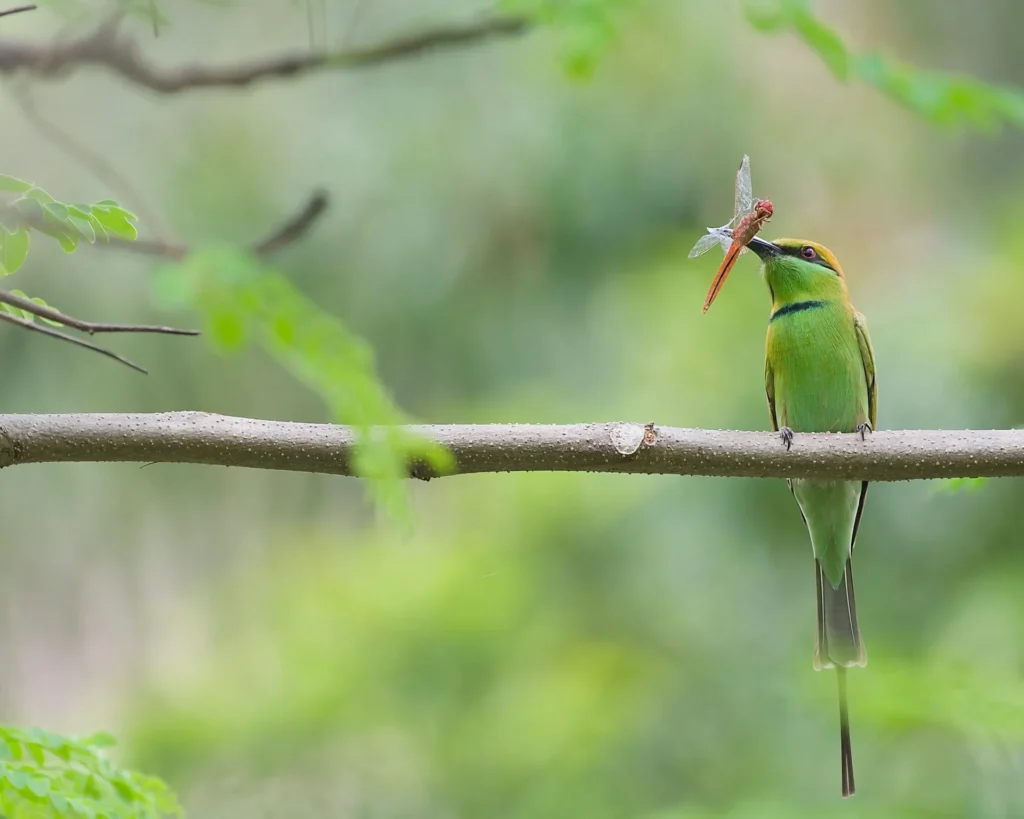
Image: Asian Green Bee-eater. The most common bee-eater easily seen in cities as well.
Bee-eaters are among the most active and colorful birds you will encounter on an Indian safari. For birdwatchers and wildlife photographers, they offer an excellent subject for observation because they tend to perch out in the open, hunt actively during daylight hours, and tolerate human observers well if approached quietly.
If you want to understand these birds beyond their striking plumage, you need to look at their specific habitat choices, seasonal movements, and unique nesting behaviors. Modern citizen-science data, such as the millions of observations compiled in the State of India’s Birds report, has significantly advanced our understanding of where these birds live and how their populations are changing across the Indian subcontinent.
This guide provides a practical field framework to help you identify each species, understand their behavior, and plan your trips to the best birding locations in India.
Bee-eaters of India: An Overview
Bee-eaters belong to the avian family Meropidae. Across India, they occupy a wide variety of ecological niches, ranging from arid semi-deserts and agricultural fields to deep river valleys and dense tropical forests.
As a group, these birds are defined by their specialized lifestyle as aerial insectivores. They catch almost all of their food mid-air, using highly coordinated flight maneuvers to intercept fast-moving insects.
Understanding bee-eaters requires looking at data collected on a massive scale. The State of India’s Birds 2023 report, which analyzed over 30 million eBird observations from more than 30,000 birdwatchers, provides the most accurate picture to date of bird distributions and population trends across the country. This data reveals that while some bee-eater species are thriving and expanding their ranges in open environments, others remain highly localized and dependent on specific, fragile habitats like undisturbed riverbanks or mature forest canopies.
How Many Bee-eater Species Occur in India?
India hosts at least seven distinct species of bee-eaters. While many general travel guides group them together or assume they all share the same habits, their residential status, distribution, and choices of environment vary significantly.
The checklist of Indian bee-eaters includes:
- Asian Green Bee-eater (Merops orientalis)
- Blue-tailed Bee-eater (Merops philippinus)
- Chestnut-headed Bee-eater (Merops leschenaulti)
- Blue-cheeked Bee-eater (Merops persicus)
- Blue-bearded Bee-eater (Nyctyornis athertoni)
- European Bee-eater (Merops apiaster)
- Blue-throated Bee-eater
These seven species cannot be treated as a single uniform group. They are split by distinct behavioral and geographic boundaries:
- Widespread Residents: The Asian Green Bee-eater is the most common and widely distributed species in the country, frequently seen across open countryside, farmland, and urban edges year-round.
- Within-India and Regional Migrants: The Blue-tailed Bee-eater and Blue-cheeked Bee-eater alter their locations based on the season, migrating across regions or entering India as winter visitors to utilize seasonal insect gluts.
- Forest Specialists: The Blue-bearded Bee-eater and Chestnut-headed Bee-eater avoid open country entirely, restricting themselves to forest ecosystems such as the Western Ghats, the foothills of the Himalayas, and the woodland tracts of Central India.
Knowing these distinctions helps you narrow down exactly which species are possible to see based on the specific terrain and timing of your safari.
Field Note: Do not rely on old travel brochures that label every green bird with a long tail as a “Green Bee-eater.” Look closely at the bird’s size, throat coloration, and the presence or absence of extended central tail feathers to determine the true identity of the species.
Indian Bee-eater Species Identification
When identifying bee-eaters in the field, beginners often focus entirely on the overall body color. Because most species share varying degrees of green plumage, this approach frequently leads to misidentification. Instead, experienced birders look at specific field marks: the color of the throat patch, the presence or absence of elongated central tail feathers (streamers), the underwing color in flight, and the distinctive facial mask or eye-stripe.
The following profiles cover the key field marks and typical environments for the bee-eater species found across the Indian subcontinent.
Asian Green Bee-eater (Merops orientalis)
The Asian Green Bee-eater is the smallest and most frequently encountered species in the country. It is highly adaptable and commonly seen in open countryside, near cultivation, and around human habitation. You will typically spot them perching on fences, low bushes, and roadside utility wires.
Key Identifiers: Look for a uniformly bright green body, a distinct black “gorget” (a band across the lower throat), and long, pin-like central tail streamers.
Blue-tailed Bee-eater (Merops philippinus)
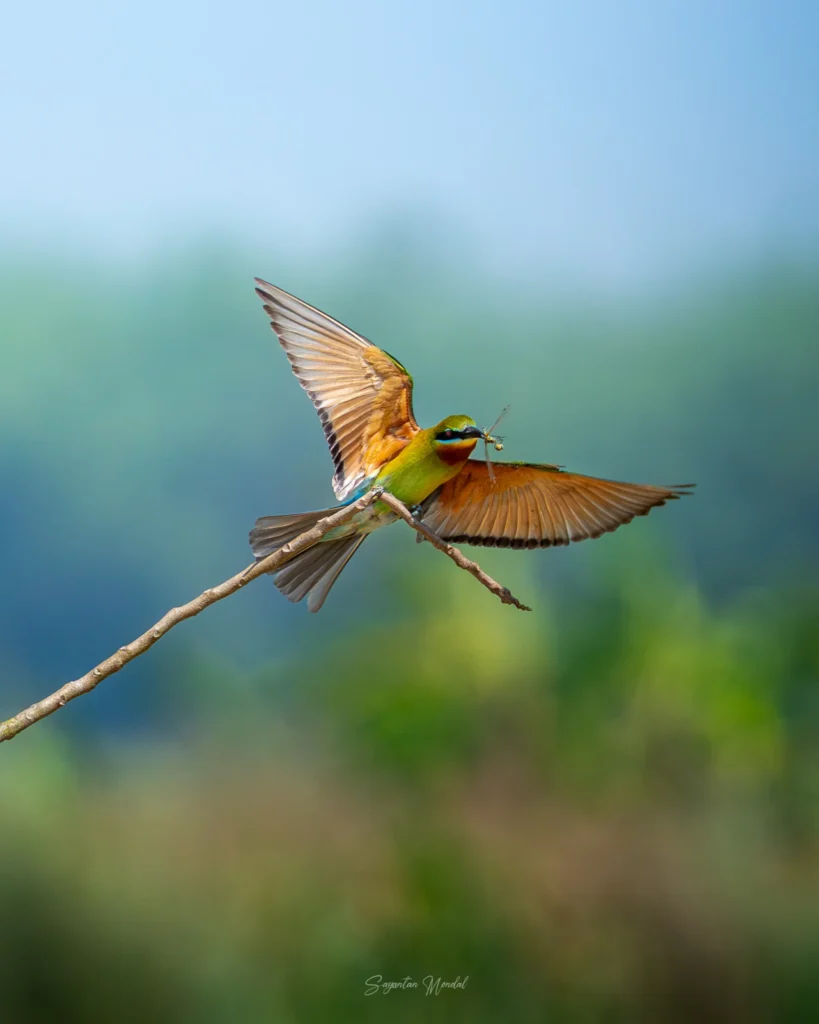
The Blue-tailed Bee-eater is larger than the Green Bee-eater and is heavily associated with open habitats, river valleys, and areas near water. According to the State of India’s Birds report, this species has a massive distribution range of 5,95,350 sq km within the country. It operates as both a within-India migrant and a winter migrant. Encouragingly, recent assessments list it as a Low Priority for conservation concern, noting a long-term population increase and a rapid current annual increase. It is globally classified as Least Concern and protected under Schedule-II of the Wild Life Protection Act in India.
Key Identifiers: It features an olive-green body, a prominent rufous or chestnut throat, a black eye-stripe, and a distinct blue lower back and tail. It also possesses central tail streamers.
Chestnut-headed Bee-eater (Merops leschenaulti)
Unlike the open-country species, the Chestnut-headed Bee-eater prefers wooded areas, forest edges, and clearings. It is commonly found in the Western Ghats, Eastern Ghats, Sub-Himalayan forests, and North-East India.
Key Identifiers: This species is easily distinguished by its rich chestnut crown and nape, a yellow throat, and the complete absence of elongated central tail streamers. The tail ends squarely.
Blue-cheeked Bee-eater (Merops persicus)
Often confused with the Green Bee-eater at a distance, the Blue-cheeked Bee-eater is generally a passage migrant or winter visitor to parts of western and northern India. However, its distribution is yielding new discoveries. Recent reports have documented breeding activity in peninsular India, specifically in saltpans near the Manakudy Mangroves in the Kanniyakumari district, marking a notable development in its known range.
Key Identifiers: It is slightly larger than the Green Bee-eater. Look for a striking blue patch above and below the prominent black eye-stripe, a rufous throat, and central tail streamers.
Blue-bearded Bee-eater (Nyctyornis athertoni)
The Blue-bearded Bee-eater is the largest of the Indian bee-eaters and a true forest specialist. It inhabits dense broadleaved forests across the Western Ghats, Eastern Ghats, Himalayan foothills, and North-East India. Because it forages higher in the forest canopy rather than out in the open, it can be difficult to spot despite its size.
Key Identifiers: It has a heavier, more robust build than the Merops species. Its defining feature is a “beard” of elongated, pale blue feathers cascading down its throat and breast. It lacks tail streamers.
European Bee-eater (Merops apiaster)
The European Bee-eater is primarily a passage migrant through north-western and western India, appearing briefly during its long migratory journeys.
Key Identifiers: This is the most multicolored bee-eater in the region. It features a rich chestnut crown and back, yellow throat, blue underparts, and a black collar. It has short central tail streamers.
Blue-throated Bee-eater
While less commonly encountered than the widespread Green or Blue-tailed species, the Blue-throated Bee-eater adds to the regional diversity of the Meropidae family in India. It is typically found in heavily wooded areas and forest clearings, sharing habitat preferences similar to the Chestnut-headed Bee-eater.
Field Guide: How to Tell Similar Species Apart
Use this identification shortcut to quickly separate species in the field based on easily observable traits.
| Species | Throat / Head Color | Tail Streamers | Primary Habitat | Distinguishing Field Mark |
| Asian Green | Green throat with a black band | Yes (Long) | Open countryside, cultivation | Entirely green body with black throat band. |
| Blue-tailed | Rufous/chestnut throat | Yes | River valleys, open habitats | Distinct blue lower back and tail. |
| Blue-cheeked | Rufous throat, blue cheeks | Yes | Arid areas, saltpans, mangroves | Prominent blue patches around the black eye-stripe. |
| Chestnut-headed | Yellow throat, chestnut crown | No (Square tail) | Forest edges, wooded areas | Lacks tail streamers; solid chestnut head. |
| Blue-bearded | Elongated blue “beard” | No (Square tail) | Dense forests, canopies | Large size and unique blue throat feathers. |
| European | Yellow throat, black collar | Yes (Short) | Open country (Passage migrant) | Highly contrasting chestnut back and yellow throat. |
Expert Tip: Before raising your binoculars to confirm colors, look at the bird’s silhouette. If the tail ends in a flat, square edge, you are likely looking at a Chestnut-headed or Blue-bearded Bee-eater. If you see long, needle-like feathers extending past the tail, you are observing one of the open-country species.
Habitat and Distribution: Open Country vs. Dense Forests
While bee-eaters are found throughout India, individual species strictly segregate by habitat type. Knowing the landscape is the most reliable way to predict which species you will encounter.
Regional Distribution Patterns
The widespread open-country species, such as the Asian Green and Blue-tailed Bee-eaters, thrive near cultivation, human habitation, and open river valleys. You will frequently find them utilizing exposed embankments, riverbanks, and loamy mudbanks across peninsular river systems.
Conversely, forest specialists like the Blue-bearded and Chestnut-headed Bee-eaters require woodland environments. Their distribution maps tightly track India’s major forested corridors, including the Western Ghats, Eastern Ghats, Satpuras, Sub-Himalayan forests, and North-East India. The Chestnut-headed Bee-eater is also frequently recorded in Kerala.
Recent Breeding Records in India
Citizen science datasets, such as the millions of observations driving the State of India’s Birds report, continuously update our understanding of bee-eater distribution. For example, the Blue-cheeked Bee-eater has recently been documented breeding in peninsular India. Nests were recorded in saltpans near the Manakudy Mangroves in the Kanniyakumari district, highlighting a notable range expansion and a successful adaptation to mangrove-edge systems.
Diet and Hunting Behavior
Bee-eaters are specialized aerial insectivores. They do not forage on the ground or glean insects from leaves; they catch their prey entirely in mid-air using highly coordinated flight maneuvers.
What Bee-eaters Eat
A common misconception among travelers is that these birds consume exclusively bees. While bees certainly form a portion of their diet, bee-eaters are opportunistic hunters of many flying insects. Their prey includes wasps, hornets, dragonflies, and grasshoppers.
Aerial Insectivory and Wire Perching
Bee-eaters possess a highly active foraging behavior. Studies on small bee-eaters in southern India indicate that these birds spend a large share of their time scanning the sky and feeding.
This behavior explains why you will frequently see them perched in rows on electric wires, exposed bare branches, or fencing near open countryside. These elevated, unobstructed perches serve as practical vantage points, allowing them to scan for flying insects before launching into fast, acrobatic hunting flights.
Photography Tip: Because open-habitat bee-eaters spend a significant amount of time scanning from exposed wires and bare branches, set up your camera near these structures early in the morning or late in the afternoon. Pre-focusing on a favorite wire perch is a practical way to capture their aerial insectivory in action.
Breeding, Nesting, and Migration
A bird’s nesting habits directly influence where you are likely to find them during the breeding season. For bee-eaters, this means looking away from the trees and focusing on the earth.
Burrow Nesting in Sandbanks and Mudbanks
A common misconception among casual observers is that bee-eaters, like many other birds, build nests out of twigs in tree branches. In reality, most bee-eater species nest in burrows dug directly into banks, cliffs, or embankments.
When planning a wildlife trip during the breeding season, focus your attention on river valleys and exposed earth. Bee-eaters depend heavily on vertical surfaces such as sandbanks, mudbanks, and loamy banks to excavate their nesting tunnels.
Many species are highly social during this period. The Blue-tailed Bee-eater, for example, breeds colonially in river valleys. Finding one nesting pair often means a larger colony is utilizing the same stretch of riverbank, providing excellent opportunities for prolonged observation.
Migration and Seasonal Occurrence
Bird distributions can vary significantly depending on the season, migration patterns, and observer coverage. Not all bee-eaters stay in the same region year-round. Understanding their seasonal status is a practical tool for planning when and where to travel.
Some species are permanent residents, while others move across regions within the country or arrive from outside India to capitalize on seasonal insect abundance. For example, the Blue-tailed Bee-eater functions as both a within-India migrant and a winter migrant, shifting its range as environmental conditions change. The European Bee-eater, by contrast, is primarily a passage migrant, passing through western and north-western India for only brief windows during its longer migration journey.
Use the following table to understand the general seasonal status of key species to better time your birdwatching trips.
Table 2: Seasonal Status and Primary Indian Habitats
| Species | Primary Seasonal Status in India | Key Habitat Preferences |
| Asian Green Bee-eater | Widespread Resident | Open countryside, cultivation, human habitation edges. |
| Blue-tailed Bee-eater | Within-India Migrant / Winter Migrant | River valleys, open habitats, sandbanks, mudbanks. |
| Blue-cheeked Bee-eater | Passage Migrant / Winter Visitor | Arid regions, saltpans, mangrove edges. |
| Chestnut-headed Bee-eater | Resident (with local movements) | Forest edges, wooded areas, Sub-Himalayan and Ghat forests. |
| Blue-bearded Bee-eater | Resident | Dense broadleaved forests, forest canopies. |
| European Bee-eater | Passage Migrant | Open country (briefly during migration routes). |
Family Travel Tip: If you are traveling with children, visiting a known riverbank colony during the breeding season is highly rewarding. Because colonial nesters are highly active—constantly flying in and out of their burrows to feed nestlings—it provides reliable, fast-paced wildlife viewing that keeps younger observers engaged without requiring long periods of waiting.
Best Places to See Bee-eaters in India
Because bee-eaters are divided by habitat type, seeing a high diversity of species requires visiting different regions across India.
For open-country and water-associated species like the Asian Green and Blue-tailed Bee-eaters, the river valleys and wetlands of northern and central India provide excellent viewing. National parks with large river systems—such as Jim Corbett National Park, Kaziranga National Park, and Chambal River Sanctuary—offer ideal sandbanks and mudbanks where Blue-tailed Bee-eaters breed colonially.
To spot forest specialists like the Chestnut-headed and Blue-bearded Bee-eaters, focus your travels on dense woodland ecosystems. The Western Ghats (including areas in Kerala, Karnataka, and Tamil Nadu), the Sub-Himalayan forests, and the Satpura hill ranges in Central India are the most reliable locations. Protected areas like Periyar Tiger Reserve, Nagarhole National Park, and Kanha National Park feature the mature forest canopies these birds require.
If you are looking for passage migrants like the European Bee-eater or the localized breeding populations of the Blue-cheeked Bee-eater, plan visits to western and southern India. The arid tracts of Rajasthan and Gujarat are prime spots for migratory windows, while the saltpans near the Manakudy Mangroves in Tamil Nadu’s Kanniyakumari district provide a specific target for observing breeding Blue-cheeked Bee-eaters.
When to Visit for Birdwatching and Photography
The best time to observe bee-eaters depends entirely on their breeding and migratory cycles. The spring and summer months (typically March to June) are highly active as resident and within-India migratory species congregate around riverbanks and embankments to dig nesting burrows. The winter months (October to February) are ideal for spotting winter visitors and passage migrants in open country and coastal regions.
Conservation Status and Threats
Understanding the conservation needs of these birds requires looking at large-scale trends. The State of India’s Birds 2023 report uses citizen-science data to evaluate species health based on distribution range and population stability.
Table 3: Conservation Priority and Distribution Metrics
| Species | Global IUCN Status | State of India’s Birds (SoIB) Priority | Range Size in India | Wildlife Protection Act Schedule |
| Blue-tailed Bee-eater | Least Concern | Low Priority (Showing long-term and rapid current annual increase) | 5,95,350 sq km | Schedule-II |
| Asian Green Bee-eater | Least Concern | Low Priority | Widespread | Schedule-II |
While species like the Blue-tailed Bee-eater are currently thriving and expanding their ranges in open environments, bee-eaters face ongoing localized threats. Their heavy reliance on sandbanks, mudbanks, and loamy riverbanks for colonial nesting makes them highly vulnerable to habitat destruction caused by intensive sand mining and riverbed modifications. Additionally, forest-dwelling species are sensitive to the fragmentation of mature broadleaved forest canopies.
Responsible Tourism Tip: When visiting a nesting colony along a riverbank or dirt embankment, maintain a practical distance. Approaching too close to burrow entrances can cause the adult birds to abandon their hunting flights, leaving eggs or nestlings vulnerable to predators and heat exhaustion. Use a spotting scope or a telephoto lens to observe their behavior without disrupting their nesting workflow.
Common Identification Mistakes
- Assuming All Green Birds are Asian Green Bee-eaters: Many birdwatchers misidentify the Blue-tailed or Blue-cheeked Bee-eater because they focus entirely on the green body color. Always check for the blue tail or blue facial markings to confirm the species.
- Confusing Bee-eaters with Kingfishers: Because some small kingfishers share bright green or blue plumage and sit on similar perches near water, they are occasionally confused with bee-eaters. Look at the bill shape: kingfishers have heavy, dagger-like bills, whereas bee-eaters have slender, gently decurved bills perfectly shaped for snapping up flying insects.
- Expecting Tail Streamers on Every Species: Beginners often discard the possibility of a bee-eater if the bird lacks long, pin-like tail feathers. Remember that forest-associated species like the Chestnut-headed and Blue-bearded Bee-eaters have square tails with completely flat edges.
Frequently Asked Questions (FAQs)
How many bee-eater species are found in India?
India hosts at least seven distinct species of bee-eaters, including resident birds, within-India migrants, forest specialists, and seasonal passage migrants.
Which bee-eater is most common in India?
The Asian Green Bee-eater is the most widespread and commonly observed species, regularly found in open country, farmland, and urban fringes across the country.
What is the difference between the green bee-eater and the blue-tailed bee-eater?
The Blue-tailed Bee-eater is noticeably larger, features a prominent chestnut throat, a distinct blue lower back and tail, and prefers areas closer to river valleys and wetlands. The Asian Green Bee-eater is smaller, lacks the blue tail, and displays a prominent black band across its lower throat.
Is the blue-bearded bee-eater found in India?
Yes. The Blue-bearded Bee-eater is a resident species in India, but it is a forest specialist confined to dense broadleaved forest canopies in places like the Western Ghats and the Himalayan foothills.
Where can I see blue-cheeked bee-eaters in India?
While primarily a passage migrant or winter visitor to western and northern regions, they have recently been recorded breeding in peninsular India within the saltpans and mangrove edges near the Manakudy Mangroves in Kanniyakumari.
Which bee-eaters breed in India?
Multiple species breed in India, including the Asian Green, Blue-tailed, Chestnut-headed, and Blue-bearded Bee-eaters. Recent evidence has also confirmed localized breeding of the Blue-cheeked Bee-eater in southern India.
Do bee-eaters eat only bees?
No. While they do consume bees, they are generalist aerial insectivores that hunt a wide variety of flying insects, including wasps, hornets, dragonflies, and grasshoppers.
Are bee-eaters protected under Indian law?
Yes. Species like the Blue-tailed Bee-eater are protected under Schedule-II of the Wild Life Protection Act in India.
Why do bee-eaters frequently sit on electric wires?
Electric wires and bare branches provide excellent, unobstructed vantage points. Because bee-eaters are highly active foragers, these elevated perches allow them to easily scan the surrounding open air for flying insects before launching an attack.
What do bee-eater nests look like?
Instead of building nests in trees, most bee-eaters dig long, horizontal tunnels into vertical dirt surfaces like sandbanks, loamy embankments, and mudbanks, where they lay their eggs safely underground.
Conclusion
Bee-eaters offer an excellent window into the ecological diversity of India’s landscapes. From the highly adaptable Asian Green Bee-eater on roadside wires to the elusive Blue-bearded Bee-eater in dense forest canopies, these aerial insectivores are deeply tied to the health of their specific environments.
By understanding their field marks, preferred habitats, and seasonal movements, you can significantly enrich your birdwatching experience on your next Indian safari. Protect their nesting banks, watch their acrobatic hunting flights, and use modern citizen-science frameworks to keep your field knowledge accurate and up to date.
Author Note & Update Log: Written by the WildlifeSafaris.in Editorial Team. Last Updated: August 2026