
A practical guide to identifying the Great Hornbill, understanding its nesting habits, finding key wild hotspots, and supporting its conservation.
The Great Hornbill (Buceros bicornis) is one of the largest canopy-dwelling birds found across the Indian subcontinent and Southeast Asia. For travelers planning a wildlife safari, recognizing this species requires an understanding of its distinct physical traits, specialized habitat choices, and loud vocalizations. This guide details the essential field marks and natural history data needed to locate and observe this species responsibly.
Identifying the bird correctly in the field is the first step toward understanding its broader ecological needs and seasonal movements.
Quick ID and Facts
For an immediate reference during travel, the table below outlines the core scientific and conservation data points for the Great Hornbill.
| Parameter | Species Data |
| Scientific Name | Buceros bicornis |
| IUCN Red List Status | Vulnerable (Assessed 2020) |
| Population Trend | Decreasing |
| Primary Diet | Frugivorous (primarily figs) |
| Core Habitat | Primary evergreen and moist deciduous forests |
| Nesting Habit | Obligate cavity-nester in large old-growth trees |
Appearance and Voice
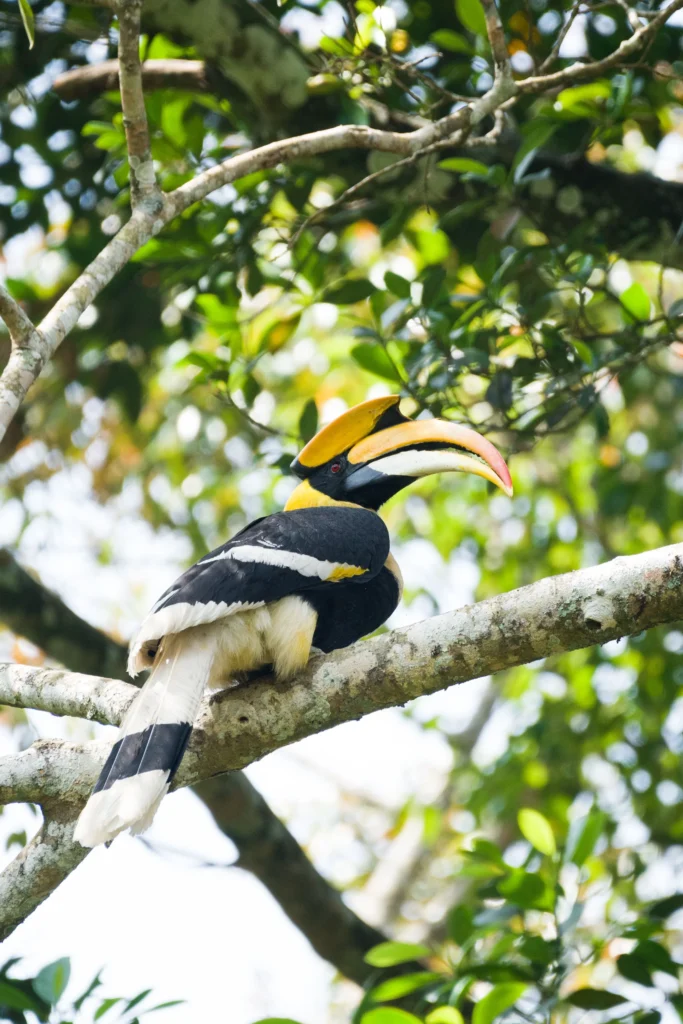
The Great Hornbill is characterized by its contrasting black and white plumage, offset by a prominent yellow-and-black structure on its upper mandible. The neck, upper breast, and specific flight feathers display a yellowish tinge, which is derived from preen oil applied by the bird during grooming. When flying overhead, the wings show a distinct white band across the black coverts, and the tail is white with a prominent black subterminal band.
The flight mechanism of the Great Hornbill produces a loud, rhythmic puffing sound that can be heard from a distance. This sound is caused by the lack of underwing covert feathers, which allows air to rush through the flight feathers during each stroke.
Its vocalizations consist of deep, resonant grunts, barks, or roars. These calls are used primarily to maintain contact between pairs or to signal territorial boundaries through the forest canopy.
Size and Sexual Dimorphism
Distinguishing between the sexes in the wild is straightforward if you focus on eye color rather than overall body coloration. While both sexes share similar plumage patterns, they display subtle variations in size and distinct variations in the markings of the eye and casque.
| Metric | Male | Female |
| Average Length | 95–120 cm | Slightly smaller than male |
| Average Weight | 2.6–3.4 kg | 2.1–3.35 kg |
| Wingspan | 150–152 cm | Slightly smaller than male |
| Iris Color | Red | White or creamy-white |
| Casque Markings | Black anterior trim | Lacks distinct black anterior trim |
In the field, a male can be recognized by his red irises and the black coloration along the front and back edges of the casque. Conversely, the female is smaller, possesses white or light cream-colored irises, and lacks the heavy black lining on the front of the casque.
Casque and Bill Function
The most prominent physical feature of the Great Hornbill is the large, U-shaped casque sitting atop its heavy bill. Despite its solid appearance, the casque is remarkably light because it consists of a cellular, hollow keratin structure supported by thin internal bony struts.
Field Note: The casque is a reliable indicator of maturity. In juveniles, the casque is underdeveloped or entirely absent, developing slowly over several years as the bird reaches breeding age.
The precise evolutionary purpose of the casque includes a mix of sexual selection and acoustic amplification. It acts as a resonating chamber that amplifies the bird’s deep calls across the dense forest canopy. During the breeding season, males also engage in aerial casquing, an aggressive behavior where flying individuals clash their casques together mid-air to establish dominance.
Range and Habitat
To successfully observe Great Hornbills in the wild, you must first understand their specific habitat requirements. These birds are not generalists; their presence is strictly tied to the availability of large, old-growth trees capable of supporting their massive nests and providing sufficient fruit.
Elevation and Forest Types
The Great Hornbill primarily inhabits primary evergreen and moist deciduous forests. While they are occasionally recorded from sea level up to higher elevations, their core breeding and foraging territories are typically found in hilly terrain between 600 and 2,000 meters.
They are highly sensitive to habitat fragmentation. Because they rely on a continuous canopy for movement and massive tree cavities for nesting, Great Hornbills rarely adapt to heavily degraded secondary forests or commercial plantations. The loss of large native timber directly correlates with local population declines.
Countries and Regional Hotspots
The species maintains a broad but increasingly fragmented footprint across the Indian subcontinent and Southeast Asia.
In India, the population is split into two distinct strongholds. The first is the Western Ghats, a mountain range running parallel to the western coast, where the birds are concentrated in dense, wet evergreen forests. The second stronghold is Northeast India, spanning the foothills of the Himalayas and the Brahmaputra floodplains.
Beyond India, their range extends into Bhutan and the lowland forests of Nepal. In Southeast Asia, populations exist in Thailand, Peninsular Malaysia, and the Indonesian island of Sumatra, though sighting probabilities vary greatly depending on local conservation enforcement.
Where to See Great Hornbills
For wildlife travelers, selecting the right destination depends on accessibility, infrastructure, and the ethical standards of local operators. Below is a breakdown of the most reliable regions for sightings, along with their legal protection status.
Table 3: Regional Presence and Protection Status
| Region / Country | Key Protected Areas | Conservation Note | Legal Framework |
| Western Ghats, India | Periyar National Park, Silent Valley | Stronghold, but facing habitat pressure | Schedule I (Wildlife Protection Act) |
| Northeast India | Pakke Tiger Reserve, Kaziranga, Namdapha | Critical habitat; strong community conservation in Pakke | Schedule I (Wildlife Protection Act) |
| Nepal | Chitwan National Park, Bardia National Park | Patchy presence; localized to specific forest tracts | National Protections |
| Malaysia | Taman Negara National Park | Accessible via canopy walkways and river routes | National Protections |
| Sumatra, Indonesia | Gunung Leuser National Park | High threat level from illegal logging | National Protections |
Travel Logistics and Best Sighting Months
The most reliable way to find Great Hornbills is to locate their food sources. Because they are primarily frugivorous, sightings peak when native fig trees (Ficus species) are fruiting.
- Best Time to Visit: In the Western Ghats and Northeast India, the prime observation window is between November and March. During these dry months, the forest canopy is less dense, making large birds easier to spot against the sky. This period also coincides with the pre-breeding and nesting seasons when bird activity is highly localized.
- Microhabitats to Target: Focus your safari on riverine forests, valleys with towering emergent trees, and the edges of primary forest clearings where fruiting trees get maximum sunlight.
- Guiding and Ethics: Always hire local naturalists or indigenous guides (such as the Nyishi community guides in Pakke Tiger Reserve). Not only do they possess intimate knowledge of current nesting and feeding sites, but your financial contribution directly supports community-based conservation models.
Expert Tip: Do not request guides to take you directly to active nesting trees. Close human presence causes severe stress to the breeding pair and may lead to nest abandonment. Instead, ask your guide to position you near known fruiting trees or along established flight paths across valleys, which offer superior observation opportunities without disturbing the birds.
Diet and Foraging Behavior
While the Great Hornbill is primarily frugivorous, its diet is highly adaptable depending on seasonal availability and breeding requirements. Lipid-rich fruits, particularly wild figs (Ficus species), make up the bulk of their daily caloric intake. The birds possess a high degree of mobility, allowing them to track the asynchronous fruiting patterns of fig trees across vast tracts of forest canopy.
However, they are not strict vegetarians. To supplement their diet—especially when protein demands peak during the chick-rearing phase—Great Hornbills actively hunt. They use their massive, dexterous bills to pluck prey from branches or tree crevices, consuming small mammals, reptiles, smaller bird species, and large insects.
Outside of the breeding season, Great Hornbills typically travel in bonded pairs or small family units. When a particularly large emergent tree produces an abundance of fruit, multiple pairs may temporarily tolerate each other, gathering in larger, noisy flocks to feed before dispersing back to their respective territories.
Breeding, Nesting, and Life Cycle
The nesting cycle of the Great Hornbill involves highly specialized behaviors that tie the species inextricably to the health of primary, undisturbed forests.
Nest Selection and Tree Characteristics
Great Hornbills are obligate secondary cavity-nesters. This means their bills are not designed to excavate wood; they cannot carve out their own nests. Instead, they rely entirely on large, naturally occurring hollows formed by fungal decay, broken branches, or previous excavation by large woodpeckers.
Because of the bird’s sheer size, finding a suitable nest is a significant ecological challenge. The loss of old-growth timber directly removes available breeding sites, making this species highly vulnerable to logging.
Table 4: Nest-Tree Characteristics (Derived from Nesting Studies)
| Nest Parameter | Requirement for Great Hornbills |
| Tree Species | Large emergent species (varies by region, e.g., Tetrameles nudiflora) |
| Tree Girth (DBH) | Exceptionally wide (often exceeding 1.5 to 2 meters) to support a large internal chamber |
| Cavity Height | High above the forest floor, typically 15 to 30 meters, to avoid ground predators |
| Cavity Shape | Requires a spacious floor area for the female and chick, with a sturdy entrance rim |
Incubation and Chick Rearing Behavior
Once a pair selects a suitable cavity, they initiate one of the most distinct breeding behaviors in the avian world. The female enters the nest cavity and meticulously seals the entrance from the inside. Using a compound of mud, her own droppings, and regurgitated fruit pulp, she builds a hardened wall, leaving only a narrow vertical slit.
This barrier serves as a formidable defense against arboreal predators such as martens, snakes, and macaques. During her confinement, the female undergoes a complete molt of her flight and tail feathers, rendering her temporarily flightless and entirely dependent on her mate.
The male assumes the critical role of sole provider, returning to the nest multiple times a day to pass regurgitated fruits and small prey through the narrow slit. Once the chick is partially grown and the internal space becomes too cramped, the female breaks the seal and emerges. The chick then instinctively helps reseal the entrance from the inside, and both parents spend the subsequent weeks flying continuously to provision the growing chick until it is ready to fledge.
Ecological Importance: Seed Dispersal and Forest Health
The Great Hornbill is classified as an ecological keystone species, acting as a primary “farmer of the forest”. Their feeding mechanics and flight patterns are essential for maintaining forest health.
Because Great Hornbills have wide gapes, they swallow large fruits whole rather than destroying the seeds. As they fly long distances across the forest canopy, they digest the nutrient-rich fruit pulp and later regurgitate or excrete the large, intact seeds far from the parent tree.
This seed dispersal mechanism is critical. By moving seeds away from the immediate vicinity of the parent tree—where competition for light is fierce and seed-predation by rodents is high—hornbills exponentially increase the germination success rate of large-seeded timber species. Without large-gaped frugivores like the Great Hornbill, the natural regeneration and genetic diversity of primary evergreen forests would severely decline.
Threats and Conservation Status
The Great Hornbill is currently classified as Vulnerable on the IUCN Red List (based on the 2020 assessment), and global populations are decreasing. The survival of this species is challenged by two primary human-driven pressures: illegal hunting and the rapid degradation of their forest ecosystems.
Hunting and Trade in Casques
A significant driver of poaching is the illegal wildlife trade and hunting for cultural artifacts. A widespread misconception is that the hornbill’s casque is made of ivory. In reality, it is composed entirely of keratin. Despite this, the demand for casques, feathers, and meat continues to put severe pressure on populations across both the Indian subcontinent and Southeast Asia.
Habitat Loss and Fragmentation
Because Great Hornbills require vast tracts of primary evergreen and moist deciduous forests to find enough food and suitable nesting cavities, they are highly sensitive to habitat fragmentation. The commercial logging of old-growth timber disproportionately removes the massive trees they rely on for breeding. Unlike some adaptive bird species, Great Hornbills cannot easily transition to secondary forests or commercial plantations.
However, targeted conservation efforts have shown success. In regions like Northeast India, community-based conservation models have successfully transitioned local indigenous groups from hunting hornbills to protecting them and benefiting from eco-tourism.
How to Photograph and Observe Ethically
Photographing large canopy birds requires specialized equipment and strict adherence to field ethics. Because Great Hornbills are high-canopy dwellers, photographers typically need telephoto lenses (400mm to 600mm) and a tripod to capture sharp images in the dappled light of the forest interior.
- Never approach active nests: The breeding pair is highly sensitive to ground disturbances. Approaching a nest tree can cause the male to abandon his feeding duties, which puts both the confined female and the chick at risk of starvation.
- Do not use call playbacks: Broadcasting recorded hornbill calls to draw the birds closer disrupts their natural territorial behaviors and causes unnecessary stress.
- Wait at feeding sites: The most ethical and productive way to photograph Great Hornbills is to wait quietly in a blind or at a safe distance near a fruiting fig tree.
How You Can Help
Travelers and wildlife enthusiasts can directly contribute to the survival of the Great Hornbill through responsible choices and targeted support.
- Support Community Eco-Tourism: Choose lodges and safari operators that employ local guides and contribute directly to community-based conservation initiatives.
- Contribute to Citizen Science: Report your sightings to platforms like eBird. If you identify active nesting trees or fruiting resources, share this data with local forest departments or vetted NGOs to assist in population monitoring.
- Donate to Vetted NGOs: Financial contributions to recognized conservation programs help fund anti-poaching patrols, habitat restoration, and local education campaigns.
Common Mistakes
- Assuming casques are ivory: As noted, the casque is a hollow keratin structure, not solid ivory.
- Expecting to see them in degraded forests: Travelers often look for hornbills in the wrong environments. These birds require old-growth primary forests and rarely inhabit heavily logged secondary forests.
- Focusing only on the nest: Insisting that guides find active nests for photography is unethical and actively harms the species’ breeding success.
Frequently Asked Questions
Is the Great Hornbill endangered? It is currently classified as Vulnerable on the IUCN Red List (2020 assessment), meaning it faces a high risk of endangerment in the wild if current threats are not mitigated.
Are Great Hornbills protected by law? Yes. In India, they are listed under Schedule I of the Wildlife Protection Act, granting them the highest level of legal protection. They receive similar national protections across most of their range states.
What does the Great Hornbill eat? They are primarily frugivorous, heavily favoring wild figs. However, they also consume small mammals, reptiles, insects, and smaller birds, particularly when rearing chicks.
What is the global population estimate? While the exact number of mature individuals fluctuates and specific data varies by region, the IUCN confirms that the overall population trend is decreasing due to habitat loss and hunting.
Can Great Hornbills be observed near human settlements? Rarely. While there are occasional reports of sightings near urban fringes or coastal areas, they are primarily deep-forest birds that avoid heavy human activity and require large, undisturbed canopies to thrive.
How accurate are range maps, and where can I find them? Because the species is highly mobile and its habitat is fragmenting, local presence can be patchy. The most authoritative and updated range maps are provided by the IUCN Red List and the Hornbill Specialist Group, supplemented by regional databases like the State of India’s Birds.
Conclusion
The Great Hornbill is a vital indicator of forest health and an ecological keystone species responsible for regenerating the woodlands it inhabits. Planning a safari to observe these birds requires targeting specific habitats, traveling during the right seasons, and prioritizing ethical observation practices. By supporting local community guides and respecting the bird’s fragile breeding requirements, wildlife travelers can ensure that their visits contribute positively to the conservation of this highly specialized canopy dweller.
Author Note & Update Log: Written by the WildlifeSafaris.in Editorial Team. Last Updated: August 2026.