
A practical field guide to India’s sunbird species. Learn how to identify common and forest sunbirds, distinguish them from hummingbirds, and locate them.
Introduction, Evolutionary Distinctions & Species Checklist
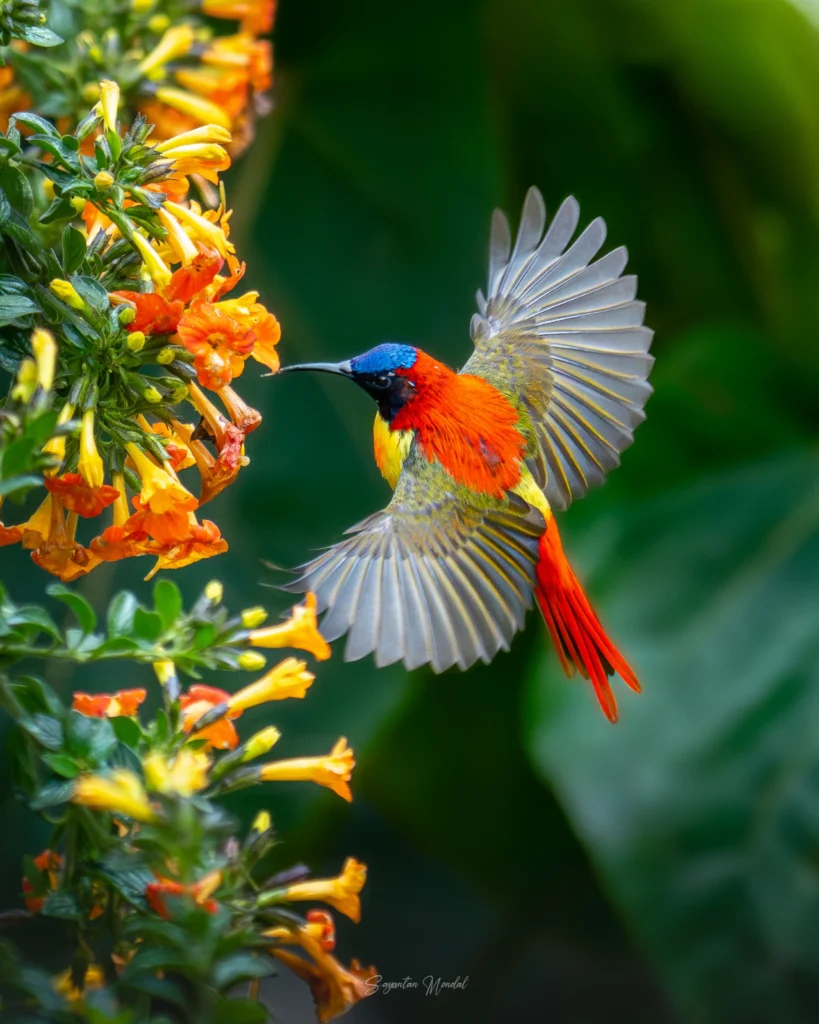
Sunbirds are among the most active and conspicuous birds found across India’s varied landscapes. For travelers, birdwatchers, and photographers, these small, nectar-feeding birds offer an excellent entry point into understanding regional ecology. They are frequently seen darting through suburban backyard patches, high-altitude hill forests, and dense tropical scrub.
Understanding how to spot and identify these birds relies on knowing their specific habitat preferences, their physical adaptations, and how they differ from similar looking birds found outside Asia.
What Are Sunbirds?
Sunbirds belong to the family Nectariniidae, a group of small Old World passerines specialized for a life built around flower nectar. They fill an ecological niche in Asia and Africa that closely mirrors that of hummingbirds in the Americas, though the two families are entirely unrelated.
The Anatomy of a Nectar Feeder
To efficiently extract nectar from deeply tubular flowers, sunbirds possess highly evolved physiological adaptations. Their most prominent feature is a decurved (downward-curving) bill, the length and curve of which vary by species to match specific floral structures. Inside the bill lies a long, slender, protractible tongue equipped with a brush-like tip, allowing the bird to collect liquid via capillary action rapidly.
Aside from their feeding instruments, sunbirds are famous for sexual dimorphism. Males typically showcase iridescent plumage that shifts color depending on the angle of sunlight, flashing deep purples, metallics, and bright crimsons. Females, by contrast, are clad in muted olives, greys, and yellows, providing vital camouflage while tending to nests.
Sunbird vs. Hummingbird: Understanding the Differences
Distinguishing between sunbirds and hummingbirds is a fundamental skill for any wildlife tracker or casual observer. While they share a similar diet and vibrant, metallic colors, their evolutionary paths, geography, and physical mechanics are completely distinct.
💡 Field Note
If you see a tiny, iridescent bird feeding on flowers in India, it is always a sunbird (or a closely related flowerpecker), never a hummingbird. Hummingbirds exist exclusively in the Americas.
The table below outlines the core functional differences between these two avian groups:
| Feature | Sunbirds (Nectariniidae) | Hummingbirds (Trochilidae) |
| Geographic Range | Old World (Asia, Africa, Australasia) | New World (North, Central, and South America) |
| Feeding Posture | Primarily perches on stems or branches while feeding; hovers only briefly. | Hovers continuously in mid-air while feeding; rarely settles on the flower. |
| Flight Mechanics | Standard passerine flight with distinct wing beats; cannot fly backward. | Specialized rotatable shoulder joints; capable of backward and upside-down flight. |
| Size | Small, but generally larger and heavier than most hummingbirds. | Includes the smallest bird species on Earth; highly lightweight frames. |
How Many Sunbird Species Live in India?
India hosts a diverse assembly of sunbird species distributed along clear geographic and altitudinal gradients. While some species have adapted to live alongside human settlements, others remain strictly bound to pristine forest environments.
The Indian Sunbird Checklist
When planning a birding itinerary across India, travelers can expect to encounter different species depending on the region’s climate and elevation. Below is the baseline checklist of primary sunbird species found within the country:
- Purple Sunbird (Cinnyris asiaticus): The most widespread species, found across nearly the entire subcontinent, from urban gardens to dry scrub forests.
- Purple-rumped Sunbird (Leptocoma zeylonica): Widespread across peninsular India, common in gardens, coastal areas, and light woodlands.
- Loten’s Sunbird (Cinnyris lotenius): A large-billed sunbird found primarily in southern India and parts of the Western Ghats.
- Crimson-backed Sunbird (Leptocoma minima): A small sunbird endemic to the moist forests of the Western Ghats.
- Olive-backed Sunbird (Cinnyris jugularis): Found predominantly in the northeast regions and parts of the Andaman and Nicobar Islands.
- Black-throated Sunbird (Aethopyga saturata): A forest specialist favoring the foothills of the Himalayas and northeast hill tracts.
- Green-tailed Sunbird (Aethopyga nipalensis): A high-altitude resident of the Himalayan moist montane forests.
- Ruby-cheeked Sunbird (Chalcoparia singalensis): A unique forest edge species localized within the eastern Himalayas and northeast India.
Profiles of Common Indian Sunbirds
For the first-time observer, starting with the most widespread species builds foundational identification skills. These three sunbirds adapt well to human-modified environments and represent the most frequent sightings for travelers and urban birdwatchers.
Purple Sunbird (Cinnyris asiaticus)
The Purple Sunbird is the most commonly encountered species across the subcontinent. The State of India’s Birds (SoIB) 2023 report indicates it has a massive distribution range of approximately 17,94,600 sq km. Due to a stable, long-term population increase, the SoIB classifies it as a species of Low Priority within India, and it holds a global status of Least Concern.
- Appearance: Breeding males display a glossy, metallic purplish-black plumage that flashes blue or green under direct sunlight. Females are heavily camouflaged, featuring olive-brown upperparts and pale yellow underparts.
- Habitat: Highly adaptable, this species thrives in urban gardens, city parks, agricultural edges, and dry scrub forests. It is a frequent and visible resident in urban centers like Delhi.
Photography Tip
To capture the true iridescence of a male Purple Sunbird, position yourself so the sun is directly behind you, illuminating the bird. In flat or overcast light, the structural colors in their feathers will simply appear dull black.
Purple-rumped Sunbird (Leptocoma zeylonica)
This is the signature garden sunbird of peninsular India. It frequently replaces the Purple Sunbird as the dominant backyard species in many southern and coastal cities.
- Appearance: Males feature a distinctive metallic green crown, a dark purple shoulder patch, and a bright yellow breast. Females are greyish-olive above with a yellow breast, easily confused with female Purple Sunbirds but typically exhibit a paler, whiter throat.
- Habitat: It prefers gardens, coastal patches, and light woodlands over dense, closed-canopy forests.
Loten’s Sunbird (Cinnyris lotenius)
Also known as the Long-billed Sunbird, this species shares much of its range with the Purple and Purple-rumped Sunbirds but generally requires slightly thicker vegetation.
- Appearance: Males are clad in metallic dark green and purple. The defining physical trait is its exceptionally long and heavily decurved bill, which allows it to access deeper flowers than its counterparts.
- Habitat: Found primarily in southern India and the lower elevations of the Western Ghats.
Regional and Forest Specialists
As you move away from cities and agricultural zones into intact wilderness, the sunbird species composition changes dramatically. Many of these species are habitat specialists, restricted to specific altitudes or forest types.
Western Ghats Endemics and Specialists
The Western Ghats harbor species that rely on the region’s high rainfall and dense evergreen canopies.
- Crimson-backed Sunbird (Leptocoma minima): This small, highly active sunbird is endemic to the moist forests of the Western Ghats. The male is recognizable by a deep crimson back and bright yellow underside, while the female is a duller olive-red.
Himalayan and Northeast India Species
The complex topography of the Himalayas and Northeast India creates distinct altitudinal zones, each hosting specific sunbird species.
- Black-throated Sunbird (Aethopyga saturata): A resident of the Himalayan foothills and the hill tracts of the northeast, this species prefers dense, humid forest environments.
- Green-tailed Sunbird (Aethopyga nipalensis): A specialist of high altitudes, this bird is a resident of Himalayan moist montane forests. It engages in altitudinal migration, dropping to slightly lower elevations to survive severe winters.
- Ruby-cheeked Sunbird (Chalcoparia singalensis): A forest edge species with a highly localized range within the eastern Himalayas and Northeast India.
- Olive-backed Sunbird (Cinnyris jugularis): While common across much of Southeast Asia, within India, this species is restricted predominantly to the northeast regions and the Andaman and Nicobar Islands.
Field Identification: Differentiating Similar Species
When trying to identify sunbirds in the field, the most common challenge is separating species with similar dark plumage or identifying dull females. Because these birds move quickly, focusing on specific anatomical markers is more reliable than trying to gauge overall color.
Purple Sunbird vs. Loten’s Sunbird
In southern and peninsular India, the breeding male Purple Sunbird and the male Loten’s Sunbird are frequently confused due to their similar dark, iridescent blue-purple plumage. You can tell them apart by looking closely at the bill size and curvature. Loten’s Sunbird has a significantly longer, more distinctly arched bill designed to probe deep tubular flowers.
| Feature | Purple Sunbird (Cinnyris asiaticus) | Loten’s Sunbird (Cinnyris lotenius) |
| Bill Length & Shape | Medium-length, moderately curved. | Exceptionally long, deeply decurved (arched). |
| Body Profile | Relatively compact and stocky. | Slender with a more elongated profile. |
| Eclipse Plumage | Non-breeding male sheds iridescent feathers for a drab look with a dark central chest stripe. | Retains a more consistent dark appearance or displays intermediate patchy iridescence. |
| Primary Range | Pan-India distribution. | Restricted mostly to Southern India and the Western Ghats. |
Identifying Male vs. Female Sunbirds
Sunbirds display high sexual dimorphism, meaning males and females look completely different.
- Adult Males (Breeding): Visually striking with intense metallic or iridescent colors, varying from deep purples to vibrant crimsons depending on the species.
- Adult Females: Uniformly drab, generally showing olive-green, grey, or pale yellow underparts to maximize camouflage during nesting.
- Non-Breeding Males (Eclipse Plumage): During the non-breeding season, males of certain species like the Purple Sunbird moult into an “eclipse” plumage. They closely resemble females but can be identified by a dark blue-black vertical stripe running down the center of their throat and breast.
💡 Quick Field Tips for Beginners
- Don’t chase the color: Structural colors shift depending on the light angle. Look at the bill shape first.
- Check the underparts: If you spot a yellow-bellied sunbird in a southern garden, check the breast. A purple breast band indicates a male Purple-rumped Sunbird; a completely pale yellow underside with olive upperparts suggests a female.
- Listen for calls: Sunbirds are highly vocal, often making sharp, repetitive chittering calls while foraging, which helps locate them before you see them.
Where to Watch Sunbirds in India
To find sunbirds reliably, look for flowering vegetation, edge habitats, and areas where forests give way to open spaces. You do not always need to travel to remote wilderness areas, as several species are well-adapted to human landscapes.
Urban Gardens and City Parks
Urban environments are excellent for observing common species because landscaping often includes flowering ornamental plants that provide a steady food supply.
- Delhi and Northern India: Public parks and domestic gardens in Delhi offer reliable year-round viewings of the Purple Sunbird. They are commonly seen feeding on ornamental hedges and flowering avenue trees.
- Southern Cities (e.g., Bengaluru, Chennai): City parks and suburban backyards here are dominated by the Purple-rumped Sunbird, often nesting right outside house verandahs.
Forest Reserves and Wildlife Hotspots
For forest specialists and endemic species, you will need to target specific geographical zones.
- The Western Ghats: National parks and plantations within the Western Ghats are the prime location for the Crimson-backed Sunbird. Look along forest edges and inside coffee or cardamom estates where native trees are preserved.
- Himalayan Foothills and Northeast India: Visiting hill stations or reserves in these regions reveals altitudinal migrants like the Green-tailed Sunbird and Black-throated Sunbird. The best months to visit are during the spring flowering season when birds are most active in the lower valleys.
Diet, Nesting, and Breeding Behavior
Sunbirds are highly active and require constant energy to fuel their fast-paced metabolism. While nectar provides their primary source of energy, their complete diet and breeding behaviors reveal a much more complex natural history.
Foraging Strategies and Insect Diet
A common misconception is that sunbirds feed exclusively on nectar. In reality, they are not strict nectarivores; they actively hunt insects and spiders to supplement their diet. This insect protein is especially critical during the breeding season, as chicks require substantial protein for rapid development rather than just sugar.
When foraging, sunbirds mostly perch on stems or branches to feed, though they are capable of hovering briefly to access awkwardly positioned flowers. Because nectar is a high-value resource, sunbirds are fiercely territorial. Males will aggressively defend a heavily flowering tree or shrub, routinely chasing away rival sunbirds and even larger species to protect their food supply.
Unique Hanging Nests
Sunbird nests are recognizable architectural structures in both forests and city gardens. They construct intricate, pouch-like hanging nests, often suspended from the thin, drooping branches of trees or large shrubs. This placement is a deliberate defense strategy, making it difficult for heavier predators like snakes or rodents to access the eggs.
The nest-building process is entirely female-led. She uses plant fibers, grass, bark, and cobwebs to weave a teardrop-shaped structure, typically featuring a side entrance that acts as a protective shield against rain and harsh sunlight.
🌿 Responsible Tourism Tip
If you discover a sunbird nest in your garden or while on safari, maintain a respectful distance. Because females invest significant energy into building the nest and raising the clutch, hovering too close for photographs can cause her to abandon the site entirely.
Ecological Role: Sunbirds and Pollination
Beyond their visual appeal, sunbirds provide a vital ecological service across India’s forests, scrublands, and urban edges. They are crucial pollinators for a wide variety of native plants.
Key Native Plants Supported by Sunbirds
The relationship between sunbirds and native flora is entirely mutualistic. As a sunbird probes deep into a flower for nectar, its forehead, chin, or bill invariably brushes against the plant’s pollen-bearing structures. When the bird moves to the next flower, it transfers this pollen, enabling the plant to reproduce.
The Purple Sunbird is specifically documented as a critical pollinator for several widespread Indian plant species.
Documented Botanical Interactions While sunbirds will visit many flowering plants, they have a documented ecological relationship with several specific native species.
| Plant Species | Habitat Type | Ecological Role |
| Butea monosperma (Flame of the Forest) | Dry deciduous forests and open plains | A major nectar source during the dry season; heavily relies on birds for cross-pollination. |
| Dendrophthoe (Mistletoe) | Parasitic on host trees in woodlands and gardens | Sunbirds are primary pollinators for this widespread genus of parasitic plants. |
| Woodfordia | Dry scrub and hill slopes | Provides crucial nectar in arid and semi-arid environments. |
| Acacia | Dry woodlands and savannahs | Serves as both a nectar source and a highly secure, thorny environment for nesting. |
Planting native, tubular-flowering species rather than exotic ornamentals is the most effective way to support local sunbird populations and encourage their natural pollination behaviors in urban areas.
Conservation Status and Environmental Threats
State of India’s Birds (SoIB) Findings
According to the State of India’s Birds (SoIB) 2023 report, fruit- and nectar-consuming birds, including many sunbird species, are currently flourishing compared to several rapidly declining bird groups in India. The data, compiled from roughly 30 million records contributed by citizen scientists and fauna enthusiasts, shows that adaptable species like the Purple Sunbird are experiencing a long-term increase in their populations.
State of India’s Birds (SoIB) 2023 Assessment
- Priority Status: Listed as Low Priority in SoIB 2023, with a long-term population increase.
- Legal Protection: Classified as Least Concern globally and protected under Schedule II of the Wildlife (Protection) Act in India.
- Distribution Footprint: Purple Sunbird’s national range size spans approximately 17,94,600 sq km.
Pressures on Forest Specialists
While common garden sunbirds are thriving, the broader environmental pressures affecting Indian wildlife still pose significant risks to habitat specialists. Forest-dependent sunbirds, such as the Crimson-backed Sunbird of the Western Ghats and the Black-throated Sunbird of the Himalayan foothills, face localized threats. Habitat degradation, expanding urbanization, climate change, and the replacement of native, diverse forests with monoculture plantations all reduce the availability of the specific floral and insect resources these birds require to survive.
Common Mistakes in Sunbird Identification
Even experienced birders can stumble when trying to identify fast-moving sunbirds. Avoiding these frequent errors will immediately improve your field accuracy:
- Assuming it is a hummingbird: Hummingbirds do not exist in India. Any small, hovering, iridescent nectar-feeder you see in the country is likely a sunbird (or a closely related flowerpecker).
- Relying solely on color: Iridescent feathers change color based on light angles. A Purple Sunbird can look completely flat black on an overcast day or in deep forest shade. Always look at the physical shape first.
- Confusing eclipse males with females: Non-breeding (eclipse) male Purple Sunbirds look very similar to the dull olive-yellow females. You can distinguish them by looking for the dark vertical stripe running down the center of the eclipse male’s throat and chest.
- Ignoring the bill profile: The most reliable way to separate a Purple Sunbird from a Loten’s Sunbird in southern India is the bill length and curvature—Loten’s is significantly longer and much more heavily arched.
Frequently Asked Questions (FAQs)
What is a sunbird? A sunbird is a small, nectar-feeding bird belonging to the Old World family Nectariniidae, characterized by a decurved bill, a brush-tipped tongue, and often highly iridescent plumage in males.
How many sunbird species are found in India? India is home to multiple sunbird species, though the exact number you encounter depends entirely on the region and altitude.
Which sunbird is most common in Indian cities? The Purple Sunbird is the most widespread in northern and central Indian cities like Delhi, while the Purple-rumped Sunbird is more frequently seen in southern and coastal urban gardens.
What is the difference between a sunbird and a hummingbird? They are unrelated bird families. Sunbirds are found in Africa and Asia, usually perch on branches to feed, and have standard passerine flight. Hummingbirds are restricted entirely to the Americas, hover continuously while feeding, and possess joints that allow them to fly backward.
Are sunbirds found all over India? Yes, but species distribution varies significantly. Purple Sunbirds are found almost pan-India, whereas species like the Crimson-backed Sunbird are restricted exclusively to the Western Ghats.
Which habitats do sunbirds prefer? Habitat preference depends on the species. Many adapt well to urban gardens, city parks, and dry scrub, while others are strictly dependent on dense, high-altitude, or moist forest environments.
What do sunbirds feed on besides nectar? Sunbirds actively hunt small insects and spiders, which provide essential protein, especially during the breeding season when they are feeding developing chicks.
Are sunbirds important pollinators? Yes, they are vital pollinators for many native Indian plants, including Butea monosperma (Flame of the Forest), Acacia, Woodfordia, and various Dendrophthoe mistletoes.
Do sunbirds make good garden birds to attract? Yes. Planting native, tubular-flowering shrubs and trees is a highly effective and natural way to support local populations and attract them to domestic gardens.
How can I identify a Purple Sunbird? Look for a medium-length curved bill. Breeding males are glossy purplish-black, while females are olive-brown above and pale yellow below.
How can I identify a Loten’s Sunbird? It looks very similar to the male Purple Sunbird but features a noticeably longer, deeply arched bill and a slightly more slender overall body profile.
How can I identify a Purple-rumped Sunbird? Males have a distinct metallic green crown, a dark purple shoulder patch, and a bright yellow breast. Females are olive above with a yellow breast, typically showing a pale whitish throat.
Which Indian sunbirds are forest-dependent? Species such as the Black-throated Sunbird, Green-tailed Sunbird, and Ruby-cheeked Sunbird rely heavily on intact forest ecosystems and edges.
Are any Indian sunbirds endemic? Yes, the Crimson-backed Sunbird is endemic to the moist forests of the Western Ghats.
Are sunbirds listed as threatened by the IUCN? The most commonly encountered Indian species, such as the Purple Sunbird, are listed as Least Concern globally by the IUCN.
Are sunbirds protected under Indian law? Yes, sunbirds are protected under Schedule II of India’s Wildlife (Protection) Act.
When do sunbirds breed in India? Breeding seasons vary regionally but often peak just before or during the spring and summer months when both insect populations and floral resources are at their highest.
What do sunbird nests look like? They build intricate, hanging, pouch-like or teardrop-shaped nests with a side entrance. These are constructed by the female using plant fibers, grass, and cobwebs.
What flowers attract sunbirds? They prefer native tubular flowers, including those of the Butea, Acacia, and Woodfordia genera, though they will readily feed from many common garden ornamentals.
What are the best places to watch sunbirds in India? Urban parks in Delhi or Bengaluru provide excellent viewing for common species, while wildlife reserves in the Western Ghats and Himalayan foothills are the best locations for observing forest specialists.
Conclusion
Observing sunbirds offers a highly accessible way to connect with India’s wildlife, whether you are on a dedicated birding safari in the high-altitude Northeast or simply watching a flowering bush from a city balcony in Delhi. By learning to look past their bright colors and focusing instead on bill shape, habitat context, and behavior, you can quickly master the identification of these energetic pollinators. While adaptable species like the Purple Sunbird are currently thriving in human-modified landscapes, prioritizing the protection of native flowering plants and intact forest ecosystems remains critical to ensuring the long-term survival of India’s specialized, forest-dependent nectar-feeders.
Author Note & Update Log: Written by the WildlifeSafaris.in Editorial Team. Last Updated: August 2026