Plan your India wildlife photography trip with our 2026 guide. Compare top tiger parks, learn about new smartphone bans, and discover the best camera gear.
Choosing the right national park for wildlife photography in India depends entirely on what you want to shoot and how much visibility you need. India currently has 107 national parks, but they are not created equal when it comes to photographic opportunities.
Madhya Pradesh is widely considered the country’s best region for tiger photography. It holds the title of India’s “Tiger State” with a population of 785 tigers, while the broader Central India Tiger Landscape supports roughly 1,000 tigers, making up about a third of the national total.
If you are planning a trip in 2026, the logistics of a safari have fundamentally changed. Central Indian parks have recently implemented a strict smartphone ban during safaris, meaning you must rely entirely on dedicated camera equipment. Additionally, manual permit booking has been entirely replaced by mandatory online systems as of 2025.
This guide breaks down exactly where to go, when to visit, and how to plan a wildlife photography trip that yields strong results.
The Top 3 Parks for Tiger Photography in India
Bandhavgarh National Park: India’s Highest Tiger Density
Bandhavgarh is the best choice if your primary goal is to capture Bengal tigers on camera. It holds the highest tiger density of any protected area in India, making it highly reliable for sightings. The park currently has an estimated population of 135 tigers.
- Best Zone: The Tala zone is the premier area for tiger spotting and offers excellent landscape features.
- Landscape: The terrain features a mix of Sal forests, open meadows, and rocky hills.
- Best Season: March to May provides the most consistent photography conditions.
Photography Tip: Look for opportunities to frame tigers against Bandhavgarh’s rocky terrain and ancient fort ruins. The high density of predators here makes it easier to capture dramatic action shots compared to thicker jungles.
Ranthambore National Park: Best Visibility for Tiger Photography
Ranthambore is the most practical option for photographers who prefer clear, unobstructed views of wildlife. Its dry deciduous forests, open grasslands, and rocky ridges mean you spend less time fighting dense foliage to get a clean shot.
- Best Zones: The areas around Padam Talao and Rajbagh lakes consistently produce excellent sightings.
- Landscape: Dry terrain mixed with striking medieval fort ruins.
- Best Season: April to June is when the vegetation thins out and animals frequent the water holes.
Photography Tip: Ranthambore is the only park where you can photograph tigers with medieval fort walls as a backdrop. Position your vehicle near the lakes to capture subjects moving against these historic ruins.
Kanha National Park: Most Scenic Tiger Landscape
Kanha is the top recommendation if you want to capture tigers in a classic, visually striking jungle environment. Often referred to as the “Queen of Central India,” this park offers vast, open meadows interspersed with dense patches of Sal forest.
- Best Zone: The Mukki zone is highly recommended for its misty atmospheric conditions.
- Landscape: Expansive grassy meadows and towering Sal trees.
- Best Season: March to May.
Photography Tip: Book early morning safaris in the Mukki zone to shoot tigers emerging through the morning mist. Once the grass thins out in April, Kanha’s open meadows are also the best place to photograph the rare, endemic Barasingha (swamp deer).
Which Tiger Park is Best for Your Photography Goals?
Every major tiger park has a distinct aesthetic and presents different photographic conditions. To help you choose the right destination, here is a breakdown of how the top parks compare.
Top Tiger Parks Comparison
| Park | Tiger Density | Visibility | Best Season | Landscape Feature |
| Bandhavgarh | Highest in India | Moderate (dense Sal) | Mar–May | Sal forest, hills, meadows |
| Ranthambore | High | Excellent (open terrain) | Apr–Jun | Dry deciduous, grasslands, rocky hills |
| Kanha | High | Moderate-High (open meadows) | Mar–May | Sal forest, vast meadows |
| Tadoba | High | Moderate | Mar–Jun | Mixed forest, reflection lakes |
| Panna | Medium (90 tigers) | High | Mar–Jun | Rocky cliffs, Ken River gorges |
Decision Guide: Choosing Your Park
- For professional photographers seeking high density: Bandhavgarh is the definitive choice. Its high concentration of tigers makes it the most reliable for frequent sightings.
- For photographers prioritizing clear visibility: Ranthambore is unparalleled. The dry deciduous forests and open terrain mean your shots are less likely to be obscured by thick foliage.
- For those seeking scenic, atmospheric landscapes: Kanha provides the classic “Jungle Book” aesthetic. The vast meadows and towering Sal trees offer stunning backdrops, even though visibility can be challenging in the denser patches of forest.
- For families and diverse wildlife: Pench is highly recommended for its family-friendly safari infrastructure and strong literary connection to The Jungle Book.
Best National Parks for Non-Tiger Wildlife Photography
While tigers dominate the Indian safari circuit, the country offers specialized destinations for photographers focused on specific, highly sought-after species.
Kaziranga National Park: One-Horned Rhino Photography
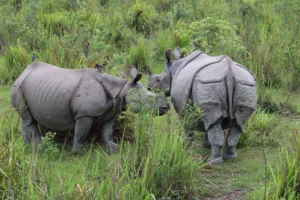
Kaziranga is a UNESCO World Heritage Site and the premier destination globally for photographing the greater one-horned rhinoceros.
- Why It Matters: The park holds roughly two-thirds of the world’s population of one-horned rhinos, with a confirmed 2,613 individuals as of 2022.
- Photography Strategy: Elephant back safaris are highly effective here, allowing you to get closer to the rhinos for intimate, low-angle portraits. Alternatively, book a jeep safari to capture wide-angle shots of rhinos standing in the tall elephant grass.
- Best Timing: March and April offer excellent grassland visibility. Early mornings are essential if you want to capture rhinos moving through atmospheric mist.
- Other Subjects: You will also find large herds of wild water buffalo (the largest population in the world at 1,666 individuals) and migratory wetland birds.
Important Note: Kaziranga closes completely from July to September due to severe monsoon waterlogging.
Hemis National Park: Snow Leopard Photography in Ladakh
Hemis requires dedication, physical endurance, and specialized gear, but it is the undisputed snow leopard capital of the world.
- Why It Matters: As India’s largest national park, it protects over 200 snow leopards—the most significant number in any protected area.
- Photography Strategy: You will be tracking on foot across high-altitude terrain. A long telephoto lens and extreme weather protection for your gear are mandatory.
- Best Timing: December to March is the peak season. During these harsh winter months, snow leopards descend to lower altitudes in search of prey, significantly increasing your chances of spotting them.
- Other Subjects: The stark, snow-covered landscape serves as a dramatic backdrop for photographing Ladakhi Urial, blue sheep, and Tibetan wolves.
Keoladeo (Bharatpur): Best Bird Photography in India
Formerly known as the Bharatpur Bird Sanctuary, Keoladeo National Park is a UNESCO World Heritage Site that functions as an essential destination for bird photographers.
- Why It Matters: The park records over 370 bird species, including a massive influx of migratory waders and waterfowl from Siberia and Central Asia.
- Photography Strategy: A 400mm to 600mm telephoto lens is a standard requirement here for detailed portraits and capturing birds in flight. Because it is a wetland, you can explore on foot or by cycle rickshaw or boat, giving you more time to wait for the perfect shot compared to a timed jeep safari.
- Best Timing: November to February is the absolute peak season when the migratory populations are at their highest.
- Logistics: Located just four hours from Delhi, Keoladeo is one of the most accessible parks in the country and an easy addition to a short wildlife trip.
Other Notable Parks for Wildlife Photography
Beyond the primary tiger reserves and specialized species parks, several other protected areas offer distinct photographic opportunities based on terrain, historical backdrop, and species recovery programs.
Panna National Park: Emerging Tiger Hotspot
Panna is located in Madhya Pradesh and has become a major success story after its tiger reintroduction program brought the population up to 90 tigers (including 64 adults and sub-adults).
- Best Zone: The Madla zone near Khajuraho is the most popular entry point and offers the highest chance of spotting tigers and leopards.
- Landscape: Characterized by dry deciduous forests, rocky escarpments, and gorges along the Ken River.
- Photography Conditions: The open, rocky terrain allows for clean backgrounds and dramatic elevation in your shots. Summer temperatures regularly cross 40°C, but March through June provides the best predator tracking conditions around the remaining river pools.
Tadoba-Andhari Tiger Reserve: Reflection Shots and High Sighting Rates
Located in Maharashtra, Tadoba-Andhari protects approximately 97 tigers and has built a reputation for consistent big cat sightings.
- Landscape: A mix of dry teak forests, bamboo thickets, and expansive lakes.
- Photography Conditions: Tadoba’s prominent water bodies make it the premier park in India for capturing tiger reflection shots. As summer progresses into May and June, receding water levels concentrate wildlife around the primary lakes, offering clear sightlines.
Jim Corbett National Park: India’s Oldest Park with Himalayan Backdrops
Established in 1936, Jim Corbett National Park in Uttarakhand holds the highest total tiger population of any single reserve in India, with 260 individuals.
- Landscape: Positioned in the Himalayan foothills, the park combines dense Sal forests, wide pebble riverbeds, and the expansive Ramganga River.
- Photography Conditions: Thick jungle foliage means general visibility can be lower than in Central Indian parks, but the scenic depth is substantial. The Dhikala zone is particularly notable for riverbed landscapes, wild elephant herds, gharials, and raptors.
Gir National Park: The Only Asiatic Lion Location
Gir National Park in Gujarat is the only place in the world where you can photograph the Asiatic lion in the wild.
- Why It Matters: The 2025 census recorded 891 Asiatic lions in Gujarat—a 32% increase from 674 in 2020.
- Photography Conditions: The dry, open teak forests create a warm, golden backdrop that matches the lions’ coats. For controlled, close-up portraits, the Devalia Safari Park buffer area provides reliable photo opportunities. Gir also supports over 300 bird species and marsh crocodiles along its rivers.
Pench National Park: Family-Friendly Photography with Jungle Book Connections
Straddling Madhya Pradesh and Maharashtra, Pench provided the landscape inspiration for Rudyard Kipling’s The Jungle Book.
- Landscape: Open canopy teak forests and undulating terrain crisscrossed by seasonal streams.
- Photography Conditions: The open forest floor makes it relatively easy to track animals through the trees compared to denser parks. It is well-suited for beginners and families seeking clear views of tigers, leopards, and wild dogs (dholes).
Best Time to Visit Indian National Parks for Photography
Most Indian national parks open in October and close by late June, remaining shut from July through September due to the monsoon season. The ideal month to travel depends entirely on the species and conditions you wish to capture.
October to December: Post-Monsoon Greenery
- Conditions: The forest is dense, vibrant green, and dust-free following the monsoon rains.
- Best For: Wide-angle landscape compositions, active animal movement, and scenic environmental portraits.
- Trade-off: Thick vegetation makes tracking tigers more difficult, as animals do not need to congregate around specific water sources.
January to February: Winter and Peak Birding
- Conditions: Cool temperatures bring morning mist over water bodies and river valleys.
- Best For: Bird photography (especially migratory waders and waterfowl at Keoladeo and Corbett) and atmospheric morning landscape shots.
- Trade-off: Heavy morning fog can reduce visibility during the first hour of a drive.
March to June: Dry Season and Big Cat Sightings
- Conditions: Rising temperatures cause grasses to dry out and leaf cover to drop significantly.
- Best For: Big cat photography. With small waterholes drying up, tigers, lions, and leopards regularly visit the remaining permanent water bodies.
- Trade-off: Temperatures frequently exceed 40°C in May and June, requiring proper hydration and equipment protection against heat and fine dust.
Best Time to Visit by Wildlife Type
| Wildlife Subject | Optimal Months | Peak Window | Primary Reason |
| Bengal Tigers | March to June | April to June | Thinning foliage; animals congregate at permanent waterholes |
| Asiatic Lions | November to March | December to February | Moderate temperatures; lions active in open teak scrub |
| One-Horned Rhinos | November to April | March to April | Shortened, dry grassland improves sightlines |
| Snow Leopards | December to March | January to February | Predators descend to lower valley altitudes following prey |
| Migratory Birds | November to February | December to January | Peak population of wintering species across northern and central wetlands |
Practical Guide: Safari Permits, Fees, and Photography Rules
Securing safari slots and staying compliant with forest department regulations requires careful preparation, as rules have tightened across several states.
+————————————————————————————+
| SAFARI CHECKLIST |
+————————————————————————————+
| [ ] Book permits online 60-90 days in advance (peak season) |
| [ ] Pack dedicated cameras (DSLR / mirrorless) – phones prohibited in Central MP |
| [ ] Carry original ID matching permit details |
| [ ] Prepare cash for camera fees at entry gate (INR 100 – INR 500) |
| [ ] Ensure flash and drone gear are left behind at lodge |
+————————————————————————————+
Mandatory Online Booking Requirements
- All national park safari permits must be booked through official state forest department portals.
- For peak season travel between March and May, reserve permits 60 to 90 days in advance.
- High-demand zones such as Dhikala in Corbett or Tala in Bandhavgarh fill up almost immediately once booking windows open.
- Official state portals include the Madhya Pradesh Forest Department portal for central reserves and girlion.gujarat.gov.in for Gir National Park.
Camera Fees and Permit Costs
- Camera Fees: Dedicated DSLR and mirrorless cameras attract a standard daily entry fee between ₹100 and ₹500 depending on the reserve. In Gir, camera fees are set at ₹200 per unit.
- Vehicle Permits: Standard jeep permit costs vary widely by state. A full vehicle permit at Gir costs ₹7,440 on weekdays and ₹9,300 on weekends for up to six visitors, with guide and vehicle fees paid separately on-site.
The 2026 Smartphone Ban in Central India
- National parks across Central India (primarily in Madhya Pradesh) enforce a strict ban on smartphone use during game drives.
- Mobile phones must be powered off or placed in airplane mode and stored inside bags or vehicle storage compartments throughout the drive.
- Mobile photography and videography are strictly prohibited inside the parks.
- Only dedicated photographic equipment—such as DSLRs, mirrorless cameras, and compact point-and-shoot cameras—is permitted for taking photographs.
General Safari Ethics and Restrictions
- No Flash Photography: Flash is strictly prohibited in all national parks to avoid disorienting wildlife.
- No Drones: Unmanned aerial vehicles (drones) are completely banned across all Indian protected areas without high-level central government permits.
- Tripod Restrictions: Tripods are generally not permitted inside standard safari jeeps due to space constraints; beanbags or monopods are the practical alternative.
- Special Border Permits: Parks located near international borders (such as border zones in the northeast or Ladakh) require an Inner Line Permit (ILP) for Indian citizens or a Restricted Area Permit (RAP) for foreign passport holders.
Photography Equipment Recommendations
Choosing the right focal length prevents unnecessary lens changes in dusty safari vehicles.
+————————————————————————————+
| RECOMMENDED FOCAL LENGTHS |
+————————————————————————————+
| Wide Habitat / Landscapes | [====] 16-35mm |
| Rhinos (Elephant Safari) | [========] 200-300mm |
| Tigers & Lions | [============] 300-400mm |
| Birds & Distant Wildlife | [==================] 400-600mm |
+————————————————————————————+
Lens Selection by Species
- Bengal Tigers & Asiatic Lions (300mm–400mm): A 100–400mm or 300mm telephoto provides the ideal balance between framing full-body environmental portraits and isolating subjects across waterholes at safe distances.
- One-Horned Rhinos (200mm–300mm): Because elephant back safaris in Kaziranga allow closer approaches, a 70–200mm or 100–300mm lens is well-suited for low-angle portraits.
- Bird Photography (400mm–600mm): Keoladeo and Corbett require longer focal lengths to resolve plumage detail on distant waders and capture raptors in flight.
- Landscapes & Forest Scenes (16mm–35mm): A wide zoom is essential for capturing misty morning horizons over Kanha’s meadows or the riverbeds of Jim Corbett.
Lighting and Composition Strategies
- Shoot During Golden Hours: Animal movement peaks during the first two hours after sunrise (6:00 AM to 9:00 AM) and the last two hours before sunset (4:00 PM to 6:00 PM).
- Shutter Speed Baseline: Keep shutter speeds between 1/500s for resting animals and 1/2000s or faster for big cats on the move or birds taking flight.
- RAW Capture: Always shoot in RAW format to retain shadow detail under dense Sal tree canopies and recover highlights on reflective water bodies.
- Dust Protection: Keep a protective cover over your gear when driving along dry forest tracks, especially during summer months.
Common Mistakes to Avoid
- Relying on Mobile Phones: Assuming you can snap quick backup photos on a smartphone will lead to confiscation or fines in Central Indian parks where mobile photography is banned.
- Choosing the Wrong Season for Your Target: Visiting dense parks like Corbett in November expecting easy tiger sightings often leads to disappointment; November is optimal for scenery and birds, while March to June is the primary window for big cats.
- Assuming High Density Guarantees Immediate Sightings: While Bandhavgarh has the highest density, animal movement is dynamic; book at least 4 to 6 safaris across multiple zones to maximize photographic success.
- Overlooking Non-Core or Buffer Zones: Many buffer zones feature active waterholes and lighter vehicle traffic, often providing cleaner backgrounds than crowded core routes.
Frequently Asked Questions
1. Which is the best national park in India for wildlife photography?
Bandhavgarh is best for tiger density, Ranthambore for clear visibility, Kaziranga for one-horned rhinos, Gir for Asiatic lions, and Keoladeo for bird species.
2. What is the best month to visit national parks for wildlife photography?
March to May is the most productive period for big cats due to thinning vegetation and waterhole activity, while November to February is best for migratory birds.
3. Which park has the highest tiger density in India?
Bandhavgarh National Park in Madhya Pradesh holds the highest tiger density among protected areas in India, with an estimated 135 tigers.
4. Is Bandhavgarh better than Ranthambore for tiger photography?
Bandhavgarh offers higher tiger density, while Ranthambore provides better visibility due to open, dry terrain and historic fort backdrops.
5. How much does a safari cost at Bandhavgarh National Park?
Standard safari permits range from ₹1,000 to ₹3,000 for permit booking, with total vehicle and guide charges bringing standard drives to ₹6,000–₹10,000 per safari.
6. What is the photography fee at Indian national parks?
Standard camera fees for professional DSLR/mirrorless equipment range from ₹100 to ₹500 per entry depending on the park.
7. Can I book safari permits online for Indian national parks?
Yes, online booking is mandatory across state forest department platforms.
8. Is Kaziranga National Park good for wildlife photography?
Kaziranga is the top park globally for photographing greater one-horned rhinos, wild water buffalo, and wetland birds.
9. Which park is best for rhino photography in India?
Kaziranga National Park in Assam protects two-thirds of the world’s one-horned rhino population (2,613 individuals).
10. What is the best time to visit Kaziranga for photography?
November to April is the open season, with March and April offering the best visibility after grass burning and dry weather.
11. Where can I photograph snow leopards in India?
Hemis National Park in Ladakh is the premier location, housing over 200 snow leopards.
12. Is Hemis National Park open for snow leopard photography in winter?
Yes, winter (December to March) is the primary tracking season because snow leopards descend to lower valley altitudes.
13. Which national park is best for bird photography in India?
Keoladeo National Park (Bharatpur) in Rajasthan is the premier bird sanctuary, with over 370 recorded species.
14. Is Keoladeo (Bharatpur) good for bird photography?
It is one of Asia’s top birding sites, particularly between November and February when winter migrants arrive from Siberia and Central Asia.
15. What lens do I need for wildlife photography in Indian national parks?
A 100–400mm or 300mm lens is standard for large mammals, while a 400mm–600mm lens is recommended for birds.
16. Are smartphones allowed during wildlife safaris in India?
In Central Indian reserves (such as Madhya Pradesh), smartphones must be switched off or placed in airplane mode; mobile photography is banned during safaris.
17. Which park offers elephant safari for photography in India?
Kaziranga and Jim Corbett offer elephant safaris for photography and wildlife tracking.
18. Is Panna National Park good for tiger photography?
Panna is an emerging hotspot with 90 tigers and open, rocky gorge landscapes that provide clean photo backdrops.
19. How many tigers are in Madhya Pradesh national parks?
Madhya Pradesh holds 785 tigers, making it the leading “Tiger State” in India.
20. Can I use flash photography at Indian national parks?
No, flash photography is strictly banned in all Indian national parks to protect wildlife.
Conclusion
Planning a productive wildlife photography trip to India requires matching your target subject to the correct habitat, season, and park rules. If Bengal tigers are your primary focus, choose Bandhavgarh for density, Ranthambore for clear visibility, or Kanha for classic meadow scenery. For specialized species, head to Kaziranga for rhinos, Gir for Asiatic lions, Hemis for snow leopards, or Keoladeo for winter bird migrations.
Book permits well in advance, pack dedicated camera bodies to comply with current safari regulations, and focus your drives around early morning and late afternoon light for the best field results.