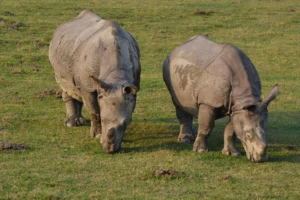
Discover how Kaziranga grew from 600 rhinos to 2,613, built the world’s 3rd highest tiger density, and established a frontline conservation model.
Why Kaziranga Is Regarded as a Benchmark in Wildlife Conservation
Kaziranga National Park represents one of the most effective habitat recovery programs in modern wildlife history. Located along the floodplains of the Brahmaputra River across Assam’s Golaghat, Nagaon, and Sonitpur districts, the park transitioned from a heavily depleted hunting ground into a stronghold for endangered megafauna.
+————————————————————————-+
| KAZIRANGA AT A GLANCE |
| |
| [ 2,613 Rhinos ] [ 148 Tigers ] [ 122 Patrol |
| 70% of global total 18.65 / 100 sq km Camps ] |
| (2022 Census) (3rd Highest Globally) (Incl. 2 Floating)|
+————————————————————————-+
Understanding this success requires examining the structural interventions behind the numbers. The park did not recover through passive protection alone. It required continuous legislative updates, physical expansion of protected boundaries, an armed and well-equipped frontline staff, and targeted species reintroduction programs.
The Numbers Behind the Turnaround
The recovery of the greater one-horned rhinoceros (Rhinoceros unicornis) is Kaziranga’s most cited metric:
- Global Rhino Stronghold: Kaziranga shelters 2,613 rhinos (2022 census), which constitutes roughly 70% of the estimated 4,000 greater one-horned rhinos surviving globally.
- State-Wide Core: Across Assam, the total rhino count stands at 4,014 (2024 data). Kaziranga houses approximately 65% of the state’s entire rhino population.
- High-Density Predator Habitat: Beyond herbivores, the park supports 148 Royal Bengal tigers (2024 census), maintaining a density of 18.65 tigers per 100 square kilometres—the third highest recorded globally.
Global One-Horned Rhino Distribution (~4,000 Total)
┌───────────────────────────────────────────────┬───────────┐
│ Kaziranga National Park (2,613) │ 70% │
├───────────────────────────────────────────────┼───────────┤
│ Rest of Assam & India │ 15% │
├───────────────────────────────────────────────┼───────────┤
│ Nepal Protected Areas │ 15% │
└───────────────────────────────────────────────┴───────────┘
Legal Milestones: From Forest Reserve to UNESCO World Heritage Site
The formal protection of Kaziranga began after Mary Curzon, wife of the Viceroy of India, visited the area in 1904 and failed to see a single rhinoceros. Her concerns led to formal administrative action:
- 1905: The Kaziranga Proposed Reserve Forest was established with an initial area of 232 square kilometres.
- 1916: The reserve was reclassified as a Game Sanctuary to curb unregulated hunting.
- 1950: The area was formally renamed the Kaziranga Wildlife Sanctuary by the state forest department.
- 1968 & 1974: Following the passage of the Assam National Park Act of 1968, the sanctuary was officially gazetted as a National Park in 1974, covering a core area of 430 square kilometres.
- 1985: UNESCO designated Kaziranga a World Heritage Site under natural criteria, recognising its intact alluvial grasslands and viable populations of threatened mammals.
- 2006: The park received formal status as a Tiger Reserve, establishing administrative and financial mechanisms to secure the predator-prey balance of the floodplain.
From Near-Extinction to 2,613: The Rhino Recovery Timeline
RHINO POPULATION TRAJECTORY (1960s–2022)
3,000 ┼ ● 2,613 (2022)
│ ● 2,413
2,000 ┼ ● 1,500 (2018)
│ (1980s)
1,000 ┼
│ ● 600
0 ┼───(1960s)──────────────────────────────────────────────────────
The recovery of Kaziranga’s rhino population is a long-term operational success achieved over six decades of strict ground enforcement.
The 1960s Crisis: When Only 600 Rhinos Remained
By the mid-1960s, hunting pressure, habitat loss from agricultural encroachment, and early poaching syndicates reduced Kaziranga’s rhinos to roughly 600 individuals. Flooding forced wildlife onto the higher elevations of the neighbouring Karbi Anglong hills, where animals were easily ambushed outside protected boundaries. The population was ecologically vulnerable to localized disease outbreaks and poaching surges.
Steady Growth: The 1980s Through the 2018 Census
Through the 1970s and 1980s, the Assam Forest Department expanded anti-poaching infrastructure. Staff were deployed directly into interior beat camps rather than operating solely from peripheral range offices.
- 1980s Census: The population climbed to 1,500 individuals, representing a 150% increase from the 1960s baseline.
- 2018 Census: A dedicated two-day census recorded 2,413 rhinos, marking a 302% increase.
This consistent growth proved that the grassland habitat had the ecological carrying capacity to support higher herbivore densities, provided direct human mortality was controlled.
The 2022 Census and Reaching Zero Rhino Poaching in 2025
The comprehensive census conducted in March 2022 recorded 2,613 rhinos, confirming a 335% total increase over the 1960s population.
Rhino Population Distribution (2022 Census Breakdown)
├── Adults: 1,823
├── Sub-adults: 365
└── Calves & Juveniles: 425
Total Count: 2,613 Rhinos
In 2025, Kaziranga recorded zero incidents of rhino poaching across the calendar year. This milestone resulted from a multi-agency security network combining armed forest personnel, intelligence sharing, drone surveillance, and joint operations with local police along transit corridors.
+————————————————————————-+
| FIELD NOTE: Grassland Visibility and Seasonal Rhino Movement |
| |
| Rhinos rely on the tall elephant grass (Saccharum elephantinus) for |
| cover and feeding during the monsoon and early winter. Following the |
| controlled burning carried out by forest staff between January and |
| February, visibility in the Central (Kohora) and Western (Bagori) |
| sectors improves significantly as fresh shoots attract large grazing |
| congregations along the water bodies (beels). |
+————————————————————————-+
Table 1: Greater One-Horned Rhino Population Growth Timeline
| Period / Year | Recorded Rhino Population | Percentage Increase (from 1960s) | Key Conservation Milestone |
| 1960s | ~600 | Base | Critical low point; widespread poaching pressure |
| 1980s | ~1,500 | +150% | Establishment of interior beat camps and formal national park status |
| 2018 | 2,413 | +302% | Translocation programs active under Indian Rhino Vision 2020 |
| 2022 | 2,613 | +335% | Core population stabilizes; represents 70% of global species total |
| 2024 | 4,014 (Assam Total) | +569% (State Total) | State-wide metapopulation consolidation across multiple reserves |
| 2025 | 2,613+ | — | Zero rhino poaching recorded across the entire calendar year |
The Kaziranga Model, Field Infrastructure & The Van Durga Frontline
The Kaziranga Model of Conservation: How It Works on the Ground
Wildlife protection in Kaziranga does not rely on a single strategy. Instead, it operates on what experts term the “Kaziranga Model of Conservation”. This model integrates heavy investment in frontline personnel, extensive anti-poaching infrastructure, and scientific habitat management. It requires treating the park not just as a protected area, but as an actively managed security zone.
Investment in Forest Frontlines: 800 Personnel, 200 Guards
The foundation of the park’s security is its continuous ground presence. Kaziranga operates with a deployment of approximately 800 anti-poaching personnel, which includes a core contingent of 200 dedicated forest guards. This staffing level ensures 24/7 coverage across the core and buffer zones, allowing for rapid response to incursions and continuous monitoring of wildlife movement.
122 Anti-Poaching Camps Including 2 Floating on Brahmaputra
Ground operations are coordinated through a network of 122 anti-poaching camps distributed strategically throughout the reserve. Because the northern boundary of Kaziranga is defined by the shifting channels of the Brahmaputra River, standard land-based camps are insufficient. To secure this porous riverine border, the forest department operates two floating anti-poaching camps. These water-based outposts allow guards to maintain a permanent presence on the river, monitoring boat traffic and intercepting poachers attempting water-based insertions.
Mobility Infrastructure: 123 Boats + 47 Elephants
Navigating a floodplain requires specialised transport, particularly during the monsoon when up to 80% of the park can be submerged. The mobility fleet is designed specifically for this terrain:
- Water Transport: The department maintains 123 country boats, 6 mechanised boats, 4 speed boats, and 2 motor launches. This extensive riverine fleet is essential for navigating flooded grasslands and conducting rescue operations during peak monsoon season.
- Departmental Elephants: Kaziranga employs 47 departmental elephants. These elephants are critical for patrolling dense, tall grass areas (where vehicle access is impossible) and for safely approaching aggressive or injured wildlife during veterinary interventions.
Weapons Arsenal: 346 Rifles + Wireless Communication
To counter heavily armed poaching syndicates, frontline staff are equipped with robust firearms and communication technology. The standard issue includes 346 rifles (.315 bore), supplemented by 33 Single Barrel Breech Loading (SBBL) and 18 Double Barrel Breech Loading (DBBL) guns.
Communication is maintained through a secure network comprising 20 fixed and mobile wireless stations, alongside more than 100 walkie-talkies. This ensures immediate coordination between isolated beat camps and the central command during anti-poaching operations.
Scientific Habitat Management: Grassland & Wetland Ecology
Security is paired with active ecological management. The park authorities conduct targeted reforestation programs and manage the delicate balance between grassland, wetland, and floodplain ecosystems. This includes controlled winter burning to clear dead elephant grass, which promotes the growth of nutritious new shoots essential for rhinos and wild water buffalo before the monsoon arrives.
Table 3: Anti-Poaching Infrastructure & Mobility Fleet
| Infrastructure / Equipment | Total Count | Primary Operational Purpose |
| Anti-Poaching Camps | 122 | Decentralised ground deployment and area security |
| Floating Camps | 2 | 24/7 water-based patrolling on the Brahmaputra River |
| Forest Personnel | ~800 | Total anti-poaching staff (including 200 forest guards) |
| .315 Bore Rifles | 346 | Primary weaponry for frontline forest guards |
| Country Boats | 123 | Floodplain navigation and seasonal rescue operations |
| Mechanised/Speed Boats | 10 | Fast response on major river channels (6 mechanised, 4 speed) |
| Departmental Elephants | 47 | Accessing dense, tall-grass terrain without roads |
Van Durgas: 108 Women Forest Guards Revolutionizing Anti-Poaching
A significant evolution in Kaziranga’s frontline strategy occurred in August 2023 with the induction of 108 women as “Van Durgas” (women forest guards). While women have previously served in forestry roles, this large-scale, tactical deployment directly into field operations marked a structural shift in park management.
August 2023: 108 Women Joined as Van Durgas
Under the leadership of Field Director Sonali Ghosh, these 108 guards underwent rigorous training identical to their male counterparts, learning both police-military tactical skills and specialized forest management. A common misconception is that Van Durgas were recruited solely for anti-poaching combat; in reality, their responsibilities encompass comprehensive park management and community liaison.
Area Domination: Controlling Embankment Areas Inside Park
As explained by Range Officer Bidyut Bikash Borah, a primary role of the Van Durgas is “area domination”. This involves controlling and monitoring the high embankments and peripheral areas adjacent to the park. By maintaining a visible, organized presence, they deter illegal incursions and manage local human traffic near sensitive wildlife corridors.
Active Patrolling: Vulnerable Camps Deployment
Van Durgas are deployed to vulnerable and remote anti-poaching camps, conducting active foot patrols through dense grasslands. As noted by Suniya Pegu, who manages operations in the Eastern Agoratoli range, these patrols are critical for gathering ground intelligence, tracking animal movements, and maintaining the perimeter security that contributed to the park achieving zero rhino poaching in 2025.
+————————————————————————-+
| EXPERT TIP: The Role of Community Intelligence |
| |
| Anti-poaching success often relies on information from surrounding |
| villages. Van Durgas have proven highly effective at engaging with |
| village women networks on the park’s periphery. These relationships |
| help forest authorities gather early intelligence on suspicious |
| movements, effectively neutralizing poaching threats before individuals |
| even enter the park boundaries. |
+————————————————————————-+
Monsoon Flood Assistance: Rescue & Safe Animal Passage
During the annual floods, operations shift from routine patrol to emergency response. The Van Durgas play a crucial role in securing safe passage for animals migrating to the higher grounds of the Karbi Anglong hills. They execute rescue operations for stranded wildlife, utilizing the park’s country boats to navigate flooded zones.
Traffic Management: Reducing Vehicle-Related Animal Mortality
When floodwaters rise, animals cross National Highway 37, which cuts across critical wildlife corridors. Van Durgas are deployed along the highway to enforce speed limits and barricade crossing points. This direct traffic management is vital for reducing vehicle-related wildlife mortality, which remains one of the highest causes of unnatural animal deaths during the monsoon season.
Tiger Demographics, IRV 2020 Translocations & Vulture Reintroduction
Tiger Population Dynamics: Density and Habitat Carrying Capacity
While Kaziranga is synonymous with the greater one-horned rhinoceros, its tall grassland ecosystem supports an exceptionally high prey base, making it one of India’s most important tiger habitats. Recognising this ecological significance, the park was officially declared a Tiger Reserve in 2006.
The Survey Methodology: 103 Days and 293 Camera Traps
Tracking tigers in Kaziranga’s dense, towering elephant grass requires rigorous scientific methodology. The 2024 tiger census was not based on simple pugmark tracking. Instead, researchers conducted an intensive 103-day survey utilizing 293 camera traps distributed across the reserve. This transparent census process yielded 4,011 images, allowing researchers to accurately identify individual tigers through their unique stripe patterns.
From 80 Big Cats in 1997 to 148 in 2024
The tiger population has shown a strong upward trajectory, albeit with natural ecological fluctuations.
- In 1997, the first formal estimation recorded 80 tigers within the park.
- By 2014, the count grew to 96, and subsequent surveys in 2018 and 2019 recorded 99 and 121 tigers, respectively.
- Following a slight dip to 104 tigers during the 2022 census, the 2024 report confirmed a surge to 148 tigers—a 42% increase from 2022.
Understanding Kaziranga’s Density Rank: 18.65 Tigers Per 100 sq km
A common misconception is that Kaziranga holds the absolute highest tiger density in the world. The 2024 census data clarified that with 148 tigers, the reserve maintains a density of 18.65 tigers per 100 square kilometres. This officially ranks Kaziranga third globally for tiger density, confirming its status as a critical, high-yield predator landscape.
Table 2: Kaziranga Tiger Population and Density Trends
| Year | Recorded Tiger Count | Population Change | Notes |
| 1997 | 80 | Base | Initial formal estimation |
| 2014 | 96 | +20% | Steady growth observed |
| 2018/19 | 99 / 121 | +3.1% / +22% | Natural fluctuations in carrying capacity |
| 2022 | 104 | -14% (from 2019) | Interim census count |
| 2024 | 148 | +42% (from 2022) | Achieved 18.65/100 sq km density (3rd globally) |
Translocation and Range Expansion: Indian Rhino Vision 2020 and Beyond
Maintaining all rhinos in a single protected area creates a high-risk scenario where disease, severe flooding, or a targeted poaching surge could devastate the species. To mitigate this, wildlife authorities initiated the Indian Rhino Vision 2020 (IRV 2020).
Objectives of the Indian Rhino Vision 2020 (IRV 2020)
IRV 2020 was an ambitious program designed to attain a metapopulation of 3,000 rhinos spread across seven protected areas in Assam by the year 2020. The initiative brought together the Assam Forest Department, the International Rhino Foundation, WWT, IFAW, and the USFWS. Because Kaziranga and the smaller Pobitora Wildlife Sanctuary were reaching ecological carrying capacity (“bursting at the seams”), they served as the primary source populations for these translocations.
Rebuilding Populations: Translocations to Manas and Laokhowa-Burachapori
The program successfully re-established rhino populations in historical habitats:
- Manas National Park: Since 2008, 32 rhinos have been translocated to Manas, resulting in the natural birth of 11 calves—a clear indicator of successful acclimatization.
- Laokhowa-Burachapori: On March 29, 2016, 10 rhinos were successfully translocated to this wildlife sanctuary.
- Future Targets: Dibru Saikhowa and Orang National Park remain key target protected areas for future range expansion.
Capture Protocols, 1-Year Boma Acclimatization, and Radio-Telemetry
Translocating megafauna requires strict veterinary and security protocols. Rather than immediate hard releases, translocated rhinos at Laokhowa-Burachapori were kept in a secured boma (enclosure) for one year to acclimatize before full release. Furthermore, released rhinos in Manas were fitted with radio collars for real-time tracking, supported by newly established anti-poaching camps in the target zones. Notably, not all translocated animals were captured wild adults; some were hand-raised calves that had been rescued during seasonal Kaziranga floods.
Recent Land Additions: The 200 sq km Expansion and Corridor Consolidation
To support this growing population, Kaziranga physically expanded. In 2023, the Assam Cabinet approved a 200 square kilometre (47,306 hectares) expansion to the park. Crucially, this included reclaiming 12.82 square kilometres of encroachment-free land under the Burhachapori-Laokhowa axis, effectively strengthening the wildlife corridors necessary for natural dispersal.
Table 4: IRV 2020 Rhino Translocation Breakdown
| Target Protected Area | Rhinos Translocated | Year Initiated | Conservation Status |
| Manas National Park | 32 | 2008 | Active breeding (11 calves born) |
| Laokhowa-Burachapori | 10 | 2016 | Released post-1-year boma acclimatization |
| Dibru Saikhowa | Planned | — | Target site identified |
| Orang National Park | Planned | — | Supported by 200 sq km habitat expansion |
Reintroducing Scavengers: Vulture Restoration in the Floodplains
While rhinos and tigers dominate the headlines, ecosystem health depends heavily on scavengers. India’s vulture populations suffered a catastrophic decline, prompting Kaziranga to initiate a historic reintroduction program for these critically endangered birds.
The Captive Breeding Program at Rani Village
The foundation of this recovery is the Vulture Conservation Breeding Centre (VCBC) at Rani Village, operated by the Bombay Natural History Society (BNHS) in partnership with the RSPB and the Assam Forest Department. Here, critically endangered vulture species are bred in captivity with the explicit goal of wild release.
Soft-Release Aviaries and Solar Tracking in 2025–2026
The reintroduction follows a phased, scientifically monitored approach:
- December 2025: 35 captive-bred vultures (30 White-rumped and 5 Slender-billed) were reintroduced into the wild—the first captive-bred release of its kind in India.
- March 2026: Marked the historic first release specifically for captive-bred Slender-billed vultures.
- Methodology: Before full release, the birds are acclimatized in a soft-release aviary situated in the Biswanath Wildlife Division. Once released, they are monitored using solar-powered trackers to gather data on their ranging behavior and survival rates.
Proof of Natural Breeding: Wild Slender-Billed Vulture Nesting
The ultimate measure of conservation success is natural reproduction in the wild. During the 2023–24 season, researchers documented a wild Slender-billed vulture chick nesting alongside Himalayan Griffons. This observation provided crucial proof of natural breeding success in the Kaziranga landscape, confirming that the habitat can sustain recovering scavenger populations.
Ecosystem Biodiversity, Current Threats, Responsible Visitor Guide, Common Mistakes, FAQs & Conclusion
Beyond the Rhino: The Big Four and Riverine Biodiversity
While Kaziranga’s reputation was built on the recovery of the greater one-horned rhinoceros, the park’s conservation strategy protects an entire floodplain ecosystem. Wildlife management here focuses heavily on maintaining the habitats required by the “Big Four” species: the rhinoceros, the tiger, the elephant, and the Asiatic water buffalo.
Wild Water Buffalo and Asiatic Elephants
The tall grasslands and extensive water bodies (beels) make Kaziranga ideal for large herbivores.
- Asiatic Elephants: The reserve holds between 1,228 and 1,300 Asiatic elephants, representing the country’s largest population of the species.
- Asiatic Water Buffalo: Kaziranga supports approximately 1,800 wild Asiatic water buffalo, which is the largest remaining population anywhere in the world.
Rare Ungulates: Eastern Swamp Deer and Hog Deer
The park is the main enclave for several vanishing ungulate species. It shelters around 800 Eastern swamp deer (barasingha), providing critical refuge for a population highly vulnerable to habitat loss elsewhere. Additionally, the reserve sustains a population of approximately 9,000 hog deer, which serves as a primary prey base for the high density of tigers. Other significant mammals present include the gaur, sambar, sloth bear, and the Gangetic dolphin in the river systems.
Specialized Canopy and Avian Fauna: Western Hoolock Gibbons and Bengal Floricans
Beyond the large mammals, Kaziranga’s mixed deciduous forests and grasslands protect highly specialized species. The canopy is home to the Western Hoolock Gibbon, the only ape species found in India, classified as endangered. The grasslands also provide one of the last remaining homes for the critically endangered Bengal Florican.
Table 5: Key Mammal Populations and Conservation Significance in Kaziranga
| Species | Kaziranga Population | Global / India Significance |
| Greater One-Horned Rhino | 2,613 | ~70% of the global population |
| Asiatic Water Buffalo | 1,800 | World’s largest population |
| Asiatic Elephant | 1,228–1,300 | Country’s largest population |
| Royal Bengal Tiger | 148 | 3rd highest density globally (18.65/100 sq km) |
| Eastern Swamp Deer | 800 | Main enclave of this vanishing species |
Ongoing Ecological Challenges: Floods, Encroachment, and Corridor Pressure
Despite the clear successes of the Kaziranga Model, the park requires constant active management to mitigate persistent environmental and human-induced threats.
The Brahmaputra Annual Inundation: Benefits and Survival Hazards
Annual flooding from the Brahmaputra River is a natural ecosystem disruption essential for replenishing the park’s wetlands and supporting the growth of elephant grass. However, it presents severe survival hazards for wildlife. The rising waters cause animal stranding and force large mammals to migrate southward toward the higher elevations of the Karbi Anglong hills.
National Highway 37 and Human-Wildlife Conflict
As animals migrate during the floods, they must cross National Highway 37, which acts as a barrier along the park’s southern boundary. This creates a high risk of vehicle accidents and human-wildlife conflict. Furthermore, habitat saturation inside the core area—where populations of rhinos and elephants are reaching carrying capacity—drives the need for continued translocation efforts and land expansion to prevent animals from spilling into adjacent agricultural lands.
Persistent Wildlife Trade Risks
While park authorities achieved zero rhino poaching in 2025, the threat from wildlife syndicates is not entirely eliminated. Tiger poaching remains a specific concern; for instance, in June 2026, a poaching bid was foiled inside the park, resulting in two arrests and the seizure of homemade rifles.
Practical Guide: Visiting Kaziranga to Support Conservation
Tourism in Kaziranga is structured to minimize ecological disruption while generating funds that directly support the park’s frontline operations.
Best Time to Visit and Zone-by-Zone Overview
The most practical time to visit is during the dry season, from November to April, when the floodwaters have receded, roads are navigable, and wildlife congregates around the remaining permanent water bodies.
Table 6: Safari Zones Comparison Guide for Visitors
| Zone | Primary Wildlife Focus | Accessibility & Terrain |
| Central Zone (Kohora) | Excellent for rhino viewing | High visibility, central access point |
| Western Zone (Bagori) | Known for high tiger density | Mix of dense grass and water bodies |
| Kaziranga Village Area | Cultural access and park entry | Easy logistical base for early safaris |
Safari Options and Field Etiquette
The park offers three primary ways to explore the terrain: elephant safaris, jeep safaris, and boat safaris on the riverine boundaries. When visiting, standard conservation ethics apply: visitors must strictly stay inside their vehicles, refrain from littering, and maintain a quiet, respectful distance from the wildlife.
How Tourism Revenue Directly Supports Frontline Staff
Visitor entry fees do not simply disappear into a general government fund. Tourism revenue is directly channelled back into park infrastructure, paying for the maintenance of anti-poaching camps and the ongoing training of forest guards, including the Van Durgas.
Common Mistakes to Avoid When Planning a Kaziranga Safari
- Focusing solely on the “Big Two”: Many visitors fixate entirely on tigers and rhinos, ignoring the globally significant populations of wild water buffalo, Eastern swamp deer, and endangered bird species.
- Planning a monsoon visit: The park is largely submerged and inaccessible to tourists during the peak monsoon months (typically June to September). Visiting outside the November–April window often results in cancelled safaris.
- Underestimating the terrain: The towering elephant grass heavily obscures visibility. Expecting clear, wide-open views typical of short-grass savannas will lead to disappointment.
Frequently Asked Questions About Kaziranga Conservation
Why is Kaziranga considered a major conservation success story? Kaziranga successfully reversed a critical population decline, growing its one-horned rhino population from just 600 in the 1960s to 2,613 by 2022—an increase of 335%. It also maintains the third-highest tiger density in the world.
Does Kaziranga have the highest tiger density globally? No. This is a common misconception. According to the 2024 census, Kaziranga has a density of 18.65 tigers per 100 square kilometres, making it the third-highest density globally, not the first.
Who are the Van Durgas and what is their role? The Van Durgas are a force of 108 women forest guards inducted in August 2023. They are responsible for area domination along park embankments, traffic management during floods, rescuing stranded animals, and maintaining active patrols to prevent poaching.
Did Kaziranga achieve zero rhino poaching? Yes. Through a combination of the 122 anti-poaching camps, armed frontline staff, and intelligence gathering, the park recorded zero rhino poaching incidents in 2025. However, authorities remain vigilant against tiger poaching.
What was the Indian Rhino Vision 2020 (IRV 2020)? IRV 2020 was a translocation program aimed at establishing a population of 3,000 rhinos across seven protected areas in Assam. It successfully moved rhinos from Kaziranga to Manas National Park and Laokhowa-Burachapori to reduce the risk of keeping the entire population in one location.
How many wild water buffalo and elephants live in the park? Kaziranga holds the world’s largest population of wild Asiatic water buffalo (roughly 1,800) and India’s largest population of Asiatic elephants (1,228 to 1,300).
Summary: Practical Lessons from Kaziranga’s Conservation Journey
Kaziranga National Park proves that species recovery is possible even from the brink of extinction. The transition from 600 rhinos to 2,613 did not happen by simply drawing lines on a map. The “Kaziranga Model” demonstrates that successful conservation requires a heavily equipped frontline of forest guards, active habitat management, rapid mobility during extreme weather, and the scientific foresight to expand boundaries and translocate species before habitats become saturated. By integrating women into tactical field roles and reintroducing vital scavengers like the Slender-billed vulture, Kaziranga continues to evolve, setting an operational standard for wildlife reserves globally.
Kaziranga National Park : Topics Cluster
- Complete Guide to Kaziranga Detailed Guide
- Kaziranga Safari Quick Guide
- Guwahati to Kaziranga Travel Guide
- Best Resorts near Kaziranga National Park
- 4 Days Assam Wildlife itinerary
- Rhinos conservation
- One Horned Rhinoceros
- Grasslands Ecology
- Wildlife in Assam
- Birding Hotspots in Assam
- Wildlife Tourism in Assam
- Wildlife Tourism in Northeast India
- Biodiversity of Northeast India
- UNESCO World Heritage Sites India Wildlife
- Biodiversity hotspots of India
- Kaziranga Elephant Safaris (upcoming)
- Kaziranga Photography Guide (upcoming)