
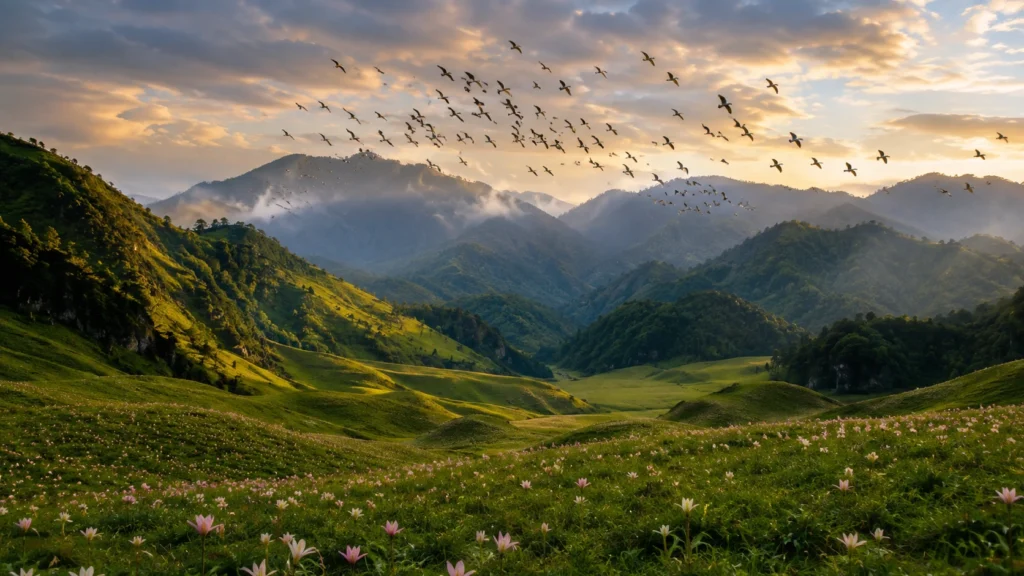
Nagaland, perched in the rugged mountain ranges of Northeast India, is an ecological treasure trove situated squarely within the Indo-Burma biodiversity hotspot. The state’s topography is characterised by steep, verdant ridges, deep river valleys, and prominent peaks such as Mount Saramati. With over seventy-three per cent of its geographical area blanketed by forests, Nagaland features a diverse vegetative matrix that transitions seamlessly from tropical moist deciduous and semi-evergreen forests in the lower altitudes to sub-tropical pine, temperate broadleaved, and alpine scrub forests in the higher elevations. This dense, multi-tiered canopy serves as a critical refuge for highly elusive, evolutionarily distinct flora and fauna.
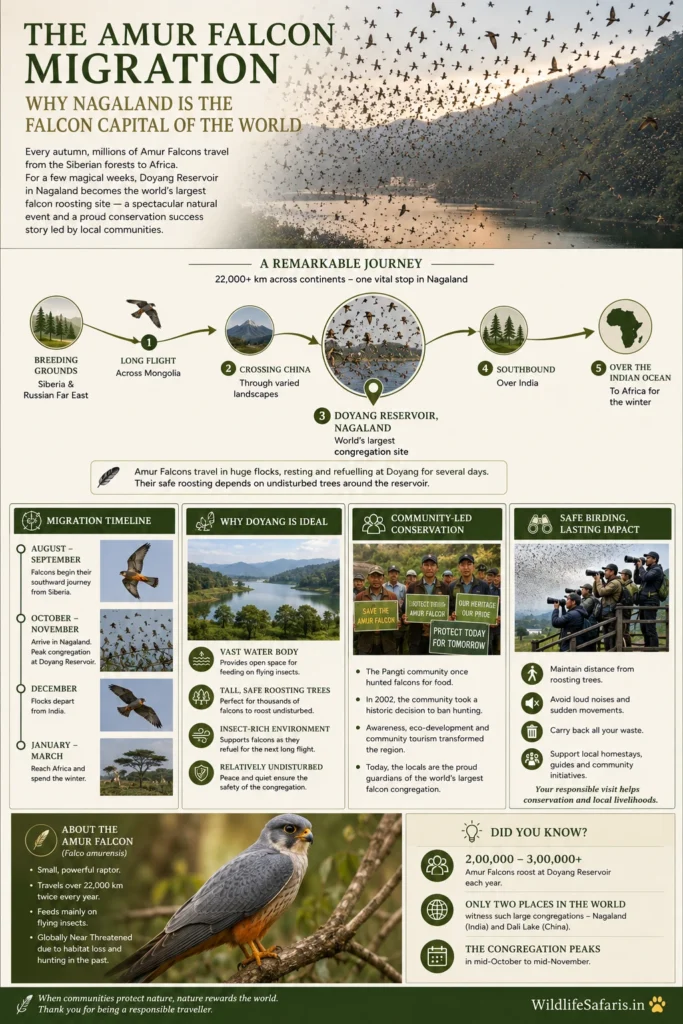
The state’s wildlife profile is headlined by its state animal, the mithun—a semi-domesticated bovine of immense cultural and ecological significance—alongside formidable wild species such as the clouded leopard, Himalayan black bear, and the western hoolock gibbon. Ntangki National Park stands as the primary protected wilderness, safeguarding healthy populations of Asian elephants within the contiguous Intanki Elephant Reserve, as well as providing crucial habitat for the rare Malayan sun bear and the slow loris. Furthermore, Nagaland holds a globally unrivalled ornithological distinction. The Doyang Reservoir in the Wokha district hosts the world’s largest congregation of migrating Amur falcons, earning the state the prestigious title of the “Falcon Capital of the world.”
Conservation in Nagaland is uniquely intertwined with community initiatives. Due to customary land ownership laws, formal government-protected areas are small; however, indigenous Naga tribes have spearheaded globally recognised grassroots conservation models. Most notably, the Khonoma Nature Conservation and Tragopan Sanctuary was established by the local community, completely banning traditional hunting to protect endemic species like the highly endangered state bird, Blyth’s tragopan. Despite the lingering challenges of shifting cultivation (jhum) and unregulated logging, Nagaland presents a deeply authentic, community-driven wildlife frontier, offering unparalleled birdwatching and exploratory eco-tourism experiences in the heart of the Patkai range.
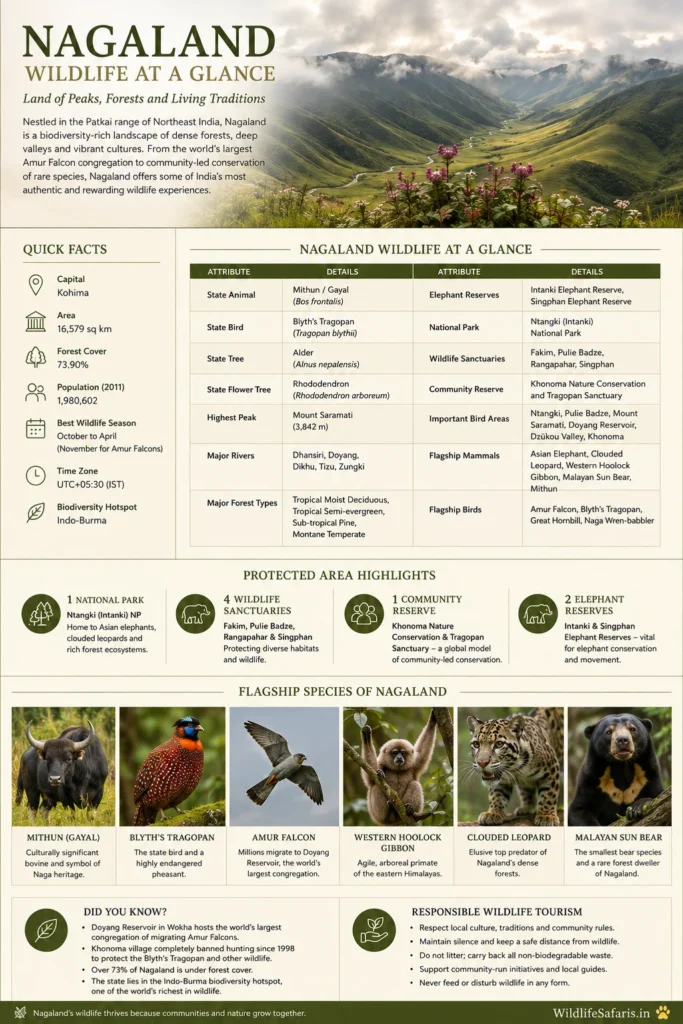
Quick Facts Table
| Category | Details |
| State / Union Territory | Nagaland |
| Capital | Kohima |
| Area | 16,579 sq km |
| Population | 1,980,602 (2011 Census) |
| Forest Cover | 73.90% |
| Official Language(s) | English |
| Time Zone | UTC+05:30 (IST) |
| Best Wildlife Season | October to April (November for Amur Falcons) |
State Wildlife Master Table
| Attribute | Details |
| State / Union Territory | Nagaland |
| Capital | Kohima |
| Geographic Region | Northeast India (Patkai Range) |
| Total Area | 16,579 sq km |
| Forest Cover | 73.90% |
| State Animal | Mithun / Gayal (Bos frontalis) |
| State Bird | Blyth’s Tragopan (Tragopan blythii) |
| State Tree | Alder (Alnus nepalensis) |
| State Flower | Tree Rhododendron (Rhododendron arboreum) |
| Highest Peak | Mount Saramati (3,842 m) |
| Major Rivers | Dhansiri, Doyang, Dikhu, Tizu, Zungki |
| Major Forest Types | Tropical Moist Deciduous, Tropical Semi-evergreen, Sub-tropical Pine, Montane Temperate |
| Biodiversity Hotspot | Indo-Burma |
| UNESCO Natural Sites | None |
| Biosphere Reserves | None |
| Tiger Reserves | None |
| Elephant Reserves | Intanki Elephant Reserve, Singphan Elephant Reserve |
| National Parks | Ntangki (Intanki) |
| Wildlife Sanctuaries | Fakim, Pulie Badze, Rangapahar, Singphan |
| Conservation Reserves | Not officially specified (Numerous Community Conserved Areas exist) |
| Community Reserves | Khonoma Nature Conservation and Tragopan Sanctuary (Community-led) |
| Ramsar Sites | None |
| Important Bird Areas (IBAs) | Ntangki, Pulie Badze, Mount Saramati, Doyang Reservoir, Dzükou Valley, Khonoma |
| Major Wildlife Corridors | Kaziranga-Karbi Anglong-Ntangki Elephant Corridor |
| Flagship Mammals | Asian Elephant, Clouded Leopard, Western Hoolock Gibbon, Malayan Sun Bear, Mithun |
| Flagship Birds | Amur Falcon, Blyth’s Tragopan, Great Hornbill, Naga Wren-babbler |
| Endemic Wildlife | Naga Wren-babbler (regional endemic) |
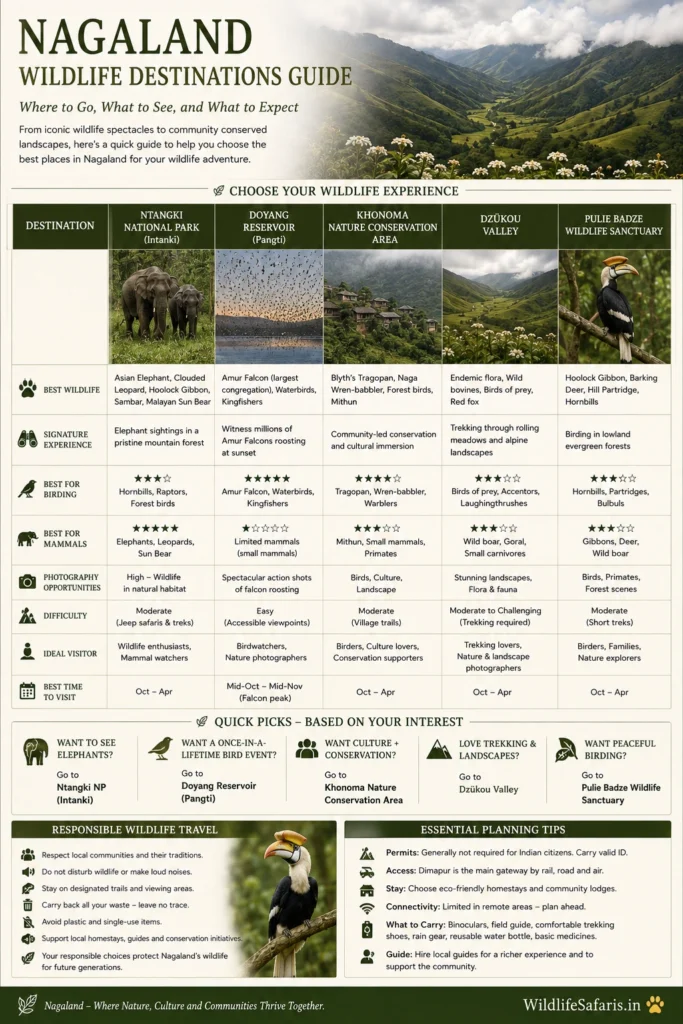
| Best Wildlife Destinations | Doyang Reservoir (Pangti), Ntangki NP, Khonoma Village, Dzükou Valley |
| Best Time for Wildlife Tourism | October to April |
| Nearest International Airports | Lokpriya Gopinath Bordoloi International Airport (Guwahati) – Dimapur is a domestic airport |
| Official Forest Department Website | forest.nagaland.gov.in |
Protected Areas Summary Table
| Protected Area | Category | District | Area (sq km) | Year Established | Famous For |
| Ntangki (Intanki) National Park | National Park | Peren | 202.02 | 1993 | Asian Elephant, Hoolock Gibbon, Clouded Leopard |
| Fakim Wildlife Sanctuary | Wildlife Sanctuary | Kiphire | 6.42 | 1980 | Blyth’s Tragopan, Slender Loris, Panther |
| Pulie Badze Wildlife Sanctuary | Wildlife Sanctuary | Kohima | 9.23 | 1980 | Blyth’s Tragopan, Dzükou Valley Gateway, Tragopan Sanctuary |
| Rangapahar Wildlife Sanctuary | Wildlife Sanctuary | Dimapur | 4.70 | 1986 | Avifauna, Chital, Urban Forest Conservation |
| Singphan Wildlife Sanctuary | Wildlife Sanctuary | Mon | 23.57 | 2009 | Elephant Reserve, Barking Deer, Hornbills |
Wildlife Highlights
- Top Mammals: Asian Elephant, Clouded Leopard, Western Hoolock Gibbon, Malayan Sun Bear, Mithun (Gayal), Barking Deer, Himalayan Black Bear, Slow Loris, Stump-tailed Macaque.
- Top Birds: Amur Falcon, Blyth’s Tragopan, Great Hornbill, Rufous-necked Hornbill, Dark-rumped Swift, Naga Wren-babbler, Mountain Bamboo Partridge.
- Reptiles & Amphibians: Asian Leaf Turtle, Monitor Lizard, Bamboo Pit Viper, Reticulated Python.
- Flagship Flora: Alder, Tree Rhododendron, Dzükou Lily (endemic to Dzükou Valley), diverse terrestrial Orchids, dense Bamboo brakes.
- Best Wildlife Experiences: Witnessing the phenomenal mass roosting of Amur Falcons at Doyang Reservoir in November, birding and trekking through the community-protected forests of Khonoma, exploring the virgin rainforests of Ntangki National Park, and hiking the floral paradise of the Dzükou Valley.
Conservation Challenges
- Hunting and Poaching: There is a deep-rooted cultural tradition of bushmeat hunting and trophy collection among local tribes. While this historically decimated wildlife populations, widespread community-led hunting bans (as seen in Pangti and Khonoma) are aggressively reversing this trend.
- Shifting Cultivation (Jhum): The traditional slash-and-burn agricultural practice, when operating on shortened cycles due to population pressure, severely degrades primary forests, causing habitat fragmentation and soil erosion on steep hillsides.
- Lack of Protected Area Network: Under Article 371A of the Indian Constitution, the vast majority of land in Nagaland is privately or community-owned. Consequently, formal government-protected areas cover a very small percentage of the state, making wildlife conservation entirely dependent on complex community negotiations.
- Human-Elephant Conflict: The fragmentation of the vital Kaziranga-Karbi Anglong-Ntangki forest corridor pushes elephant herds into agricultural lands in the Wokha, Peren, and Dimapur districts, resulting in severe crop depredation.
- Logging: Unregulated timber extraction, particularly of valuable hardwoods from community-owned unclassed forests, poses a continuous threat to the state’s dense canopy cover and arboreal wildlife.
Responsible Wildlife Tourism
- Support Community Ecotourism: Always opt for village homestays and community-run eco-tourism initiatives (like those in Khonoma and Pangti). This directly incentivises locals to protect wildlife rather than hunt it.
- Falcon Viewing Ethics: When visiting the Doyang Reservoir to see the Amur Falcons, maintain absolute silence, do not use flash photography at dusk, and remain in designated viewing areas to avoid stressing the exhausted, migrating birds.
- Respect Tribal Customs: Nagaland’s forests are deeply cultural. Always seek permission from the Village Council or local guides before entering community forests or photographing traditional practices.
- Zero Littering on Treks: When trekking the pristine Dzükou Valley or Mount Saramati, implement a strict “leave no trace” policy. Carry all plastics and non-biodegradable waste back to major towns.
- Avoid Wildlife Products: Given the region’s hunting history, tourists must actively decline to purchase or consume any wild bushmeat or animal trophies to discourage the practice.
- Use Authorised Guides: The terrain is rugged and heavily forested. Always hike with registered local guides who understand the topography and the boundaries of community-owned lands.
Did You Know?
- Nagaland is globally celebrated as the “Falcon Capital of the World.” Every year in October and November, millions of Amur Falcons stop at the Doyang Reservoir to roost for several weeks during their incredible 22,000-kilometre migration from Siberia to South Africa.
- Khonoma village, located near Kohima, is recognised as India’s first “Green Village” due to its pioneering decision in 1998 to completely ban hunting and logging to protect the Blyth’s Tragopan.
- The state animal, the Mithun, is not entirely wild nor fully domesticated; it is a unique bovine species allowed to roam freely in the forests and is a symbol of wealth and prestige in Naga culture.
- The Dzükou Valley, straddling the border of Nagaland and Manipur, is famous for its unique topography that looks like a freshly mowed lawn and is the only place in the world where the Dzükou Lily grows.
- Because land in Nagaland is primarily owned by the people, the state has pioneered the concept of Community Conserved Areas (CCAs), where village councils independently declare and enforce wildlife protection laws over their ancestral forests.
- Pulie Badze Wildlife Sanctuary, situated right on the outskirts of the capital Kohima, provides a crucial catchment area for the city’s water supply and acts as a gateway to the Dzükou Valley.
Safari Planning : Topics Cluster
- How to book a wildlife safari in India?
- Park by Park Online Safari Booking Guide
- Tiger Safari India Planning Workbook
- Park by Park Safari Permits Guide
- National Parks Permit Guide – Park by Park Guide
- Tatkal Safari Booking Guide – Last Minute Safari Permits Booking
- Tiger Safari in India Cost
- Indian Wildlife Safari Budget Planner
- Jeep vs Canter Safari
- Best time for Tiger Sightings in India
- How far advanced should you book safari permits?
- Can foreigners book Indian Wildlife Safari online?
- Special Permits Guide for Foreigners and Domestic Visitors
- How to book a Safari Permit online in India? 2026 step by step guide
- Senior Citizens Friendly Safari Planning
- Multi Generation Family Safari Planning
- 50 things to know before your first safari in India