Discover the Fishing Cat in India, including its habitat, distribution, behaviour, conservation status, threats, wetlands, and recent research.
Fishing Cat in India: India’s Elusive Wetland Wild Cat
Wetlands are among India’s most productive ecosystems, supporting countless birds, reptiles, amphibians, fish, and mammals. Hidden within many of these marshes, mangroves, floodplains, and reed beds lives one of the country’s least-seen wild cats—the Fishing Cat (Prionailurus viverrinus). Unlike most members of the cat family, this species is closely associated with water and has evolved remarkable adaptations that allow it to hunt aquatic prey.
Although it occurs across several parts of India, the Fishing Cat is rarely encountered. It is primarily nocturnal, occupies dense wetland vegetation, and often survives outside protected forests in landscapes shared with people. This dependence on wetlands also makes it particularly vulnerable to habitat loss, making the species an important indicator of the health of India’s freshwater and coastal ecosystems.
What Is the Fishing Cat?
The Fishing Cat is a medium-sized wild cat native to South and Southeast Asia. India supports some of its most important remaining populations, particularly in the wetlands of eastern and northeastern India.
Unlike the larger tiger or leopard, the Fishing Cat has evolved to exploit aquatic habitats. It is a capable swimmer and feeds on a variety of wetland animals, especially fish, but its diet is much broader than its name suggests.
The species is recognised internationally as an important wetland predator and is protected under India’s Wildlife (Protection) Act. It is also the State Animal of West Bengal, reflecting its close association with the state’s extensive riverine and mangrove landscapes.
Scientific Classification
| Classification | Details |
| Common Name | Fishing Cat |
| Scientific Name | Prionailurus viverrinus |
| Family | Felidae |
| Order | Carnivora |
| Distribution | South and Southeast Asia |
Why Is It Called the Fishing Cat?
The name comes from the species’ unusual hunting behaviour.
Unlike most cats, Fishing Cats regularly hunt in water. They patrol the edges of ponds, marshes, creeks, and mangrove channels, searching for fish and other aquatic prey. Their partially webbed feet and confidence in water distinguish them from many other wild cats.
Despite the name, fish are only part of their diet. They also consume frogs, crabs, snakes, birds, rodents, and other small animals found in wetland habitats.
Field Note: The Fishing Cat should not be thought of as a “cat that only eats fish.” It is an opportunistic predator that takes advantage of whatever prey is available in healthy wetlands.
Physical Appearance and Identification
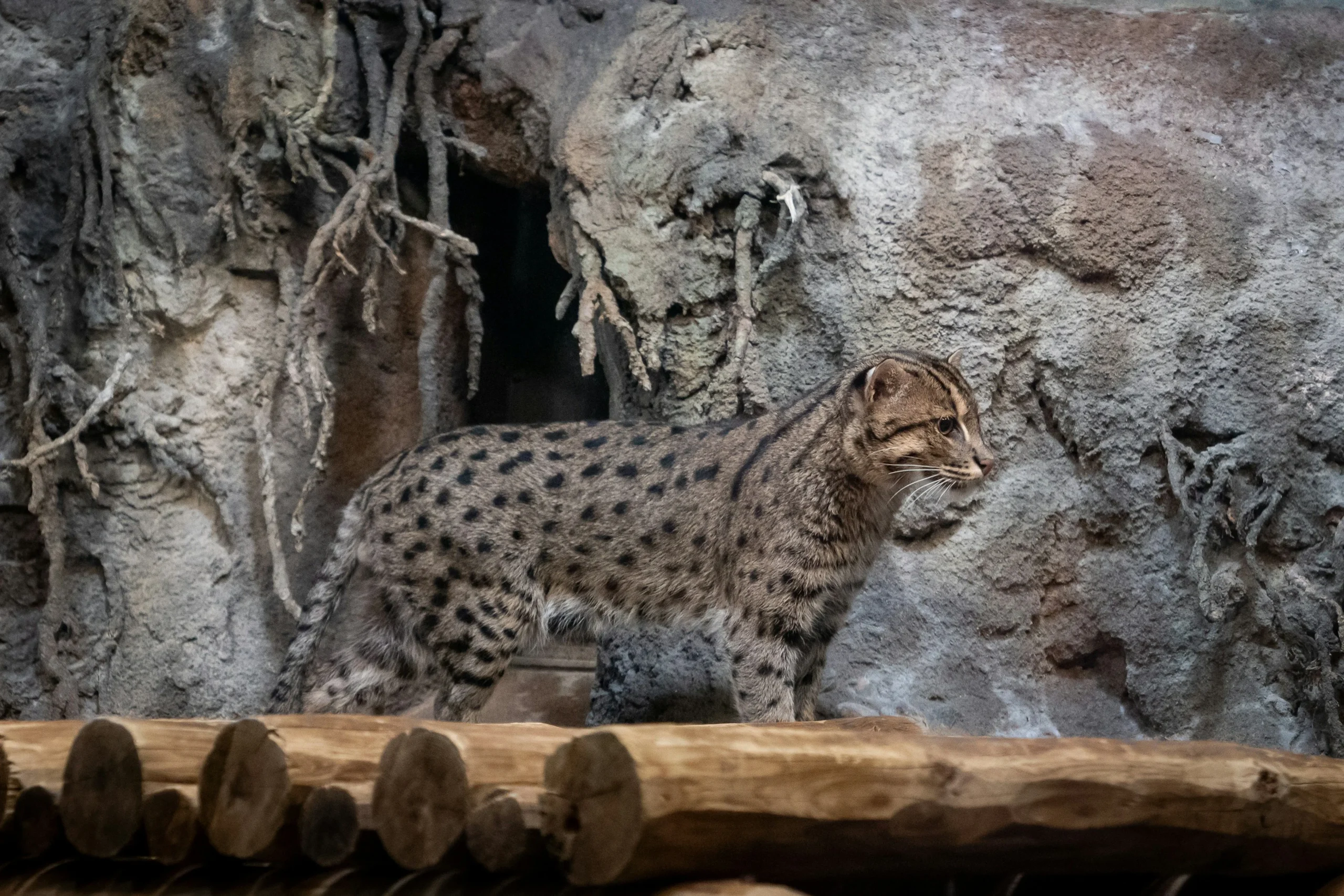
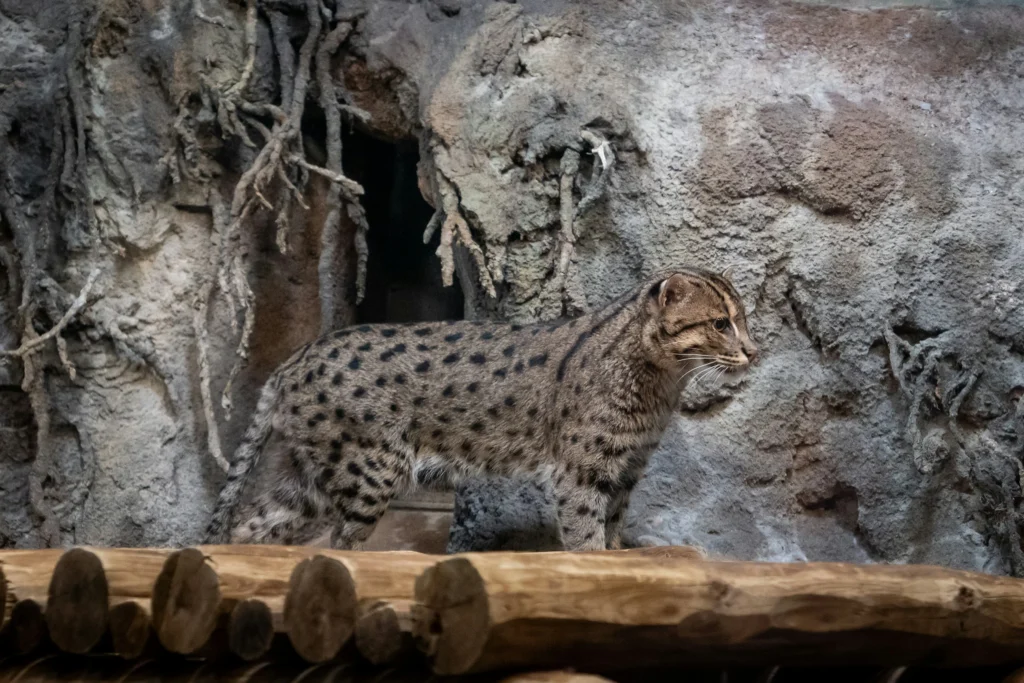
The Fishing Cat has a stocky, muscular build suited to life around water.
Key identification features include:
- Olive-grey coat marked with dark spots and stripes.
- Two to three bold stripes running from the forehead towards the back.
- Short, rounded ears.
- Broad head and powerful jaws.
- Relatively short tail compared to body length.
- Strong legs adapted for moving through marshy ground.
Adults generally measure around 57–78 cm in body length and weigh roughly 5–16 kg, although size varies between males and females. Its robust appearance often makes it look larger than other small wild cats found in India.
How to Distinguish a Fishing Cat from Other Wild Cats
Many people confuse the Fishing Cat with the Leopard Cat or Jungle Cat, especially when sightings are brief.
Some useful field characteristics include:
- A heavier, more muscular body.
- A broader face.
- Distinctive rows of elongated spots rather than rosettes.
- A noticeably shorter tail.
- Strong association with wetlands and water bodies.
Habitat often provides the biggest clue. A medium-sized spotted cat observed hunting near marshes, mangroves, or reed beds is more likely to be a Fishing Cat than other small feline species.
Where Is the Fishing Cat Found in India?
The Fishing Cat has a patchy distribution across India rather than occurring continuously throughout the country.
Its range largely follows major wetland systems, including mangroves, floodplains, estuaries, marshes, lagoons, and river basins. Many important populations also occur outside protected areas, where wetlands overlap with villages, agricultural land, fisheries, and aquaculture landscapes. This makes conservation particularly challenging because protecting the species often requires safeguarding working wetlands as well as wildlife reserves.
Major Strongholds in India
Current research highlights several important landscapes:
- Sundarbans – India’s largest mangrove ecosystem and one of the species’ strongest known populations.
- Chilika Lagoon (Odisha) – The site of the world’s first comprehensive Fishing Cat population estimate.
- Kaziranga floodplains (Assam) – Important riverine habitat supporting confirmed populations.
- East Kolkata Wetlands – Human-dominated wetlands that continue to support Fishing Cats.
- Coastal wetlands of Andhra Pradesh, including the Coringa landscape.
- The Ganga-Brahmaputra floodplains, which contain numerous interconnected wetland habitats.
These areas illustrate the species’ dependence on healthy wetland ecosystems rather than dense forests alone.
Habitat and Ecology
The Fishing Cat is closely tied to wetlands throughout its life. Unlike many other wild cats that can adapt to a wide range of habitats, this species depends on permanent or seasonal water bodies that provide food, shelter, and breeding sites. As wetlands disappear or become fragmented, Fishing Cat populations often decline even when nearby forests remain intact.
Why Wetlands Matter
Wetlands provide everything a Fishing Cat needs:
- Reliable fish and amphibian populations.
- Dense vegetation for cover.
- Safe resting and breeding sites.
- Access to multiple prey species throughout the year.
Because of this close relationship, conservationists often describe the Fishing Cat as a wetland indicator species. Healthy Fishing Cat populations usually indicate that the surrounding wetland ecosystem continues to support a wide variety of aquatic life.
This makes the species valuable not only for its own conservation but also as a symbol for protecting India’s rapidly shrinking wetlands.
Expert Tip: Protecting a Fishing Cat often means protecting an entire wetland ecosystem that also supports migratory birds, reptiles, fish, amphibians, and local communities.
Preferred Habitats
Fishing Cats occupy a variety of wetland environments rather than a single habitat type.
They are commonly associated with:
- Freshwater marshes
- Mangrove forests
- Floodplains
- Swamps
- Riverbanks
- Estuaries
- Coastal lagoons
- Reed beds
- Brackish wetlands
They may also occur in landscapes influenced by people, including:
- Rice fields
- Aquaculture ponds
- Traditional fishing areas
- Village wetlands
This ability to survive in modified landscapes is unusual among wild cats. However, it also increases encounters with people, making coexistence an important conservation challenge.
Distribution Across India’s Wetland Landscapes
Rather than forming one continuous population, Fishing Cats occur in scattered wetland systems across the country.
Eastern India
Eastern India supports some of the largest known populations due to its extensive river systems and coastal wetlands.
Important regions include:
- West Bengal
- Odisha
- East Kolkata Wetlands
- Sundarbans
- Lower Ganga floodplains
These wetlands provide abundant aquatic prey and extensive marsh vegetation.
Northeastern India
The floodplains of the Brahmaputra River also support Fishing Cats.
Confirmed landscapes include:
- Kaziranga National Park
- Riverine wetlands
- Marshes associated with major floodplain systems
These periodically flooded habitats produce rich fish populations that benefit the species.
Southern and Coastal India
Fishing Cats are also recorded from several coastal and inland wetlands of peninsular India.
Important areas include:
- Chilika Lagoon
- Coringa Wildlife Sanctuary
- Godavari delta
- Krishna delta
- Selected Western Ghats wetlands
Although populations here are generally more fragmented, these wetlands remain important for maintaining the species’ overall distribution in India.
Major Fishing Cat Landscapes in India
| Landscape | Habitat Type | Importance |
| Sundarbans | Mangrove forest | One of India’s strongest known populations |
| Chilika Lagoon | Coastal lagoon | World’s first Fishing Cat population estimate |
| Kaziranga | River floodplain | Important northeastern stronghold |
| East Kolkata Wetlands | Urban wetland | Demonstrates coexistence outside protected areas |
| Coringa | Mangrove and estuary | Site of India’s first reported Fishing Cat collaring project |
| Ganga-Brahmaputra Floodplains | Marshes and river systems | Extensive connected wetland habitats |
Behaviour and Natural History
The Fishing Cat has evolved several behavioural adaptations that distinguish it from most other wild cats.
It is generally secretive, spends much of its time in dense vegetation, and is most active when human activity is low. This explains why the species remained poorly understood for many years despite living near towns and villages in some regions.
Hunting Adaptations
Fishing Cats are highly specialised predators.
Adaptations include:
- Strong muscular forelimbs.
- Broad paws with partially webbed toes.
- Thick fur that provides insulation near water.
- Excellent swimming ability.
- Sharp eyesight and hearing for detecting movement.
These features allow them to capture prey both in shallow water and along muddy wetland edges.
Unlike the common image of cats avoiding water, Fishing Cats regularly enter ponds, streams, marshes, and mangrove creeks while searching for food.
Diet
Fish are an important food source, but the species has a varied diet.
Recorded prey includes:
- Fish
- Frogs
- Crabs
- Crustaceans
- Snakes
- Birds
- Small mammals
- Carrion on occasion
The exact diet depends on local prey availability and seasonal wetland conditions.
This dietary flexibility helps the species survive across different wetland ecosystems, although healthy fish populations remain particularly important.
Common Misconception: Despite its name, the Fishing Cat does not rely exclusively on fish.
Activity Pattern
Fishing Cats are primarily nocturnal.
Most activity occurs:
- After sunset
- During the night
- Around dawn
This behaviour helps them avoid human disturbance while taking advantage of active aquatic prey.
Daytime sightings are uncommon and usually occur in quiet wetlands with minimal disturbance.
Breeding and Life Cycle
Compared with larger Indian cats such as tigers and leopards, relatively little is known about Fishing Cat breeding in the wild.
Researchers continue to study reproduction using:
- Camera traps
- Radio-collaring
- Long-term field monitoring
- Population surveys
As research expands, scientists are gaining a better understanding of breeding behaviour, home ranges, and movement between fragmented wetlands.
Photography Tip: Even experienced wildlife photographers rarely see a Fishing Cat in the wild. Camera trap images provide many of the photographs used in research because the species is secretive and mostly active at night.
Fishing Cat Conservation Status
Although the Fishing Cat is one of Asia’s most distinctive wild cats, its future depends on the survival of wetlands. Across much of its range, marshes, mangroves, floodplains, and estuaries are being altered by urban expansion, infrastructure, aquaculture, and changing land use. These pressures have made the species a conservation priority in India and several neighbouring countries.
IUCN Red List Status
The Fishing Cat is currently classified as Vulnerable on the IUCN Red List according to the latest conservation assessments referenced in the research brief.
A Vulnerable classification indicates that the species faces a high risk of extinction in the wild if current threats continue. While Fishing Cats remain widespread across parts of South and Southeast Asia, their populations are fragmented and closely tied to shrinking wetland habitats.
Field Note: Older books and websites may describe the Fishing Cat as “Endangered.” More recent assessments classify it as Vulnerable, so readers should rely on the latest conservation sources.
Legal Protection in India
India provides the Fishing Cat with the country’s highest level of legal protection by listing it under Schedule I of the Wildlife (Protection) Act, 1972.
This status places the species alongside India’s most protected wildlife and makes hunting, capture, and trade illegal except under exceptional circumstances permitted by law.
International Protection
In addition to Indian law, the Fishing Cat receives international protection through its inclusion in CITES Appendix II.
This helps regulate international trade and supports conservation efforts across the species’ range.
State Animal of West Bengal
The Fishing Cat is the State Animal of West Bengal, reflecting the importance of the state’s wetlands, particularly the Sundarbans and East Kolkata Wetlands, for the species’ long-term survival.
The designation has helped raise public awareness and encouraged greater attention to wetland conservation across the state.
Legal Protection at a Glance
| Conservation Framework | Status |
| IUCN Red List | Vulnerable |
| Wildlife (Protection) Act, India | Schedule I |
| CITES | Appendix II |
| State Animal | West Bengal |
Threats Facing Fishing Cats
The greatest challenge facing the Fishing Cat is not direct persecution but the gradual disappearance and degradation of wetlands.
Because the species depends so heavily on these habitats, even small changes to wetland landscapes can reduce available food, shelter, and breeding areas. Many remaining populations now survive in isolated habitat fragments separated by roads, farms, towns, and industrial development.
Wetland Loss
Wetlands are often drained or converted for:
- Urban expansion
- Agriculture
- Industrial development
- Infrastructure projects
- Land reclamation
As wetlands disappear, Fishing Cats lose the habitats that support their prey and provide cover for hunting and breeding. Unlike some larger mammals, they cannot simply move to nearby forests because their ecological requirements are closely linked to water.
Habitat Fragmentation
Even where wetlands remain, they are often broken into isolated patches.
Fragmented habitats can:
- Reduce genetic exchange between populations.
- Increase encounters with people.
- Make dispersal more difficult.
- Raise the risk of local population declines.
Maintaining connections between wetlands is therefore an important part of long-term conservation planning.
Aquaculture and Land-use Change
Many Fishing Cats live near fish farms, shrimp ponds, and other aquaculture operations.
While these landscapes may still provide suitable habitat, they can also create conflict if cats prey on farmed fish or enter areas used for commercial production. Expansion of aquaculture may also replace natural marshes and mangroves with simplified artificial habitats.
Human–Wildlife Conflict
Fishing Cats occasionally come into conflict with people living near wetlands.
Reported issues include:
- Predation on fish in ponds.
- Poultry losses.
- Retaliatory killing following perceived livestock damage.
- Misunderstanding of the species’ ecological role.
Conservation organisations increasingly work with local communities to reduce conflict while promoting the value of healthy wetlands.
Road Mortality
As roads and settlements expand through wetland landscapes, Fishing Cats face an increasing risk of vehicle collisions.
Road mortality has become a recognised conservation concern in several regions, particularly where transport corridors cut across traditional movement routes between wetlands.
Threats by Region
| Region | Major Threats |
| West Bengal | Wetland loss, urbanisation, conflict outside protected areas |
| Odisha | Wetland alteration, aquaculture expansion |
| Assam | Habitat fragmentation in floodplain landscapes |
| Andhra Pradesh | Coastal development and mangrove pressures |
Recent Research and Conservation Efforts
Over the past decade, dedicated surveys have significantly improved understanding of the Fishing Cat’s distribution in India. Camera traps, systematic population estimates, and radio-collaring are providing researchers with better information than was previously available.
Chilika Lagoon Population Estimate
Chilika Lagoon in Odisha became the focus of the world’s first Fishing Cat population estimate, which recorded 176 individuals.
The survey highlighted the global importance of Chilika as one of the species’ major strongholds and demonstrated the value of long-term scientific monitoring.
Sundarbans Population Survey
The first dedicated population estimation in the Indian Sundarbans recorded at least 385 Fishing Cats.
This work provided one of the clearest pictures yet of the species’ status within one of India’s most significant mangrove ecosystems.
Kaziranga Survey
Kaziranga National Park is internationally known for rhinos and tigers, but recent focused surveys have also confirmed its importance for Fishing Cats.
The park’s first dedicated survey documented 57 Fishing Cats, demonstrating that its floodplain wetlands support an important population.
Coringa Radio-Collaring Project
A recent milestone in Indian Fishing Cat research was the reported radio-collaring project in Coringa Wildlife Sanctuary.
Tracking individual animals helps researchers understand:
- Home range size
- Habitat use
- Movement between wetlands
- Responses to human activity
Such information can guide future conservation planning and habitat management.
The Fishing Cat Project
Since 2010, The Fishing Cat Project (TFCP) has worked with researchers, government agencies, and local communities to improve understanding and conservation of the species.
Its work includes:
- Scientific research
- Population monitoring
- Community engagement
- Wetland conservation
- Public awareness
- Support for field surveys
The project has played an important role in bringing attention to a species that was once overlooked in conservation planning.
Can You See a Fishing Cat in India?
Seeing a Fishing Cat in the wild is possible, but it should never be the primary goal of a visit. Even in areas where the species is known to occur, sightings are uncommon because Fishing Cats are naturally secretive, spend much of their time in dense vegetation, and are mostly active after dark.
For most visitors, the best approach is to appreciate the wetlands that support the species rather than expecting a direct encounter.
Best Places to Learn About Fishing Cats
The following landscapes are among the most important for understanding the species and its habitat:
| Landscape | Why It Matters |
| Sundarbans | One of India’s most important Fishing Cat strongholds and the country’s largest mangrove ecosystem. |
| Chilika Lagoon | Site of the world’s first Fishing Cat population estimate and an internationally important wetland. |
| Kaziranga National Park | River floodplains supporting a confirmed Fishing Cat population alongside many other wetland species. |
| East Kolkata Wetlands | Demonstrates that Fishing Cats can survive in human-dominated wetlands when habitat remains suitable. |
| Coringa Wildlife Sanctuary | Important coastal wetland where recent research has expanded knowledge of the species. |
While exploring these areas, visitors are more likely to appreciate the broader wetland ecosystem than to actually see a Fishing Cat.
Responsible Wildlife Tourism
Wetlands are fragile environments that support many species beyond the Fishing Cat.
Responsible visitors should:
- Remain on authorised routes.
- Avoid disturbing wildlife, especially at night.
- Never attempt to attract animals with food or sounds.
- Respect local fishing communities and protected-area regulations.
- Support conservation-focused tourism operators where available.
Responsible behaviour helps protect both wildlife and the wetlands on which local communities depend.
Responsible Tourism Tip: The best wildlife experience is one that leaves no lasting impact on the habitat.
Fishing Cat vs Leopard Cat vs Jungle Cat
| Feature | Fishing Cat | Leopard Cat | Jungle Cat |
| Preferred Habitat | Wetlands, marshes, mangroves | Forests and woodland | Grasslands, scrub, wetlands |
| Body Build | Stocky and muscular | Slender | Long-legged and lean |
| Tail | Relatively short | Longer | Medium length |
| Main Diet | Fish, frogs, crabs, birds, small mammals | Small mammals, birds, reptiles | Rodents, birds, reptiles |
| Swimming Ability | Excellent | Limited | Moderate |
| Association with Water | Very strong | Occasional | Variable |
Expert Tips
For Wildlife Enthusiasts
Don’t judge the health of a Fishing Cat population by whether you see one. Camera-trap surveys are often far more effective than direct observation because the species is naturally elusive.
For Birdwatchers
Many of India’s best birding wetlands also provide suitable Fishing Cat habitat. Learning about the ecosystem as a whole often leads to a more rewarding visit than focusing on a single species.
For Wildlife Photographers
Avoid using flash or attempting night-time photography outside authorised programmes. Disturbing nocturnal wildlife can alter natural behaviour.
For Students
Fishing Cats are an excellent example of how the conservation of a single predator depends on the protection of an entire ecosystem rather than a single protected area.
Common Mistakes
When reading about or searching for Fishing Cats, avoid these common misconceptions:
- Assuming the species only lives inside national parks.
- Believing it eats only fish.
- Confusing it with Leopard Cats or Jungle Cats.
- Thinking wetlands are less valuable than forests for wildlife conservation.
- Expecting easy sightings during a typical wildlife trip.
- Referring to outdated conservation assessments without checking current sources.
Frequently Asked Questions
Is the Fishing Cat found only in India?
No. The species occurs in several South and Southeast Asian countries, although India supports some of its most significant remaining populations.
Where is the Fishing Cat found in India?
It occurs in scattered wetland landscapes, including the Sundarbans, Chilika Lagoon, Kaziranga floodplains, East Kolkata Wetlands, coastal Andhra Pradesh, and parts of the Ganga-Brahmaputra river systems.
Why is it called a Fishing Cat?
It is named for its ability to hunt aquatic prey, particularly fish, although it also feeds on frogs, crabs, birds, reptiles, and small mammals.
Is the Fishing Cat endangered?
According to the latest references used for this article, the species is classified as Vulnerable on the IUCN Red List.
Is the Fishing Cat protected in India?
Yes. It is protected under Schedule I of the Wildlife (Protection) Act, 1972, providing the highest level of legal protection.
Why is the Fishing Cat important?
As a top predator in wetlands, it helps maintain ecological balance and serves as an indicator of healthy wetland ecosystems.
Can Fishing Cats swim?
Yes. They are among the best swimmers in the cat family and are well adapted to hunting in and around water.
Are Fishing Cats dangerous to humans?
There is no evidence that Fishing Cats pose a significant threat to people. They generally avoid human contact and are naturally shy.
What is the biggest threat to the Fishing Cat?
The greatest long-term threat is the loss and fragmentation of wetlands, along with increasing conflict in human-dominated landscapes.
Can tourists reliably see a Fishing Cat?
No. Even in well-known habitats, sightings are uncommon because the species is elusive and mostly nocturnal. Visiting these wetlands should be viewed as an opportunity to appreciate the ecosystem rather than to guarantee a sighting.
Conclusion
The Fishing Cat is one of India’s most specialised and least-seen wild cats. Its dependence on marshes, mangroves, floodplains, and other wetlands makes it a powerful reminder that wildlife conservation extends far beyond forests and national parks.
Recent surveys in landscapes such as Chilika Lagoon, the Sundarbans, Kaziranga, and Coringa have greatly improved our understanding of the species, but they also highlight the challenges it faces. Wetland loss, habitat fragmentation, and increasing human pressure continue to threaten populations across much of its range.
Protecting the Fishing Cat ultimately means protecting India’s wetlands—the ecosystems that provide clean water, support fisheries, reduce floods, sustain migratory birds, and benefit millions of people. By safeguarding these habitats, conservation efforts help ensure that this remarkable wetland predator remains part of India’s natural heritage for generations to come.