Discover the three crocodiles of India, where they live, how they differ, conservation success, safety tips, and the best places to see them in the wild.
Crocodiles of India: Species Guide, Habitat, Conservation, and the Best Places to See Them
India is one of the few countries where you can find three native crocodilian species, each adapted to a different type of aquatic habitat. From broad freshwater rivers and reservoirs to mangrove-lined estuaries and coastal wetlands, these reptiles play an important role as apex predators and scavengers, helping maintain the balance of aquatic ecosystems.
Although crocodiles often attract attention because of their size and reputation, India’s conservation story is equally significant. The launch of the Crocodile Conservation Project in 1975 marked a turning point for all three species. Over the past five decades, captive breeding, habitat protection, and reintroduction programmes have helped several populations recover, making India an important stronghold for crocodilian conservation. At the same time, growing populations in some regions have increased interactions between people and crocodiles, creating new challenges for wildlife managers.
Whether you are planning a wildlife safari, photographing reptiles, studying Indian wildlife, or simply curious about these ancient animals, understanding the differences between India’s crocodilians is the best place to begin.
How Many Crocodile Species Are Found in India?
India is home to three native crocodilian species:
| Common Name | Scientific Name | Primary Habitat |
| Mugger Crocodile | Crocodylus palustris | Freshwater rivers, lakes, reservoirs, ponds and wetlands |
| Saltwater Crocodile | Crocodylus porosus | Estuaries, mangroves, tidal rivers and coastal wetlands |
| Gharial | Gavialis gangeticus | Large, clean, fish-rich rivers with sandy banks |
Although all three belong to the order Crocodylia, they differ greatly in appearance, habitat preferences, diet, and behaviour. Understanding these differences makes it much easier to identify them in the wild and appreciate the conservation challenges each species faces.
Crocodile vs Gharial Explained
One of the most common misconceptions is that a gharial is simply another type of crocodile.
In everyday conversation, people often group all large aquatic reptiles under the term “crocodile.” Biologically, however, the gharial is a distinct crocodilian with specialised adaptations that set it apart from both true crocodiles found in India.
The easiest way to distinguish them is by the shape of the snout.
- Mugger crocodiles have a broad, powerful snout suited to catching a wide variety of prey.
- Saltwater crocodiles also have a robust snout but are generally larger and adapted to estuarine and coastal environments.
- Gharials possess an exceptionally long, narrow snout lined with sharp interlocking teeth, an adaptation for catching fish efficiently in flowing rivers.
Another important difference lies in habitat.
Muggers are highly adaptable and occupy an impressive range of freshwater environments, including reservoirs, irrigation canals, village ponds, marshes, and even urban rivers. Saltwater crocodiles are associated with mangroves, estuaries, and tidal rivers, while gharials depend on large river systems with clean water, abundant fish, and exposed sandbanks for nesting.
Field Note: If you see a large reptile basking beside a village reservoir or inland lake, it is almost certainly a mugger crocodile. If you are on the Chambal River and notice an animal with a remarkably thin snout, you are most likely looking at a gharial.
Species Comparison at a Glance
| Feature | Mugger Crocodile | Saltwater Crocodile | Gharial |
| Scientific name | Crocodylus palustris | Crocodylus porosus | Gavialis gangeticus |
| Main habitat | Freshwater wetlands | Coastal estuaries and mangroves | Large freshwater rivers |
| Diet | Opportunistic carnivore | Large opportunistic predator | Primarily fish |
| Distribution in India | Widespread across many states | Eastern coast and islands | Northern river systems |
| Notable adaptation | Highly adaptable habitat use | Largest living crocodilian | Long, slender fish-catching snout |
| Conservation focus | Human coexistence and habitat protection | Coastal habitat conservation | River restoration and captive breeding |
Expert Tip
If your goal is to observe all three species in the wild, no single destination offers them together. Instead:
- Visit Bhitarkanika National Park for saltwater crocodiles.
- Explore the National Chambal Sanctuary to see gharials.
- Look for mugger crocodiles in freshwater reserves and wetlands across much of peninsular and western India.
Together, these three destinations provide an excellent introduction to India’s crocodilian diversity while showcasing the very different habitats each species depends upon.
Meet the Three Crocodilians of India
Although India’s crocodilians share a common ancestry, each species has evolved to occupy a different ecological niche. Their appearance, preferred habitats, feeding habits, and conservation needs vary considerably. Learning to recognise these differences not only enhances wildlife watching but also provides insight into how each species has adapted to survive in India’s diverse aquatic landscapes.
Mugger Crocodile (Crocodylus palustris)
The mugger crocodile is the species that most Indians are likely to encounter. It is widely distributed, highly adaptable, and capable of living in an impressive range of freshwater habitats—from protected national parks to reservoirs, irrigation canals, village ponds, and even urban rivers. This flexibility has helped the species recover across many parts of the country, but it has also increased interactions with people.
How to Identify a Mugger Crocodile
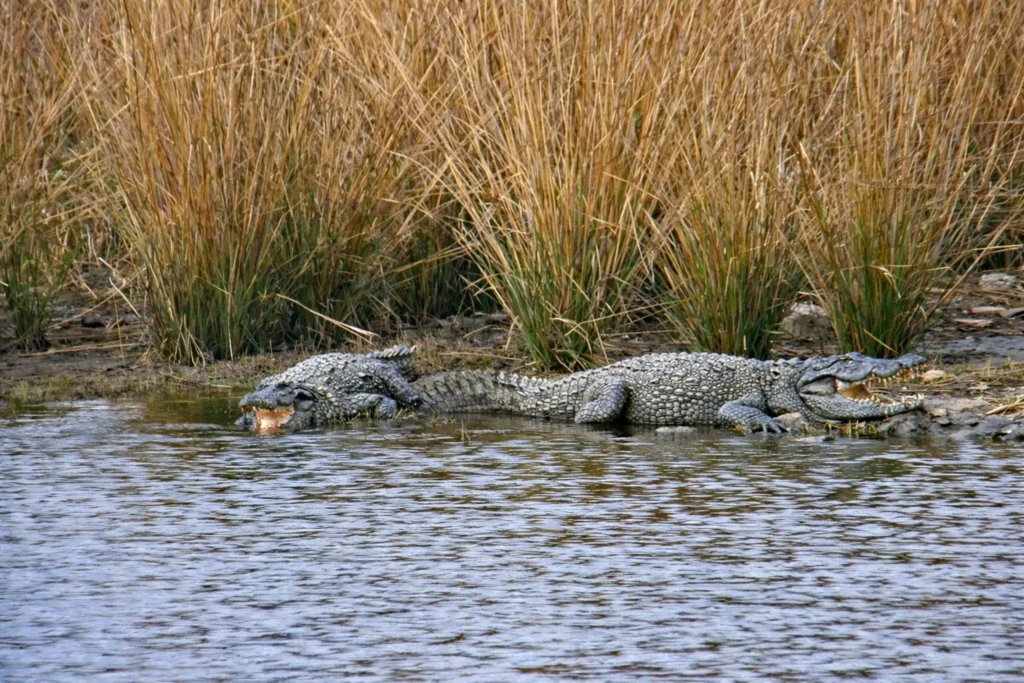
Image : Two Mugger Crocodiles sun bathing by a river in Rajasthan.
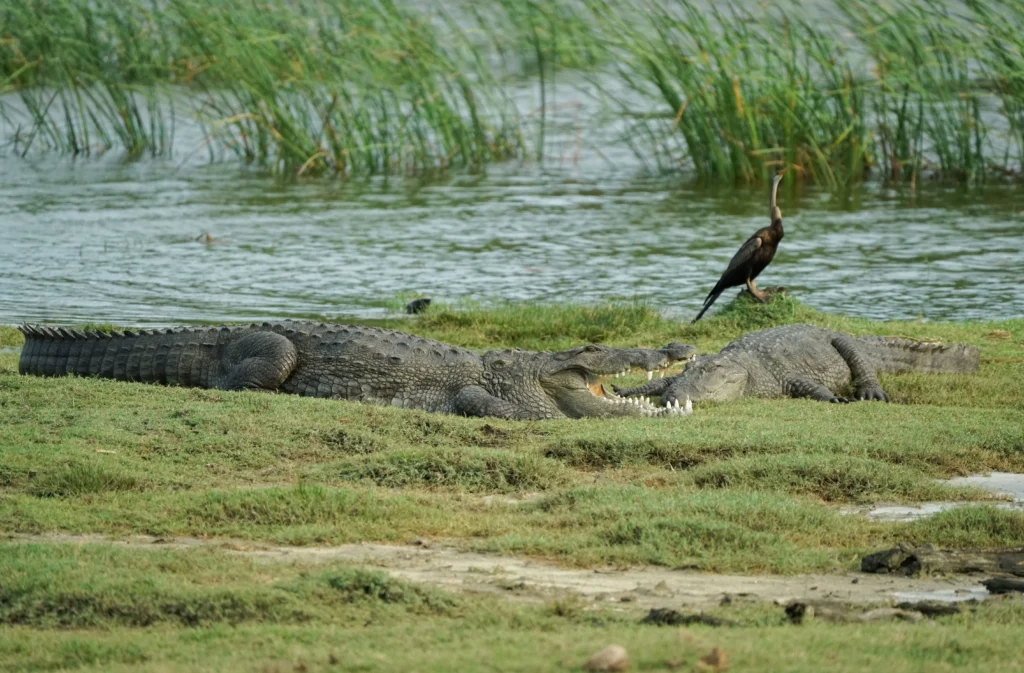
Image: Two mugger crocodiles showcasing their characteristic olive green scales color. Crocodiles usually open their mouths while basking in the sun.
Muggers have a broad snout, a robust body, and powerful jaws suited to handling a wide variety of prey. Their olive-brown colour helps them blend into muddy riverbanks and shallow wetlands.
Compared with the gharial, their head appears wider and shorter. They are also noticeably smaller and more heavily built than the largest saltwater crocodiles.
Where Are Mugger Crocodiles Found?
The mugger has the widest distribution of India’s three crocodilians and has been recorded from at least 18 states. Unlike the other two species, it is not restricted to a particular habitat type.
You may find mugger crocodiles in:
- Rivers
- Natural lakes
- Reservoirs
- Marshes
- Irrigation canals
- Farm ponds
- Village tanks
- Urban rivers
- Seasonal wetlands
- Slow-moving streams
This remarkable adaptability explains why the species has successfully recolonised many landscapes where other crocodilians cannot survive.
Behaviour and Ecology
Mugger crocodiles are primarily ambush predators. They spend much of the day basking on exposed banks or floating almost motionless near the water’s surface before making short, rapid attacks on prey.
Like other crocodilians, they regulate their body temperature through basking and frequently move between sun and shade depending on weather conditions.
Burrows dug into riverbanks also play an important role. These provide shelter during extreme temperatures and help the animals survive periods of drought. Recent urban studies, including work along Gujarat’s Vishwamitri River, have improved scientists’ understanding of basking behaviour, den use, and habitat selection in human-dominated landscapes.
Field Note: During cooler mornings, muggers often remain completely still while basking. This makes them easier to observe and photograph without disturbing their natural behaviour.
What Do Mugger Crocodiles Eat?
Muggers are opportunistic carnivores with a varied diet.
Depending on size and habitat, they may feed on:
- Fish
- Amphibians
- Reptiles
- Water birds
- Small and medium-sized mammals
- Carrion
Their ability to exploit different food sources is one reason they thrive across such a broad range of habitats.
Breeding and Nesting
Female mugger crocodiles typically construct nests on sandy banks or elevated ground close to water. Suitable nesting sites require enough warmth for egg incubation while remaining above seasonal flood levels.
After hatching, females often remain near the nest and assist hatchlings as they reach the water, providing a level of parental care that contributes to juvenile survival.
Conservation Status
The mugger crocodile has become one of India’s major conservation success stories.
Recent conservation assessments estimate that India now supports approximately 10,000–12,000 mugger crocodiles, with populations increasing across many regions. This recovery reflects decades of habitat protection, captive breeding, and reintroduction efforts initiated under the Crocodile Conservation Project.
However, recovery also presents new management challenges. As muggers expand into reservoirs, canals, and urban waterways, wildlife authorities increasingly focus on balancing species conservation with public safety and conflict mitigation.
Saltwater Crocodile (Crocodylus porosus)
The saltwater crocodile is the largest living crocodilian in the world and India’s most powerful reptile. Despite its name, it is not restricted to the sea. In India, it occupies estuaries, mangrove forests, tidal rivers, and coastal wetlands where freshwater mixes with seawater.
How to Identify a Saltwater Crocodile
Saltwater crocodiles have:
- A broad, heavy head
- Massive jaws
- Thick muscular tail
- Powerful body built for both swimming and short bursts of speed
Large adults appear considerably bulkier than mugger crocodiles, particularly around the neck and shoulders.
Where Are Saltwater Crocodiles Found in India?
Unlike the widespread mugger, saltwater crocodiles have a much more restricted distribution.
The principal strongholds are:
- Bhitarkanika National Park (Odisha)
- The Sundarbans
- The Andaman and Nicobar Islands
These landscapes provide the tidal creeks, mangrove channels, mudflats, and estuarine habitats that the species requires.
Behaviour
Saltwater crocodiles are well adapted to coastal ecosystems.
Individuals may move between rivers, estuaries, creeks, and marine environments, taking advantage of changing tides and seasonal conditions.
Like other crocodilians, they spend long periods basking but are equally comfortable remaining submerged with only their eyes and nostrils visible above the water. This behaviour allows them to remain concealed while monitoring their surroundings.
Diet
Saltwater crocodiles are opportunistic predators capable of taking a broad range of prey depending on age and size.
Their diet may include:
- Fish
- Crabs
- Birds
- Reptiles
- Mammals
Large adults occupy the top of the food chain within coastal wetland ecosystems.
Conservation Success in Bhitarkanika
One of India’s greatest conservation achievements is the recovery of saltwater crocodiles in Bhitarkanika National Park.
The 2024 reptile census recorded 1,811 saltwater crocodiles, demonstrating the long-term success of habitat protection and conservation management in this unique mangrove ecosystem.
This makes Bhitarkanika one of the world’s most important protected areas for the species and one of the best places for visitors hoping to observe saltwater crocodiles responsibly.
Photography Tip: Boat safaris in Bhitarkanika often provide eye-level views of basking crocodiles. A telephoto lens allows close-up images without disturbing the animals.
Gharial (Gavialis gangeticus)
The gharial is unlike any other crocodilian in India.
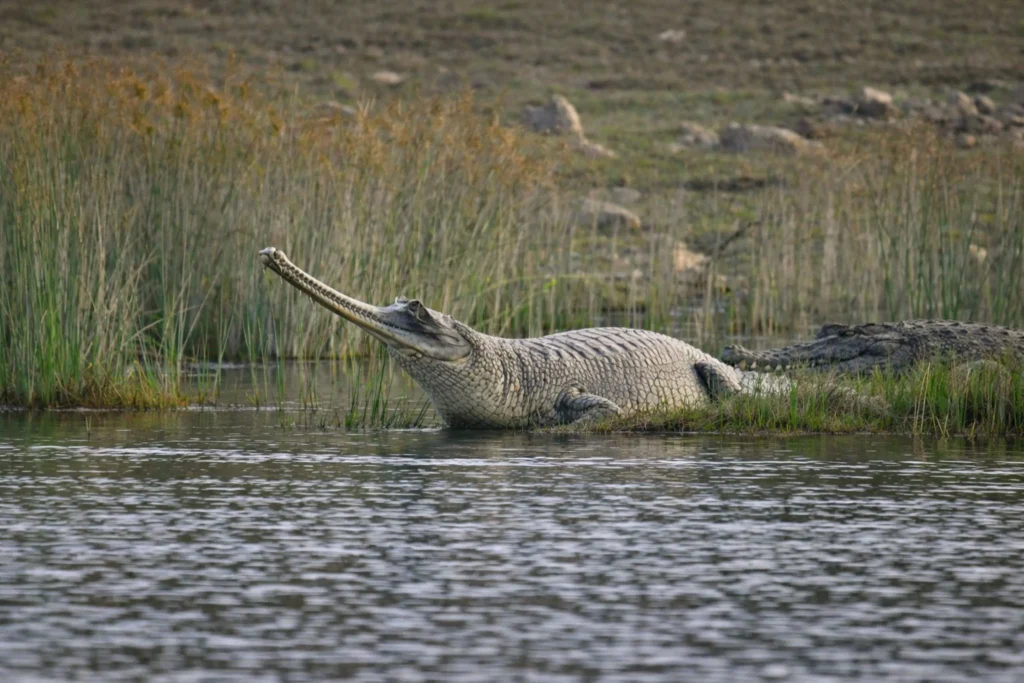
Image: Gharial by a river with its unique snout lifted.
Its long, slender snout immediately distinguishes it from both mugger and saltwater crocodiles, reflecting a highly specialised lifestyle centred on catching fish in large rivers. Because of this unique adaptation, the gharial is considered one of the world’s most distinctive reptiles.
How to Identify a Gharial
The gharial’s defining features include:
- Extremely long, narrow snout
- Numerous sharp interlocking teeth
- Streamlined body
- Relatively weaker limbs for movement on land
Adult males develop a rounded swelling at the tip of the snout, known as the ghara, from which the species derives its common name.
This specialised anatomy allows gharials to catch slippery fish with remarkable efficiency while creating very little resistance in flowing water.
Where Are Gharials Found?
Today, gharials survive mainly in a handful of protected river systems.
Important strongholds include:
- National Chambal Sanctuary
- Katerniaghat Wildlife Sanctuary
- Gandak River
- Corbett landscape
- Son Gharial Sanctuary
India now supports around 80% of the world’s remaining wild gharials, making the country’s river conservation efforts globally significant.
A Specialist Among Crocodilians
Unlike mugger and saltwater crocodiles, gharials depend on:
- Deep, flowing rivers
- Healthy fish populations
- Wide sandy banks for nesting
- Relatively undisturbed river channels
Because these requirements are so specific, gharials are highly sensitive to changes such as dam construction, sand mining, river modification, and declining fish stocks.
For conservationists, healthy gharial populations are often regarded as indicators of healthy river ecosystems.
Diet
The gharial is primarily a fish-eater.
Its slender jaws are not designed for capturing large mammals like those of other crocodilians. Instead, the narrow snout reduces water resistance, allowing rapid sideways movements when catching fish.
This feeding strategy enables gharials to occupy a different ecological niche from mugger crocodiles, even where their ranges overlap.
Conservation Status
The gharial remains the most conservation-dependent of India’s crocodilians.
Recovery efforts continue to focus on:
- Protecting large river systems
- Conserving nesting sandbanks
- Maintaining healthy fish populations
- Captive breeding and reintroduction
- Long-term monitoring of wild populations
Although conservation programmes have prevented extinction, the species continues to require intensive management because of its specialised habitat requirements and the ongoing pressures affecting India’s river ecosystems.
Habitat and Distribution Across India
Each of India’s three crocodilians occupies a distinct ecological niche. While there is some overlap between species, their preferred habitats differ significantly. Understanding these habitat preferences helps explain why muggers are widespread across much of the country, why saltwater crocodiles are largely confined to coastal ecosystems, and why gharials survive only in a handful of protected river systems.
Freshwater Rivers, Lakes and Reservoirs
Freshwater habitats support the largest geographical range of crocodilians in India, particularly the mugger crocodile.
Muggers are remarkably adaptable and can thrive in a variety of freshwater environments, including:
- Large perennial rivers
- Smaller streams
- Natural lakes
- Artificial reservoirs
- Irrigation canals
- Marshes
- Village ponds
- Seasonal wetlands
Unlike many reptiles that depend on relatively undisturbed habitats, muggers often coexist with agriculture and human settlements, provided suitable water bodies and basking sites remain available. This flexibility has played a major role in their recovery across many Indian states.
Estuaries, Mangroves and Coastal Wetlands
Saltwater crocodiles occupy an entirely different environment.
Rather than inland freshwater systems, they are associated with:
- Mangrove forests
- Estuaries
- Tidal rivers
- Coastal creeks
- Brackish lagoons
- Coastal wetlands
These habitats experience regular tidal fluctuations, creating a mixture of fresh and salt water. Saltwater crocodiles are well adapted to these changing conditions and may move considerable distances between rivers, estuaries, and coastal waters.
Some of India’s finest mangrove ecosystems, including Bhitarkanika National Park and the Sundarbans, provide ideal conditions for this species.
Large River Systems
The gharial is the most habitat-specialised of India’s crocodilians.
Instead of occupying lakes or marshes, it depends on:
- Wide rivers
- Deep channels
- Strong water flow
- Abundant fish
- Extensive sandy banks
These sandy banks are essential for nesting, while deep channels provide ideal feeding grounds.
Because these river characteristics have declined in many parts of India due to river modification and habitat degradation, gharials now survive mainly within carefully managed river landscapes.
Field Note: A healthy gharial population usually indicates a healthy river. Their dependence on clean water, fish populations, and undisturbed sandbanks makes them valuable indicators of river ecosystem health.
Urban Waterways
One of the more surprising developments in recent years has been the increasing recognition of crocodiles living in urban environments.
The Vishwamitri River in Vadodara has become an important study area for mugger crocodiles living alongside dense human populations.
Recent research has examined:
- Basking locations
- Den sites
- Feeding behaviour
- Age structure
- Habitat use within the city
These studies demonstrate that crocodiles are capable of adapting to highly modified landscapes when suitable aquatic habitat remains available. They also highlight the importance of managing coexistence between wildlife and people.
State-wise Distribution
Although all three crocodilians occur in India, their ranges differ considerably.
| Species | Major Strongholds |
| Mugger Crocodile | Gujarat, Maharashtra, Madhya Pradesh, Rajasthan, Uttar Pradesh, Goa, Kerala, Tamil Nadu, Odisha, Uttarakhand and many other states |
| Saltwater Crocodile | Odisha (Bhitarkanika), Sundarbans, Andaman & Nicobar Islands |
| Gharial | National Chambal Sanctuary, Katerniaghat, Gandak River, Son Gharial Sanctuary, Corbett landscape |
The mugger has by far the broadest distribution, while saltwater crocodiles and gharials remain concentrated in relatively few strongholds because of their specialised habitat requirements.
Decision Guide: Where Should You Go?
| If you want to see… | Best destination |
| Saltwater crocodiles | Bhitarkanika National Park |
| Gharials | National Chambal Sanctuary |
| Mugger crocodiles | Numerous freshwater reserves across western, central and southern India |
| Urban crocodiles | Vishwamitri River, Vadodara (view only through authorised or guided visits) |
Behaviour, Feeding and Breeding
Although the three species occupy different habitats, they share many behavioural traits that have allowed crocodilians to survive for millions of years. At the same time, each species has evolved feeding strategies and breeding behaviour suited to its own environment.
Basking Behaviour
Crocodilians are ectothermic, meaning they rely on external sources of heat to regulate their body temperature.
Basking serves several important functions:
- Raising body temperature after cool nights
- Supporting digestion
- Conserving energy
- Maintaining normal metabolic processes
Visitors often see crocodiles lying motionless on riverbanks or mudflats during the morning. This apparent inactivity is a normal part of their daily routine rather than a sign that the animal is asleep.
As temperatures rise, crocodiles frequently return to the water or seek shade to avoid overheating.
Burrows and Shelter
Mugger crocodiles are known to excavate burrows in riverbanks and reservoir edges.
These shelters help them:
- Escape extreme heat
- Avoid cold conditions
- Survive seasonal droughts
- Rest during periods of low activity
Recent urban ecology studies have highlighted the importance of these den sites, particularly where crocodiles share landscapes with people. Protecting such features can reduce unnecessary disturbance while supporting healthy crocodile populations.
Feeding Strategies
Although all three crocodilians are carnivores, their diets differ considerably.
Mugger Crocodile
Muggers are generalist predators.
Their varied diet includes:
- Fish
- Amphibians
- Reptiles
- Birds
- Mammals
- Carrion
Their willingness to consume many different prey types contributes to their success across a wide range of habitats.
Saltwater Crocodile
Saltwater crocodiles are also opportunistic hunters.
Depending on their size and habitat, they feed on:
- Fish
- Crustaceans
- Birds
- Reptiles
- Mammals
As apex predators, they play an important role in maintaining ecological balance within coastal wetlands.
Gharial
The gharial occupies a very different ecological niche.
Its long, slender snout allows rapid sideways movements through water, making it highly effective at catching fish.
Unlike the broader-snouted mugger and saltwater crocodile, the gharial is not adapted for capturing large terrestrial prey. Instead, it specialises almost exclusively in aquatic hunting.
Nesting and Reproduction
Successful breeding depends heavily on suitable nesting habitat.
Female crocodilians generally select elevated sandy or earthen sites close to water where eggs can incubate safely above normal flood levels.
Important nesting requirements include:
- Stable riverbanks or sandbanks
- Suitable soil temperature
- Minimal disturbance
- Easy access to water after hatching
For gharials, broad sandy banks along large rivers are particularly important. Their continued availability is one reason river conservation remains central to gharial recovery efforts.
Why Crocodiles Matter to Healthy Wetlands
Crocodiles are more than large predators.
As apex predators and scavengers, they help regulate aquatic food webs and remove dead animals from rivers and wetlands. This contributes to healthier ecosystems and supports the overall balance of freshwater and coastal habitats.
The gharial plays an additional ecological role as an indicator species. Because it requires clean, fish-rich rivers with undisturbed nesting banks, its presence often reflects the health of an entire river ecosystem.
Responsible Tourism Tip
If you encounter crocodiles during a safari, river cruise, or wetland visit:
- Observe from a safe distance.
- Never attempt to attract or feed crocodiles.
- Stay inside authorised boats or viewing areas.
- Follow instructions from guides and forest staff.
- Give basking and nesting animals plenty of space.
Responsible wildlife viewing reduces disturbance while allowing natural behaviour to continue, creating a better experience for both visitors and the animals.
Crocodile Conservation in India
India’s crocodile conservation programme is widely regarded as one of the country’s most successful wildlife recovery initiatives. At a time when all three native crocodilian species faced serious declines due to hunting, habitat loss, and human disturbance, a coordinated national effort helped reverse many of those trends.
The focus has gradually shifted over the decades. Early conservation concentrated on preventing extinction and rebuilding populations. Today, many wildlife managers also work on maintaining habitats, reducing human-crocodile conflict, and ensuring that recovering populations can coexist with people.
The Crocodile Conservation Project (1975–2025)
India launched the Crocodile Conservation Project in 1975, making 2025 the programme’s 50th anniversary. The initiative was developed when crocodilian populations had declined significantly in many parts of the country.
Its major objectives included:
- Protecting remaining wild populations
- Establishing captive breeding centres
- Releasing young crocodiles into suitable habitats
- Creating and strengthening protected areas
- Supporting scientific research and long-term monitoring
The project became one of India’s earliest large-scale reptile conservation programmes and demonstrated that coordinated conservation action could help recover threatened species.
Captive Breeding and Reintroductions
Captive breeding formed a key component of the conservation strategy.
Wildlife authorities collected eggs or hatchlings from vulnerable nests, raised young crocodiles under protected conditions, and later released them into suitable habitats.
These programmes were particularly important for species with small or fragmented populations, especially the gharial.
Combined with habitat protection and improved management of protected areas, captive breeding helped rebuild populations that had declined sharply during the twentieth century.
Protected Areas That Support Crocodilian Recovery
Several protected landscapes now play a central role in crocodile conservation.
Bhitarkanika National Park
Bhitarkanika is India’s best-known stronghold for the saltwater crocodile. Its extensive mangrove forests, tidal creeks, mudflats, and estuarine habitats provide ideal conditions for breeding and long-term population growth.
The park’s regular monitoring programme also contributes valuable scientific data on population trends.
National Chambal Sanctuary
The Chambal River remains one of the world’s most important habitats for the gharial.
Its relatively clean water, deep channels, and wide sandy banks provide the conditions required for successful breeding and survival.
The sanctuary also protects other river wildlife, making it one of India’s most important freshwater conservation landscapes.
Other Important Landscapes
Additional areas supporting crocodilian conservation include:
- Katerniaghat Wildlife Sanctuary
- Satkosia
- Son Gharial Sanctuary
- Corbett landscape
- Gandak River
- Sundarbans
- Andaman & Nicobar Islands
Each landscape protects different habitats and contributes to the conservation of one or more crocodilian species.
Population Recovery
Recent conservation assessments show encouraging trends for two of India’s crocodilian species, although recovery has not been uniform.
Mugger Crocodile
Recent estimates suggest India now supports approximately 10,000–12,000 mugger crocodiles, with populations increasing across many regions.
The species has benefited from its adaptability, allowing it to occupy a wide variety of freshwater habitats beyond protected areas.
Saltwater Crocodile
The 2024 Bhitarkanika reptile census recorded 1,811 saltwater crocodiles, highlighting the continued importance of this protected mangrove ecosystem for the species.
Gharial
Although gharials remain much more restricted than the other two species, India now supports around 80% of the world’s remaining wild gharial population.
Continued recovery depends on maintaining healthy river systems rather than simply increasing crocodile numbers. Protecting nesting sandbanks, conserving fish populations, and reducing river degradation remain central priorities.
Population Recovery Snapshot
| Species | Current Trend | Key Conservation Focus |
| Mugger Crocodile | Increasing in many regions | Coexistence with people, habitat protection |
| Saltwater Crocodile | Stable and recovering in major strongholds | Mangrove and estuarine habitat conservation |
| Gharial | Recovering but still conservation-dependent | River restoration, nesting habitat protection, captive breeding |
Challenges That Remain
Despite encouraging progress, crocodile conservation is far from complete.
Current threats include:
- Habitat loss
- River fragmentation
- Sand mining
- Dams and altered river flows
- Water pollution
- Accidental capture in fishing nets
- Road mortality
- Retaliatory killing following conflict with people
Many of these threats affect aquatic ecosystems as a whole, meaning conservation efforts benefit numerous other species in addition to crocodilians.
Human-Crocodile Conflict
As crocodile populations recover, interactions between people and crocodiles have become more common in some areas.
This is particularly true where expanding human settlements overlap with rivers, reservoirs, irrigation systems, and wetlands occupied by mugger crocodiles.
The goal of modern wildlife management is therefore not simply species recovery, but enabling long-term coexistence between people and crocodiles.
Why Do Conflicts Occur?
Most incidents arise when people and crocodiles use the same water bodies.
Common situations include:
- Fishing
- Bathing
- Washing clothes
- Collecting water
- Livestock entering rivers
- Recreational activities close to crocodile habitat
Recovering crocodile populations also mean that more animals are occupying habitats where people already live and work.
Urban Crocodiles
One of the best-known examples of urban coexistence comes from the Vishwamitri River in Vadodara.
Rather than treating these crocodiles solely as a conflict issue, researchers have studied their behaviour, den locations, basking sites, and movement patterns to better understand how wildlife and cities can coexist.
These studies are helping wildlife managers develop more informed approaches to reducing conflict while protecting crocodile populations.
Conflict Hotspots
Conflict does not occur uniformly across India.
Instead, it tends to be concentrated in landscapes where:
- Human populations are dense.
- Water resources are heavily shared.
- Crocodile numbers have recovered.
- Natural habitats overlap with villages or towns.
Understanding these local conditions is more useful than assuming all crocodile habitats present the same level of risk.
Practical Safety Advice for Visitors
Most wildlife travellers observe crocodiles safely by following basic precautions.
Stay on designated routes
Whether on a safari, river cruise, or nature trail, remain within authorised viewing areas.
Never approach basking crocodiles
A crocodile that appears inactive can enter the water surprisingly quickly if disturbed.
Keep a safe distance from the water’s edge
Avoid standing close to riverbanks, particularly where visibility is poor or warning signs are present.
Follow local guidance
Forest staff and experienced naturalist guides understand local crocodile behaviour and seasonal conditions. Their advice should always take priority.
Never feed crocodiles
Feeding encourages animals to associate people with food and increases the likelihood of dangerous encounters.
Responsible Tourism Tip
Responsible wildlife tourism benefits both visitors and crocodiles.
Choose operators that:
- Follow protected-area regulations.
- Maintain appropriate viewing distances.
- Avoid disturbing basking or nesting animals.
- Support conservation and local communities.
Observing crocodiles behaving naturally is far more rewarding than attempting to get unnecessarily close for photographs.
Best Places to See Crocodiles in India
For wildlife enthusiasts, India offers several excellent destinations to observe crocodilians in their natural habitats.
| Destination | Best Known For | Species |
| Bhitarkanika National Park | Mangroves and tidal creeks | Saltwater Crocodile |
| National Chambal Sanctuary | Large river ecosystem | Gharial |
| Sundarbans | Mangrove delta | Saltwater Crocodile |
| Andaman & Nicobar Islands | Coastal wetlands | Saltwater Crocodile |
| Satkosia | River gorge ecosystem | Mugger Crocodile |
| Katerniaghat Wildlife Sanctuary | River conservation | Gharial |
| Vishwamitri River, Vadodara | Urban crocodile ecology | Mugger Crocodile |
Decision Guide: If your primary goal is photography, Bhitarkanika offers the best opportunities for observing saltwater crocodiles from boats. If you want to see gharials, the Chambal River provides one of the most reliable locations. For those interested in the adaptable mugger crocodile, freshwater wetlands across western and central India offer numerous opportunities.
Common Misconceptions About Crocodiles in India
Misunderstandings about crocodiles are widespread. Some arise from confusing the three species, while others stem from sensational media coverage that overlooks their ecological importance and conservation history.
Here are some of the most common myths.
“India Has Only One Crocodile Species”
Incorrect.
India has three native crocodilian species:
- Mugger crocodile (Crocodylus palustris)
- Saltwater crocodile (Crocodylus porosus)
- Gharial (Gavialis gangeticus)
Each occupies different habitats, has distinct physical characteristics, and faces different conservation challenges.
“A Gharial Is Just Another Crocodile”
Not exactly.
Although gharials belong to the crocodilian order, they represent a separate evolutionary lineage with highly specialised adaptations. Their long, narrow snout and fish-based diet distinguish them from the broader-snouted crocodiles found elsewhere in India.
“Crocodiles Live Only in Remote Forests”
This is only partly true.
While saltwater crocodiles and gharials depend largely on protected coastal wetlands and major river systems, mugger crocodiles are remarkably adaptable.
They are found in:
- Reservoirs
- Irrigation canals
- Village ponds
- Urban rivers
- Agricultural landscapes
- Protected wetlands
The growing mugger population in Vadodara’s Vishwamitri River is one of the best-known examples of crocodiles living alongside dense human populations.
“All Crocodiles Are Equally Dangerous”
Risk varies considerably.
Several factors influence the likelihood of conflict, including:
- Species
- Animal size
- Habitat
- Human activity
- Local conditions
Most wildlife tourists observe crocodiles safely by following park regulations, maintaining a respectful distance, and avoiding unnecessary risks near water.
“Crocodile Recovery Means Conservation Is Complete”
Population recovery is an important achievement, but it does not mean conservation work is finished.
Modern conservation increasingly focuses on:
- Maintaining suitable habitat
- Restoring river ecosystems
- Reducing conflict with people
- Monitoring populations
- Supporting coexistence in shared landscapes
For the gharial in particular, long-term survival depends as much on healthy rivers as on the number of animals.
Practical Checklist for Visitors
If you plan to visit wetlands, rivers, or mangrove habitats where crocodiles occur, the following precautions will help ensure both your safety and the welfare of the animals.
Before Your Visit
✔ Research which crocodilian species occurs in the area.
✔ Visit recognised protected areas whenever possible.
✔ Hire experienced local naturalist guides.
✔ Carry binoculars or a telephoto lens instead of planning to approach wildlife.
While Watching Crocodiles
✔ Stay on designated trails and boat routes.
✔ Keep a safe distance from basking animals.
✔ Never feed crocodiles.
✔ Avoid disturbing nesting sites.
✔ Listen to forest staff and boat operators.
✔ Remain alert near riverbanks, particularly where visibility is limited.
Photography Checklist
✔ Use a telephoto lens.
✔ Avoid sudden movements.
✔ Do not request boat operators to move closer than permitted.
✔ Focus on natural behaviour rather than close-up portraits.
✔ Respect other wildlife sharing the habitat.
Frequently Asked Questions
How many crocodile species are found in India?
India has three native crocodilian species: the mugger crocodile, the saltwater crocodile, and the gharial.
Which is the largest crocodile in India?
The saltwater crocodile (Crocodylus porosus) is the largest crocodilian found in India and the largest living crocodilian species in the world.
Is the gharial actually a crocodile?
The gharial belongs to the crocodilian order but differs significantly from true crocodiles in appearance, behaviour, and ecology. Its long, narrow snout is specially adapted for catching fish.
Where can I see saltwater crocodiles in India?
The best places include:
- Bhitarkanika National Park
- The Sundarbans
- The Andaman & Nicobar Islands
These regions contain the estuaries and mangrove habitats preferred by the species.
Where are gharials found?
Important populations survive in:
- National Chambal Sanctuary
- Katerniaghat Wildlife Sanctuary
- Gandak River
- Son Gharial Sanctuary
- Corbett landscape
India supports the majority of the world’s remaining wild gharials.
Are mugger crocodiles found only in rivers?
No.
Muggers are highly adaptable and also inhabit lakes, reservoirs, marshes, irrigation canals, ponds, and even urban waterways.
Why are crocodiles found in cities like Vadodara?
The Vishwamitri River provides suitable aquatic habitat, allowing mugger crocodiles to survive within an urban environment. Ongoing research is helping wildlife managers improve coexistence between people and crocodiles.
What do Indian crocodiles eat?
Their diets vary by species.
- Mugger crocodiles are opportunistic predators feeding on fish, amphibians, reptiles, birds, mammals, and carrion.
- Saltwater crocodiles consume fish, crustaceans, birds, reptiles, and mammals.
- Gharials feed primarily on fish using their specialised long snout.
Are crocodiles dangerous to tourists?
Serious incidents involving wildlife tourists are uncommon when visitors follow park rules.
Maintaining a safe distance, avoiding riverbanks in crocodile habitats, and listening to guides are the best ways to reduce risk.
Why are gharials important for river conservation?
Because gharials require clean, flowing rivers with abundant fish and undisturbed sandbanks, healthy gharial populations often indicate healthy river ecosystems. Their conservation benefits many other freshwater species.
Conclusion
India’s crocodilians represent three very different evolutionary strategies for surviving in aquatic environments.
The adaptable mugger crocodile thrives in an extraordinary variety of freshwater habitats, from reservoirs and marshes to urban rivers. The saltwater crocodile dominates coastal estuaries and mangrove forests, where it remains an apex predator. The gharial, with its slender snout and fish-specialised lifestyle, depends on healthy river systems that are increasingly rare.
Together, these species tell one of India’s most encouraging conservation stories. Since the launch of the Crocodile Conservation Project in 1975, decades of habitat protection, captive breeding, scientific research, and protected-area management have helped many crocodile populations recover. Yet the work continues. Habitat degradation, river modification, pollution, fishing pressures, and human-wildlife conflict remain ongoing challenges, particularly for the gharial and for crocodiles living close to people.
For wildlife travellers, crocodiles offer more than the chance to see one of the world’s oldest reptile groups. They provide a window into the health of India’s rivers, wetlands, mangroves, and estuaries. Visiting destinations such as Bhitarkanika National Park, the National Chambal Sanctuary, or other protected wetlands with experienced guides allows visitors to appreciate these reptiles responsibly while supporting the conservation of the ecosystems they inhabit.
Ultimately, protecting crocodiles is about far more than safeguarding a single group of reptiles. It is about conserving the rivers, wetlands, and coastal landscapes on which countless other species—and many human communities—also depend.