
Discover the most common birds spotted across India’s cities, wetlands, and open country. Learn to identify them accurately using data-backed field cues.
Introduction to India’s Common Bird Species
If you want to start birdwatching in India without becoming overwhelmed by the sheer volume of species, you must begin by learning the birds right outside your door. You do not need to travel to remote wilderness areas or deep forest sanctuaries to build a strong baseline of ornithological knowledge. Human-dominated landscapes—such as city parks, backyard gardens, agricultural edges, and local municipal lakes—provide immediate access to a wide array of avian behavior and identification opportunities.
Focusing your early attention on widespread, frequently encountered birds establishes a critical point of reference. Once you thoroughly understand the silhouette, flight pattern, and behavioral traits of a highly common urban or rural resident, you can instantly recognize when an unusual or migratory bird enters the area. This practical guide breaks down the birds most frequently seen across India, grouping them by their primary habitats to make field identification as straightforward as possible.
Understanding the Data: How This List Was Chosen
The Role of Citizen Science and eBird India
If you are wondering how naturalists and researchers determine which birds are truly widespread across India, the answer lies in large-scale citizen science datasets rather than isolated academic studies. The baseline for identifying common species relies heavily on platforms like eBird India. This platform allows thousands of amateur birdwatchers, safari guides, and professional researchers to upload standardized checklists from the field.
The scale of this collaborative data-gathering effort provides an incredibly accurate, real-time map of avian distribution across the country. The primary benchmark for modern Indian ornithology is the landmark State of India’s Birds 2023 report. This comprehensive national assessment evaluated 942 bird species that occur regularly within the country. Rather than relying on guesswork or localized observations, the assessment analyzed roughly 30 million field observations contributed by more than 30,000 distinct birdwatchers.
Citizen Science Scale (State of India’s Birds 2023):
├── Observations Analyzed: ~30 Million
├── Active Contributors: 30,000+ Birdwatchers
└── Species Regularly Assessed: 942
This massive pool of observations ensures that when a species is labeled as “commonly spotted,” that designation is backed by hard numbers across multiple geographic regions.
Habitat Specialists vs. Generalists
When analyzing which birds you are most likely to spot, it helps to understand the difference between a habitat specialist and a habitat generalist. This distinction explains why certain birds are found almost everywhere, while others remain tied to very specific terrains.
- Habitat Generalists: These are highly adaptable species that thrive in a variety of environments. They adjust easily to changing landscapes, altering their diets and nesting habits to use human structures, open lawns, and urban waste. Because they are not dependent on a single type of vegetation or climate, their range sizes are expansive, making them the most commonly spotted birds across India.
- Habitat Specialists: These birds rely on specific, undisturbed ecosystems, such as pristine grasslands, mature forest canopies, or intact coastal mudflats. Because their survival is linked to the health of a specific habitat, they rarely venture into urban areas or farmland.
By focusing on generalists and locally abundant specialists, this guide highlights the specific species you are practically guaranteed to encounter during your travels and daily walks.
Birds Commonly Seen in Cities and Parks
If you are a beginner birdwatcher, urban parks and housing colonies are the best places to start your practice. Urban birds do not belong to a separate taxonomic group; rather, they are highly adaptable species that have successfully adjusted to human-dominated landscapes. They utilize concrete structures for nesting and rely on human food waste, garden fruit trees, and ornamental plants for sustenance.
Because these birds are habitat generalists, they tolerate noise and proximity to people, making them exceptionally easy to observe and photograph without specialized equipment.
Urban Adaptations and Key Resident Species
The following species are residents, meaning they remain in India year-round rather than migrating. You will likely hear them before you see them.
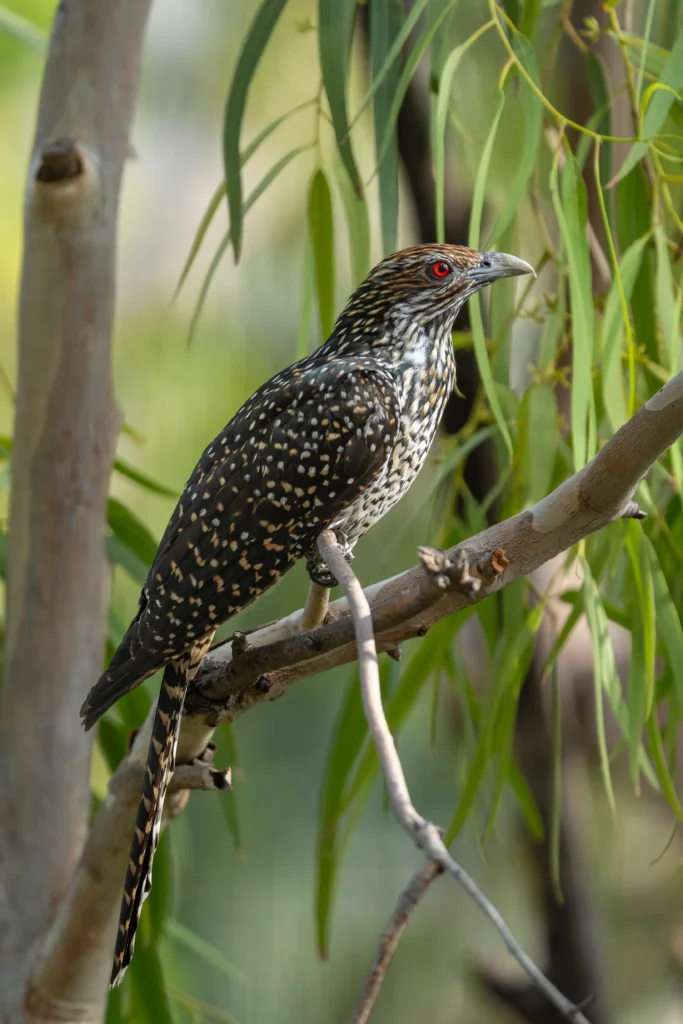
- Asian Koel (Eudynamys scolopaceus): Known for its loud, escalating ko-oo call during the summer, this bird is a staple of Indian cities. The male is glossy black with striking red eyes, while the female is brown with heavy white spotting. According to the State of India’s Birds 2023 report, the Asian Koel is currently doing very well and expanding its footprint.
- House Crow (Corvus splendens): A highly intelligent scavenger identified by its glossy black plumage and contrasting grey neck. Observers often ask if they are still common. Because they are supreme generalists that thrive on urban waste, they remain one of the most widespread birds in the country.
- House Sparrow (Passer domesticus): Small, chunky brown birds with stout bills. Males have a distinct black throat patch. While there is frequent concern over their numbers in highly concretized metropolitan centers, they remain commonly distributed across the subcontinent wherever there are crevices for nesting and spilled grain.
- Common Myna (Acridotheres tristis): Easily identified by its brown body, black hood, and bright yellow skin behind the eye. They are confident, ground-feeding birds often seen strutting across lawns in pairs or noisy flocks.
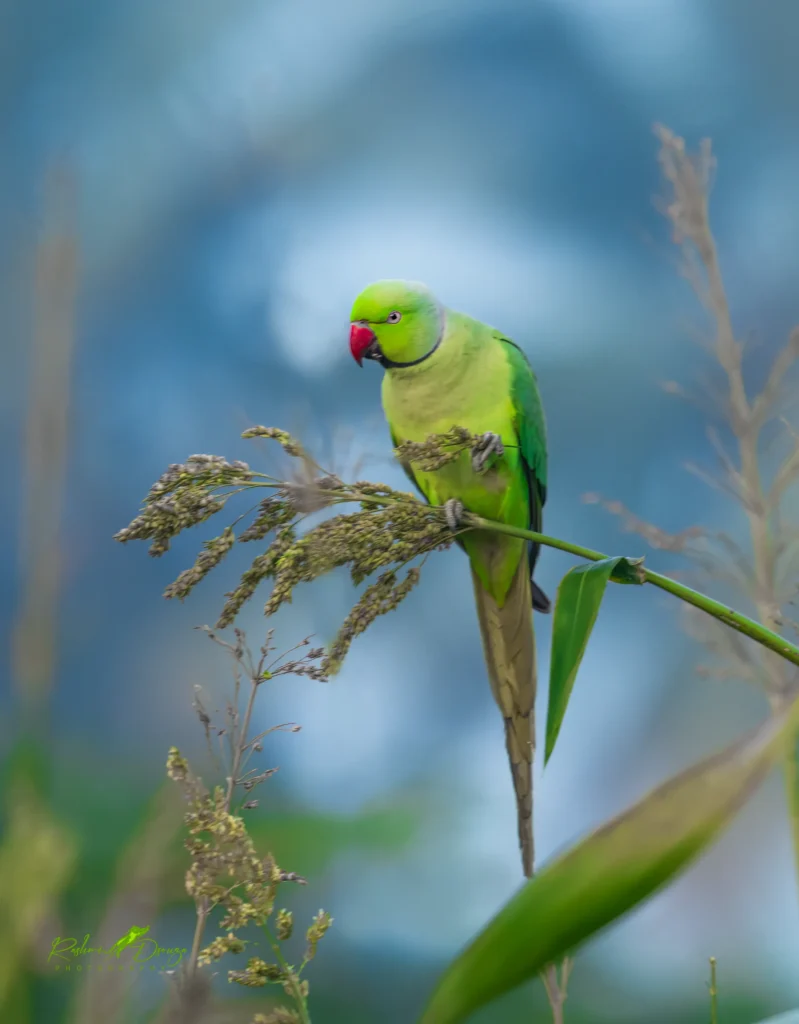
- Rose-ringed Parakeet (Psittacula krameri): A bright green parrot with a long, pointed tail. Adult males develop a distinct rose-and-black neck ring. They nest in the cavities of large older trees found in municipal parks and are easily spotted flying rapidly in screeching flocks at dusk.
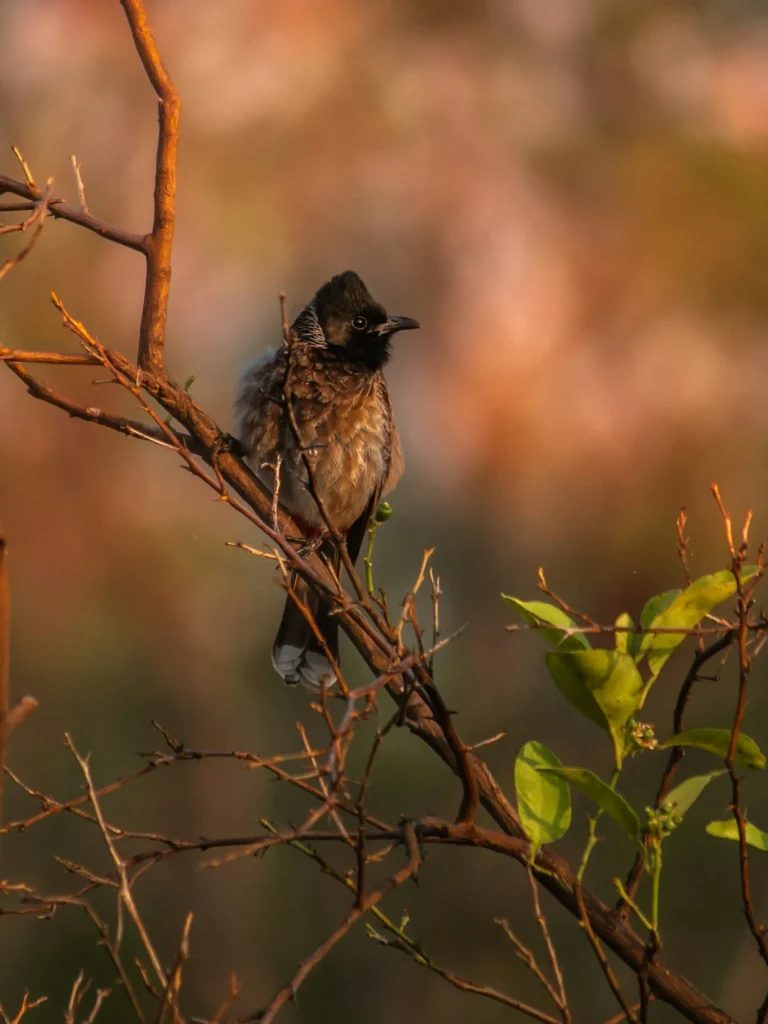
- Red-vented Bulbul (Pycnonotus cafer): A medium-sized, smoky-brown bird with a short crest on its head and a bright red patch beneath its tail (the vent). They are a constant presence in backyard gardens, feeding on berries and small insects.
Expert Tip: If you want to practice identifying birds by their calls, begin with the Asian Koel and Common Myna. Their vocalizations are loud, distinct, and repeat frequently throughout the morning, providing an excellent baseline for auditory identification.
Birds Common in Farmland and Open Country
Agricultural landscapes, village outskirts, and dry scrublands host a different set of birds. These open areas provide exposed ground for foraging and scattered trees, telephone wires, or fence posts that serve as hunting perches.
While some adaptable species thrive in these heavily modified agricultural spaces, it is critical to note that widespread grassland species—which rely on undisturbed, native grasses—are showing broad population declines across India.
Agricultural Landscapes and Edge Species
When traveling by train or driving along rural highways, these are the birds you will most frequently spot perched on utility wires or foraging in freshly plowed fields.
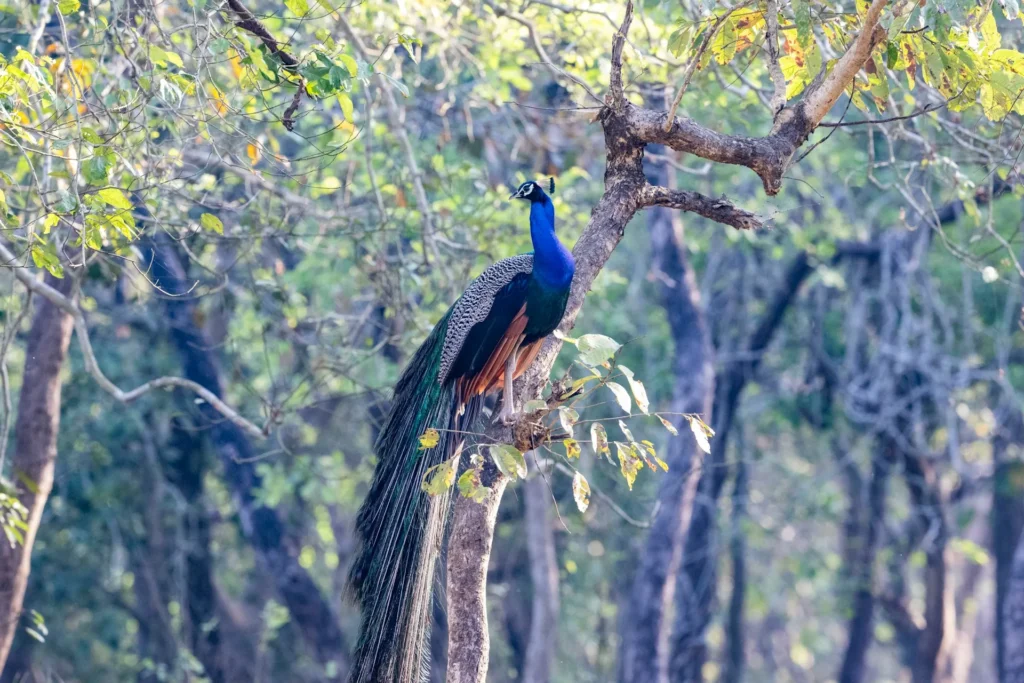
- Indian Peafowl (Pavo cristatus): The national bird of India is unmistakable, with the male sporting a massive, iridescent tail train. The State of India’s Birds 2023 report highlights that the Indian Peafowl is doing remarkably well, showing a clear upward population trend as it successfully colonizes agricultural edges and dry habitats.
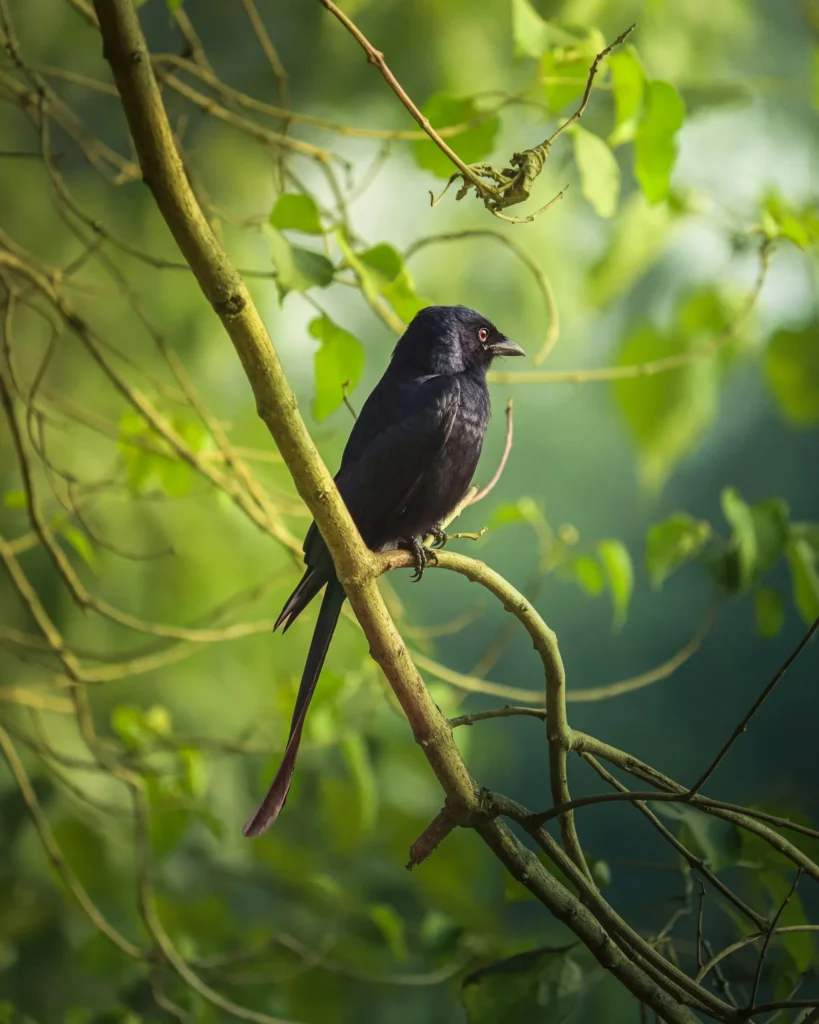
- Black Drongo (Dicrurus macrocercus): A slender, completely black bird with a deeply forked tail. It is an aggressive, agile flier often seen perched on wires or riding on the backs of cattle to catch insects stirred up from the grass. Its distinct silhouette makes it very easy to identify.
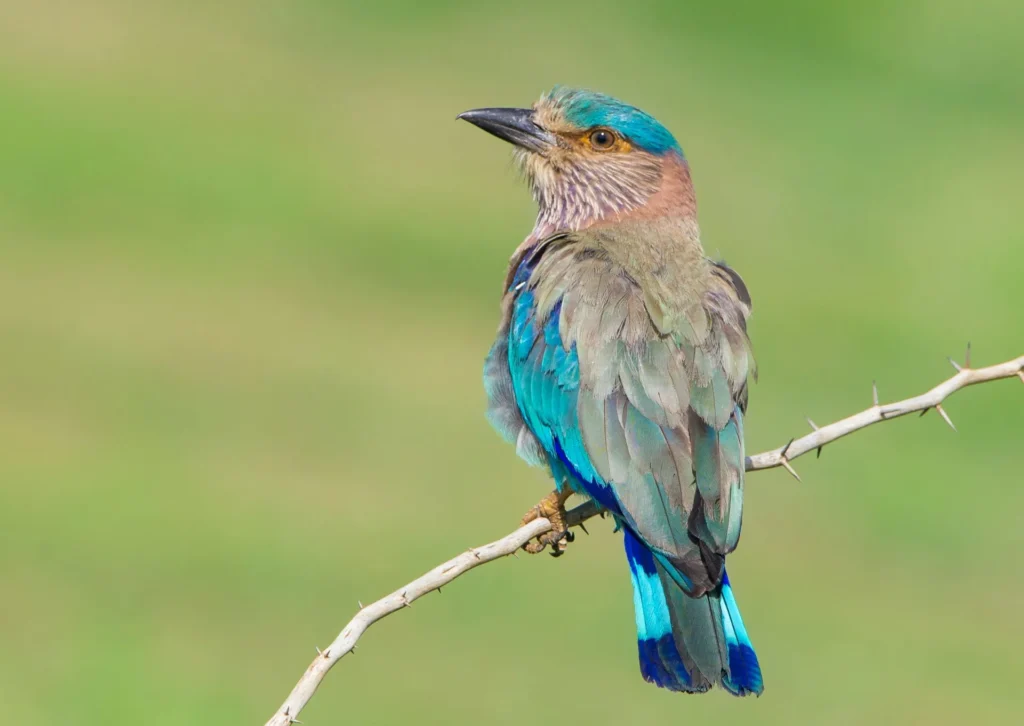
- Indian Roller (Coracias benghalensis): When perched, this stocky bird looks relatively plain with a brownish breast. However, when it takes flight, it reveals brilliant bands of turquoise and deep blue across its wings. They are sit-and-wait predators that hunt large insects from exposed perches.
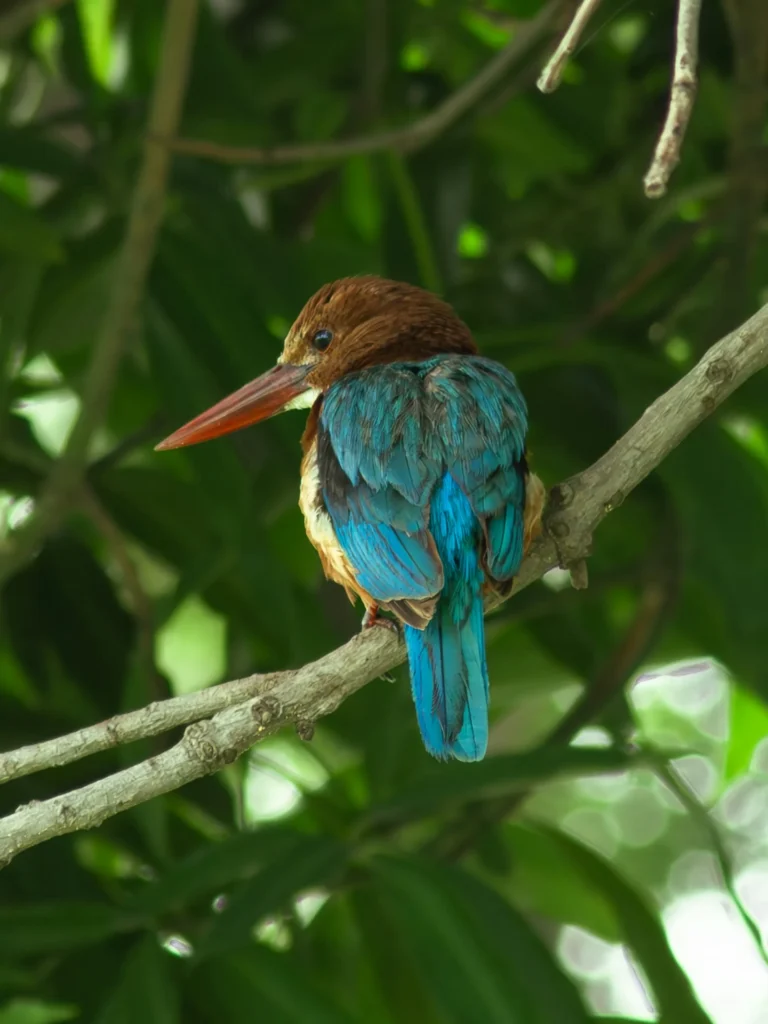
- White-throated Kingfisher (Halcyon smyrnensis): Unlike many kingfishers, this common resident does not require water to survive. It is frequently seen in dry farmland, marked by its bright electric-blue back, heavy red bill, and stark white throat. It hunts lizards, rodents, and large insects.
- Green Bee-eater (Merops orientalis): A tiny, vibrant green bird with a rusty crown, a black throat band, and central tail feathers that extend into sharp pins. They are highly social and often line up together on branches or wires, flying out in quick, acrobatic loops to catch bees and wasps in mid-air.
Comparing City and Farmland Habitats
Understanding the primary differences between these environments will help you set realistic expectations for what you can spot on a given day.
Table 1: Primary Indian Bird Habitats and Common Species Categories
| Habitat Type | Key Characteristics | Representative Species | Visibility Ease |
| Cities & Urban Parks | High concrete density, artificial lawns, ornamental trees, abundant human food waste. | House Crow, Common Myna, Rose-ringed Parakeet, Asian Koel. | Very High. Birds are habituated to human presence and easy to approach. |
| Farmland & Open Country | Plowed fields, scattered large trees, utility wires, open scrub perimeters. | Indian Peafowl, Black Drongo, Indian Roller, Green Bee-eater. | High. Birds use exposed perches (wires, posts), making them highly visible from roads. |
Field Note: The concept of an “edge habitat”—where a village meets a farm, or a farm meets a scrub forest—is crucial for birdwatching. These transitional zones consistently yield the highest variety of species because they offer the feeding opportunities of open country combined with the safety and roosting potential of trees.
Birds Common Near Water and Wetlands
Whether you are visiting a recognized sanctuary or simply walking around a municipal lake, waterbodies attract a high concentration of birdlife. These environments are highly productive, offering easy viewing opportunities because the lack of dense tree cover leaves the birds exposed. However, the State of India’s Birds 2023 report highlights that while some adaptable water birds are holding steady, there are broad, worrying declines across wetland-dependent ducks and migratory shorebirds.
Lake, River, and Wetland Indicators
The following species are highly reliable indicators of nearby fresh water. You will frequently find them wading in shallows, resting on mudbanks, or foraging in flooded agricultural fields.
- Indian Pond Heron: (Often called the paddybird). While standing still at the water’s edge, it appears as a stocky, well-camouflaged brown bird. However, it flashes stark white wings the moment it takes flight.
- Little Egret: A slender, pure white heron with black legs and distinct yellow feet. It is commonly seen wading in shallow water, using its feet to stir up small fish.
- Red-wattled Lapwing: A noisy, long-legged bird found near almost any water source. It is easily identified by its brown back, black breast, red fleshy eye wattle, and loud, frantic did-he-do-it call.
- Indian Spot-billed Duck: A large, resident dabbling duck. Look for the bright yellow tip on its black bill and the distinct green patch on its wing during flight.
- Little Cormorant: A completely black waterbird often seen diving for fish or perching on dead trees with its wings spread wide open to dry in the sun.
Distinguishing Common Wintering Ducks and Waterfowl
Not all birds you see in Indian wetlands are year-round residents. During the winter months, vast numbers of migratory birds arrive from Central Asia and Europe. Migratory birds are not necessarily rare; in fact, many winter migrants are seasonal and locally abundant during peak months.
Identifying winter migrants often comes down to recognizing flocking behavior. While resident species might be seen in small numbers, winter migratory ducks and geese often congregate in large rafts on the open water. Monitoring these flocks is important, as national data indicates broad population declines among many migratory duck species.
Birds Common Along Coasts
Coastal mudflats and estuaries provide rich feeding grounds where river systems meet the sea. These tidal zones expose vast stretches of nutrient-rich mud, attracting specialized foragers.
Estuary and Mudflat Foragers
- Brahminy Kite: A medium-sized raptor with a striking white head and breast that contrasts sharply with its rich chestnut body. It is a common scavenger along beaches, estuaries, and fishing harbors.
- Migratory Shorebirds: Small wading birds, such as sandpipers and plovers, are frequently spotted running rapidly along the waterline probing for invertebrates. Keep in mind that these groups require intact coastal habitats, and recent data shows widespread population declines among migratory shorebirds.
Photography Tip: When photographing shorebirds or wetland birds, lower your physical profile. Crouching or sitting quietly near the water’s edge breaks your human silhouette, allowing birds to forage much closer to you naturally without feeling threatened.
Birds Common in Forests and Scrub
Deep, pristine forests often yield fewer sightings for beginners because the dense upper canopy obscures the birds. The most productive birdwatching actually happens at forest edges, in secondary woodlands, and amid dense shrubbery. It is important to note that birds entirely dependent on intact, old-growth forests—known as habitat specialists—are currently facing severe population pressures across India.
Secondary Woodlands and Dense Shrubbery
The birds below are commonly found in wooded areas, scrub forests, and heavily planted estates.
- Jungle Babbler: Known colloquially as the “Seven Sisters” because they almost always travel in noisy, social flocks of six to ten birds. They are dusty brown with pale yellow eyes, frequently seen aggressively tossing dead leaves on the forest floor to find insects.
- Oriental Magpie-Robin: A striking black-and-white bird (females are dark grey and white) with a long tail that it frequently holds cocked upright. It prefers wooded edges and is known for its complex, melodic songs, especially early in the morning.
- Common Tailorbird: A tiny, energetic olive-green bird with a rust-colored crown. It gets its name from its habit of stitching leaves together with plant fibers or spider silk to create a pouch for its nest. You will often hear its loud, repetitive cheewit-cheewit call from deep within dense bushes before you see it.
- Coppersmith Barbet: A small, chunky green bird with a crimson forehead and throat. It is heavily camouflaged in the canopy, but its call is a highly distinctive, repetitive took-took-took that sounds exactly like a coppersmith striking metal with a hammer.
Practical Field Identification Tips for Beginners
Many first-time birdwatchers struggle because they rely entirely on color to identify a species. In the field, lighting conditions constantly change. A bright green bird can look entirely black when perched high in a tree against a bright sky. To accurately identify Indian birds, you must build a framework based on structural cues and behavioral patterns before looking at plumage.
Identifying Birds by Silhouette, Size, and Behavior
When you spot an unfamiliar bird, quickly assess its shape and actions rather than rushing to find its exact color in a guidebook.
- Size Referencing: Never estimate size in inches or centimeters. Instead, compare the unknown bird to familiar yardsticks. Is it sparrow-sized, pigeon-sized, or crow-sized?
- Beak Shape: The bill dictates the bird’s diet. A short, thick, conical beak indicates a seed-eater (like a sparrow). A long, dagger-like bill belongs to a fish-hunter (like a kingfisher or heron). A tiny, thin bill points to an insectivore (like a tailorbird).
- Foraging Behavior: Notice where and how the bird feeds. Does it aggressively flip dead leaves on the ground (babblers)? Does it sit motionless on a wire and launch into the air to catch flying insects (drongos and bee-eaters)? Does it wade in shallow water (egrets)?
- Flight Patterns: Watch how the bird moves through the air. Woodpeckers and barbets often have an undulating, roller-coaster flight path. Pigeons and ducks fly in direct, rapid, straight lines.
Understanding Seasonality: Resident Birds vs. Winter Migrants
A common mistake is assuming that all Indian birds are found nationwide year-round. In reality, bird availability changes significantly by season and region. Understanding the difference between resident and migratory species helps you know exactly what to expect during different months.
Migratory birds are not necessarily rare; some are strictly seasonal but become locally abundant when they arrive. There is often significant seasonal overlap between resident birds and winter migrants sharing the same feeding grounds.
Table 2: Seasonal Residency Profiles
| Category | Definition | Peak Observation Time | Common Examples |
| Year-Round Residents | Species that remain in India throughout the year to breed and forage. | Visible year-round. Often easiest to spot during their summer breeding season when calling frequently. | House Crow, Asian Koel, Indian Peafowl, White-throated Kingfisher. |
| Winter Migrants | Birds that travel from Central Asia, Europe, or the Himalayas to escape freezing winters. | November to February. Often found congregating in large flocks on wetlands. | Northern Shoveler, Bar-headed Goose, various sandpipers. |
| Local/Passage Migrants | Species that move regionally within India based on monsoons or altitude. | Transitional months (March-April or September-October). | Pied Cuckoo (arrives just ahead of the monsoon). |
Commonly Confused Birds: Avoiding Beginner Pitfalls
Field-identification pitfalls are incredibly common for beginners. India hosts several distinct species that share overlapping habitats and strikingly similar silhouettes. Learning to separate these “confusion pairs” is a major milestone in practical birdwatching.
Look-Alike Species and Distinguishing Field Marks
When you encounter two birds that look nearly identical, you must look for one specific “field mark”—a unique physical trait or behavior that definitively separates them.
Table 3: Common Identification Pitfalls and Look-Alike Pairs
| Bird 1 | Bird 2 | Shared Characteristics | Key Distinguishing Field Mark |
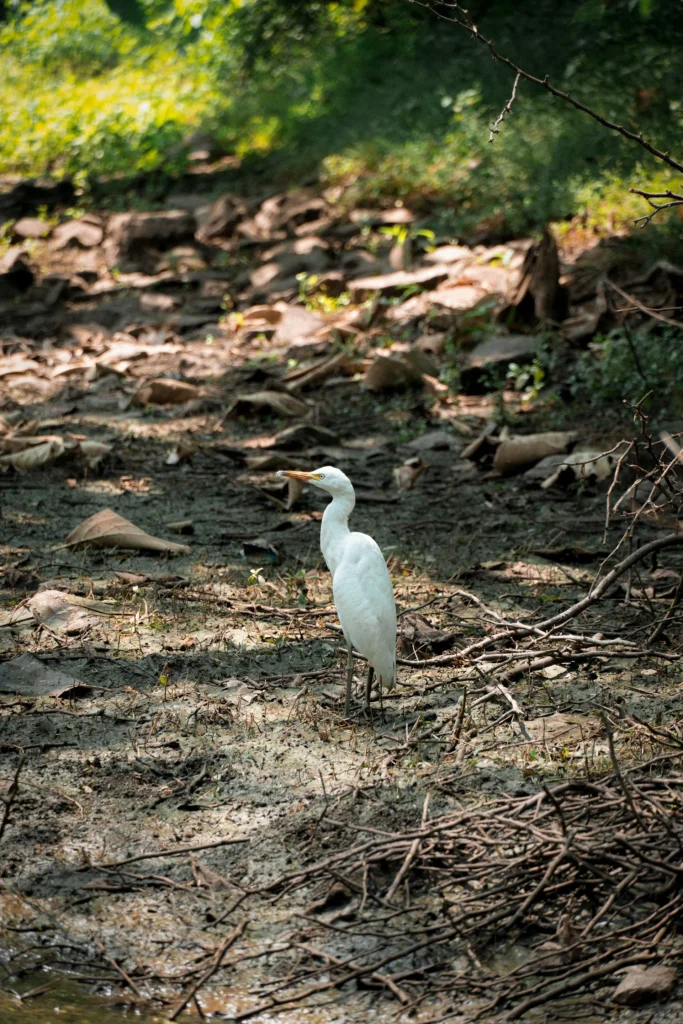
| Little Egret | Cattle Egret | Small, pure white herons often found near water or open fields. | The Little Egret has a black beak and black legs with distinct yellow feet. The Cattle Egret has a yellow beak and dark legs. |
| House Crow | Large-billed Crow (Jungle Crow) | Widespread, highly adaptable black corvids. | The House Crow has a distinct grey neck and collar. The Large-billed Crow is entirely glossy black with a noticeably thicker beak. |
| Black Drongo | Ashy Drongo | Slender birds with deeply forked tails, hunting from wires and branches. | The Black Drongo is deep glossy black. The Ashy Drongo is slate-grey with distinct red eyes. |
| Indian Pond Heron | Striated Heron | Small, stocky herons that stand motionless near the water’s edge. | When the Indian Pond Heron takes flight, it flashes stark white wings. The Striated Heron’s wings remain dark in flight. |
| Brown Rock Chat | Female Indian Robin | Small, brown, ground-dwelling birds found in dry, rocky, or urban areas. | The female Indian Robin has a distinct rusty-red patch under her tail (the vent). The Brown Rock Chat is uniformly earthy-brown. |

Decision Guide: If you are unsure which bird you are looking at, write down the beak color, leg color, and tail shape immediately. Do not try to memorize the exact shade of feathers. These three structural cues resolve the vast majority of beginner confusion pairs.
Common Mistakes Made by Beginner Birdwatchers
Even when observing the most frequently spotted species, beginners often make a few distinct observational errors. Correcting these early will drastically improve your field skills.
Expecting Nationwide Distribution
A major misconception is that all “common” Indian birds are found across the entire country. Bird visibility varies strongly by region, habitat, and climate. A bird that is incredibly abundant in the agricultural fields of North India may be completely absent from the coastal estuaries of the south. Always consult a region-specific field guide or local eBird data before assuming a species will be present in your location.
Assuming “Common” Means “Safe”
It is a mistake to assume that a widespread bird requires no conservation effort. While highly adaptable urban birds are holding steady, the State of India’s Birds 2023 report clearly shows that many familiar habitat specialists—including various raptors, grassland birds, and migratory shorebirds—are facing severe population declines. “Common” does not mean “not worth conserving”.
Believing Migratory Birds Are Inherently Rare
Many beginners ignore migratory species, assuming they are too rare to spot without an expert guide. In reality, migratory birds are not necessarily rare. Many winter migrants, particularly waterfowl and shorebirds, are highly seasonal and locally abundant. If you visit a major wetland in January, migratory ducks will often outnumber the resident species.
FAQs About Common Birds in India
How many bird species occur in India? The State of India’s Birds 2023 report assessed 942 bird species that occur regularly within the country. The comprehensive India checklist is maintained and updated regularly on the Indian Birds platform to reflect new taxonomic revisions and conservation data.
What are the easiest birds to spot in Indian cities? The most visible urban birds are habitat generalists that have adapted to human environments. These include the House Crow, Asian Koel, Common Myna, Rose-ringed Parakeet, and Red-vented Bulbul.
Are familiar species like the House Crow and House Sparrow declining? Despite frequent localized concerns regarding concretization, the House Sparrow remains common across India wherever crevices for nesting and spilled grain exist. The House Crow, a supreme generalist, also remains highly widespread and stable.
What is the difference between a resident bird and a winter migrant? Resident birds live and breed in India throughout the entire year. Winter migrants travel to India from regions like Central Asia and Europe to escape freezing temperatures, typically arriving between November and February.
Which birds are commonly seen near lakes and wetlands? Common wetland indicators include the Indian Pond Heron, Little Egret, Red-wattled Lapwing, and Little Cormorant. During winter, these areas also host large flocks of migratory ducks and shorebirds.
How do I start identifying birds by color and behavior? Do not rely on color alone, as lighting can be deceptive. Instead, look at the bird’s size compared to a familiar species, observe its beak shape to understand its diet, and note its foraging behavior (e.g., wading in water versus catching insects mid-air).
What tools or digital applications help identify Indian birds? The most robust platform for Indian birdwatchers is eBird India, which allows users to log sightings, explore local hotspots, and access regional checklists. It is heavily utilized by Bird Count India and is a primary source of data for national conservation assessments.
Are common birds in India considered safe from extinction? No. The State of India’s Birds 2023 report classified 178 species as High Conservation Priority. While 217 species remain stable or are increasing, widespread declines are actively occurring among raptors, migratory shorebirds, and grassland species[cite: 1].
Sources and Methodology
This guide is built on the most current data available for Indian ornithology to ensure accurate field practice and conservation awareness. The primary framework relies on the State of India’s Birds 2023 report, a comprehensive national assessment that evaluated 942 species using roughly 30 million observations from over 30,000 birdwatchers[cite: 1].
Taxonomy, endemism notes, and baseline species lists align with the official India checklist maintained by Indian Birds. Data regarding seasonal abundance, geographic distribution, and regional hotspots is drawn from eBird India and the citizen-science initiatives organized by Bird Count India[cite: 1].
Conclusion: Starting Your Field Practice
Building reliable birdwatching skills in India does not require an immediate expedition into a national park. The most effective way to start is by stepping outside and observing the generalists adapting to your local environment. By studying how a Common Myna forages on a lawn or watching the distinct flight path of a Black Drongo from a roadside wire, you train your eyes to catch structural cues rather than just colors.
Begin logging what you see using platforms like eBird India. Not only will this help you build a personal record of seasonal changes in your area, but your everyday checklists will directly contribute to the national datasets monitoring the health of India’s avian populations.
Author Note & Update Log: Written by the WildlifeSafaris.in Editorial Team. Last Updated: August 2026