
Understand predator-prey relationships in Indian forests, prey base, tiger ecology, leopard diets, habitat change, and why healthy ecosystems depend on balance.
Predator-Prey Relationships in Indian Forests: The Foundation of Healthy Ecosystems
Every wildlife sighting in an Indian forest is part of a much larger ecological story. A tiger resting beside a waterhole, a herd of chital grazing in a meadow, or a pack of dholes moving through bamboo all depend on a network of interactions that keeps the forest functioning.
At the centre of this network are predator-prey relationships—the continuous interaction between animals that hunt and those they feed upon. These relationships regulate wildlife populations, influence animal behaviour, and help maintain ecological balance across forests ranging from the Western Ghats to the dry deciduous landscapes of central India.
Understanding these relationships is valuable for more than wildlife enthusiasts. They influence where predators occur, how successful conservation programmes become, and why some landscapes experience greater human-wildlife conflict than others. Modern wildlife management in India increasingly recognises that protecting predators alone is not enough. Healthy predator populations depend on healthy prey populations supported by suitable habitat.
What Are Predator-Prey Relationships?
A predator-prey relationship describes the interaction in which one animal hunts another for food. While the concept appears simple, it forms one of the most important processes shaping natural ecosystems.
Predators rely on prey for survival, while prey species evolve behaviours, senses, and physical adaptations that improve their chances of avoiding capture. This ongoing interaction influences population sizes, animal movements, habitat use, and even the structure of vegetation over time.
Rather than existing as isolated pairs of hunter and hunted, predators and prey are connected through complex food webs. A tiger may hunt sambar or wild pig, a leopard may feed on barking deer or langurs, while dholes often hunt medium-sized ungulates in coordinated packs. Together, these interactions create a balanced ecological system.
Food Chains vs Food Webs
A food chain presents a simple sequence of energy transfer—for example:
Grass → Chital → Tiger
Real forests, however, operate as food webs where each species interacts with multiple others.
For example:
- Chital feed on grasses, leaves and fruits.
- Leopards may hunt chital, langurs, porcupines and smaller mammals.
- Tigers prey on several ungulate species depending on availability.
- Dholes often target medium-sized deer but may occasionally hunt larger prey collectively.
This interconnected structure makes forests more resilient because predators can often switch between different prey species as environmental conditions change.
Why Predator-Prey Balance Matters
A balanced predator-prey system benefits the entire forest.
When prey populations remain healthy:
- Predators obtain sufficient natural food.
- Hunting pressure is distributed across multiple prey species.
- Competition among predators is reduced.
- Human-wildlife conflict may decrease because predators are less likely to depend on livestock or other domestic animals.
Conversely, declining prey populations can affect predator movements, increase competition, and contribute to greater interactions between wildlife and people in shared landscapes. These outcomes depend on local ecological conditions and should not be viewed as inevitable, but they are important considerations in wildlife management.
Field Note: Conservation programmes increasingly assess both predator numbers and prey populations because protecting carnivores without maintaining a healthy prey base cannot sustain balanced ecosystems over the long term.
Why Indian Forests Are Especially Important
India supports one of the world’s most diverse assemblages of large terrestrial predators. Tigers, leopards, dholes and wolves occupy landscapes that range from tropical rainforests and moist deciduous forests to dry forests, grasslands and agricultural mosaics.
This diversity creates numerous predator-prey interactions that vary between regions. A leopard living in the Western Ghats may depend largely on wild prey within forest fragments, while leopards inhabiting human-dominated landscapes may consume a greater proportion of domestic animals. Similarly, prey preferences of tigers, leopards and dholes differ enough to reduce direct competition even when they share the same forest.
These regional differences explain why conservation planning cannot rely on a single approach. Wildlife managers must consider prey availability, habitat quality, landscape connectivity and local ecological conditions together when managing protected areas and surrounding landscapes.
Meet India’s Major Predators and the Prey That Supports Them
Meet India’s Major Predators
India’s forests support several large carnivores, but not all predators play the same ecological role. Their hunting methods, preferred prey, habitat use, and interactions with one another differ considerably. These differences reduce direct competition and allow multiple predator species to coexist within the same landscape.
Rather than competing for exactly the same food, each predator occupies a slightly different ecological niche shaped by prey availability, habitat structure, and body size.
Bengal Tiger (Panthera tigris tigris)
The Bengal tiger is India’s largest terrestrial predator and occupies the top position in most forest food webs.
Its size allows it to hunt some of the largest herbivores found in Indian forests. Although tigers are capable of taking a wide variety of prey, they generally focus on medium- and large-sized ungulates that provide the greatest energy return.
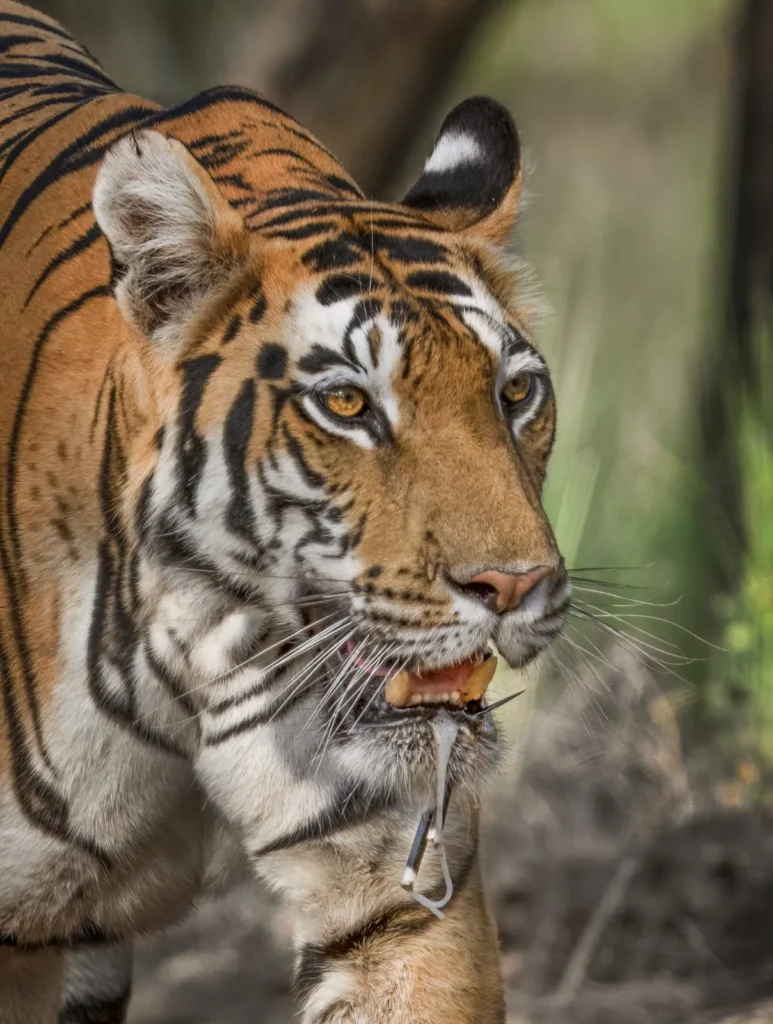
Machli, a resident tigress in the Churna range of Satpura National Park (Satpura Tiger Reserve), was spotted with sharp porcupine quills embedded in her lower jaw after a dangerous hunt.
Common prey includes:
- Sambar
- Chital (spotted deer)
- Gaur
- Wild pig
- Nilgai (where present)
- Barking deer
The exact diet varies between landscapes depending on which prey species are locally abundant. Tigers do not follow a fixed menu—they adapt to available prey while generally favouring larger animals that maximise energy gained from each hunt.
Hunting Strategy
Tigers are solitary ambush predators.
Instead of chasing prey over long distances, they rely on:
- dense vegetation for concealment
- slow, careful stalking
- short bursts of speed
- powerful attacks from close range
Because ambush hunting requires cover, habitat quality directly influences hunting success.
Field Note: Dense vegetation benefits both predator and prey. While it helps tigers approach unnoticed, it also provides hiding places and escape routes for herbivores, maintaining a dynamic balance rather than guaranteeing successful hunts.
Indian Leopard (Panthera pardus fusca)
Leopards are among India’s most adaptable large carnivores.
Unlike tigers, they occupy an extraordinary variety of habitats, including:
- dense forests
- dry deciduous forests
- hills
- plantations
- agricultural landscapes
- areas close to villages
Their success comes from dietary flexibility rather than sheer size.
Leopards hunt prey ranging from small mammals to medium-sized deer, adjusting their diet according to local availability. This adaptability enables them to survive in landscapes where larger predators may struggle.
Typical Wild Prey
Depending on habitat, leopards commonly hunt:
- Barking deer
- Chital
- Indian muntjac
- Indian spotted chevrotain
- Indian porcupine
- Hare
- Langurs
- Macaques
Studies from the Anamalai Hills showed that wild prey accounted for the overwhelming majority of prey biomass consumed by large carnivores, with a few wild species contributing most of the leopard’s diet.
Living Near People
One reason leopards generate more conflict than tigers is their ability to exploit human-dominated landscapes.
Where natural prey becomes scarce or where villages overlap with leopard habitat, they may also prey on:
- dogs
- goats
- calves
- other domestic animals
This shift should not be interpreted as a preference for livestock everywhere. It reflects local ecological conditions, prey availability, and opportunities within shared landscapes.
Dhole (Indian Wild Dog)
The dhole is India’s only wild social canid that regularly hunts in coordinated packs.
Although smaller than tigers and leopards, teamwork enables dholes to hunt prey much larger than any individual could capture alone.
Their social hunting strategy differs fundamentally from the ambush tactics of big cats.
Instead of stealth alone, dholes rely on:
- cooperation
- endurance
- coordinated pursuit
- communication within the pack
This allows them to hunt efficiently in suitable habitats.
Preferred Prey
Dholes commonly target:
- Chital
- Sambar
- Barking deer
- Wild pig
- Other medium-sized ungulates
Research from Kalakkad-Mundanthurai Tiger Reserve shows that prey preferences differ among tigers, leopards, and dholes, reducing direct competition despite living in the same landscape.
Indian Grey Wolf and Other Co-predators
Although wolves are more closely associated with grasslands and open habitats than dense forests, they remain important predators in parts of India.
Other carnivores, including species such as the sloth bear in certain ecological contexts, are also considered during wildlife assessments because they influence prey populations and broader ecosystem dynamics. Wildlife surveys increasingly evaluate these co-predators alongside tigers to better understand entire carnivore communities rather than focusing on a single flagship species.
The Prey That Supports India’s Forests
Predators often receive most public attention, but healthy prey populations are the true foundation of forest ecosystems.
Without sufficient prey, even well-protected forests cannot sustain stable populations of large carnivores.
Conservationists therefore place great emphasis on the prey base—the abundance, diversity, and distribution of animals available for predators to hunt. Modern tiger reserve management routinely considers prey assessments alongside predator monitoring because both are essential for long-term ecological health.
Large Ungulates: The Core Prey Base
Medium- and large-sized herbivores provide most of the food required by India’s largest predators.
Important ungulate prey include:
- Chital (Spotted Deer)
- Sambar
- Gaur
- Wild Pig
- Nilgai
- Barking Deer
- Chousingha
These animals convert plant biomass into energy that can then support higher trophic levels, making them indispensable to forest food webs.
Smaller Mammals and Primates
Not every hunt involves large deer.
Depending on habitat and predator species, smaller animals may also contribute significantly to diets, including:
- Indian porcupine
- Indian hare
- Langurs
- Macaques
- Indian spotted chevrotain
- Indian muntjac
These prey species are particularly important for adaptable predators such as leopards and help maintain dietary diversity across different landscapes.
Domestic Animals in Shared Landscapes
In forests surrounded by villages and farmland, domestic animals may become part of the available prey base.
These include:
- Dogs
- Goats
- Cattle
- Calves
Their presence can increase the likelihood of conflict between people and predators, particularly where wild prey is limited or where predators regularly move through human-dominated areas. However, the extent of domestic prey use varies widely among landscapes and should not be generalised across India.
Comparison Table: Major Predators and Their Typical Prey
| Predator | Primary Hunting Style | Typical Prey |
| Bengal Tiger | Solitary ambush | Sambar, chital, gaur, wild pig, nilgai |
| Indian Leopard | Ambush and opportunistic hunting | Barking deer, chital, porcupine, langurs, macaques, smaller mammals |
| Dhole | Cooperative pack hunting | Chital, sambar, barking deer, wild pig |
| Indian Grey Wolf | Cooperative pursuit in open habitats | Medium-sized mammals and available ungulates depending on habitat |
Expert Tip: During a safari, spotting herbivores behaving alertly—such as chital giving alarm calls or langurs scanning the forest canopy—can indicate the recent presence of a predator. These behavioural clues often provide valuable insight into predator-prey interactions, even when the predator itself remains unseen.
How Habitat Shapes Predator-Prey Relationships and What We Learn from Indian Forests
How Habitat Influences Predator-Prey Relationships
Predator-prey interactions do not occur in the same way across every Indian forest. Habitat structure, vegetation, water availability, human disturbance, and prey abundance all influence where predators hunt, which prey they target, and how successfully they coexist.
This is why two forests with similar predator populations can have very different ecological dynamics. Understanding these habitat differences helps explain wildlife behaviour and guides conservation planning.
Dense Forests: Favouring Ambush Hunters
Dense forests with thick undergrowth provide excellent cover for predators that rely on stealth.
For species such as the Bengal tiger and leopard, vegetation allows them to stalk prey before launching a short, powerful attack.
At the same time, dense forests also benefit prey species by providing:
- Cover from predators
- Multiple escape routes
- Diverse feeding areas
- Safe resting sites
Healthy forests therefore create a balance where neither predator nor prey has a consistent advantage.
Why Dense Forests Matter
Dense forests generally support:
- Higher habitat complexity
- Better concealment for predators
- Greater diversity of prey species
- More stable ecological interactions
Rather than guaranteeing higher hunting success, habitat complexity creates a dynamic system where predator and prey continually adapt to one another.
Fragmented Forests
Many Indian landscapes consist of isolated forest patches surrounded by agriculture, roads, or settlements.
Fragmentation affects both predators and prey by:
- Reducing available habitat
- Interrupting wildlife movement
- Isolating prey populations
- Increasing encounters with people
Some prey species avoid highly disturbed areas, while adaptable predators such as leopards may continue using fragmented habitats if sufficient food remains available.
Ecological Consequences
Fragmented forests may lead to:
- Uneven prey distribution
- Greater competition for resources
- Increased movement between habitat patches
- Higher chances of human-wildlife interactions
The severity of these effects depends on the size of the forest patches, habitat quality, and connectivity with larger protected landscapes.
Plantation Landscapes
Plantation landscapes are often assumed to be poor wildlife habitat, but research shows the picture is more complex.
In the Anamalai Hills of the Western Ghats, forest fragments embedded within plantation landscapes continued to support healthy populations of wild prey. Large carnivores relied predominantly on these wild prey species rather than domestic animals, demonstrating the ecological importance of retaining native forest patches within modified landscapes.
This finding highlights that conservation should focus not only on large protected areas but also on preserving smaller forest remnants that function as important refuges for wildlife.
Field Note: Even relatively small forest fragments can contribute significantly to predator-prey dynamics when they retain suitable habitat and sufficient wild prey.
Wildlife Corridors and Edge Habitats
Wildlife corridors connect separate forest blocks, allowing animals to move safely between habitats.
These connections help:
- Maintain genetic diversity
- Allow predators to disperse naturally
- Enable prey populations to recolonise suitable habitats
- Reduce isolation of wildlife populations
Without connected landscapes, predators may be forced to travel through villages or agricultural land more frequently, increasing the potential for conflict. Corridor conservation therefore benefits both wildlife and local communities.
Case Studies from Indian Forests
Real-world research demonstrates that predator-prey relationships vary considerably across India. The following examples illustrate how habitat, prey availability, and human activity shape wildlife behaviour.
Case Study: Anamalai Hills, Western Ghats
The Anamalai Hills provide one of the best-studied examples of predator-prey dynamics in a mixed landscape of rainforest fragments and plantations.
Researchers found that wild prey contributed approximately 98.1% of the biomass consumed by large carnivores in the study area. Four species—Indian muntjac, Indian spotted chevrotain, sambar, and Indian porcupine—accounted for most of the leopard’s prey biomass.
What This Tells Us
The findings show that:
- Native forest fragments remain valuable wildlife habitat.
- Wild prey can continue supporting predators even within modified landscapes.
- Protecting remaining natural vegetation is often more beneficial than focusing solely on plantation management.
This challenges the assumption that all human-modified landscapes are unsuitable for large carnivores.
Case Study: Kalakkad-Mundanthurai Tiger Reserve
Research in Kalakkad-Mundanthurai Tiger Reserve examined how tigers, leopards, and dholes share available prey.
Although these predators occupy the same landscape, their diets differ sufficiently to reduce direct competition.
This phenomenon, known as prey partitioning, allows multiple carnivore species to coexist by concentrating on different prey types or prey sizes according to availability.
Why Prey Partitioning Matters
Without dietary differences:
- Competition among predators would increase.
- Food shortages could become more frequent.
- Some predator populations might decline.
Instead, ecological specialisation enables several carnivore species to occupy the same forest successfully.
Case Study: Human-Dominated Landscapes in Western Maharashtra
Leopards living close to villages often face different ecological conditions from those inside protected forests.
Research from western Maharashtra found that domestic animals formed a substantial component of leopard diets in some human-dominated landscapes, with dogs contributing a significant share of identified domestic prey.
These findings should be interpreted within their local context rather than applied universally across India.
Conservation Lessons
The study illustrates that:
- Leopard behaviour is highly adaptable.
- Human land use influences available prey.
- Managing natural prey populations can be one component of reducing conflict, alongside improved livestock protection and community engagement.
Case Study: East-Central India’s Declining Prey Base
Recent assessments have highlighted concerns about declining prey populations in parts of east-central India, including sections of Odisha, Jharkhand, and Chhattisgarh.
Conservationists have emphasised that prey restoration is essential because predators depend on adequate prey populations for long-term survival. Monitoring prey abundance has therefore become an important part of reserve management alongside tiger monitoring.
Comparison Table: Habitat and Predator-Prey Dynamics
| Habitat Type | Typical Characteristics | Effect on Predator-Prey Relationships |
| Intact forest | Continuous native vegetation | Stable prey populations and natural predator behaviour |
| Fragmented forest | Isolated habitat patches | Altered movement patterns and uneven prey distribution |
| Plantation landscape | Mixed plantations with forest remnants | Forest fragments can continue supporting substantial wild prey |
| Human-dominated landscape | Villages and agriculture near forests | Greater reliance on domestic prey in some areas and increased potential for conflict |
Photography Tip: Instead of focusing only on large carnivores, observe the behaviour of deer, langurs, and wild pigs. Alarm calls, vigilant postures, and sudden movement often reveal predator activity before the predator becomes visible.
How Scientists Study Predator-Prey Relationships, Conservation, FAQs & Conclusion
How Scientists Measure Prey Populations
Conservation decisions are based on systematic field surveys rather than occasional wildlife sightings. Scientists combine multiple methods because each reveals a different aspect of predator-prey ecology. Together, these approaches help estimate prey abundance, understand predator diets, and evaluate habitat quality.
Line Transect Surveys
Line transects are one of the most widely used techniques for estimating populations of large herbivores.
Researchers walk predetermined routes and record animals seen or heard, along with their distance from the transect. Statistical analysis then estimates prey density across the landscape.
This method is particularly useful for monitoring:
- Chital
- Sambar
- Gaur
- Nilgai
- Wild pig
- Other ungulates
Because these herbivores form the primary prey base for many large carnivores, regular monitoring helps managers understand whether habitats can continue supporting healthy predator populations.
Camera Traps
Camera traps automatically photograph animals that pass in front of motion sensors.
Although commonly associated with tiger censuses, they also provide valuable information on:
- Prey species presence
- Activity patterns
- Habitat use
- Relative abundance
- Predator-prey overlap
Since the same cameras record both predators and prey, researchers gain a more complete picture of ecosystem dynamics.
Scat Analysis
Scat (faeces) contains undigested remains such as hair, bones, feathers, and other biological material.
By analysing these remains, scientists can determine which prey species predators have consumed.
Scat analysis helps answer questions such as:
- Which prey species are most frequently eaten?
- Do diets vary between landscapes?
- Are predators relying on wild or domestic prey?
- How do diets differ among tigers, leopards, and dholes?
Many of the diet studies discussed earlier rely on scat analysis combined with laboratory identification techniques.
DNA-Based Techniques
Modern wildlife research increasingly supplements traditional field methods with DNA analysis.
Genetic material recovered from scat or other biological samples can help identify:
- Predator species
- Individual animals
- Some prey remains
- Population relationships
These techniques improve the accuracy of ecological studies while reducing the need to directly handle wildlife.
Occupancy Models
Occupancy modelling estimates the probability that a species uses different parts of a landscape.
Rather than counting every individual animal, this approach evaluates patterns of presence and absence across habitats.
Managers use these models to understand:
- Habitat suitability
- Wildlife distribution
- Effects of habitat fragmentation
- Changes over time
Occupancy studies complement prey surveys and camera-trap data, providing a broader understanding of ecosystem health.
Comparison Table: Methods Used to Study Predator-Prey Relationships
| Method | Primary Purpose | Main Strength |
| Line transects | Estimate prey density | Effective for large herbivores |
| Camera traps | Record wildlife presence | Monitors predators and prey simultaneously |
| Scat analysis | Study predator diets | Identifies prey consumed |
| DNA analysis | Species identification | Improves accuracy of ecological studies |
| Occupancy models | Understand habitat use | Evaluates distribution across landscapes |
How Conservationists Restore Predator-Prey Balance
Modern wildlife conservation focuses on protecting complete ecosystems rather than individual species.
A healthy predator population depends on suitable habitat, abundant prey, and connected landscapes. When one of these components declines, the entire ecological system can be affected.
Habitat Restoration
Protecting and restoring native vegetation improves food availability and shelter for prey species while providing hunting habitat for predators.
Maintaining Healthy Prey Populations
Wildlife managers regularly monitor ungulate populations because adequate prey is essential for sustaining large carnivores. In some landscapes, prey restoration forms part of broader conservation planning.
Protecting Wildlife Corridors
Connected habitats allow animals to disperse naturally, reduce population isolation, and maintain long-term ecological resilience.
Reducing Human Pressures
Conservation programmes also work to reduce habitat degradation, illegal hunting, and other human pressures that affect both predators and prey. In landscapes shared with people, conflict mitigation measures such as improved livestock protection and community engagement are important complementary strategies.
Responsible Tourism Tip: During safaris, avoid encouraging drivers to pursue predators or disturb prey animals for better photographs. Natural behaviour provides a more meaningful wildlife experience and reduces stress on animals.
Common Misconceptions
“Predators alone determine ecosystem health.”
Healthy ecosystems depend on predators, prey, vegetation, water availability, and habitat quality working together.
“More predators always mean healthier forests.”
Predator populations must be supported by adequate prey and suitable habitat. Numbers alone do not indicate ecosystem health.
“Tigers always hunt the same prey.”
Tiger diets vary among landscapes depending on locally available prey species.
“Leopards always prefer livestock.”
In many protected forests, leopards rely primarily on wild prey. Greater use of domestic animals has been documented in some human-dominated landscapes and should not be generalised.
“Simply counting prey animals is enough.”
Conservation planning also considers prey biomass, habitat connectivity, prey distribution, and human disturbance.
Frequently Asked Questions
What is a predator-prey relationship?
It is the ecological interaction in which one animal hunts another for food, helping regulate wildlife populations and maintain ecosystem balance.
Why is prey base important for tigers?
A healthy prey base provides the food resources required to sustain tiger populations over the long term.
What are the main prey species of Indian tigers?
Common prey includes sambar, chital, gaur, wild pig, nilgai, and barking deer, although diets vary between landscapes.
Why do leopards sometimes attack livestock?
In some human-dominated landscapes, domestic animals become part of the available prey base. This varies with local ecological conditions and should not be viewed as typical everywhere.
How do scientists know what predators eat?
Researchers commonly use scat analysis, supported by field observations and modern laboratory techniques.
What is prey density?
Prey density refers to the number of prey animals within a given area and is one indicator used to assess habitat quality.
Why are wildlife corridors important?
They connect habitats, allowing predators and prey to move safely between forest areas while maintaining healthy populations.
Do predators compete with one another?
Yes, but many species reduce competition through prey partitioning, habitat preferences, and different hunting strategies.
How does habitat fragmentation affect predator-prey relationships?
Fragmentation can alter prey distribution, restrict wildlife movement, and increase interactions between wildlife and people.
Why should safari visitors understand predator-prey relationships?
Understanding these interactions helps visitors interpret animal behaviour, appreciate ecosystem processes, and enjoy more meaningful wildlife experiences.
Conclusion
Predator-prey relationships are the ecological foundation of India’s forests. Every tiger, leopard, dhole, deer, wild pig, and langur forms part of a connected food web that has evolved over thousands of years.
Research from diverse Indian landscapes shows that successful conservation depends not only on protecting predators but also on maintaining healthy prey populations, conserving habitat, and preserving landscape connectivity. Studies from the Western Ghats, central India, and other regions demonstrate that local ecological conditions strongly influence predator diets, prey availability, and interactions with people.
For wildlife travellers, understanding these relationships transforms a safari from a search for charismatic animals into an appreciation of the ecological processes that sustain entire forests. Every alarm call, grazing herd, and predator sighting reflects the complex balance that conservation efforts seek to protect.