Discover the clouded leopard’s habitat, behaviour, diet, conservation status, and where it lives in India in this comprehensive wildlife guide.
Introduction
Among Asia’s wild cats, few are as difficult to observe as the clouded leopard (Neofelis nebulosa). Even experienced researchers often rely on camera traps rather than direct sightings to study this secretive predator. For wildlife travellers, spotting one in the wild is considered exceptionally rare, making it one of the most elusive mammals inhabiting the forests of South and Southeast Asia.
Despite its name, the clouded leopard is not simply a smaller version of the common leopard. It belongs to a different genus, possesses unique physical adaptations, and occupies a specialised ecological niche within dense forest habitats. Its large, cloud-shaped markings, remarkable climbing ability, and unusually long canine teeth have fascinated naturalists for decades.
In India, the species is largely confined to the forested landscapes of the Northeast, where evergreen forests and connected wildlife corridors remain essential for its survival. Recent conservation research has also highlighted the growing importance of maintaining forest connectivity across international borders as habitat fragmentation and climate change continue to reshape suitable landscapes.
This guide explains what makes the clouded leopard unique, where it occurs, how it behaves, the threats it faces, and why protecting connected forest landscapes is becoming increasingly important for its future.
What Is a Clouded Leopard?
The clouded leopard (Neofelis nebulosa) is a medium-sized wild cat native to the forests of South and Southeast Asia. Although it is sometimes described as the world’s smallest big cat, its classification is more complex than that label suggests. It belongs to the genus Neofelis, making it distinct from the common leopard (Panthera pardus) and other members of the Panthera genus.
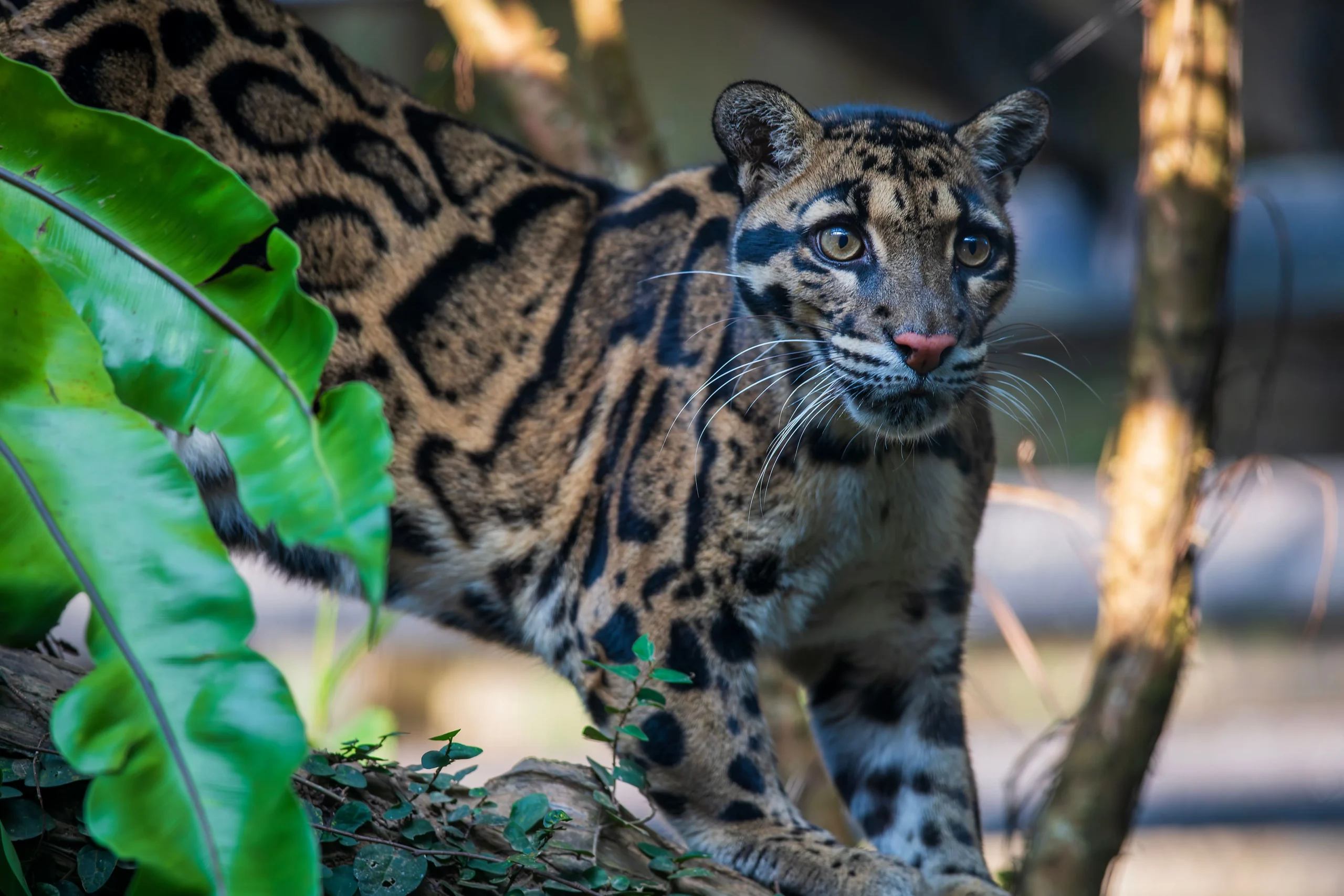
The species takes its common name from the large, irregular cloud-like blotches that cover its coat. These markings provide effective camouflage in forests where broken sunlight filters through dense vegetation, helping the animal remain concealed while moving or hunting.
Clouded leopards are best known for three defining characteristics:
- Their exceptional tree-climbing ability.
- Their unusually long canine teeth relative to skull size.
- Their highly secretive and largely solitary behaviour.
Although capable of remarkable feats in trees—including descending trunks headfirst—they are also known to hunt on the ground, demonstrating that they are adaptable predators rather than purely arboreal hunters.
Scientific Name and Classification
| Classification | Details |
| Common name | Clouded Leopard |
| Scientific name | Neofelis nebulosa |
| Family | Felidae |
| Genus | Neofelis |
| IUCN Red List status | Vulnerable |
| CITES status | Appendix I |
| Distribution | South and Southeast Asia, including Northeast India |
Why Is It Called a Clouded Leopard?
Unlike the solid rosettes of a common leopard, the clouded leopard’s coat features large, irregular patches edged in black that resemble clouds drifting across the sky. These distinctive markings inspired its English name and also help break up the animal’s outline in dense forests, making it difficult to detect even at close range.
Is It a Big Cat or a Small Cat?
The clouded leopard is frequently referred to as the world’s smallest big cat because of its evolutionary relationship with larger members of the cat family and several anatomical characteristics. However, this description is informal rather than a strict scientific classification.
Taxonomically, it belongs to the genus Neofelis, separate from the Panthera genus that includes tigers, lions, leopards, jaguars, and snow leopards. Understanding this distinction helps avoid one of the most common misconceptions—that a clouded leopard is simply a juvenile or smaller form of the common leopard.
Clouded Leopard Quick Facts
| Feature | Details |
| Scientific name | Neofelis nebulosa |
| Conservation status | Vulnerable |
| Protection | CITES Appendix I |
| Female weight | Approximately 11.5–13.5 kg |
| Male weight | Approximately 16–18 kg |
| Activity | Mostly nocturnal or crepuscular |
| Social behaviour | Solitary |
| Primary diet | Deer, pigs, monkeys, squirrels and birds |
| Main Indian range | Forests of Northeast India |
| Distinguishing feature | Long canine teeth and exceptional climbing ability |
Expert Tip
If your goal is to see a clouded leopard in the wild, adjust your expectations. Even dedicated wildlife researchers rarely encounter one directly. Most confirmed records come from camera traps, making this a species best appreciated through its ecology, conservation story, and role in maintaining healthy forest ecosystems rather than through the expectation of a safari sighting.
Physical Characteristics and Extraordinary Adaptations
The clouded leopard is built differently from most wild cats. Although only medium-sized, it combines a powerful body, long tail, flexible joints, and exceptionally large canine teeth into a predator that is equally comfortable moving through trees and hunting on the forest floor.
Many of its physical features are adaptations to life in dense forests rather than open landscapes. These characteristics allow it to climb, balance, and navigate complex forest canopies more effectively than larger cats such as leopards.
Coat Pattern and Identification
The clouded leopard is instantly recognisable by the large, irregular blotches covering its coat. These dark-edged markings resemble patches of cloud, giving the species both its common name and effective camouflage.
Instead of standing out, the pattern breaks up the animal’s outline among filtered sunlight, vines, branches, and dense vegetation. This camouflage helps conceal the cat while resting, travelling, or stalking prey.
Other identifying features include:
- A grey to yellowish-brown coat.
- Large cloud-shaped markings bordered by black.
- Dark spots on the legs.
- Black stripes running along the head and neck.
- A long, thick tail that improves balance while climbing.
Unlike the common leopard’s smaller rosettes, the clouded leopard’s markings are much larger and more irregular, making the two species relatively easy to distinguish when seen clearly.
Body Size and Build
Despite often being described as the world’s smallest big cat, the clouded leopard is a robust predator.
According to the research brief:
| Feature | Approximate Value |
| Female weight | 11.5–13.5 kg |
| Male weight | 16–18 kg |
| Body type | Medium-sized, muscular |
| Tail | Long and heavily furred for balance |
The long tail acts almost like a balancing pole, helping the animal move confidently across branches and uneven terrain.
Its relatively short but muscular legs provide the strength needed for climbing and powerful leaps between trees.
The Longest Canine Teeth Relative to Skull Size
One of the clouded leopard’s most remarkable features is its dentition.
Among all living cat species, it has the longest canine teeth relative to its skull size. This unusual characteristic has often led researchers to compare it with the extinct sabre-toothed cats, although the two are not closely related.
These elongated canines are useful for gripping prey securely, particularly in dense forests where hunts often occur at close range rather than over long pursuits.
This adaptation reflects the species’ specialised hunting strategy rather than simply its body size.
Tree-Climbing and Arboreal Life
Perhaps no feature defines the clouded leopard more than its climbing ability.
While many cats can climb trees, few possess the combination of flexibility, strength, and balance seen in Neofelis nebulosa. These abilities allow it to move through forest canopies in ways that even larger cats generally cannot.
Flexible Ankles and Head-First Descents
The clouded leopard’s ankle joints rotate more freely than those of most other cats.
This flexibility enables it to:
- Descend tree trunks headfirst.
- Climb steep trunks with confidence.
- Hang beneath branches.
- Navigate tangled forest canopies.
- Shift direction rapidly while climbing.
These adaptations make it one of the most agile arboreal predators in Asia’s forests. They are especially valuable in steep, densely wooded landscapes where vertical movement is often easier than travelling along the ground.
Exceptional Balance in the Canopy
Several physical adaptations work together to make the clouded leopard an accomplished climber.
Behaviour and Arboreal Adaptations
| Adaptation | Why It Matters |
| Long tail | Improves balance on branches |
| Flexible ankle joints | Allows headfirst descent |
| Powerful limbs | Aid climbing and jumping |
| Strong claws | Provide grip on bark |
| Muscular build | Supports movement through trees |
These characteristics enable the animal to rest, travel, and escape danger efficiently in forested habitats.
However, climbing is only one part of its ecological strategy.
Do Clouded Leopards Hunt Mostly in Trees?
This is one of the most common misconceptions about the species.
Because clouded leopards are exceptional climbers, many people assume they hunt primarily in trees. Current evidence suggests otherwise.
Although they frequently use trees for movement, resting, and avoiding disturbance, much of their hunting appears to take place on the ground. Their climbing ability should therefore be viewed as an important adaptation for navigating forest environments rather than an indication that they are exclusively arboreal hunters.
This distinction helps explain why the species requires extensive, connected forest habitats. It depends on both the canopy and the forest floor to meet different aspects of its daily life.
Behaviour and Ecology
Clouded leopards are among the least-studied wild cats in Asia, largely because they are difficult to observe directly. Much of what scientists know comes from camera-trap studies, field observations, and indirect evidence rather than frequent sightings.
Their elusive nature means that some aspects of their behaviour are still being investigated, but several broad patterns are well established.
Mostly Nocturnal or Crepuscular
Clouded leopards are generally considered nocturnal or crepuscular, meaning they are most active during the night and around dawn or dusk.
These activity patterns help them:
- Avoid human disturbance.
- Reduce competition with larger predators.
- Hunt when many prey species are active.
Because they move primarily under low-light conditions in dense forests, opportunities for direct observation remain extremely limited.
Solitary by Nature
Adult clouded leopards usually live alone except during mating or when females are raising cubs.
This solitary lifestyle is typical of many forest-dwelling wild cats and reduces competition for prey in habitats where visibility is low and encounters between individuals are naturally infrequent.
Females may produce litters of one to five cubs, although young remain hidden and are seldom observed in the wild.
Field Note
Many photographs of clouded leopards seen online come from camera traps rather than traditional wildlife photography. If you visit forests in Northeast India, consider the species a symbol of healthy forest ecosystems rather than an animal you should expect to encounter. Its rarity is part of what makes every confirmed record scientifically valuable.
Habitat and Distribution
Clouded leopards are forest specialists that depend on extensive areas of connected woodland. Although they occur across several countries in South and Southeast Asia, their distribution is increasingly fragmented due to habitat loss and human activities.
In India, the species is largely restricted to the forested landscapes of the Northeast, where suitable habitat still survives across international borders. Understanding where clouded leopards live—and why these forests matter—is essential to appreciating both the species’ ecology and its conservation challenges.
Where Do Clouded Leopards Live?
Historically, the clouded leopard occupied a broad range extending from the eastern Himalayas through much of Southeast Asia and into parts of southern China.
Today, its range includes populations in:
- India
- Nepal
- Bhutan
- Bangladesh
- Myanmar
- Thailand
- Laos
- Cambodia
- Vietnam
- Malaysia
- Other parts of Southeast Asia
However, these populations are no longer connected across much of their historical range. Instead, many survive in isolated forest patches separated by agriculture, roads, settlements, and other human development. This fragmentation reduces opportunities for movement, breeding, and long-term genetic exchange.
Preferred Habitat
Although often associated with tropical evergreen rainforests, clouded leopards are more adaptable than many people realise.
Research shows they use several forest types, provided there is sufficient cover and prey.
Habitat Types Used by Clouded Leopards
| Habitat Type | Use by Clouded Leopard |
| Primary evergreen rainforest | Preferred habitat |
| Secondary forest | Frequently used where suitable cover remains |
| Deciduous forest | Occupied in some parts of the range |
| Shrubland | Occasionally used |
| Grassland edges | Used where adjoining forests exist |
| Mangrove forests | Recorded in suitable landscapes |
Dense vegetation appears to be more important than any single forest type. Areas offering continuous canopy, rugged terrain, and abundant prey provide the best conditions for the species.
Clouded Leopard Distribution in India
India represents the western edge of the clouded leopard’s current distribution.
Unlike tigers or common leopards, which occur across much of the country, clouded leopards are largely confined to the forests of Northeast India. Their occurrence reflects the region’s close ecological links with the forests of Bhutan, Bangladesh, Myanmar, and Southeast Asia.
The dense subtropical and tropical forests of the Northeast provide:
- Continuous canopy cover.
- Steep forested terrain.
- Diverse prey species.
- Connections with neighbouring international landscapes.
These conditions make the region one of the species’ most important strongholds within India.
Northeast India: The Species’ Stronghold
Northeast India supports some of the country’s most intact forest ecosystems, many of which remain connected across international boundaries.
The research brief identifies this region as the principal Indian landscape for clouded leopards, with particular importance given to forest corridors that allow animals to move between protected and unprotected habitats.
For conservationists, these forests are valuable not only because they contain clouded leopards but also because they support numerous other threatened mammals that depend on healthy evergreen ecosystems.
Meghalaya and the Garo Hills
Among the landscapes highlighted in recent conservation work, Meghalaya’s Garo Hills receive particular attention.
The area forms part of an important corridor network that helps maintain habitat connectivity for clouded leopards and other forest wildlife. Conservation organisations continue supporting efforts to protect these connected forests because isolated populations are generally more vulnerable than those able to move across larger landscapes.
Rather than viewing individual protected areas in isolation, conservation planning increasingly focuses on maintaining entire landscapes where wildlife can disperse naturally.
Why Wildlife Corridors Matter
For wide-ranging forest mammals, protected areas alone are often insufficient.
Animals need safe routes that connect forests, allowing them to:
- Find mates.
- Access seasonal resources.
- Maintain healthy genetic diversity.
- Recolonise suitable habitat.
- Adapt to environmental changes over time.
For the clouded leopard, these connected landscapes are especially important because its habitat is naturally patchy and continues to shrink in several parts of Asia. Forest corridors reduce the risks associated with isolated populations and improve long-term survival prospects.
A 2025 Conservation Roadmap
One of the most significant recent developments for the species came from a 2025 conservation roadmap, which identified 18 transboundary wildlife corridors considered important for the clouded leopard’s future.
The study emphasised that conservation cannot stop at national borders. Since clouded leopard habitat extends across multiple countries, coordinated management between neighbouring nations is essential.
The roadmap also highlighted habitat suitability modelling, showing that maintaining connected forests may become even more important as climate change alters suitable habitat across the species’ range.
Can You See a Clouded Leopard on Safari?
For most visitors, the honest answer is probably not.
Unlike tigers in central India or lions in Gir, clouded leopards are not considered reliable safari sightings. Their naturally low densities, nocturnal habits, dense forest habitat, and secretive behaviour make encounters exceptionally uncommon.
Many researchers spend years studying the species with little or no direct observation, relying instead on:
- Camera traps.
- Footprints.
- Scratches on trees.
- Scat.
- Other indirect field evidence.
Decision Guide: Should You Visit Northeast India Hoping to See One?
| Traveller Goal | Expectation |
| Guaranteed wildlife sightings | Not realistic |
| Learning about forest ecosystems | Excellent |
| Exploring Northeast India’s biodiversity | Highly rewarding |
| Understanding conservation landscapes | Excellent |
| Seeing clouded leopard in the wild | Extremely rare |
Visiting these forests is still worthwhile. Even without a clouded leopard sighting, they offer opportunities to appreciate one of India’s richest forest ecosystems and understand why protecting connected habitats benefits many species beyond a single elusive cat.
Responsible Tourism Tip
If you visit forests where clouded leopards occur, avoid expecting guides to “find” one. Responsible wildlife tourism values healthy habitats and ethical wildlife viewing over rare sightings. Supporting protected areas and local conservation initiatives contributes more to the species’ future than disturbing forests in search of a glimpse.
Conservation Status and Future Outlook
Clouded leopards face many of the same pressures affecting forest wildlife across Asia: habitat loss, fragmentation, illegal hunting, and the growing impacts of climate change. Although the species still occupies a wide geographic range, much of that range is now broken into isolated populations, making long-term conservation increasingly challenging.
Modern conservation efforts therefore focus not only on protecting individual animals but also on safeguarding the forests and wildlife corridors that connect populations across landscapes and international borders.
Conservation Status
The clouded leopard (Neofelis nebulosa) is currently classified as Vulnerable on the IUCN Red List and is protected under CITES Appendix I, which prohibits international commercial trade in wild-caught individuals and their body parts.
These classifications reflect widespread concern about declining populations and continued pressure on the species throughout much of its range.
Unlike some better-studied large carnivores, there is no precise global population estimate for clouded leopards. Their secretive behaviour and dense forest habitat make them difficult to monitor, so scientists rely heavily on camera traps, habitat modelling, and indirect field evidence rather than complete population counts.
Population Trends
Although exact numbers remain uncertain, available research indicates a worrying long-term decline.
According to the World Land Trust, mainland Asian populations and range declined by approximately 30% between 1999 and 2019, largely because of habitat loss and hunting.
This trend highlights an important conservation point:
A species can remain widespread geographically while still experiencing significant declines if suitable habitat becomes fragmented and isolated.
Major Threats
Habitat Loss and Fragmentation
Habitat loss remains the single greatest threat to clouded leopards.
As forests are cleared or divided by roads, agriculture, settlements, and infrastructure, suitable habitat becomes increasingly fragmented.
Fragmentation creates several problems:
- Smaller populations become isolated.
- Animals have fewer opportunities to disperse.
- Genetic diversity declines over time.
- Young individuals struggle to establish new territories.
- Human-wildlife interactions become more frequent.
Because clouded leopards depend heavily on forest cover, they are particularly vulnerable to these changes.
Hunting and Illegal Wildlife Trade
Illegal hunting continues to threaten clouded leopards in parts of their range.
Historically, the species has been targeted for:
- Its distinctive pelt.
- Body parts used in illegal wildlife trade.
- Opportunistic hunting.
Even relatively low levels of hunting can have serious consequences because clouded leopard populations are naturally sparse and reproduce slowly compared with smaller carnivores.
Climate Change
Climate change is becoming an increasingly important conservation concern.
Recent habitat-suitability modelling suggests that future climate scenarios could substantially reduce suitable habitat and increase fragmentation across parts of the species’ range.
Although the exact impacts will vary between regions, the findings reinforce the importance of protecting large, connected forest landscapes that allow wildlife to adapt as environmental conditions change.
Why Forest Corridors Are So Important
One of the strongest themes emerging from recent clouded leopard research is the importance of habitat connectivity.
A protected forest surrounded by unsuitable land may eventually become an ecological island. Wildlife corridors reduce this isolation by linking forests and allowing animals to move safely between them.
For clouded leopards, connected landscapes help maintain:
- Gene flow between populations.
- Access to mates.
- Seasonal movement.
- Long-term population resilience.
- Recovery after local declines.
Rather than focusing solely on individual reserves, conservation organisations increasingly work at the landscape scale, recognising that wildlife does not recognise political or administrative boundaries.
The 2025 Transboundary Corridor Roadmap
A significant milestone came with a 2025 conservation roadmap, which identified 18 transboundary wildlife corridors considered critical for the clouded leopard’s future.
These corridors connect habitats across multiple countries, including landscapes associated with Northeast India and neighbouring regions.
The study emphasised three key priorities:
- Protect remaining connected forests.
- Strengthen cooperation between neighbouring countries.
- Plan conservation using future climate projections rather than only current distributions.
This landscape-level approach recognises that conserving isolated protected areas alone may not be sufficient for the long-term survival of wide-ranging forest species.
A Flagship Species for Forest Conservation
Clouded leopards are increasingly regarded as a flagship species for evergreen forest conservation.
Protecting the forests they depend upon also benefits numerous other plants and animals that share the same habitats.
Healthy forests supporting clouded leopards also provide habitat for:
- Other wild cats.
- Primates.
- Deer.
- Birds.
- Countless lesser-known forest species.
Conserving one elusive predator therefore contributes to protecting entire forest ecosystems rather than a single species in isolation.
Threats and Conservation Actions
| Threat | Why It Matters | Conservation Response |
| Habitat loss | Reduces suitable forest | Protect remaining forests |
| Forest fragmentation | Isolates populations | Maintain wildlife corridors |
| Illegal hunting | Removes breeding animals | Strengthen law enforcement |
| Illegal wildlife trade | Reduces wild populations | International protection under CITES |
| Climate change | Alters suitable habitat | Landscape-scale conservation and habitat connectivity |
Clouded Leopard Compared With Similar Cats
The clouded leopard is often confused with both the common leopard and the leopard cat. While all three belong to the cat family, they differ considerably in size, appearance, behaviour, and evolutionary relationships.
Clouded Leopard vs Common Leopard
| Feature | Clouded Leopard | Common Leopard |
| Scientific name | Neofelis nebulosa | Panthera pardus |
| Genus | Neofelis | Panthera |
| Body size | Medium-sized | Considerably larger |
| Coat pattern | Large cloud-shaped markings | Rosettes |
| Climbing ability | Highly specialised | Excellent climber but less specialised |
| Main habitat in India | Northeast forests | Widespread across India |
The two species are not closely related enough for the clouded leopard to be considered simply a smaller leopard. Their evolutionary histories diverged long ago, and each occupies a distinct ecological niche.
Clouded Leopard vs Leopard Cat
| Feature | Clouded Leopard | Leopard Cat |
| Size | Medium-sized | Small wild cat |
| Coat | Large cloud-like patches | Small solid spots |
| Lifestyle | Forest predator | Broadly adaptable |
| Conservation focus | Connected forest landscapes | Varies across range |
| Visibility | Extremely elusive | Occasionally easier to detect |
Although their names sound similar, these species differ greatly in appearance and ecology.
Mainland vs Sunda Clouded Leopard
Many readers are surprised to learn that there are two recognised clouded leopard species.
| Feature | Mainland Clouded Leopard | Sunda Clouded Leopard |
| Scientific name | Neofelis nebulosa | Neofelis diardi |
| Distribution | South and Southeast Asia, including India | Borneo and Sumatra |
| Occurs in India | Yes | No |
Understanding this distinction helps avoid confusion when reading wildlife literature from different parts of Asia.
Photography Tip
If your interest is wildlife photography, treat the clouded leopard as a species to learn about rather than expect to photograph in the wild. Images seen in documentaries, books, and scientific publications are frequently obtained through camera traps or from carefully managed conservation projects rather than routine safari encounters.
Common Misconceptions
Before concluding, it’s worth addressing a few misconceptions that often appear in online articles and social media. Clearing these up helps readers better understand both the biology of the clouded leopard and the conservation challenges it faces.
“Clouded leopards are simply smaller leopards.”
Incorrect.
Despite the name, clouded leopards are not a smaller form of the common leopard. They belong to the genus Neofelis, whereas the common leopard belongs to Panthera. Their evolutionary history, anatomy, and ecological adaptations are distinct.
“They spend their entire lives in trees.”
Not quite.
Clouded leopards are among the world’s best climbing cats and possess remarkable arboreal abilities. However, research indicates that they often hunt on the ground and use both the forest floor and canopy as part of their daily lives. Their climbing skills should be viewed as an adaptation for navigating dense forests rather than evidence of an exclusively tree-dwelling lifestyle.
“They occur throughout India.”
No.
In India, clouded leopards are primarily associated with the forests of the Northeast. Unlike the common leopard, they are not distributed across most of the country. Their Indian range represents part of a larger forest landscape extending into Bhutan, Bangladesh, Myanmar, and other parts of Southeast Asia.
“Seeing one on safari is easy.”
Far from it.
Clouded leopards are among Asia’s most elusive mammals. Even experienced researchers frequently depend on camera traps rather than direct sightings. Visitors to Northeast India should appreciate these forests for their biodiversity rather than expect to encounter this secretive predator.
“Clouded leopards only survive in untouched rainforest.”
This is an oversimplification.
Although they favour dense evergreen forests, clouded leopards are also known to use secondary forests, deciduous forests, shrublands, mangrove habitats, and grassland edges where suitable cover and prey remain available.
Practical Checklist for Responsible Wildlife Travellers
If you’re exploring forests where clouded leopards occur, keep these principles in mind:
✔ Respect park regulations and guide instructions.
✔ Avoid disturbing wildlife in the hope of finding elusive species.
✔ Never encourage off-route driving or trekking for sightings.
✔ Support destinations and organisations that protect forest connectivity.
✔ Remember that camera-trap images often represent years of patient research rather than routine wildlife encounters.
✔ Appreciate the broader forest ecosystem, not just a single flagship species.
Responsible tourism helps ensure these landscapes remain healthy for clouded leopards and countless other forest-dependent animals.
Frequently Asked Questions
What is the scientific name of the clouded leopard?
The clouded leopard’s scientific name is Neofelis nebulosa. It belongs to the genus Neofelis, which is distinct from the genus Panthera that includes tigers and common leopards.
Is the clouded leopard found in India?
Yes. In India, the species is primarily found in the forested landscapes of the Northeast, where suitable habitat remains connected with neighbouring countries.
Which Indian states are most important for clouded leopards?
The research brief highlights Northeast India, particularly landscapes such as Meghalaya’s Garo Hills, as important areas for the species and its conservation.
Why is it called a clouded leopard?
Its coat features large, irregular cloud-shaped markings that provide excellent camouflage in dense forests and inspired its common name.
Are clouded leopards nocturnal?
They are generally considered nocturnal or crepuscular, being most active during the night and around dawn or dusk.
What do clouded leopards eat?
Their diet includes a variety of medium-sized animals such as:
- Deer
- Wild pigs
- Monkeys
- Squirrels
- Birds
Diet varies according to prey availability within their forest habitat.
Are clouded leopards arboreal?
They are exceptionally skilled climbers and spend considerable time in trees, but they also travel and hunt on the ground. They should be regarded as highly adaptable forest predators rather than exclusively arboreal cats.
Why are clouded leopards so difficult to see?
Several factors contribute to their rarity:
- Dense forest habitat.
- Mostly nocturnal activity.
- Solitary behaviour.
- Naturally low population densities.
- Excellent camouflage.
These characteristics make direct sightings extremely uncommon.
Are clouded leopards endangered?
The species is currently classified as Vulnerable by the IUCN. Habitat loss, forest fragmentation, illegal hunting, and climate change remain significant conservation concerns.
How many clouded leopards remain in the wild?
There is no reliable global population estimate. Because clouded leopards are difficult to observe, researchers avoid presenting precise numbers and instead monitor trends through camera traps, habitat studies, and long-term conservation research.
Why are wildlife corridors so important?
Wildlife corridors connect fragmented forests, allowing clouded leopards to move between habitats, maintain genetic diversity, and adapt to changing environmental conditions. Recent conservation research has identified 18 transboundary corridors as particularly important for the species’ future.
Can tourists realistically see a clouded leopard?
It is possible but highly unlikely.
Most wildlife travellers should view a clouded leopard sighting as an extraordinary bonus rather than the primary objective of a trip. Northeast India’s forests are rewarding destinations because of their ecological richness, even when this elusive predator remains unseen.
Conclusion
The clouded leopard occupies a unique place among Asia’s wild cats. Its cloud-like coat, remarkable climbing ability, and secretive lifestyle have made it one of the continent’s most fascinating yet least understood predators. Although often described as the world’s smallest big cat, it is best appreciated as a distinct species with specialised adaptations for life in dense forests.
In India, the clouded leopard serves as a symbol of the Northeast’s remaining evergreen landscapes. These forests do far more than shelter a single elusive cat—they support entire ecological communities that depend on connected, healthy habitats. As recent conservation research has shown, protecting wildlife corridors and maintaining cooperation across international borders will be just as important as safeguarding individual protected areas.
For wildlife enthusiasts, the greatest value of the clouded leopard may not lie in the chance of seeing one. Instead, it lies in understanding the forests it represents and recognising that conserving these landscapes benefits countless other species as well.
Whether you are a wildlife traveller, student, photographer, or conservation-minded reader, learning about the clouded leopard offers a deeper appreciation of Asia’s forests and the long-term efforts required to protect them.