West Bengal presents one of the most dramatic and complete ecological gradients in the Indian subcontinent. The state’s topography plunges from the towering, snow-capped peaks of the Eastern Himalayas in the north, through the dense, elephant-dominated foothills of the Terai and Dooars, down into the vast, fertile expanse of the Gangetic plains, finally culminating in the intricate estuarine labyrinth of the Sundarbans in the south. This incredible geographical diversity sustains a forest cover of nearly nineteen per cent, sheltering ecosystems that range from sub-alpine rhododendron forests to the world’s largest contiguous mangrove delta.
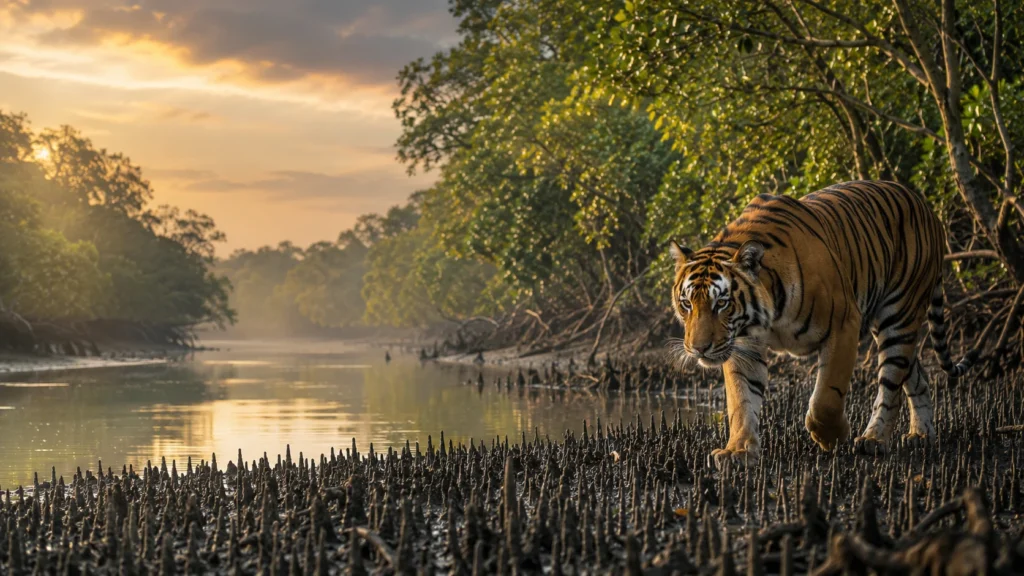
The apex of West Bengal’s wildlife conservation lies in its dual extremes. In the extreme south, the Sundarbans National Park—a UNESCO World Heritage and Ramsar site—harbours the world’s only mangrove-dwelling population of Bengal tigers. These apex predators have evolved remarkable semi-aquatic adaptations to hunt in the tidal mudflats, sharing the estuarine waters with saltwater crocodiles and the elusive fishing cat, the state animal. Conversely, in the extreme north, the high-altitude forests of Singalila and Neora Valley National Parks serve as critical sanctuaries for the highly endangered red panda, Himalayan black bear, and the clouded leopard.
The central foothills, specifically the Dooars region comprising Jaldapara and Gorumara National Parks, are globally significant for hosting the largest population of the Indian one-horned rhinoceros outside of Assam, thriving alongside massive herds of Asian elephants and Indian bison (Gaur). The state’s avifauna is equally rich, featuring the state bird, the white-throated kingfisher, and significant migratory populations that winter in the unique, sewage-fed aquaculture ecosystem of the East Kolkata Wetlands. Navigating intense human-wildlife conflict—from tigers in the delta to elephants traversing the tea estates of the north—West Bengal remains a highly complex, phenomenally biodiverse frontier for Indian wildlife.
Quick Facts Table
| Category | Details |
| State / Union Territory | West Bengal |
| Capital | Kolkata |
| Area | 88,752 sq km |
| Population | 91,276,115 (2011 Census) |
| Forest Cover | 18.96% |
| Official Language(s) | Bengali, English |
| Time Zone | UTC+05:30 (IST) |
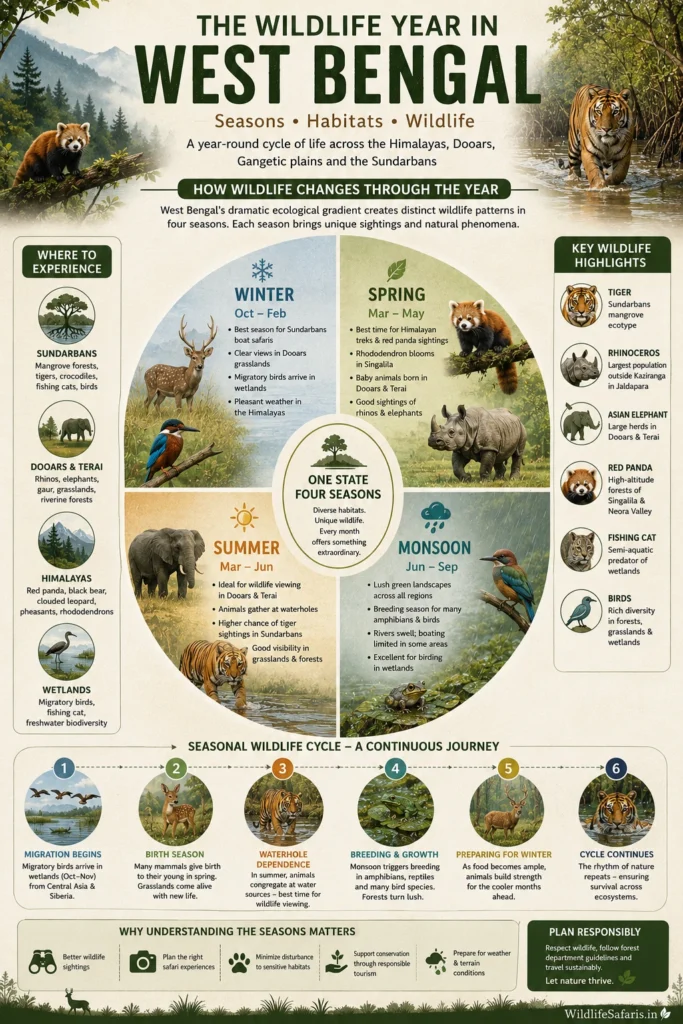
| Best Wildlife Season | October to April (Sundarbans & Dooars) / March to May (Himalayas) |
State Wildlife Master Table
| Attribute | Details |
| State / Union Territory | West Bengal |
| Capital | Kolkata |
| Geographic Region | Eastern Himalayas, Gangetic Plains, Sundarbans Delta |
| Total Area | 88,752 sq km |
| Forest Cover | 18.96% |
| State Animal | Fishing Cat / Machh Beral (Prionailurus viverrinus) |
| State Bird | White-throated Kingfisher (Halcyon smyrnensis) |
| State Tree | Chatim / Devil’s Tree (Alstonia scholaris) |
| State Flower | Night-flowering Jasmine / Shiuli (Nyctanthes arbor-tristis) |
| Highest Peak | Sandakphu (3,636 m) |
| Major Rivers | Hooghly (Ganga), Teesta, Torsa, Jaldhaka, Mahananda |
| Major Forest Types | Mangrove, Tropical Moist Deciduous, Sub-alpine, Temperate |
| Biodiversity Hotspot | Himalayas |
| UNESCO Natural Sites | Sundarbans National Park |
| Biosphere Reserves | Sundarbans Biosphere Reserve |
| Tiger Reserves | Sundarbans, Buxa |
| Elephant Reserves | Eastern Dooars, Mayurjharna |
| National Parks | Sundarbans, Buxa, Gorumara, Jaldapara, Neora Valley, Singalila |
| Wildlife Sanctuaries | 16 Sanctuaries (including Mahananda, Chapramari, Senchal, Sajnekhali, Lothian Island) |
| Conservation Reserves | Not officially specified |
| Community Reserves | Not officially specified |
| Ramsar Sites | Sundarbans Wetland, East Kolkata Wetlands |
| Important Bird Areas (IBAs) | Sundarbans, Singalila, Neora Valley, Mahananda, Lava-Lolaygaon |
| Major Wildlife Corridors | Buxa-Manas Corridor, Mahananda-Apchand Corridor |
| Flagship Mammals | Bengal Tiger, Indian Rhinoceros, Asian Elephant, Red Panda, Fishing Cat |
| Flagship Birds | White-throated Kingfisher, Blood Pheasant, Masked Finfoot, Mangrove Pitta |
| Endemic Wildlife | Several mangrove invertebrate species, Sundarbans Tiger (ecological sub-population) |
| Best Wildlife Destinations | Sundarbans TR, Jaldapara NP, Singalila NP, Gorumara NP |
| Best Time for Wildlife Tourism | October to April (Mountain parks best visited in spring for rhododendrons) |
| Nearest International Airports | Netaji Subhas Chandra Bose International Airport (Kolkata), Bagdogra International Airport (Siliguri) |
| Official Forest Department Website | https://forest.wb.gov.in/ |
Protected Areas Summary Table
| Protected Area | Category | District | Area (sq km) | Year Established | Famous For |
| Sundarbans National Park | Tiger Reserve | South 24 Parganas | 1,330.10 (Core NP) | 1984 (NP), 1973 (TR) | Swamp Tigers, Mangroves, Estuarine Crocodiles |
| Buxa Tiger Reserve | Tiger Reserve | Alipurduar | 760.87 | 1983 (TR status) | Asian Elephant, Leopard, Trans-boundary (Bhutan) |
| Jaldapara National Park | National Park | Alipurduar | 216.51 | 2012 (NP status) | Indian One-horned Rhinoceros, Elephant Safaris |
| Gorumara National Park | National Park | Jalpaiguri | 79.45 | 1994 | Indian Rhinoceros, Gaur, Riverine Grasslands |
| Singalila National Park | National Park | Darjeeling | 78.60 | 1992 | Red Panda, Himalayan Black Bear, Sandakphu Trek |
| Neora Valley National Park | National Park | Kalimpong | 88.00 | 1986 | Pristine Virgin Forest, Red Panda, Clouded Leopard |
| Mahananda Wildlife Sanctuary | Wildlife Sanctuary | Darjeeling, Jalpaiguri | 158.04 | 1976 | Asian Elephant, Rufous-necked Hornbill |
| Chapramari Wildlife Sanctuary | Wildlife Sanctuary | Jalpaiguri | 9.60 | 1976 | Gaur (Indian Bison), Asian Elephant, Birdwatching |
| Sajnekhali Wildlife Sanctuary | Wildlife Sanctuary | South 24 Parganas | 362.40 | 1976 | Mangrove Interpretation Centre, Birding, Water Monitor |
Wildlife Highlights
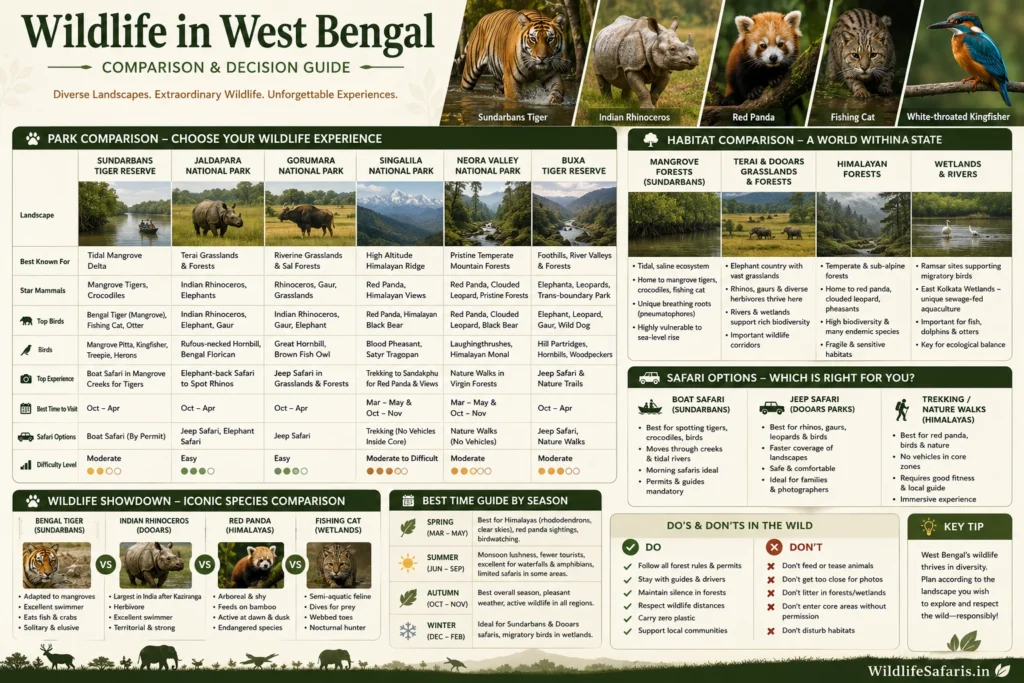
- Top Mammals: Bengal Tiger (Mangrove ecotype), Indian Rhinoceros, Asian Elephant, Red Panda, Fishing Cat, Gaur (Indian Bison), Himalayan Black Bear, Clouded Leopard, Gangetic Dolphin.
- Top Birds: White-throated Kingfisher, Masked Finfoot, Mangrove Pitta, Blood Pheasant, Satyr Tragopan, Rufous-necked Hornbill, Brown-winged Kingfisher.
- Reptiles & Amphibians: Saltwater Crocodile (Estuarine Crocodile), Water Monitor Lizard, King Cobra, Indian Python, Olive Ridley Sea Turtle.
- Flagship Flora: Sundari Tree (Heritiera fomes), diverse Mangroves (Goran, Gewa), Rhododendron, Himalayan Oak, Terai Elephant Grass.
- Best Wildlife Experiences: Boat safaris through the narrow, tidal creeks of the Sundarbans searching for swimming tigers, tracking rhinos on elephant-back in Jaldapara, and trekking the high-altitude Singalila ridge for a glimpse of the red panda.
Conservation Challenges
- Human-Tiger Conflict: The Sundarbans experiences some of the most intense human-tiger conflict in the world. As local villagers venture into the dense mangrove swamps for honey collection, fishing, and crab hunting, they frequently encounter tigers, leading to high human fatalities and retaliatory killings.
- Railway Tragedies: A railway line passing directly through the dense forests of the Dooars (connecting Siliguri to Alipurduar) acts as a severe death trap, regularly resulting in the tragic deaths of elephants and gaurs struck by speeding trains.
- Climate Change and Rising Seas: The Sundarbans delta is exceptionally vulnerable to global warming. Rapid sea-level rise causes coastal erosion, submerges low-lying islands, and increases water salinity, which threatens the survival of the Sundari trees and alters the tigers’ drinking water supply.
- Poaching: Given its porous international borders with Bhutan, Nepal, and Bangladesh, North Bengal acts as a sensitive transit route for the illegal wildlife trade, occasionally threatening rhino horn and leopard pelt security.
- Habitat Encroachment: In the northern foothills, the expansion of tea estates and human settlements severely fragments critical elephant corridors, escalating human-elephant conflict.
Responsible Wildlife Tourism
- Boat Safari Silence: The Sundarbans is a tidal labyrinth where tigers are incredibly elusive. Maintain absolute silence on the motorized boats and watch the mudbanks closely; noise easily carries over the water and scares wildlife deep into the mangroves.
- Strict Trekking Rules: When undertaking the popular Sandakphu trek in Singalila National Park, always hire a registered guide. Stay strictly on the trail to avoid disturbing the fragile alpine flora and the highly sensitive red panda habitat.
- No Plastics in Wetlands: The East Kolkata Wetlands and the Sundarbans rely heavily on delicate hydrological balances. Ensure you carry absolutely zero single-use plastics during your visit.
- Respect Rhino Territory: During jeep or elephant safaris in Jaldapara and Gorumara, never pressure the guide to approach a rhinoceros too closely. They are unpredictable and can charge vehicles if they feel threatened.
- Avoid Forest Intrusions: Never enter the Sundarbans core areas without official forest department permits and armed guards. The terrain is lethal, not just due to tigers, but also deep mud, extreme tides, and estuarine crocodiles.
Did You Know?
- The Sundarbans delta is named after the dominant Sundari mangrove tree (Heritiera fomes) found in the region, which translates to “beautiful forest” in Bengali.
- Tigers in the Sundarbans are the only tigers in the world that have adapted to live in a mangrove environment; they are exceptional swimmers and regularly consume fish and crabs as part of their diet.
- Jaldapara National Park holds the largest population of the Indian One-horned Rhinoceros in India outside of Kaziranga National Park in Assam.
- The East Kolkata Wetlands is a globally unique Ramsar site that naturally treats the city’s sewage using sunlight and algae, converting it into a thriving aquaculture system that produces tonnes of fish daily.
- Singalila National Park sits on a high ridge that forms the border with Nepal, and the trek to its highest point, Sandakphu, offers unparalleled views of four of the world’s five highest peaks, including Everest and Khangchendzonga.
- The Fishing Cat, unlike most felines, has partially webbed toes and dives headfirst into the water to catch its prey, making the wetlands of Bengal its perfect hunting ground.
Safari Planning : Topics Cluster
- How to book a wildlife safari in India?
- Park by Park Online Safari Booking Guide
- Tiger Safari India Planning Workbook
- Park by Park Safari Permits Guide
- National Parks Permit Guide – Park by Park Guide
- Tatkal Safari Booking Guide – Last Minute Safari Permits Booking
- Tiger Safari in India Cost
- Indian Wildlife Safari Budget Planner
- Jeep vs Canter Safari
- Best time for Tiger Sightings in India
- How far advanced should you book safari permits?
- Can foreigners book Indian Wildlife Safari online?
- Special Permits Guide for Foreigners and Domestic Visitors
- How to book a Safari Permit online in India? 2026 step by step guide
- Senior Citizens Friendly Safari Planning
- Multi Generation Family Safari Planning
- 50 things to know before your first safari in India