
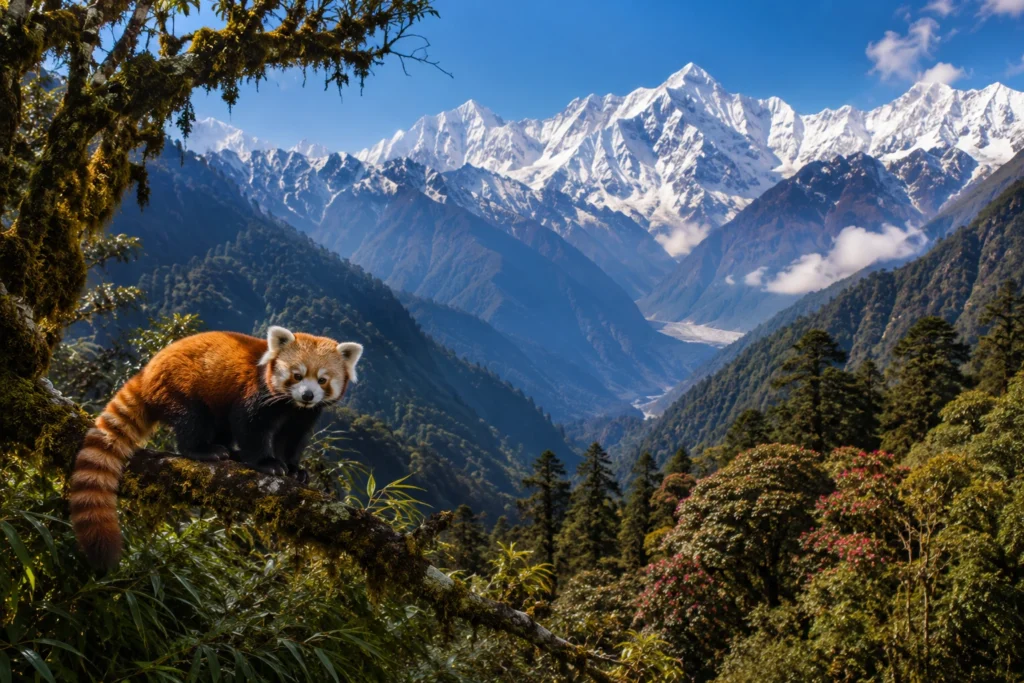
Sikkim, nestled in the Eastern Himalayas, is a spectacular ecological marvel and India’s second-smallest state. Despite its compact size, the state exhibits an extreme altitudinal gradient, rising from tropical river valleys at 300 metres to the towering, snow-clad summit of Mount Khangchendzonga at 8,586 metres. This dramatic topography, shaped by the Teesta River basin, creates a highly compressed ecological zoning. Within a span of a few dozen kilometres, the vegetation transitions from tropical semi-evergreen and moist deciduous forests to temperate broadleaved, sub-alpine conifer, and ultimately, stark alpine scrub and perpetual snowlines. This unique geography allows Sikkim to harbour an incredibly dense concentration of biodiversity, containing nearly one-third of all flowering plants found in India.
The ecological anchor of the state is the Khangchendzonga National Park, which covers a staggering twenty-five per cent of Sikkim’s total landmass. Designated as India’s first and only “Mixed” UNESCO World Heritage Site (recognised for both natural and cultural significance), it protects critical high-altitude habitats. The region is the stronghold of the highly elusive snow leopard, the Himalayan tahr, and the state animal, the red panda, which navigates the dense, moss-draped temperate forests of the middle altitudes. Beyond the megafauna, Sikkim is a botanical paradise, globally renowned for its phenomenal diversity of rhododendrons (over 30 species) and orchids (over 500 species).
Conservation in Sikkim is deeply intertwined with indigenous Bhutia and Lepcha cultural beliefs, which revere the mountains, lakes, and forests as sacred entities. This cultural reverence is reflected in the recent designation of the sacred Khecheopalri Lake as a Ramsar site. While Sikkim has achieved significant conservation milestones, including becoming India’s first fully organic state and imposing strict plastic bans, it faces escalating ecological pressures. The rapid expansion of border infrastructure, hydroelectric projects, and high-altitude tourism requires constant, careful management to ensure the preservation of this fragile Himalayan sanctuary.
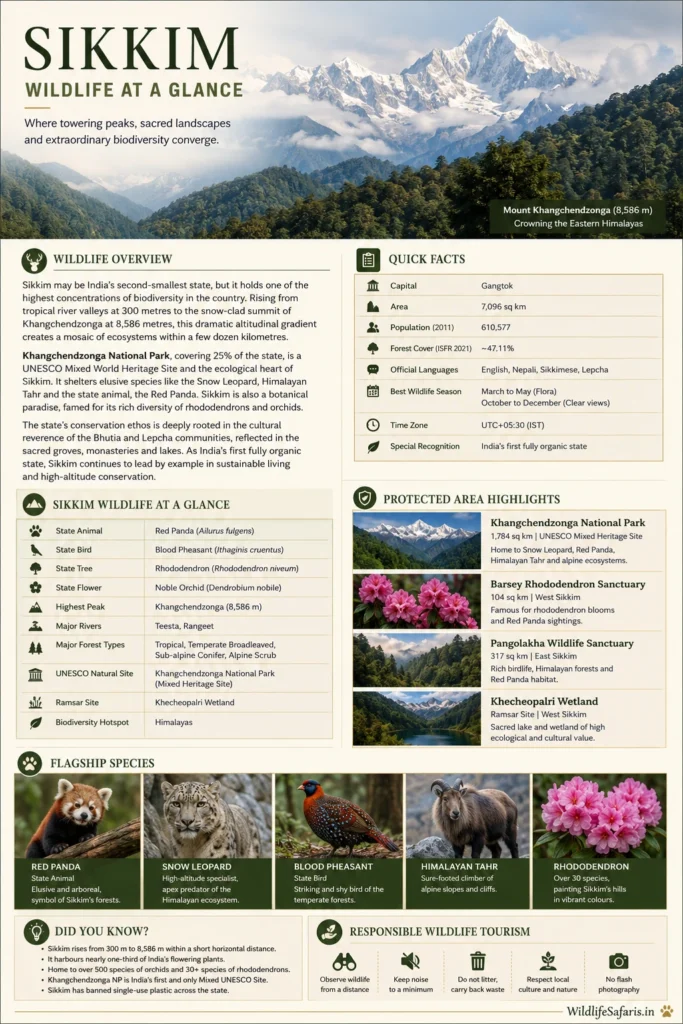
Quick Facts Table
| Category | Details |
| State / Union Territory | Sikkim |
| Capital | Gangtok |
| Area | 7,096 sq km |
| Population | 610,577 (2011 Census) |
| Forest Cover | ~47.11% (ISFR 2021) |
| Official Language(s) | English, Nepali, Sikkimese, Lepcha |
| Time Zone | UTC+05:30 (IST) |
| Best Wildlife Season | March to May (Flora) / October to December (Clear views) |
State Wildlife Master Table
| Attribute | Details |
| State / Union Territory | Sikkim |
| Capital | Gangtok |
| Geographic Region | Eastern Himalayas |
| Total Area | 7,096 sq km |
| Forest Cover | ~47.11% |
| State Animal | Red Panda (Ailurus fulgens) |
| State Bird | Blood Pheasant (Ithaginis cruentus) |
| State Tree | Rhododendron (Rhododendron niveum) |
| State Flower | Noble Orchid (Dendrobium nobile) |
| Highest Peak | Khangchendzonga (8,586 m) |
| Major Rivers | Teesta, Rangeet |
| Major Forest Types | Tropical, Temperate Broadleaved, Sub-alpine Conifer, Alpine Scrub |
| Biodiversity Hotspot | Himalayas |
| UNESCO Natural Sites | Khangchendzonga National Park (Mixed Heritage Site) |
| Biosphere Reserves | Khangchendzonga Biosphere Reserve |
| Tiger Reserves | None |
| Elephant Reserves | None |
| National Parks | Khangchendzonga |
| Wildlife Sanctuaries | 7 Sanctuaries (including Barsey, Fambong Lho, Maenam, Pangolakha) |
| Conservation Reserves | Sling Dong Fairrieanum Orchid Conservation Reserve |
| Community Reserves | Not officially specified |
| Ramsar Sites | Khecheopalri Wetland |
| Important Bird Areas (IBAs) | Khangchendzonga, Kyongnosla, Maenam, Barsey, Lachen |
| Major Wildlife Corridors | Pangolakha-Neora Valley (West Bengal) Corridor |
| Flagship Mammals | Snow Leopard, Red Panda, Himalayan Tahr, Blue Sheep (Bharal), Musk Deer |
| Flagship Birds | Blood Pheasant, Himalayan Monal, Satyr Tragopan, Snow Partridge |
| Endemic Wildlife | Sikkim Snow Toad, several Orchid and Rhododendron species |
| Best Wildlife Destinations | Khangchendzonga NP, Barsey Rhododendron Sanctuary, Pangolakha WLS |
| Best Time for Wildlife Tourism | March to May (Rhododendron blooms) |
| Nearest International Airports | Bagdogra International Airport (West Bengal) / Pakyong Airport (Domestic) |
| Official Forest Department Website | forest.sikkim.gov.in |
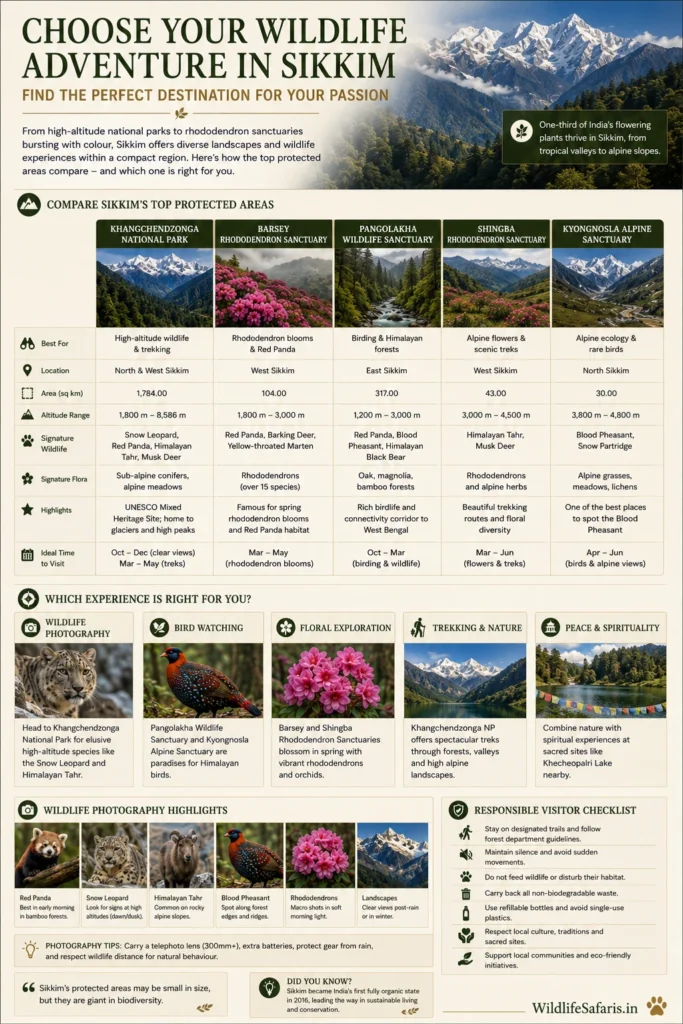
Protected Areas Summary Table
| Protected Area | Category | District | Area (sq km) | Year Established | Famous For |
| Khangchendzonga National Park | National Park | North, West Sikkim | 1,784.00 | 1977 | Snow Leopard, Red Panda, Mixed UNESCO Site |
| Barsey Rhododendron Sanctuary | Wildlife Sanctuary | West Sikkim | 104.00 | 1996 | Dense Rhododendron Blooms, Red Panda |
| Fambong Lho Wildlife Sanctuary | Wildlife Sanctuary | East Sikkim | 51.76 | 1984 | Sub-tropical Flora, Avifauna, proximity to Gangtok |
| Kyongnosla Alpine Sanctuary | Wildlife Sanctuary | East Sikkim | 31.00 | 1984 | Alpine Flora, Blood Pheasant, Red Panda |
| Maenam Wildlife Sanctuary | Wildlife Sanctuary | South Sikkim | 35.34 | 1987 | Temperate Forests, Serow, Barking Deer |
| Pangolakha Wildlife Sanctuary | Wildlife Sanctuary | East Sikkim | 128.00 | 2002 | Tiger Transients, Red Panda, High-altitude Lakes |
| Shingba Rhododendron Sanctuary | Wildlife Sanctuary | North Sikkim | 43.00 | 1984 | Yumthang Valley, High-altitude Flora |
| Kitam Bird Sanctuary | Wildlife Sanctuary | South Sikkim | 6.00 | 2005 | Low-altitude Avifauna, Sal and Pine Forests |
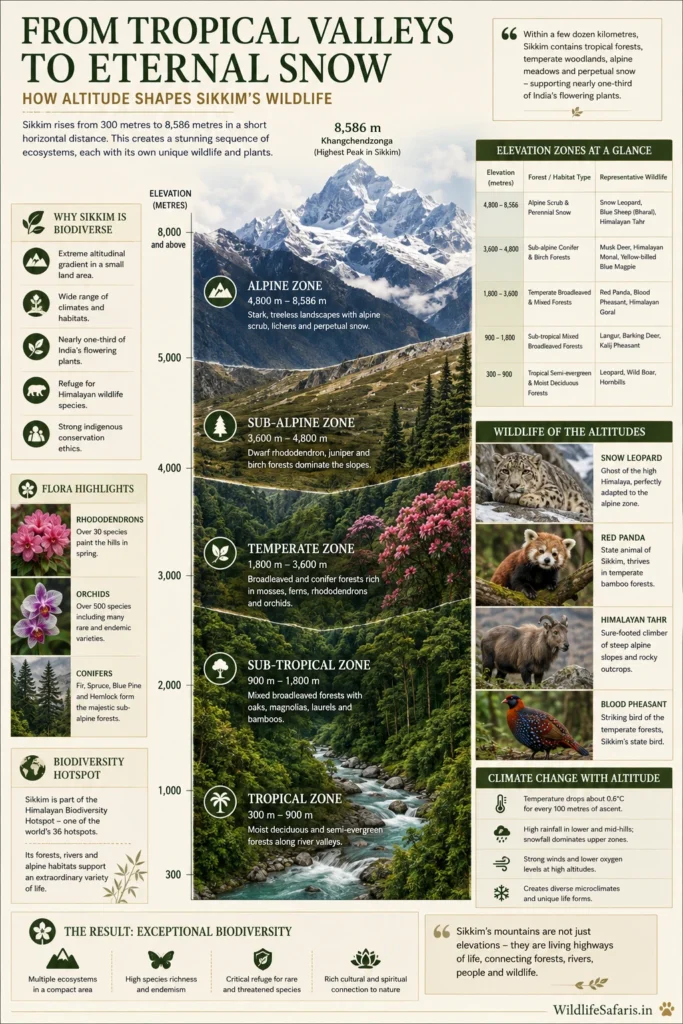
Wildlife Highlights
- Top Mammals: Snow Leopard, Red Panda, Himalayan Tahr, Blue Sheep (Bharal), Himalayan Musk Deer, Himalayan Black Bear, Clouded Leopard, Tibetan Wolf, Takin.
- Top Birds: Blood Pheasant, Himalayan Monal, Satyr Tragopan, Snow Partridge, Golden Eagle, Lammergeier (Bearded Vulture), Grandala, Fire-tailed Myzornis.
- Reptiles & Amphibians: Sikkim Snow Toad, Himalayan Pit Viper.
- Flagship Flora: Over 30 species of Rhododendron, 500+ species of Orchids (including the Noble Orchid and Lady’s Slipper), Himalayan Cedar, Blue Pine, Juniper.
- Best Wildlife Experiences: Multi-day high-altitude trekking in Khangchendzonga National Park (e.g., the Goecha La trek), photographing the vibrant spring blooms in Barsey Rhododendron Sanctuary, and birdwatching in the temperate forests of Pangolakha.
Conservation Challenges
- Border Infrastructure: Due to its highly sensitive geopolitical location, the continuous expansion of strategic border roads and military infrastructure causes significant forest fragmentation, landslides, and disturbance to alpine ecosystems.
- Hydropower Development: The damming of the Teesta River and its tributaries for hydroelectric projects drastically alters the natural hydrology of the valleys, submerging critical lowland riverine habitats and affecting aquatic biodiversity.
- High-Altitude Tourism: The massive influx of tourists to ecologically fragile zones like Tsomgo Lake, Nathu La, and the Yumthang Valley leads to severe waste management challenges and vehicular pollution in previously pristine alpine environments.
- Climate Change: Rising global temperatures are causing the rapid retreat of Himalayan glaciers (like the Zemu Glacier), which alters downstream water availability and shifts the treeline higher, squeezing the narrow alpine habitats of the snow leopard and blue sheep.
- Feral Dogs: In high-altitude army camps and tourist hubs, subsidies of human food waste have led to an explosion in feral dog populations. These packs form a formidable predatory threat to ground-nesting birds, musk deer, and red pandas.
Responsible Wildlife Tourism
- Strict Adherence to Permits: Much of North and East Sikkim requires an Inner Line Permit (ILP) or Protected Area Permit (PAP) due to proximity to the international border. Always obtain proper documentation and never enter restricted areas.
- Respect Sacred Landscapes: Mount Khangchendzonga and numerous glacial lakes (like Khecheopalri) are deeply sacred to the local communities. Avoid swimming in or polluting these lakes, and respect local customs regarding noise and behaviour.
- Zero Waste on Treks: When undertaking rigorous trails like Goecha La, strictly enforce a “pack-in, pack-out” policy. Leave absolutely no plastic, wrappers, or sanitary waste in the alpine zones.
- Do Not Pluck Flora: Resist the temptation to pick rhododendron flowers, rare orchids, or high-altitude medicinal plants. It is both ecologically damaging and illegal.
- Acclimatise Before Trekking: Wildlife exploration in Sikkim often requires rapid ascents to high altitudes. Ensure proper acclimatisation to avoid Acute Mountain Sickness (AMS), which can lead to emergency helicopter evacuations that disturb wildlife.
- Avoid Pack Animal Overloading: If using dzos (yak-cow hybrids) or mules for trekking, ensure you hire ethical operators who do not overload or mistreat their pack animals.
Did You Know?
- Khangchendzonga National Park is India’s only “Mixed” UNESCO World Heritage Site, meaning it was inscribed for both its exceptional natural biodiversity and its profound cultural and religious significance to the indigenous Sikkimese people.
- Sikkim is the first state in the world to become 100% organic, banning the use of chemical fertilisers and pesticides statewide, which has profoundly benefited its soil health and local insect biodiversity.
- The state encompasses an incredible elevation variation, plunging from the third-highest peak in the world (8,586 m) to tropical valleys at just 300 metres above sea level, all within an area roughly the size of a large city.
- The Red Panda is primarily a bamboo eater. Unlike the Giant Panda, the Red Panda belongs to its own unique taxonomic family, Ailuridae, and is biologically closer to skunks and raccoons than to bears.
- Despite having no resident tiger population, the Pangolakha Wildlife Sanctuary in East Sikkim occasionally records Bengal tigers at elevations exceeding 3,000 metres, using the area as a high-altitude transit corridor between India and Bhutan.
- Khecheopalri Lake, recently designated as a Ramsar wetland, is locally known as the “wish-fulfilling lake” and is famed for being kept perfectly clear of floating leaves by the surrounding birds, according to local legend.
Safari Planning : Topics Cluster
- How to book a wildlife safari in India?
- Park by Park Online Safari Booking Guide
- Tiger Safari India Planning Workbook
- Park by Park Safari Permits Guide
- National Parks Permit Guide – Park by Park Guide
- Tatkal Safari Booking Guide – Last Minute Safari Permits Booking
- Tiger Safari in India Cost
- Indian Wildlife Safari Budget Planner
- Jeep vs Canter Safari
- Best time for Tiger Sightings in India
- How far advanced should you book safari permits?
- Can foreigners book Indian Wildlife Safari online?
- Special Permits Guide for Foreigners and Domestic Visitors
- How to book a Safari Permit online in India? 2026 step by step guide
- Senior Citizens Friendly Safari Planning
- Multi Generation Family Safari Planning
- 50 things to know before your first safari in India
Himalayas : Topics Cluster
- Himalayan Wildlife Comprehensive Guide
- Wildlife in Ladakh
- Himalayan Pheasants
- Raptors of Himalayas
- Wildlife in Sikkim
- Wildlife in Arunachal Pradesh
- Wildlife in Uttarakhand
- Wildlife in Himachal Pradesh
- Wildlife in Jammu and Kashmir
- Himalayan Black Bear
- Snow Leopard
- Kibber Wildlife Sanctuary Guide
- Great Himalayan National Park
- Khangchendzonga National Park
- Eastern Himalayas