
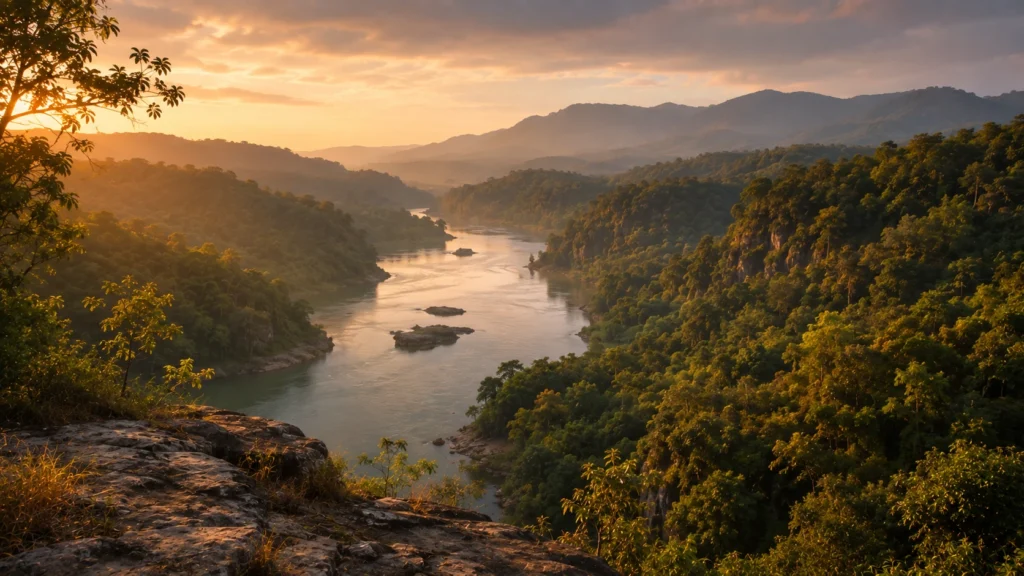
Andhra Pradesh, situated along the southeastern coast of the Indian peninsula, features a diverse and ecologically significant landscape dominated by the rugged Eastern Ghats and an expansive coastline hugging the Bay of Bengal. The state’s topography transitions from undulating mountainous terrain to vast river deltas, creating a mosaic of habitats. Experiencing a predominantly tropical climate, the region supports major ecosystems, including the dense Nallamala forested hills, the globally critical freshwater expanse of Kolleru Lake, and the complex estuarine environments formed by the Godavari and Krishna rivers. The state’s forest cover, comprising primarily southern tropical dry deciduous, moist deciduous, and coastal mangrove forests, acts as a vital sanctuary for peninsular biodiversity.
The region’s wildlife is characterised by a strong presence of flagship mammals, notably the Bengal tiger, which finds a stronghold in the expansive Nagarjunasagar Srisailam Tiger Reserve. The state animal, the blackbuck, roams the open plains and scrublands alongside the Indian leopard, dhole, and the Indian pangolin. Andhra Pradesh also supports an isolated population of Asian elephants in the southern Koundinya Wildlife Sanctuary. The state’s avifauna is exceptionally rich, particularly across its extensive wetland networks. Pulicat Lake, India’s second-largest brackish water lagoon, attracts thousands of migratory greater flamingos, while the Ramsar-designated Kolleru Lake supports massive breeding colonies of spot-billed pelicans and painted storks.
Conservation within Andhra Pradesh is anchored by a robust Protected Area network encompassing three National Parks, numerous Wildlife Sanctuaries, and the Seshachalam Hills Biosphere Reserve. The preservation of the Coringa mangroves, protection of the critically endangered Jerdon’s courser habitat, and mitigation of human-wildlife conflict are paramount conservation priorities. Wildlife tourism in the state offers highly distinctive experiences, ranging from riverine safaris in Papikonda to premier ornithological excursions along the coast, solidifying Andhra Pradesh’s role as a crucial frontier for ecological preservation in India.
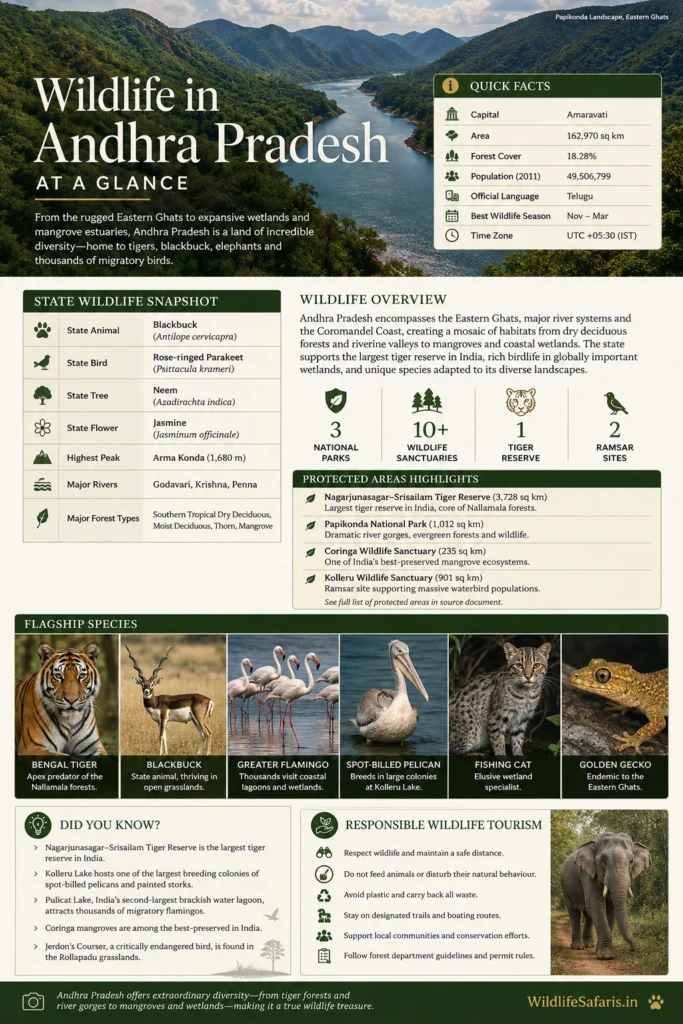
Quick Facts Table
| Category | Details |
| State / Union Territory | Andhra Pradesh |
| Capital | Amaravati |
| Area | 162,970 sq km |
| Population | 49,506,799 (2011 Census, post-bifurcation) |
| Forest Cover | 18.28% |
| Official Language(s) | Telugu |
| Time Zone | UTC+05:30 (IST) |
| Best Wildlife Season | November to March |
State Wildlife Master Table
| Attribute | Details |
| State / Union Territory | Andhra Pradesh |
| Capital | Amaravati |
| Geographic Region | Eastern Ghats and Coromandel Coast |
| Total Area | 162,970 sq km |
| Forest Cover | 18.28% |
| State Animal | Blackbuck (Antilope cervicapra) |
| State Bird | Rose-ringed Parakeet (Psittacula krameri) |
| State Tree | Neem (Azadirachta indica) |
| State Flower | Jasmine (Jasminum officinale) |
| Highest Peak | Arma Konda (1,680 m) |
| Major Rivers | Godavari, Krishna, Penna |
| Major Forest Types | Southern Tropical Dry Deciduous, Moist Deciduous, Thorn, Mangrove |
| Biodiversity Hotspot | Not officially specified |
| UNESCO Natural Sites | None |
| Biosphere Reserves | Seshachalam Hills Biosphere Reserve |
| Tiger Reserves | Nagarjunasagar Srisailam Tiger Reserve (NSTR) |
| Elephant Reserves | Rayala Elephant Reserve |
| National Parks | Papikonda, Rajiv Gandhi (Rameswaram), Sri Venkateswara |
| Wildlife Sanctuaries | Coringa, Gundla Brahmeswaram, Kambalakonda, Koundinya, Krishna, Kolleru, Nelapattu, Pulicat Lake, Rollapadu, Sri Lankamalleswara, Sri Penusila Narasimha |
| Conservation Reserves | Not officially specified |
| Community Reserves | Not officially specified |
| Ramsar Sites | Kolleru Lake |
| Important Bird Areas (IBAs) | Coringa, Kolleru, Pulicat Lake, Rollapadu, Sri Lankamalleswara, Nelapattu |
| Major Wildlife Corridors | Nallamala-Seshachalam Corridor, Eastern Ghats Elephant Corridors |
| Flagship Mammals | Bengal Tiger, Blackbuck, Indian Leopard, Asian Elephant, Dhole |
| Flagship Birds | Greater Flamingo, Spot-billed Pelican, Great Indian Bustard, Jerdon’s Courser |
| Endemic Wildlife | Jerdon’s Courser, Golden Gecko, Slender Loris |
| Best Wildlife Destinations | NSTR, Coringa WLS, Pulicat Lake WLS, Papikonda NP |
| Best Time for Wildlife Tourism | November to March |
| Nearest International Airports | Rajiv Gandhi International Airport (Hyderabad), Visakhapatnam International Airport, Tirupati Airport (International) |
| Official Forest Department Website | https://forests.ap.gov.in/ |
Protected Areas Summary Table
| Protected Area | Category | District | Area (sq km) | Year Established | Famous For |
| Papikonda National Park | National Park | Alluri Sitharama Raju, Eluru | 1,012.86 | 2008 | Bengal Tiger, Gaur, Riverine Ecosystems |
| Rajiv Gandhi (Rameswaram) National Park | National Park | YSR Kadapa | 2.40 | 2005 | Sand Dune Ecosystems, Scorpions, Invertebrates |
| Sri Venkateswara National Park | National Park | Tirupati, Annamayya | 353.62 | 1989 | Slender Loris, Golden Gecko, Dry Deciduous Forests |
| Nagarjunasagar Srisailam Tiger Reserve | Tiger Reserve | Nandyal, Prakasam, Palnadu | 3,296.31 | 1983 | Bengal Tiger, Indian Leopard, Nallamala Hills Ecosystem |
| Coringa Wildlife Sanctuary | Wildlife Sanctuary | Kakinada | 235.70 | 1978 | Mangroves, Fishing Cat, Estuarine Crocodiles |
| Gundla Brahmeswaram Wildlife Sanctuary | Wildlife Sanctuary | Nandyal, Prakasam | 1,194.00 | 1990 | Bengal Tiger, Indian Pangolin, Teak Forests |
| Koundinya Wildlife Sanctuary | Wildlife Sanctuary | Chittoor | 357.60 | 1990 | Asian Elephant, Sloth Bear, Dry Deciduous Scrub |
| Krishna Wildlife Sanctuary | Wildlife Sanctuary | Krishna, Bapatla | 194.81 | 1989 | Mangroves, Fishing Cat, Smooth-coated Otter |
| Kolleru Wildlife Sanctuary | Wildlife Sanctuary | Eluru, Krishna | 308.55 | 1999 | Spot-billed Pelican, Painted Stork, Freshwater Ecosystem |
| Nelapattu Wildlife Sanctuary | Wildlife Sanctuary | Tirupati | 4.58 | 1976 | Spot-billed Pelican Breeding Colony |
| Pulicat Lake Wildlife Sanctuary | Wildlife Sanctuary | Tirupati | 500.00 | 1976 | Greater Flamingo, Migratory Waterfowl |
| Rollapadu Wildlife Sanctuary | Wildlife Sanctuary | Nandyal | 6.14 | 1988 | Great Indian Bustard, Lesser Florican, Blackbuck |
| Sri Lankamalleswara Wildlife Sanctuary | Wildlife Sanctuary | YSR Kadapa | 464.42 | 1988 | Jerdon’s Courser (Historically), Red Sanders |
| Sri Penusila Narasimha Wildlife Sanctuary | Wildlife Sanctuary | Nellore, Annamayya | 1,030.85 | 1997 | Indian Panther, Sloth Bear, Cheetal |
Wildlife Highlights
- Top Mammals: Bengal Tiger, Asian Elephant, Blackbuck, Indian Leopard, Dhole (Indian Wild Dog), Fishing Cat, Gaur, Sloth Bear.
- Top Birds: Greater Flamingo, Spot-billed Pelican, Painted Stork, Great Indian Bustard, Indian Skimmer, River Tern.
- Reptiles & Amphibians: Estuarine Crocodile (Godavari delta), Mugger Crocodile, Golden Gecko, Indian Python, Russell’s Viper.
- Endemic Species: Jerdon’s Courser (Critically Endangered), Golden Gecko (Eastern Ghats endemic).
- Flagship Flora: Red Sanders (Pterocarpus santalinus – highly endemic to Seshachalam hills), Mangroves (Avicennia and Rhizophora spp.), Teak.
- Best Wildlife Experiences: Tiger Safari in NSTR (Farahabad / Srisailam), Mangrove Boating in Coringa, Birdwatching at Pulicat Lake and Kolleru, River Cruise through Papikonda.
Conservation Challenges
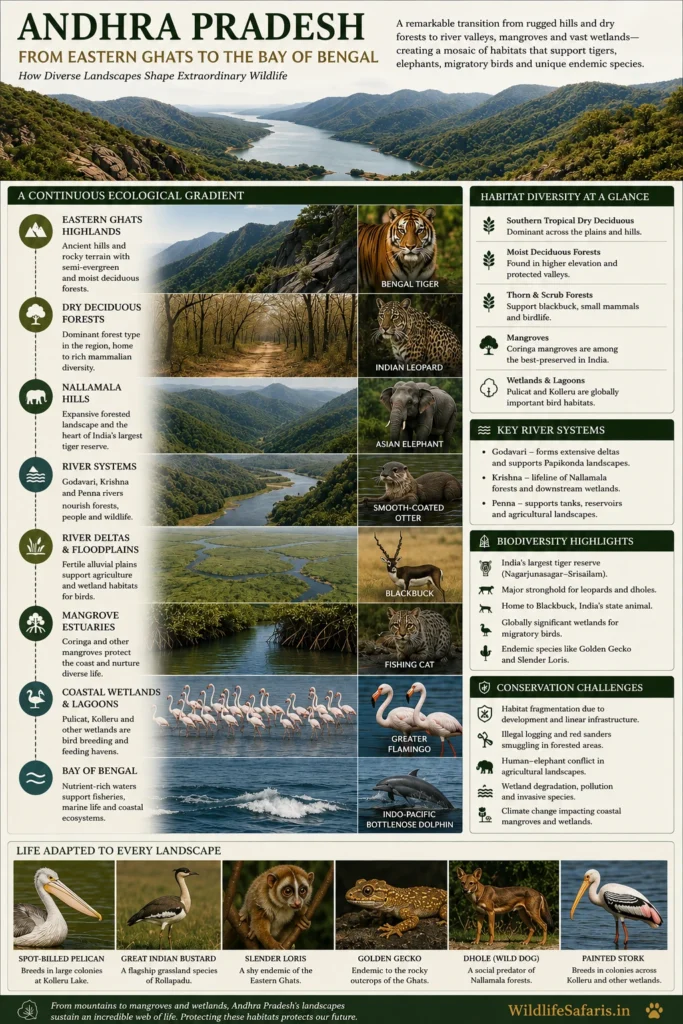
- Habitat Fragmentation: Linear infrastructure development, including highways and canal networks, disrupting wildlife corridors in the Eastern Ghats.
- Poaching and Illegal Logging: The illegal extraction and smuggling of highly valued endemic Red Sanders timber from the Seshachalam hills severely impacts the ecosystem.
- Human-Wildlife Conflict: Elephant depredation of agricultural crops in the Chittoor district (Koundinya WLS) due to restricted migratory corridors.
- Wetland Degradation: Intensive commercial aquaculture (shrimp and fish farming) encroaching upon the borders of Kolleru Lake and coastal mangrove ecosystems.
- Invasive Species: Proliferation of invasive weeds such as Prosopis juliflora and Lantana camara degrading native grasslands in Rollapadu and dry deciduous forests.
- Climate Change: Increased frequency of cyclonic storms along the Bay of Bengal coast threatening the structural integrity of mangrove forests in Coringa and Krishna estuaries.
Responsible Wildlife Tourism
- Silence is Golden: Maintain strict silence during safaris in the Nallamala forests to increase the chances of sighting elusive predators like the Bengal tiger.
- Respect Wetland Ecosystems: Do not approach nesting colonies of pelicans and flamingos too closely by boat; keep a generous distance to prevent stress.
- Follow Safari Regulations: Always remain inside the vehicle or designated boat; walking is strictly prohibited in most Protected Areas unless on an authorised trail.
- No Flash Photography: Disable camera flashes, especially when photographing nocturnal species or birds nesting in dense coastal foliage.
- Support Local Conservation: Choose eco-tourism initiatives and interpretation centres managed by local communities in collaboration with the Andhra Pradesh Forest Department.
- Say No to Plastics: Avoid carrying single-use plastics into sensitive areas like Coringa and Kolleru, and ensure all waste is brought back to urban centres.
Did You Know?
- Nagarjunasagar Srisailam Tiger Reserve (NSTR) is the largest tiger reserve in India by total area, encompassing parts of five districts across the Nallamala hills.
- Coringa Wildlife Sanctuary is the second-largest contiguous stretch of mangrove forests in India, trailing only behind the Sundarbans.
- The Jerdon’s Courser, an elusive nocturnal bird historically found in the Sri Lankamalleswara Wildlife Sanctuary, was believed extinct for 86 years before its sensational rediscovery in 1986.
- Kolleru Lake is one of the largest shallow freshwater lakes in Asia and functions as a massive natural flood-balancing reservoir between the Krishna and Godavari deltas.
- The Seshachalam Hills are the only region in the world where the highly valued Red Sanders tree grows naturally.
- Koundinya Wildlife Sanctuary is the only sanctuary in Andhra Pradesh with a population of Asian elephants, which migrated back to the region from neighbouring states in the late 1980s after a 200-year absence.
- Pulicat Lake acts as a crucial wintering ground, supporting up to 15,000 Greater Flamingos annually.
Safari Planning : Topics Cluster
- How to book a wildlife safari in India?
- Park by Park Online Safari Booking Guide
- Tiger Safari India Planning Workbook
- Park by Park Safari Permits Guide
- National Parks Permit Guide – Park by Park Guide
- Tatkal Safari Booking Guide – Last Minute Safari Permits Booking
- Tiger Safari in India Cost
- Indian Wildlife Safari Budget Planner
- Jeep vs Canter Safari
- Best time for Tiger Sightings in India
- How far advanced should you book safari permits?
- Can foreigners book Indian Wildlife Safari online?
- Special Permits Guide for Foreigners and Domestic Visitors
- How to book a Safari Permit online in India? 2026 step by step guide
- Senior Citizens Friendly Safari Planning
- Multi Generation Family Safari Planning
- 50 things to know before your first safari in India