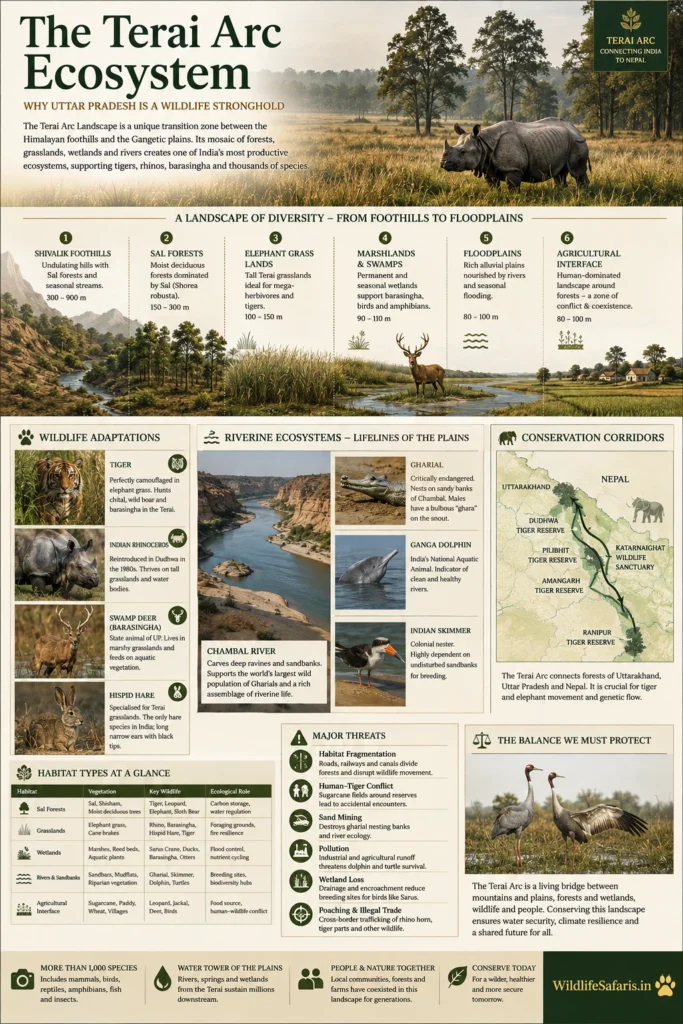
Uttar Pradesh, India’s most populous state, encompasses a vast and remarkably diverse geographical expanse. The landscape transitions from the towering foothills of the Shivaliks in the north to the fertile, sweeping plains of the Indo-Gangetic basin, ultimately giving way to the rugged, ancient Vindhyan plateau in the south. Experiencing a humid subtropical climate, the state records a relatively low forest cover of approximately nine per cent. However, this vegetation is incredibly vital, predominantly featuring tropical moist deciduous forests, dense tropical dry deciduous woodlands, and the highly specialised, marshy grasslands of the Terai Arc Landscape along the Indo-Nepal border.
The cornerstone of Uttar Pradesh’s wildlife conservation is the Dudhwa National Park, which, along with its contiguous sanctuaries, forms the Dudhwa Tiger Reserve. This globally critical Terai ecosystem is a sanctuary for mega-herbivores and apex predators, harbouring thriving populations of the Bengal tiger, the one-horned rhinoceros (successfully reintroduced in the 1980s), and the state animal, the swamp deer (barasingha). In recent years, the state has aggressively expanded its tiger conservation footprint, notifying the Pilibhit Tiger Reserve, the Amangarh Tiger Reserve (acting as a crucial buffer to Jim Corbett), and the Ranipur Tiger Reserve, marking the first dedicated tiger habitat in the arid Bundelkhand region.
Equally significant is the state’s riverine and wetland ecology. The tri-state National Chambal Sanctuary remains the ultimate stronghold for the critically endangered gharial and the elusive Gangetic river dolphin. Furthermore, Uttar Pradesh boasts a staggering twelve Ramsar-designated wetlands, including Haiderpur Wetland, Bakhira, and the recently added Patna and Shekha Jheel Bird Sanctuaries. These massive freshwater ecosystems serve as indispensable wintering grounds for the Central Asian Flyway and provide vital nesting habitats for the state bird, the towering Sarus crane. Balancing the immense pressures of human population density and agricultural expansion with the survival of these fragile ecosystems remains the central narrative of wildlife conservation in the state.
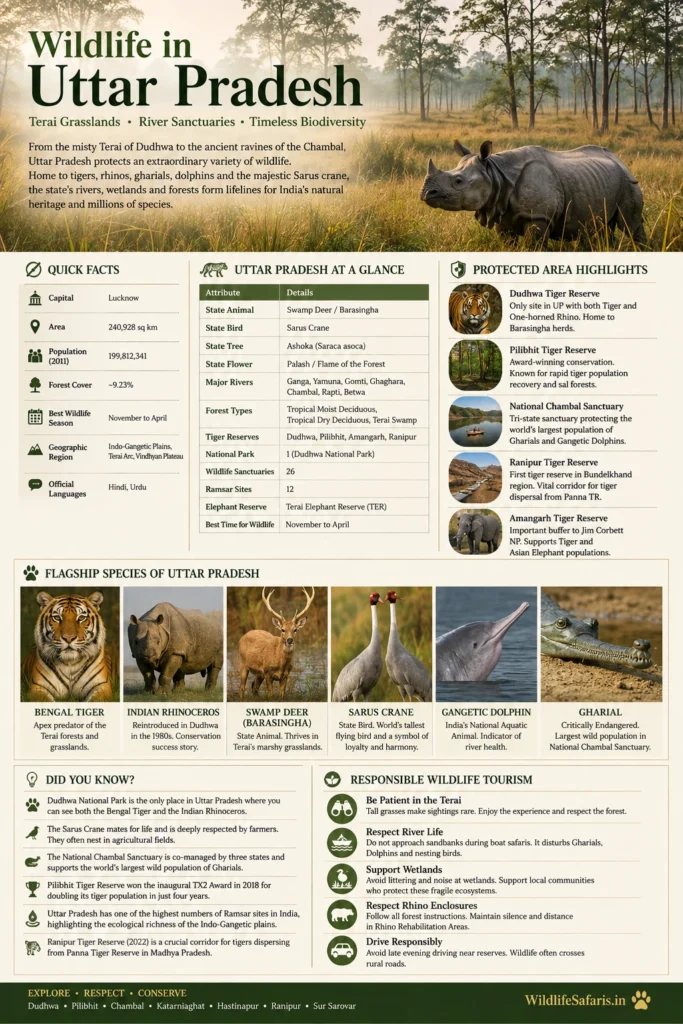
Quick Facts Table
| Category | Details |
| State / Union Territory | Uttar Pradesh |
| Capital | Lucknow |
| Area | 240,928 sq km |
| Population | 199,812,341 (2011 Census) |
| Forest Cover | ~9.23% |
| Official Language(s) | Hindi, Urdu |
| Time Zone | UTC+05:30 (IST) |
| Best Wildlife Season | November to April |
State Wildlife Master Table
| Attribute | Details |
| State / Union Territory | Uttar Pradesh |
| Capital | Lucknow |
| Geographic Region | Indo-Gangetic Plains, Terai Arc Landscape, Vindhyan Plateau |
| Total Area | 240,928 sq km |
| Forest Cover | ~9.23% |
| State Animal | Swamp Deer / Barasingha (Rucervus duvaucelii) |
| State Bird | Sarus Crane (Antigone antigone) |
| State Tree | Ashoka (Saraca asoca) |
| State Flower | Palash / Flame of the Forest (Butea monosperma) |
| Highest Peak | Amsot Peak, Shivalik Hills (957 m) |
| Major Rivers | Ganga, Yamuna, Gomti, Ghaghara, Chambal, Rapti, Betwa |
| Major Forest Types | Tropical Moist Deciduous, Tropical Dry Deciduous, Terai Swamp |
| Biodiversity Hotspot | Not officially specified |
| UNESCO Natural Sites | None |
| Biosphere Reserves | None |
| Tiger Reserves | Dudhwa, Pilibhit, Amangarh, Ranipur |
| Elephant Reserves | Terai Elephant Reserve (TER) |
| National Parks | Dudhwa National Park |
| Wildlife Sanctuaries | 26 Sanctuaries (including National Chambal, Hastinapur, Kaimoor, Katarniaghat, Kishanpur) |
| Conservation Reserves | Not officially specified |
| Community Reserves | Not officially specified |
| Ramsar Sites | 12 Sites (including Sur Sarovar, Nawabganj, Haiderpur, Bakhira, Upper Ganga River, Patna BS, Shekha Jheel) |
| Important Bird Areas (IBAs) | Dudhwa, National Chambal, Okhla, Sandi, Nawabganj |
| Major Wildlife Corridors | Terai Arc Landscape (connecting to Nepal), Vindhyan-Panna Corridor |
| Flagship Mammals | Bengal Tiger, Indian Rhinoceros, Swamp Deer, Gangetic Dolphin, Gharial, Sloth Bear |
| Flagship Birds | Sarus Crane, Bengal Florican, Swamp Francolin, Painted Stork |
| Endemic Wildlife | Not officially specified |
| Best Wildlife Destinations | Dudhwa TR, Pilibhit TR, National Chambal Sanctuary, Sur Sarovar |
| Best Time for Wildlife Tourism | November to April |
| Nearest International Airports | Chaudhary Charan Singh International Airport (Lucknow), Lal Bahadur Shastri International Airport (Varanasi), Noida International Airport (Jewar – upcoming) |
| Official Forest Department Website | upforest.gov.in |
Protected Areas Summary Table
| Protected Area | Category | District | Area (sq km) | Year Established | Famous For |
| Dudhwa National Park (Dudhwa TR) | National Park | Lakhimpur Kheri | 490.00 (Core NP) | 1977 (NP), 1987 (TR) | Bengal Tiger, One-Horned Rhino, Swamp Deer |
| Pilibhit Tiger Reserve | Tiger Reserve | Pilibhit, Shahjahanpur | 730.24 | 2014 (TR status) | Rapid Tiger Population Recovery, Sal Forests |
| Ranipur Tiger Reserve | Tiger Reserve | Chitrakoot | 529.36 | 1977 (WLS), 2022 (TR) | Bundelkhand Ecology, Leopard, Sloth Bear |
| Amangarh Tiger Reserve | Tiger Reserve | Bijnor | 80.60 | 2012 (TR status) | Buffer to Jim Corbett NP, Asian Elephant, Tiger |
| National Chambal Sanctuary | Wildlife Sanctuary | Agra, Etawah | 635.00 (UP portion) | 1979 | Gharial, Gangetic Dolphin, Indian Skimmer |
| Katarniaghat Wildlife Sanctuary | Wildlife Sanctuary | Bahraich | 400.09 | 1976 | Indo-Nepal Border, Tiger, Gharial, Gangetic Dolphin |
| Hastinapur Wildlife Sanctuary | Wildlife Sanctuary | Meerut, Bijnor, Hapur | 2,073.00 | 1986 | Swamp Deer, Gangetic Dolphin, State’s Largest WLS |
| Kaimoor Wildlife Sanctuary | Wildlife Sanctuary | Mirzapur, Sonbhadra | 501.00 | 1982 | Blackbuck, Sloth Bear, Prehistoric Rock Paintings |
| Sur Sarovar (Keetham Lake) | Wildlife Sanctuary | Agra | 7.97 | 1991 | Ramsar Site, Migratory Birds, Sloth Bear Rescue Facility |
| Haiderpur Wetland | Wetland | Bijnor | 69.00 | 2021 (Ramsar) | Immense Wintering Waterfowl Flocks, Swamp Deer |
Wildlife Highlights
- Top Mammals: Bengal Tiger, Indian Rhinoceros (One-horned Rhino), Swamp Deer (Barasingha), Indian Leopard, Asian Elephant, Gangetic River Dolphin, Sloth Bear, Striped Hyena, Hispid Hare.
- Top Birds: Sarus Crane, Bengal Florican, Swamp Francolin, Great Slaty Woodpecker, Indian Skimmer, Bar-headed Goose, Painted Stork, Ospreys.
- Reptiles & Amphibians: Gharial, Mugger Crocodile, Red-crowned Roof Turtle, Indian Python, Bengal Monitor.
- Flagship Flora: Sal (Shorea robusta), Teak (Tectona grandis), Shisham (Dalbergia sissoo), Khair (Senegalia catechu), and towering Terai Elephant Grass (Saccharum ravennae).
- Best Wildlife Experiences: Tracking tigers and rhinos through the tall elephant grass of Dudhwa, undertaking a serene boat safari on the Chambal River to photograph gharials, and watching the intricate courtship dance of Sarus cranes in the wetlands of Etawah.
Conservation Challenges
- Human-Tiger Conflict: The highly fragmented nature of the Terai Arc Landscape, bordered by dense sugarcane fields, leads to frequent and severe human-tiger conflicts. Tigers often mistake the tall sugarcane for natural elephant grass, leading to accidental encounters with farmers.
- Agricultural Runoff and Pollution: The Ganga, Yamuna, and their tributaries face intense pollution from industrial effluents and agricultural chemicals, severely threatening the highly sensitive Gangetic river dolphin and native turtle populations.
- River Sand Mining: Rampant, often illegal, sand mining along the banks of the Chambal and Yamuna rivers actively destroys the vital nesting grounds of the critically endangered gharial and Indian skimmer.
- Wetland Encroachment: Despite the high number of Ramsar sites, unprotected wetlands and ox-bow lakes across the Gangetic plains are constantly drained or encroached upon for agricultural expansion, depriving the Sarus crane of its natural breeding habitat.
- Poaching Threats: Due to its porous international border with Nepal, the Terai region remains highly sensitive to the illicit cross-border trafficking of wildlife parts, specifically targeting tiger bones and rhino horn.
- Habitat Fragmentation: The construction of multi-lane expressways, railway lines, and irrigation canals disrupts the historical migratory routes of elephants moving between the forests of Uttarakhand, Uttar Pradesh, and Nepal.
Responsible Wildlife Tourism
- Patience in the Terai: The exceedingly tall grasses of Dudhwa and Pilibhit make tiger tracking much more difficult than in the open forests of Central India. Be patient, respect the silent tracking process, and appreciate the rich birdlife while waiting.
- Safe Distance from Rivers: During boat safaris in the National Chambal Sanctuary, ensure the boat does not approach the sandy banks too closely. Gharials are incredibly shy and will quickly abandon their sun-basking spots if startled, which affects their thermoregulation.
- Support Local Wetland Conservation: When visiting Ramsar sites like Haiderpur or Nawabganj, do not litter or use loud music. Many of these wetlands are surrounded by villages; supporting local eco-tourism initiatives helps turn communities into wetland protectors.
- Respect Rhino Enclosures: Dudhwa features specially designated Rhino Rehabilitation Areas. Access is strictly regulated to minimise stress on the herds; always follow the forest guard’s instructions and maintain silence.
- Avoid Evening Driving near Reserves: Due to the dense agricultural matrix surrounding Pilibhit and Dudhwa, wildlife frequently crosses rural roads. Avoid driving on these peripheral roads post-sunset to prevent leopard or deer roadkills.
Did You Know?
- Dudhwa National Park is the only place in Uttar Pradesh where one can see both the Bengal Tiger and the Indian Rhinoceros sharing the same habitat.
- The Sarus Crane, Uttar Pradesh’s state bird, is famous for mating for life. They are deeply respected by local farmers and often nest directly within agricultural fields without fear.
- The National Chambal Sanctuary is uniquely co-managed by three states—Uttar Pradesh, Madhya Pradesh, and Rajasthan—and supports the largest wild population of Gharials in the world.
- In 2014, Pilibhit was upgraded to a Tiger Reserve and soon after made global headlines by winning the inaugural TX2 Award for doubling its tiger population in just four years, far ahead of the global target.
- Uttar Pradesh boasts one of the highest numbers of Ramsar sites (Wetlands of International Importance) in India, highlighting the incredible ecological value of the Indo-Gangetic plains.
- Ranipur Tiger Reserve, notified in late 2022, is historically significant because, while it rarely had resident tigers in the past decade, it serves as a crucial natural dispersal corridor for tigers migrating out of Panna Tiger Reserve in Madhya Pradesh.
Safari Planning : Topics Cluster
- How to book a wildlife safari in India?
- Park by Park Online Safari Booking Guide
- Tiger Safari India Planning Workbook
- Park by Park Safari Permits Guide
- National Parks Permit Guide – Park by Park Guide
- Tatkal Safari Booking Guide – Last Minute Safari Permits Booking
- Tiger Safari in India Cost
- Indian Wildlife Safari Budget Planner
- Jeep vs Canter Safari
- Best time for Tiger Sightings in India
- How far advanced should you book safari permits?
- Can foreigners book Indian Wildlife Safari online?
- Special Permits Guide for Foreigners and Domestic Visitors
- How to book a Safari Permit online in India? 2026 step by step guide
- Senior Citizens Friendly Safari Planning
- Multi Generation Family Safari Planning
- 50 things to know before your first safari in India