
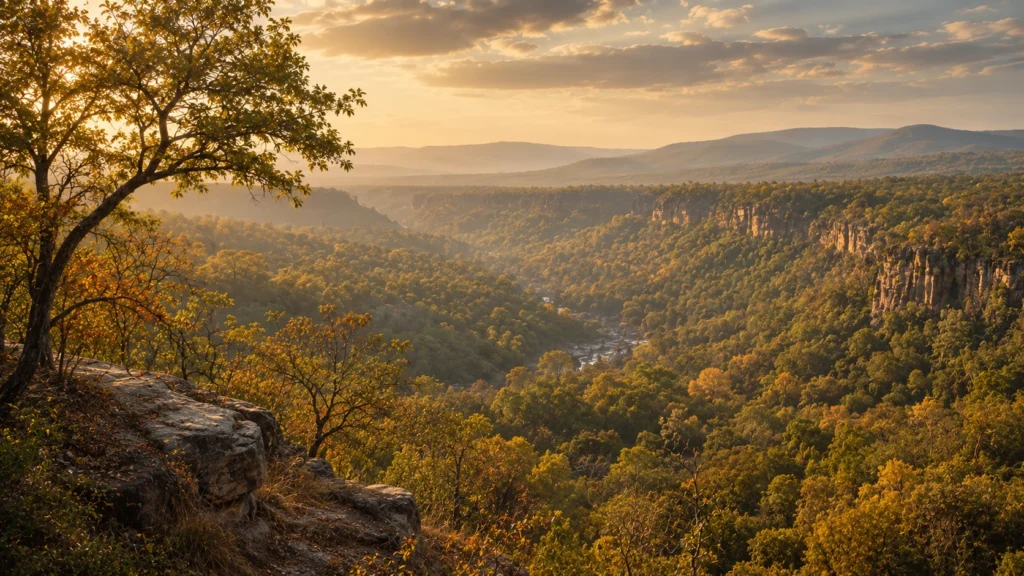
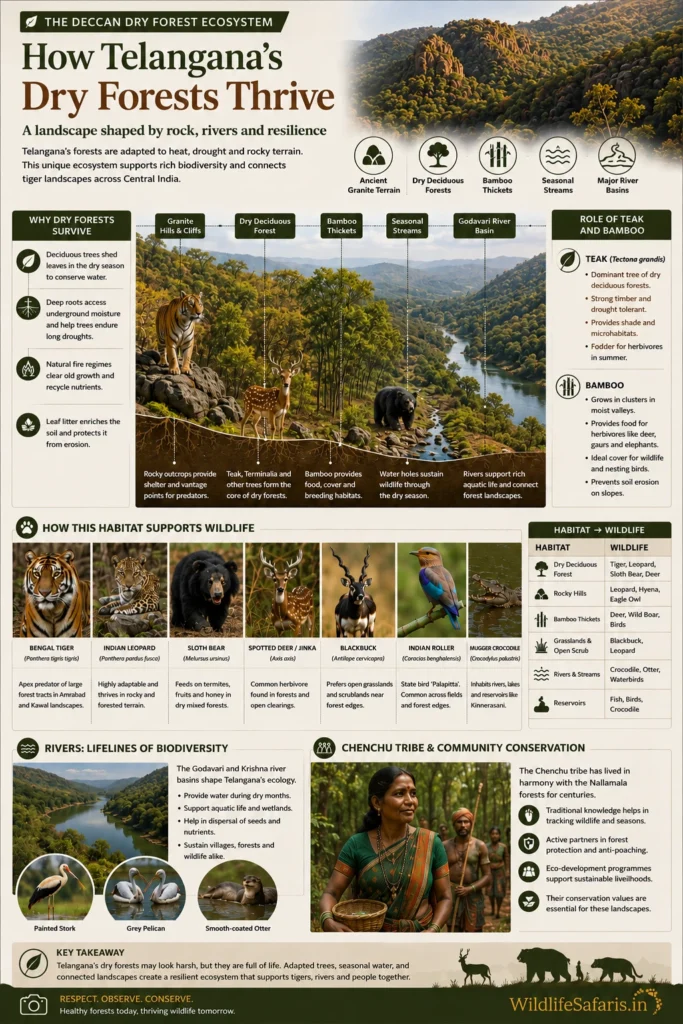
Telangana, situated on the rugged, semi-arid expanse of the Deccan Plateau in southern India, is defined by its undulating terrain, ancient granite rock formations, and the immense river basins of the Godavari and Krishna. Experiencing a hot, predominantly dry tropical climate, the state maintains a forest cover of approximately twenty-four per cent. The vegetative landscape is distinctly classified into tropical dry deciduous forests and expanses of thorny scrub, heavily dominated by teak, bamboo, and the resilient state tree, the Jammi Chettu. These hardy forests are remarkably adapted to prolonged dry spells and serve as critical refuges for central Indian megafauna.
The conservation backbone of Telangana is built upon its two expansive Tiger Reserves: Amrabad and Kawal. Amrabad Tiger Reserve, sprawling across the rugged Nallamala Hills, is one of the largest tiger reserves in India by core area. It protects a crucial population of Bengal tigers, Indian leopards, and sloth bears, while also serving as the ancestral home to the indigenous Chenchu tribe, who play an active role in forest protection. Further north, Kawal Tiger Reserve acts as a vital catchment area for the Godavari River and functions as a critical genetic corridor linking the tiger populations of Maharashtra and Chhattisgarh with southern India.
Beyond the deep forests, Telangana exhibits a strong commitment to urban wildlife integration. The heart of its capital, Hyderabad, features highly protected national parks such as Kasu Brahmananda Reddy (KBR) and Mahavir Harina Vanasthali, which provide crucial sanctuary for the state animal, the spotted deer (Jinka), and the blackbuck amidst intense urbanisation. The state bird, the vibrantly coloured Indian roller (Palapitta), is a common sight across the agricultural plains. While navigating the complex challenges of rapid highway expansion and agricultural encroachment, Telangana offers an authentic, off-the-beaten-path wildlife experience, showcasing the raw beauty of the Deccan wilderness.
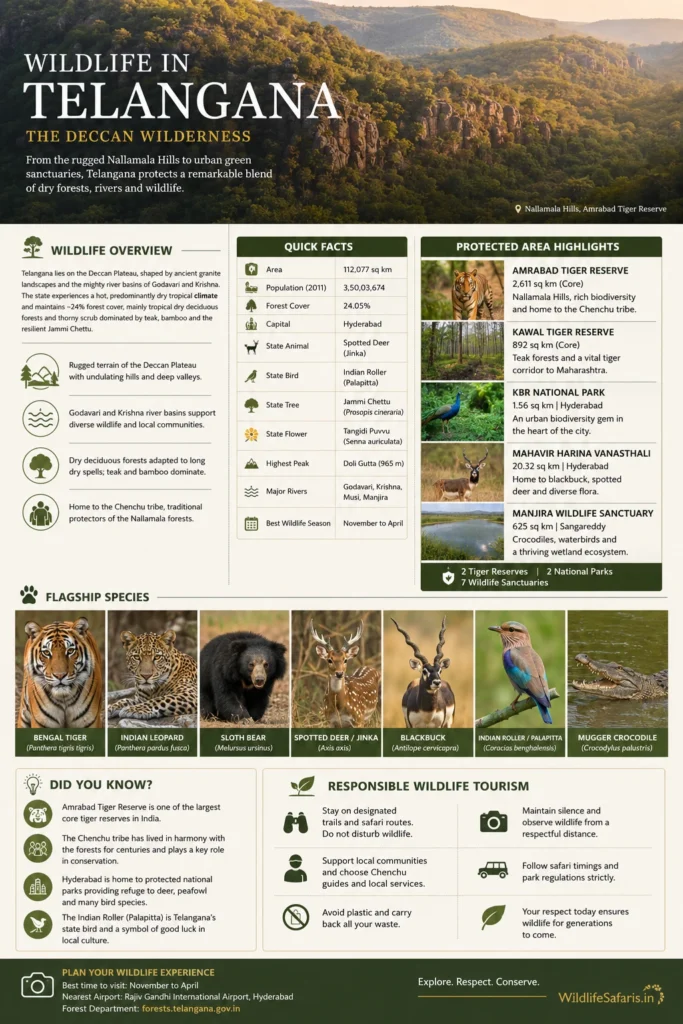
Quick Facts Table
| Category | Details |
| State / Union Territory | Telangana |
| Capital | Hyderabad |
| Area | 112,077 sq km |
| Population | 35,003,674 (2011 Census) |
| Forest Cover | 24.05% |
| Official Language(s) | Telugu, Urdu |
| Time Zone | UTC+05:30 (IST) |
| Best Wildlife Season | November to April |
State Wildlife Master Table
| Attribute | Details |
| State / Union Territory | Telangana |
| Capital | Hyderabad |
| Geographic Region | Deccan Plateau |
| Total Area | 112,077 sq km |
| Forest Cover | 24.05% |
| State Animal | Spotted Deer / Jinka (Axis axis) |
| State Bird | Indian Roller / Palapitta (Coracias benghalensis) |
| State Tree | Jammi Chettu (Prosopis cineraria) |
| State Flower | Tangidi Puvvu (Senna auriculata) |
| Highest Peak | Doli Gutta (965 m) |
| Major Rivers | Godavari, Krishna, Musi, Manjira |
| Major Forest Types | Tropical Dry Deciduous, Tropical Thorn Scrub |
| Biodiversity Hotspot | Not officially specified |
| UNESCO Natural Sites | None |
| Biosphere Reserves | None |
| Tiger Reserves | Amrabad, Kawal |
| Elephant Reserves | None |
| National Parks | Kasu Brahmananda Reddy (KBR), Mahavir Harina Vanasthali, Mrugavani |
| Wildlife Sanctuaries | 7 Sanctuaries (including Eturnagaram, Pakhal, Kinnerasani, Pocharam, Manjira) |
| Conservation Reserves | Not officially specified |
| Community Reserves | Not officially specified |
| Ramsar Sites | None currently designated |
| Important Bird Areas (IBAs) | Manjira WLS, Pakhal Lake, Kinnerasani |
| Major Wildlife Corridors | Kawal-Tadoba (Maharashtra) Corridor, Amrabad-Nagarjunasagar Corridor |
| Flagship Mammals | Bengal Tiger, Indian Leopard, Sloth Bear, Spotted Deer, Blackbuck, Dhole |
| Flagship Birds | Indian Roller, Painted Stork, Grey Pelican, Crested Serpent Eagle |
| Endemic Wildlife | Not officially specified |
| Best Wildlife Destinations | Amrabad TR, Kawal TR, Pakhal WLS, Manjira WLS |
| Best Time for Wildlife Tourism | November to April |
| Nearest International Airports | Rajiv Gandhi International Airport (Hyderabad) |
| Official Forest Department Website | forests.telangana.gov.in |
Protected Areas Summary Table
| Protected Area | Category | District | Area (sq km) | Year Established | Famous For |
| Amrabad Tiger Reserve | Tiger Reserve | Nagarkurnool, Nalgonda | 2,611.39 | 2014 (Post-bifurcation) | Nallamala Hills, Tigers, Chenchu Tribe, Sloth Bear |
| Kawal Tiger Reserve | Tiger Reserve | Mancherial, Adilabad | 892.23 (Core) | 1965 (WLS), 2012 (TR) | Teak Forests, Tiger Corridor to Maharashtra |
| Kasu Brahmananda Reddy (KBR) | National Park | Hyderabad | 1.56 | 1998 | Urban Conservation, Peafowl, Pangolin |
| Mahavir Harina Vanasthali | National Park | Hyderabad | 14.59 | 1975 | Blackbuck, Chital, Urban Deer Park |
| Mrugavani National Park | National Park | Ranga Reddy | 3.60 | 1994 | Urban Scrub Forest, Spotted Deer, Civet |
| Eturnagaram Wildlife Sanctuary | Wildlife Sanctuary | Mulugu | 806.15 | 1952 | Godavari River Basin, Giant Squirrel, Leopards |
| Kinnerasani Wildlife Sanctuary | Wildlife Sanctuary | Bhadradri Kothagudem | 635.40 | 1977 | Kinnerasani Dam, Crocodiles, Dense Deciduous Flora |
| Manjira Wildlife Sanctuary | Wildlife Sanctuary | Sangareddy | 20.00 | 1978 | Mugger Crocodiles, Migratory Birds |
| Pakhal Wildlife Sanctuary | Wildlife Sanctuary | Mahabubabad | 839.00 | 1952 | Pakhal Lake, Tigers (transient), Avifauna |
| Pocharam Wildlife Sanctuary | Wildlife Sanctuary | Medak, Kamareddy | 130.00 | 1952 | Historic Hunting Ground, Bar-headed Geese |
Wildlife Highlights
- Top Mammals: Bengal Tiger, Indian Leopard, Sloth Bear, Spotted Deer (Chital), Blackbuck, Nilgai, Chinkara, Dhole (Indian Wild Dog), Indian Pangolin, Honey Badger.
- Top Birds: Indian Roller (Palapitta), Painted Stork, Openbill Stork, Bar-headed Goose, Grey Pelican, Indian Peafowl.
- Reptiles & Amphibians: Mugger Crocodile (especially in Manjira and Kinnerasani), Indian Python, Russell’s Viper, Star Tortoise.
- Flagship Flora: Teak (Tectona grandis), Bamboo, Jammi Chettu (Prosopis cineraria), Tangidi Puvvu, Neem, Mahua.
- Best Wildlife Experiences: Jeep safaris in the rugged Nallamala hills of Amrabad, exploring the dense teak forests of Kawal, observing massive mugger crocodiles by boat at Manjira, and photographing blackbucks in Mahavir Harina Vanasthali.
Conservation Challenges
- Linear Infrastructure Corridors: The expansion of major national highways (such as the NH-44 connecting Nagpur to Hyderabad) cuts directly through the Kawal Tiger Reserve landscape, creating a lethal barrier for tigers dispersing from Maharashtra into Telangana.
- Agricultural Encroachment: The conversion of scrublands and forest fringes into cotton and paddy fields intensifies human-wildlife conflict, particularly involving wild boars, nilgai, and occasional leopards depredating livestock.
- Forest Fires: The highly arid, dry deciduous forests of Amrabad and Kawal are exceptionally vulnerable to devastating summer forest fires, which destroy ground vegetation and threaten slow-moving reptiles and nesting birds.
- Poaching and Snaring: While heavily policed, localized bushmeat hunting using wire snares remains a latent threat to ungulates like the spotted deer and wild boar, inadvertently causing severe injuries to predators like leopards and tigers.
- Invasive Species: The spread of aggressive weeds like Prosopis juliflora and Lantana camara in scrub forests degrades the native fodder availability for herbivores.
Responsible Wildlife Tourism
- Respect Urban Boundaries: When visiting city-embedded national parks like KBR or Mahavir Harina Vanasthali, strictly stay on marked walking trails. These parks act as vital green lungs and highly sensitive refuges amidst immense urban noise and pollution.
- Engage Indigenous Guides: At the Amrabad Tiger Reserve, opt for eco-tourism packages led by the local Chenchu community. Their unparalleled tracking skills enrich the safari experience, and the revenue directly incentivises their conservation efforts.
- Zero Tolerance for Plastics: Telangana forest authorities are increasingly strict about plastic bans. Carry reusable metal or glass water bottles, particularly when visiting aquatic sanctuaries like Pakhal or Manjira.
- Maintain Safari Discipline: The deciduous forests can be dense, and visibility of big cats is a matter of patience. Do not pressure drivers to speed or break route rules just to chase an alarm call.
- Silence on the Water: When taking boat rides at the Manjira Wildlife Sanctuary to observe mugger crocodiles and nesting storks, maintain absolute silence to avoid startling the wildlife.
Did You Know?
- Amrabad Tiger Reserve, originally part of the massive Nagarjunasagar-Srisailam Tiger Reserve before the bifurcation of Andhra Pradesh in 2014, is one of the largest tiger reserves in India by core area.
- The state bird, the Indian Roller (locally known as Palapitta), holds immense cultural significance and spotting one during the festival of Dussehra is considered highly auspicious in Telangana.
- Mahavir Harina Vanasthali National Park in Hyderabad was originally a private hunting ground (Shikargah) for the Nizams of Hyderabad before being converted into a highly successful urban conservation centre for the Blackbuck.
- The indigenous Chenchu tribe, inhabiting the Nallamala forests of Amrabad for millennia, are officially recognised as a Particularly Vulnerable Tribal Group (PVTG) and are now heavily integrated into the state’s tiger conservation task force.
- Manjira Wildlife Sanctuary originally began as an initiative strictly to protect the vulnerable Mugger Crocodile, which had been hunted to near extinction in the region by the 1970s.
- The state tree, the Jammi Chettu (Prosopis cineraria), is legendary in the epic Mahabharata as the tree where the Pandavas hid their weapons during their exile.
Safari Planning : Topics Cluster
- How to book a wildlife safari in India?
- Park by Park Online Safari Booking Guide
- Tiger Safari India Planning Workbook
- Park by Park Safari Permits Guide
- National Parks Permit Guide – Park by Park Guide
- Tatkal Safari Booking Guide – Last Minute Safari Permits Booking
- Tiger Safari in India Cost
- Indian Wildlife Safari Budget Planner
- Jeep vs Canter Safari
- Best time for Tiger Sightings in India
- How far advanced should you book safari permits?
- Can foreigners book Indian Wildlife Safari online?
- Special Permits Guide for Foreigners and Domestic Visitors
- How to book a Safari Permit online in India? 2026 step by step guide
- Senior Citizens Friendly Safari Planning
- Multi Generation Family Safari Planning
- 50 things to know before your first safari in India