
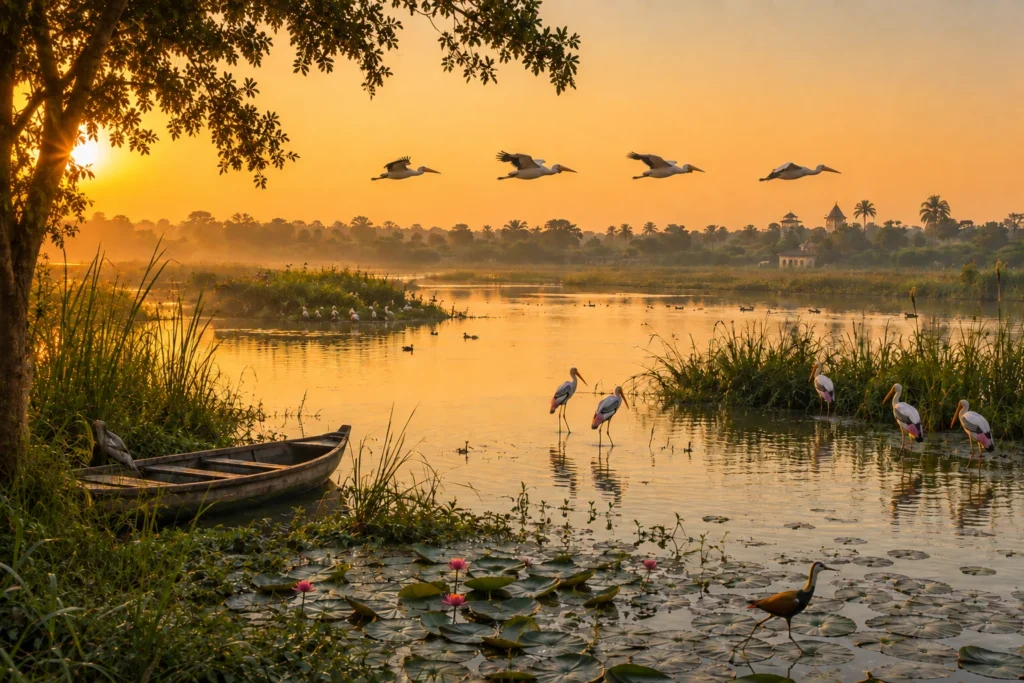
Puducherry, a Union Territory situated along the Coromandel, Malabar, and Godavari coasts, comprises four geographically disjointed enclaves: Puducherry, Karaikal, Yanam, and Mahe. Bound by the coastal regions of Tamil Nadu, Andhra Pradesh, and Kerala, the territory experiences a hot tropical maritime climate, heavily influenced by the northeast and southwest monsoons. Despite its fragmented and highly urbanised geography, Puducherry sustains a vital coastal and wetland ecological network, with its total forest cover accounting for nearly eleven per cent of its landmass. This vegetation primarily consists of littoral scrub, coastal plantations, and scattered patches of tropical dry evergreen forests, a rare forest type highly specific to the eastern Indian seaboard.
The epicentre of wildlife conservation in the territory is Oussudu (Ousteri) Lake, the largest freshwater catchment in the region and Puducherry’s only designated Wildlife Sanctuary. Recognised globally as an Important Bird Area (IBA) by the IUCN, this sprawling artificial wetland features open water, mudflats, and reed beds that sustain a complex avian ecosystem. During the winter months, Oussudu acts as a crucial stopover on the Central Asian Flyway, hosting thousands of migratory waterfowl, including painted storks, spot-billed pelicans, and Eurasian spoonbills. The state bird, the Asian koel, thrives in the urban and semi-urban canopies, while the state animal, the ubiquitous Indian palm squirrel, navigates the pervasive coastal flora, notably the state tree, the sacred Vilva (Bael), and the exotic Cannonball tree, the state flower.
Wildlife management in Puducherry faces acute challenges associated with rapid urbanisation, agricultural runoff, and the complexities of inter-state ecological governance, as Oussudu Lake is shared with Tamil Nadu. Nevertheless, the territory serves as an exemplary model of urban wetland conservation, offering highly accessible ornithological tourism and highlighting the vital role of freshwater ecosystems in sustaining coastal biodiversity.
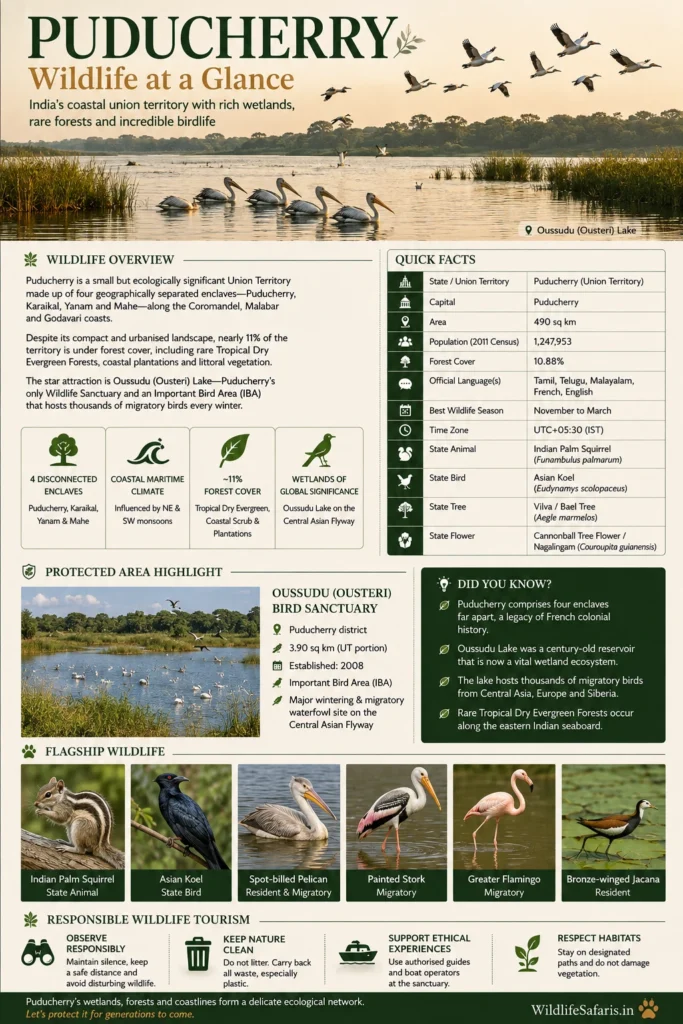
Quick Facts Table
| Category | Details |
| State / Union Territory | Puducherry (Union Territory) |
| Capital | Puducherry |
| Area | 490 sq km |
| Population | 1,247,953 (2011 Census) |
| Forest Cover | 10.88% |
| Official Language(s) | Tamil, Telugu, Malayalam, French, English |
| Time Zone | UTC+05:30 (IST) |
| Best Wildlife Season | November to March |
State Wildlife Master Table
| Attribute | Details |
| State / Union Territory | Puducherry |
| Capital | Puducherry |
| Geographic Region | Coromandel Coast, Malabar Coast, Godavari Delta |
| Total Area | 490 sq km |
| Forest Cover | 10.88% |
| State Animal | Indian Palm Squirrel (Funambulus palmarum) |
| State Bird | Asian Koel (Eudynamys scolopaceus) |
| State Tree | Vilva / Bael Tree (Aegle marmelos) |
| State Flower | Cannonball Tree Flower / Nagalingam (Couroupita guianensis) |
| Highest Peak | Les Montagnes Rouges / Red Hills (~30 m) |
| Major Rivers | Gingee, Pennaiyar, Mahe, Godavari (in Yanam) |
| Major Forest Types | Tropical Dry Evergreen, Littoral and Swamp, Coastal Scrub |
| Biodiversity Hotspot | Not officially specified |
| UNESCO Natural Sites | None |
| Biosphere Reserves | None |
| Tiger Reserves | None |
| Elephant Reserves | None |
| National Parks | None |
| Wildlife Sanctuaries | Oussudu (Ousteri) Bird Sanctuary |
| Conservation Reserves | Not officially specified |
| Community Reserves | Not officially specified |
| Ramsar Sites | None |
| Important Bird Areas (IBAs) | Oussudu Lake |
| Major Wildlife Corridors | Coastal Avian Flyways |
| Flagship Mammals | Indian Palm Squirrel, Golden Jackal, Bonnet Macaque |
| Flagship Birds | Asian Koel, Painted Stork, Spot-billed Pelican, Eurasian Spoonbill |
| Endemic Wildlife | Not officially specified |
| Best Wildlife Destinations | Oussudu Bird Sanctuary |
| Best Time for Wildlife Tourism | November to March |
| Nearest International Airports | Puducherry Airport (Domestic), Chennai International Airport |
| Official Forest Department Website | forest.py.gov.in |
Protected Areas Summary Table
| Protected Area | Category | District | Area (sq km) | Year Established | Famous For |
| Oussudu (Ousteri) Bird Sanctuary | Wildlife Sanctuary | Puducherry | 3.90 (UT portion) | 2008 | Migratory Waterfowl, Important Bird Area (IBA) |
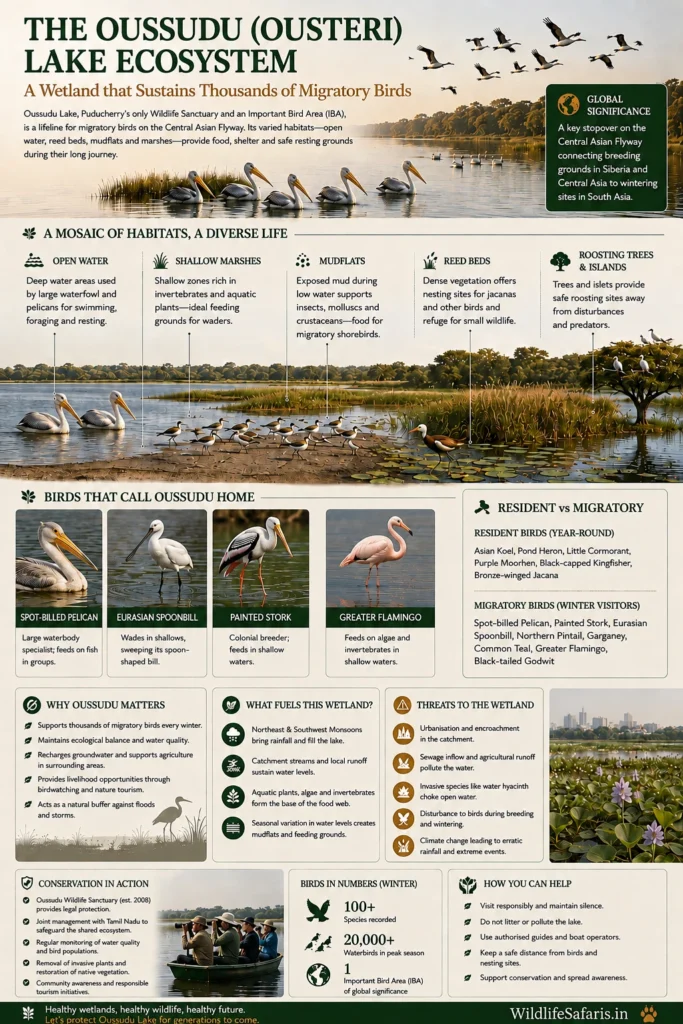
Wildlife Highlights
- Top Mammals: Indian Palm Squirrel, Golden Jackal, Bonnet Macaque, Indian Grey Mongoose, Indian Flying Fox.
- Top Birds: Asian Koel, Painted Stork, Spot-billed Pelican, Eurasian Spoonbill, Greater Flamingo, White-bellied Sea Eagle, Bronze-winged Jacana, Black-capped Kingfisher.
- Reptiles & Amphibians: Olive Ridley Sea Turtle (seasonal nesting on beaches), Indian Black Turtle, Common Vine Snake, Indian Rock Python.
- Flagship Flora: Cannonball Tree (Nagalingam), Vilva (Bael), Mangroves (in Yanam enclave), Palmyra Palm.
- Best Wildlife Experiences: Birdwatching boat rides on Oussudu Lake at dawn, observing migratory pelicans and flamingos during winter, and exploring the estuarine mangrove patches in the Yanam region.
Conservation Challenges
- Urban Encroachment: The rapid expansion of real estate, urban settlements, and infrastructure around Oussudu Lake threatens to shrink the wetland boundaries and disrupt critical avian roosting sites.
- Inter-State Governance: Oussudu Lake is ecologically contiguous but administratively divided between Puducherry (approx. 390 hectares) and Tamil Nadu, complicating unified conservation management and anti-encroachment protocols.
- Water Pollution: The discharge of untreated domestic sewage and agricultural runoff containing chemical pesticides from surrounding fields leads to severe eutrophication of the wetlands.
- Invasive Weeds: The aggressive proliferation of water hyacinth (Eichhornia crassipes) chokes the open water surfaces of Ousteri, restricting foraging areas for diving ducks and waders and altering the oxygen balance of the lake.
- Coastal Vulnerability: The coastal enclaves face acute, long-term threats from sea-level rise, coastal erosion, and high-intensity cyclonic storms, which routinely damage littoral scrub habitats and wash away turtle nesting beaches.
Responsible Wildlife Tourism
- Maintain Wetland Silence: When observing birds at Oussudu Lake, keep noise levels to an absolute minimum to avoid flushing large flocks of resting and nesting waterfowl.
- Use Official Boats: Utilise only authorised, non-motorised or low-speed boats operated by the Puducherry Tourism Development Corporation to minimise acoustic stress and water disturbance.
- Zero Plastic Tolerance: Do not carry single-use plastics into the sanctuary or leave them on the beaches, as they pose severe ingestion hazards to wading birds and marine turtles.
- Do Not Feed Wildlife: Avoid feeding macaques along the roads or fish at the lake, as artificial feeding disrupts natural foraging behaviours and introduces unhealthy pathogens into the ecosystem.
- Respect Coastal Nesting: If visiting the beaches during the winter turtle nesting season, do not use flashlights, light campfires, or walk near identified nesting pits at night.
Did You Know?
- Puducherry is geographically unique in India, comprising four disconnected coastal enclaves distributed across three different states: Tamil Nadu, Andhra Pradesh, and Kerala.
- Oussudu Lake (Ousteri) is a century-old, man-made reservoir originally built by the French administration to supply irrigation water, which naturally evolved into one of Asia’s most significant wetlands.
- The state flower of Puducherry, the Cannonball Tree flower (Nagalingam), is highly revered in Hindu culture as its central reproductive structure naturally resembles a Shiva Lingam shielded by a multi-headed snake.
- Despite its tiny geographical footprint, Oussudu Lake was recognised by the International Union for Conservation of Nature (IUCN) as a wetland of continental significance due to its incredible avian biodiversity.
- The Vilva (Bael) tree, designated as Puducherry’s state tree, is not only culturally sacred but also possesses immense traditional medicinal properties and is highly adapted to the region’s dry evergreen climate.
.
Safari Planning : Topics Cluster
- How to book a wildlife safari in India?
- Park by Park Online Safari Booking Guide
- Tiger Safari India Planning Workbook
- Park by Park Safari Permits Guide
- National Parks Permit Guide – Park by Park Guide
- Tatkal Safari Booking Guide – Last Minute Safari Permits Booking
- Tiger Safari in India Cost
- Indian Wildlife Safari Budget Planner
- Jeep vs Canter Safari
- Best time for Tiger Sightings in India
- How far advanced should you book safari permits?
- Can foreigners book Indian Wildlife Safari online?
- Special Permits Guide for Foreigners and Domestic Visitors
- How to book a Safari Permit online in India? 2026 step by step guide
- Senior Citizens Friendly Safari Planning
- Multi Generation Family Safari Planning
- 50 things to know before your first safari in India