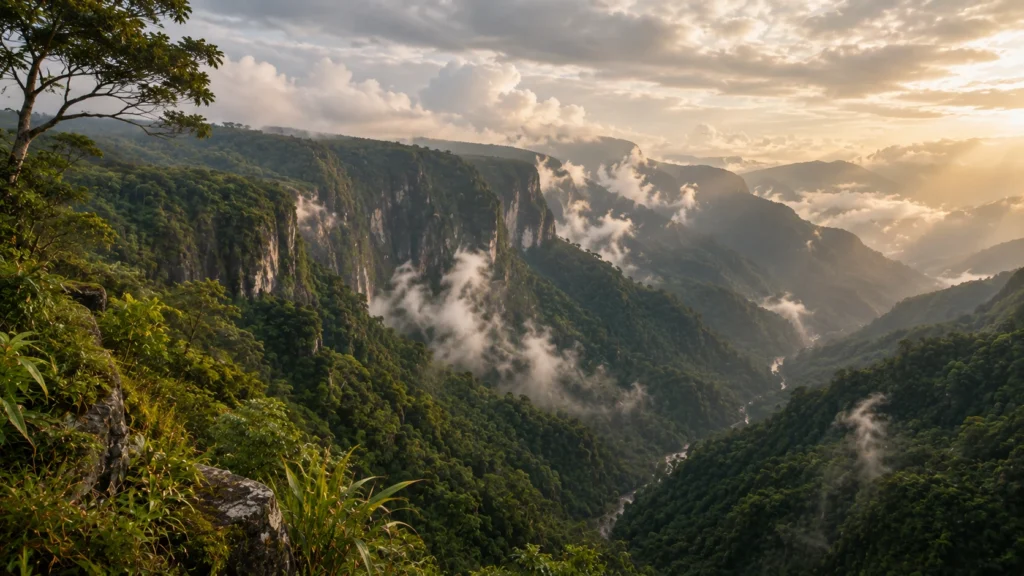
Meghalaya, the “Abode of Clouds,” is a spectacular mountainous state in Northeast India, defined by the Khasi, Jaintia, and Garo Hills. Its geography is characterised by deep gorges, high-altitude plateaus, and one of the wettest climates on Earth, which nurtures dense tropical rainforests, temperate hill forests, and expansive bamboo brakes. Covering over 76% of the state’s geographical area, these forests represent a critical segment of the Indo-Burma biodiversity hotspot. The region is also famous for its extensive limestone karst landscapes, featuring some of the longest and deepest cave systems in the subcontinent, which provide unique subterranean habitats for specialised cave fauna.
The state’s wildlife is rich and highly distinctive. The flagship species is the clouded leopard, the designated state animal, which thrives in the dense forest blocks of the Garo and Khasi hills. Meghalaya is globally significant for primate conservation, hosting the western hoolock gibbon—India’s only ape—and the capped langur. The forest canopy is a haven for a spectacular array of hornbills, including the great hornbill and wreathed hornbill, while the temperate hills of the north are home to rare pheasants like Blyth’s tragopan and Mrs. Hume’s pheasant.
Conservation in Meghalaya is uniquely rooted in traditional practices. Large tracts of forests are managed as “sacred groves” by local indigenous communities, protecting ancient trees and medicinal plants that have disappeared elsewhere. Protected areas like Nokrek Biosphere Reserve and Balpakram National Park serve as vital biodiversity strongholds. Despite the threats of coal mining, limestone extraction, and shifting cultivation (jhum), Meghalaya remains a critical frontier for exploring evolutionary lineages and pristine montane ecosystems, offering a deeply rewarding experience for researchers and nature enthusiasts alike.
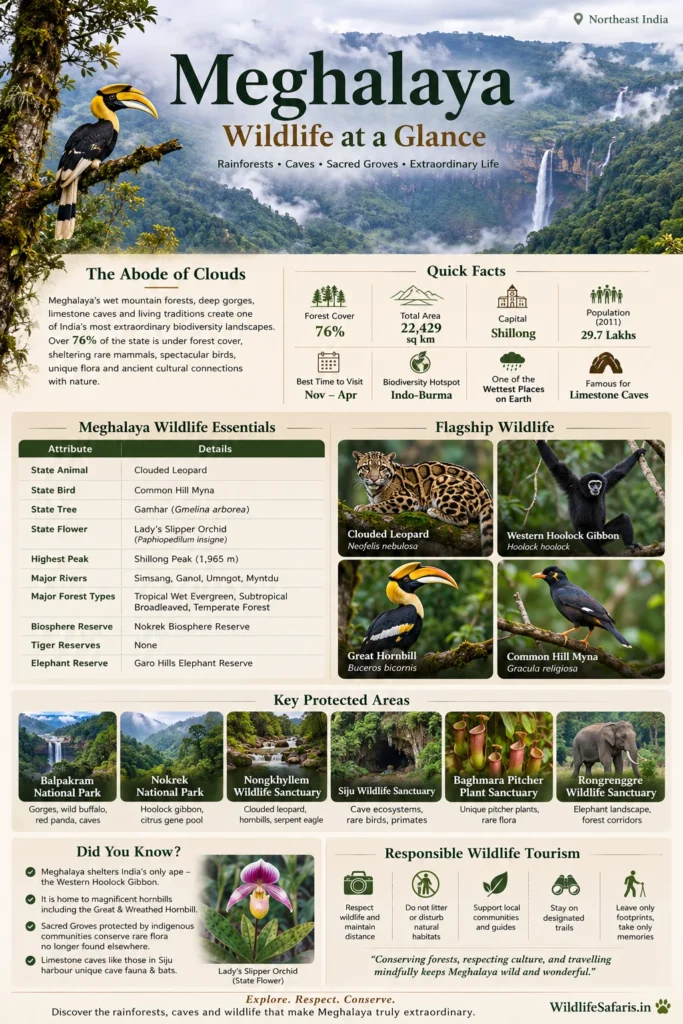
Quick Facts Table
| Category | Details |
| State / Union Territory | Meghalaya |
| Capital | Shillong |
| Area | 22,429 sq km |
| Population | 2,966,889 (2011 Census) |
| Forest Cover | 76.00% |
| Official Language(s) | English, Khasi, Garo |
| Time Zone | UTC+05:30 (IST) |
| Best Wildlife Season | November to April |
State Wildlife Master Table
| Attribute | Details |
| State / Union Territory | Meghalaya |
| Capital | Shillong |
| Geographic Region | Northeast India (Khasi, Jaintia, and Garo Hills) |
| Total Area | 22,429 sq km |
| Forest Cover | 76.00% |
| State Animal | Clouded Leopard (Neofelis nebulosa) |
| State Bird | Common Hill Myna (Gracula religiosa) |
| State Tree | Gamhar (Gmelina arborea) |
| State Flower | Lady’s Slipper Orchid (Paphiopedilum insigne) |
| Highest Peak | Shillong Peak (1,965 m) |
| Major Rivers | Simsang, Ganol, Umngot, Myntdu |
| Major Forest Types | Tropical Wet Evergreen, Subtropical Broadleaved, Temperate Forest |
| Biodiversity Hotspot | Indo-Burma |
| UNESCO Natural Sites | None |
| Biosphere Reserves | Nokrek Biosphere Reserve |
| Tiger Reserves | None |
| Elephant Reserves | Garo Hills Elephant Reserve |
| National Parks | Balpakram, Nokrek |
| Wildlife Sanctuaries | Nongkhyllem, Siju, Baghmara (Pitcher Plant), Rongrenggre |
| Conservation Reserves | Not officially specified |
| Community Reserves | Not officially specified |
| Ramsar Sites | None |
| Important Bird Areas (IBAs) | Balpakram, Nokrek, Nongkhyllem, Siju |
| Major Wildlife Corridors | Garo-Khasi Hill Corridors |
| Flagship Mammals | Clouded Leopard, Western Hoolock Gibbon, Capped Langur, Asiatic Black Bear |
| Flagship Birds | Great Hornbill, Wreathed Hornbill, Blyth’s Tragopan, Hill Myna |
| Endemic Wildlife | Khasi Hills Horned Frog, Meghalaya Toad |
| Best Wildlife Destinations | Nokrek NP, Balpakram NP, Nongkhyllem WLS |
| Best Time for Wildlife Tourism | November to April |
| Nearest International Airports | Guwahati (Assam) |
| Official Forest Department Website | megforest.gov.in |
Protected Areas Summary Table
| Protected Area | Category | District | Area (sq km) | Year Established | Famous For |
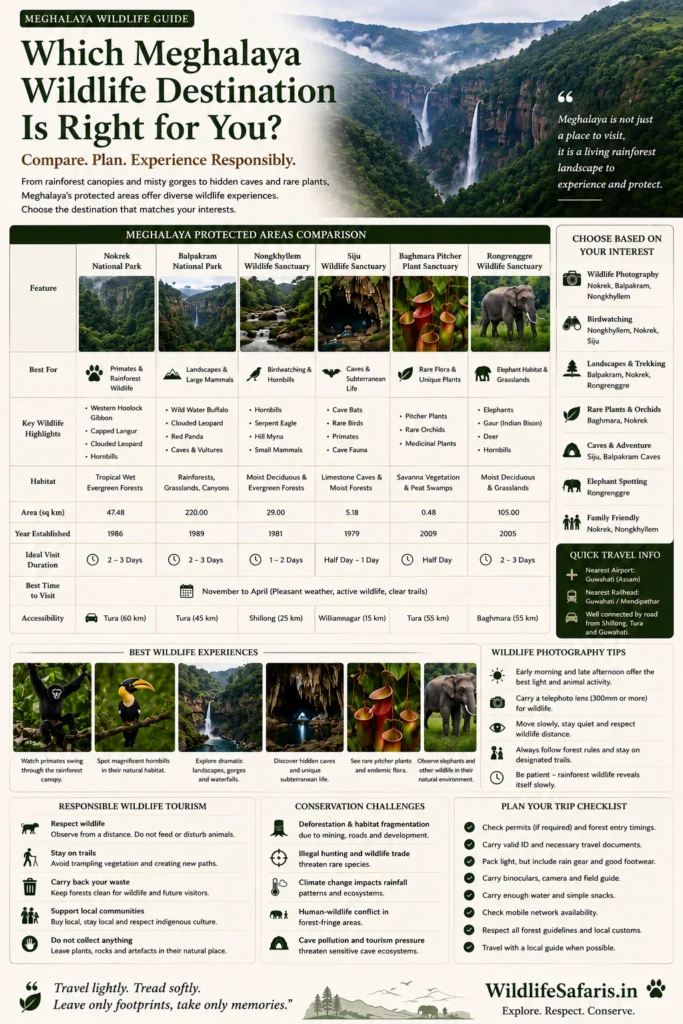
| Balpakram National Park | National Park | South Garo Hills | 220.00 | 1989 | Wild Water Buffalo, Red Panda, Limestone Caves |
| Nokrek National Park | National Park | West Garo Hills | 47.48 | 1986 | Hoolock Gibbon, Citrus indica (Gene Pool) |
| Nongkhyllem Wildlife Sanctuary | Wildlife Sanctuary | Ri-Bhoi | 29.00 | 1981 | Clouded Leopard, Hornbills, Serpent Eagle |
| Siju Wildlife Sanctuary | Wildlife Sanctuary | South Garo Hills | 5.18 | 1979 | Rare Birds, Limestone Cave Bats, Primates |
| Baghmara Pitcher Plant Sanctuary | Wildlife Sanctuary | South Garo Hills | 0.02 | 1984 | Endemic Pitcher Plant (Nepenthes khasiana) |
| Rongrenggre Wildlife Sanctuary | Wildlife Sanctuary | East Garo Hills | 20.60 | 1981 | Elephant Habitat, Moist Deciduous Forests |
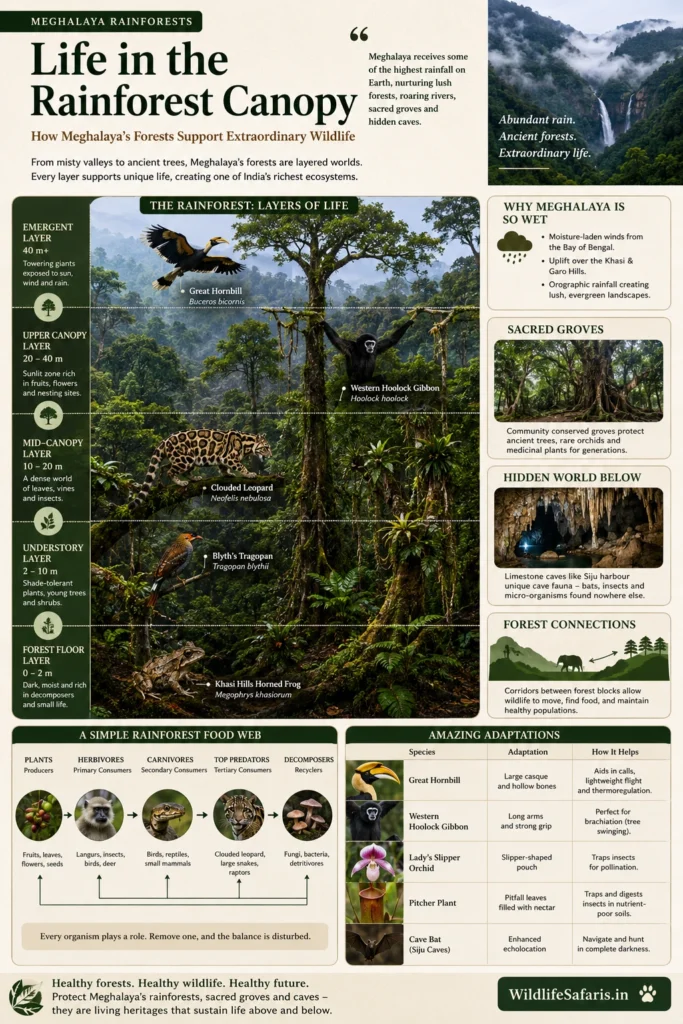
Wildlife Highlights
- Top Mammals: Clouded Leopard, Western Hoolock Gibbon, Capped Langur, Asiatic Black Bear, Binturong, Slow Loris, Himalayan Crestless Porcupine.
- Top Birds: Great Hornbill, Wreathed Hornbill, Blyth’s Tragopan, Mrs. Hume’s Pheasant, Common Hill Myna, Blue-naped Pitta.
- Reptiles & Amphibians: Burmese Python, Tokay Gecko, Khasi Hills Horned Frog, Meghalaya Toad.
- Flagship Flora: Lady’s Slipper Orchid, Nepenthes khasiana (Pitcher Plant), Citrus indica (wild ancestor of citrus).
- Best Wildlife Experiences: Trekking in the Balpakram canyon, primate watching in Nokrek, birdwatching in Nongkhyllem, and exploring the unique cave-dwelling fauna in Siju.
Conservation Challenges
- Coal Mining: Illegal and unregulated “rat-hole” coal mining has severely acidified local river systems and destroyed forest patches, leading to significant habitat loss.
- Shifting Cultivation: Traditional jhum cultivation, if practiced with short fallow cycles, leads to deforestation and the fragmentation of wildlife corridors.
- Habitat Fragmentation: Infrastructure development in the hilly terrain disrupts the connectivity required by wide-ranging species like elephants and leopards.
- Hunting: Traditional hunting practices in some rural areas continue to impact populations of small mammals, birds, and primates.
- Invasive Species: The spread of non-native vegetation in disturbed forest areas poses a risk to local floral biodiversity.
Responsible Wildlife Tourism
- Respect Sacred Groves: Many forests are “sacred groves” protected by local taboos. Never take anything from these areas, including plants, stones, or wood.
- Hire Local Guides: Always engage local community guides who are knowledgeable about forest trails and understand the local cultural protocols regarding wildlife.
- Zero Littering: The unique karst topography and caves are extremely sensitive to pollutants. Carry all waste back out.
- Avoid Wildlife Products: Never purchase animal parts or rare orchids as souvenirs.
- Stay on Paths: Stick to established forest trails to prevent the trampling of delicate understory plants and to avoid accidental encounters with venomous reptiles.
Did You Know?
- Meghalaya is home to Nepenthes khasiana, the only pitcher plant species native to India.
- Nokrek National Park is a UNESCO-designated Biosphere Reserve and serves as the gene pool for the wild ancestor of citrus, Citrus indica.
- The western hoolock gibbon, India’s only ape, is a primary resident of Meghalaya’s dense forests and is well-known for its loud, haunting calls.
- Meghalaya contains some of the deepest and longest cave systems in the world, which harbour unique species of troglobitic (cave-dwelling) fish and insects.
- Sacred groves like Mawphlang are protected by traditional customs rather than government laws, yet they remain some of the best-preserved forest patches in the state.
Safari Planning : Topics Cluster
- How to book a wildlife safari in India?
- Park by Park Online Safari Booking Guide
- Tiger Safari India Planning Workbook
- Park by Park Safari Permits Guide
- National Parks Permit Guide – Park by Park Guide
- Tatkal Safari Booking Guide – Last Minute Safari Permits Booking
- Tiger Safari in India Cost
- Indian Wildlife Safari Budget Planner
- Jeep vs Canter Safari
- Best time for Tiger Sightings in India
- How far advanced should you book safari permits?
- Can foreigners book Indian Wildlife Safari online?
- Special Permits Guide for Foreigners and Domestic Visitors
- How to book a Safari Permit online in India? 2026 step by step guide
- Senior Citizens Friendly Safari Planning
- Multi Generation Family Safari Planning
- 50 things to know before your first safari in India