
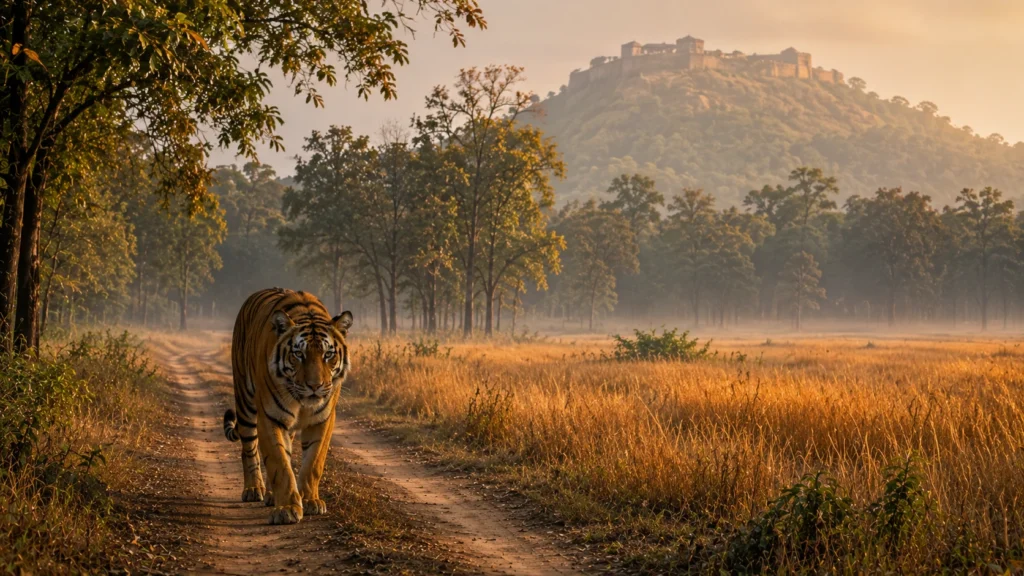
Madhya Pradesh, translating to the “Central Province,” rightfully holds the title of the ecological heart of India. Characterised by the ancient undulating plateaus of the Vindhya and Satpura mountain ranges, the state is bisected by the lifeline of central India, the Narmada River. Experiencing a tropical climate, the state sustains the largest forest cover in India by area, encompassing over twenty-five per cent of its geographical expanse. This vast forested landscape represents a major ecotone where the majestic sal forests of the east seamlessly transition into the teak-dominated dry deciduous woodlands of the west, interspersed with expansive savannah-like grasslands (known locally as maidans).
The state is globally celebrated as the “Tiger State of India,” harbouring the highest population of wild Bengal tigers in the country. This remarkable conservation success is anchored by seven designated Tiger Reserves, including world-renowned landscapes such as Kanha, Bandhavgarh, Pench, and the recently notified Veerangana Durgavati Tiger Reserve. Madhya Pradesh is also the site of one of the most ambitious global conservation experiments: the reintroduction of the African cheetah into the sprawling grasslands of Kuno National Park, marking the world’s first intercontinental translocation of a large carnivore. Furthermore, the state boasts a triumph in endemic conservation, having successfully rescued the hard-ground barasingha (swamp deer)—the state animal—from the brink of extinction within the Kanha landscape.
Avian and aquatic biodiversity is equally impressive. The National Chambal Sanctuary remains a critical sanctuary for the critically endangered gharial, the red-crowned roof turtle, and the Indian skimmer. The state’s four Ramsar-designated wetlands, including the Bhoj Wetland and Yashwant Sagar, provide vital wintering grounds for migratory waterfowl. Despite the pressing challenges of rapid infrastructure development and the fragmentation of historic wildlife corridors, Madhya Pradesh remains the undisputed apex of Indian wildlife tourism, offering highly organised, deeply immersive terrestrial safaris that set the national benchmark for protected area management.
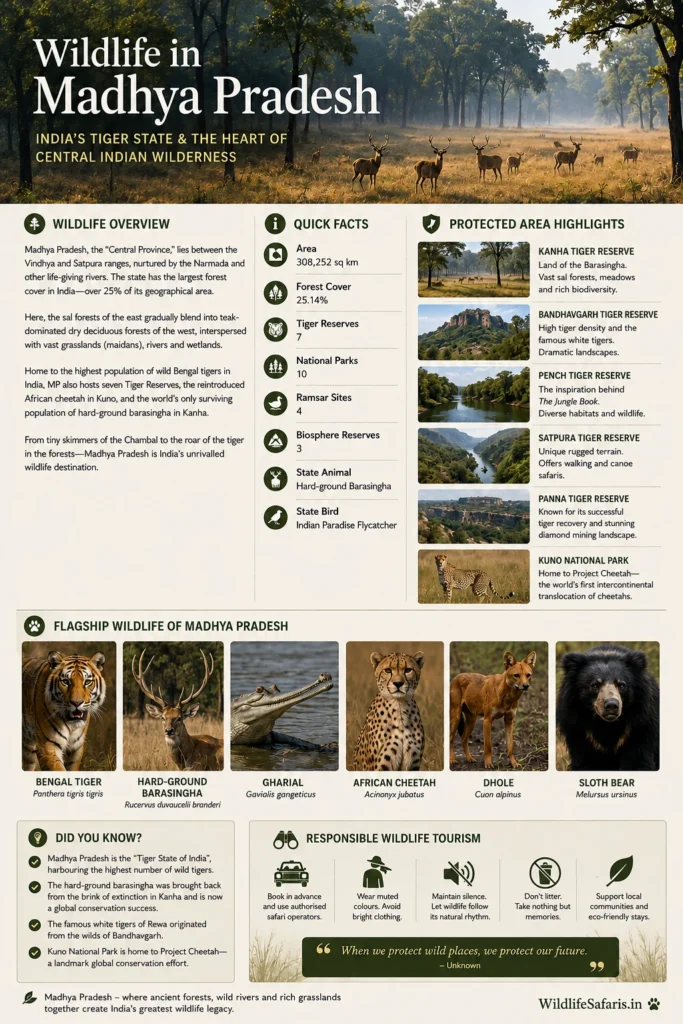
Quick Facts Table
| Category | Details |
| State / Union Territory | Madhya Pradesh |
| Capital | Bhopal |
| Area | 308,252 sq km |
| Population | 72,626,809 (2011 Census) |
| Forest Cover | 25.14% |
| Official Language(s) | Hindi |
| Time Zone | UTC+05:30 (IST) |
| Best Wildlife Season | October to June |
State Wildlife Master Table
| Attribute | Details |
| State / Union Territory | Madhya Pradesh |
| Capital | Bhopal |
| Geographic Region | Central India (Vindhya and Satpura Ranges) |
| Total Area | 308,252 sq km |
| Forest Cover | 25.14% |
| State Animal | Hard-ground Barasingha / Swamp Deer (Rucervus duvaucelii branderi) |
| State Bird | Indian Paradise Flycatcher / Dhudhraj (Terpsiphone paradisi) |
| State Tree | Banyan (Ficus benghalensis) |
| State Flower | White Lily (Lilium candidum) |
| Highest Peak | Dhupgarh, Pachmarhi (1,350 m) |
| Major Rivers | Narmada, Chambal, Betwa, Ken, Son, Tapti, Pench |
| Major Forest Types | Tropical Moist Deciduous, Tropical Dry Deciduous |
| Biodiversity Hotspot | Not officially specified |
| UNESCO Natural Sites | None |
| Biosphere Reserves | Pachmarhi, Achanakmar-Amarkantak, Panna |
| Tiger Reserves | Kanha, Bandhavgarh, Pench, Panna, Satpura, Sanjay-Dubri, Veerangana Durgavati |
| Elephant Reserves | None (though wild herds are establishing residency in Bandhavgarh and Sanjay-Dubri) |
| National Parks | Kanha, Bandhavgarh, Madhav, Sanjay, Van Vihar, Panna, Satpura, Pench, Kuno, Mandla Plant Fossils, Dinosaur Fossils |
| Wildlife Sanctuaries | 24 Sanctuaries (including National Chambal, Bori, Ratapani, Gandhi Sagar, Ken Gharial) |
| Conservation Reserves | Not officially specified |
| Community Reserves | Not officially specified |
| Ramsar Sites | Bhoj Wetland, Sakhya Sagar, Sirpur Wetland, Yashwant Sagar |
| Important Bird Areas (IBAs) | Kanha, Bandhavgarh, National Chambal, Karera, Satpura, Pench |
| Major Wildlife Corridors | Kanha-Pench Corridor, Bandhavgarh-Sanjay Dubri Corridor |
| Flagship Mammals | Bengal Tiger, Cheetah (introduced), Hard-ground Barasingha, Dhole, Sloth Bear, Gaur |
| Flagship Birds | Indian Paradise Flycatcher, Indian Vulture, Indian Skimmer, Sarus Crane |
| Endemic Wildlife | Hard-ground Barasingha (subspecies strictly endemic to Kanha) |
| Best Wildlife Destinations | Kanha TR, Bandhavgarh TR, Pench TR, Satpura TR, Kuno NP |
| Best Time for Wildlife Tourism | October to June (Summers offer maximum predator visibility at waterholes) |
| Nearest International Airports | Devi Ahilya Bai Holkar Airport (Indore), Raja Bhoj Airport (Bhopal – currently domestic with limited international charter flights) |
| Official Forest Department Website | mpforest.gov.in |
Protected Areas Summary Table
| Protected Area | Category | District | Area (sq km) | Year Established | Famous For |
| Bandhavgarh National Park | Tiger Reserve | Umaria | 448.84 (Core) | 1968 (NP), 1993 (TR) | High Tiger Density, Ancient Fort, Elephants |
| Kanha National Park | Tiger Reserve | Mandla, Balaghat | 940.00 (Core) | 1955 (NP), 1973 (TR) | Hard-ground Barasingha, Sal Forests, Tigers |
| Kuno National Park | National Park | Sheopur | 748.76 | 1981 (WLS), 2018 (NP) | African Cheetah Reintroduction, Savannah |
| Panna National Park | Tiger Reserve | Panna, Chhatarpur | 542.67 (Core) | 1981 (NP), 1994 (TR) | Tiger Recovery Programme, Vultures, Ken River |
| Pench National Park | Tiger Reserve | Seoni, Chhindwara | 292.85 (Core) | 1975 (NP), 1992 (TR) | The Jungle Book Setting, Tigers, Dhole |
| Satpura National Park | Tiger Reserve | Narmadapuram | 524.37 (Core) | 1981 (NP), 1999 (TR) | Walking Safaris, Sloth Bear, Malabar Giant Squirrel |
| Sanjay-Dubri Tiger Reserve | Tiger Reserve | Sidhi, Singrauli | 812.58 (Core) | 1981 (NP), 2008 (TR) | Sal Forests, Tigers, Sloth Bear |
| Veerangana Durgavati | Tiger Reserve | Sagar, Damoh, Narsinghpur | 1,414.00 (Core) | 2023 (TR status) | Connecting Corridor for Panna Tigers |
| National Chambal Sanctuary | Wildlife Sanctuary | Morena, Bhind (tri-state) | 435.00 (MP part) | 1978 | Gharial, Gangetic Dolphin, Indian Skimmer |
| Ratapani Wildlife Sanctuary | Wildlife Sanctuary | Raisen, Sehore | 823.84 | 1976 | Tigers, Prehistoric Rock Shelters (Bhimbetka) |
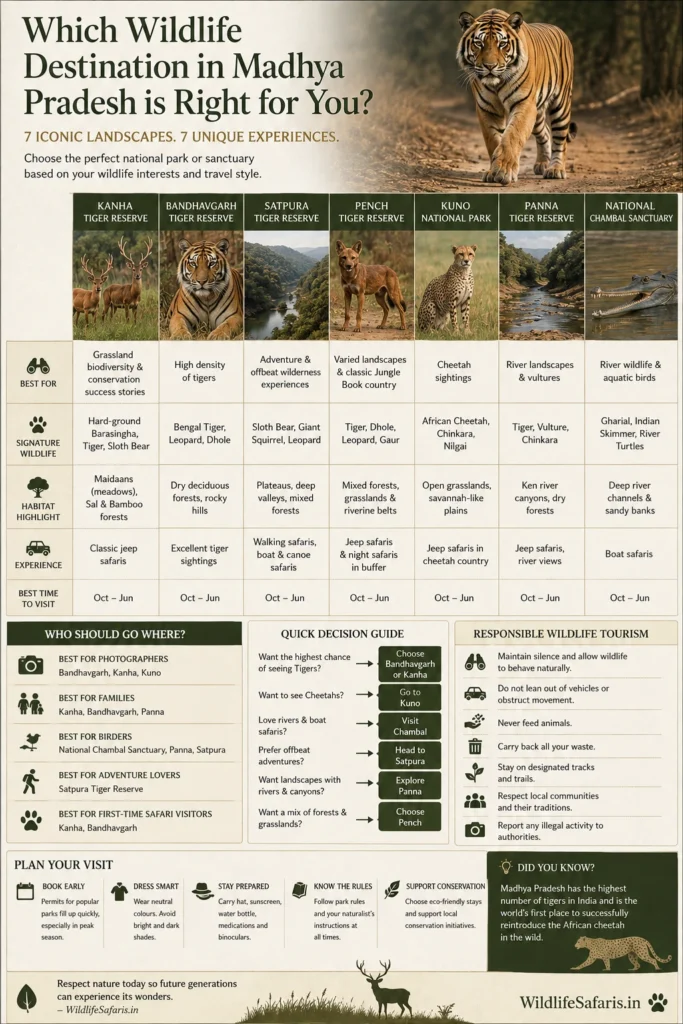
Wildlife Highlights
- Top Mammals: Bengal Tiger, African Cheetah (reintroduced), Hard-ground Barasingha, Indian Leopard, Sloth Bear, Dhole (Indian Wild Dog), Gaur (Indian Bison), Striped Hyena, Indian Pangolin, Rusty-spotted Cat.
- Top Birds: Indian Paradise Flycatcher, Indian Vulture (Long-billed Vulture), Indian Skimmer, Sarus Crane, Mottled Wood Owl, Crested Serpent Eagle, Malabar Pied Hornbill (in Satpura).
- Reptiles & Amphibians: Gharial, Mugger Crocodile, Indian Softshell Turtle, Red-crowned Roof Turtle, Indian Rock Python.
- Flagship Flora: Sal (Shorea robusta), Teak (Tectona grandis), Mahua (Madhuca longifolia), Ghost Tree (Sterculia urens), Indian Frankincense (Boswellia serrata).
- Best Wildlife Experiences: Tiger tracking on jeep safaris in Kanha and Bandhavgarh, walking safaris and canoe safaris in Satpura, nocturnal night safaris in the buffer zones of Pench, and boat safaris on the Chambal River for gharials.
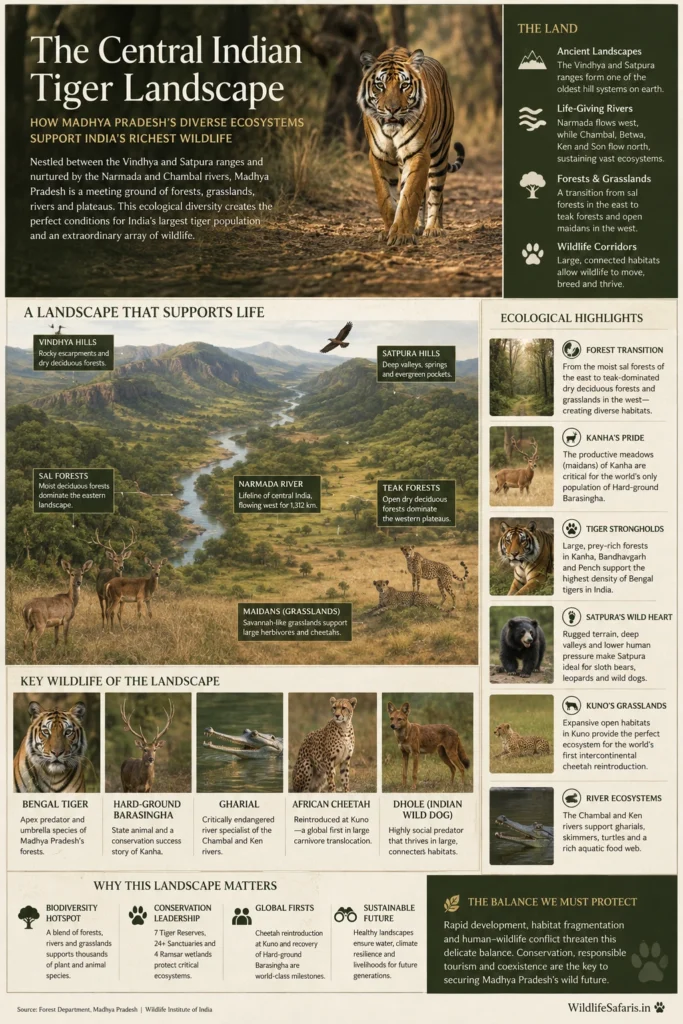
Conservation Challenges
- Linear Infrastructure Corridors: The expansion of multi-lane highways and railway networks, particularly the NH-44 cutting through the vital Kanha-Pench wildlife corridor, creates severe fragmentation and leads to wildlife mortality, necessitating the construction of massive animal underpasses.
- Human-Wildlife Conflict: The thriving tiger and leopard populations frequently spill over from the core areas into surrounding buffer zones and agricultural lands, leading to livestock depredation and retaliatory poisonings by villagers.
- Cheetah Reintroduction Complexities: Project Cheetah faces ongoing challenges adjusting African cheetahs to the Indian climate, tick-borne diseases, and establishing a stable, self-sustaining population within the Kuno landscape.
- Invasive Species: The aggressive proliferation of Lantana camara in prime forest reserves suppresses the growth of native grasses, severely impacting the fodder availability for ungulates like the chital and sambar.
- Climate Change and Forest Fires: Shifting monsoon patterns and rising summer temperatures heighten the risk of devastating forest fires in the dry deciduous tracts and threaten the moisture-dependent Sal forests of Kanha and Bandhavgarh.
- Poaching Threats: While anti-poaching measures are highly sophisticated, the latent threat of the illegal trade in tiger parts and pangolin scales remains a continuous concern for forest authorities.
Responsible Wildlife Tourism
- Advanced Safari Booking: Madhya Pradesh enforces strict carrying capacities for its Tiger Reserves. Always book core zone safaris months in advance through the official forest department portal.
- Respect Buffer Zones: Do not discount buffer zone safaris; they often offer exceptional sightings (especially of leopards and sloth bears) and feature night safari options that ease the pressure on core habitats.
- Dress for the Jungle: Wear muted colours—khaki, olive green, and brown—to blend seamlessly with the dry deciduous and teak forest environments.
- Maintain Safari Discipline: Observe strict silence in the presence of predators, never insist the driver break the designated route for a better view, and remain completely inside the gypsy at all times.
- Support Local Conservation: Choose eco-lodges that employ local Gond and Baiga tribal community members and utilise solar power and rainwater harvesting.
- No Flash on Night Safaris: If undertaking a night safari in Pench, Satpura, or Bandhavgarh, strictly refrain from using camera flashes or high-beam torches directly in the eyes of nocturnal wildlife.
Did You Know?
- Madhya Pradesh consistently retains the title of the “Tiger State of India,” recording an estimated 785 tigers in the wild according to the 2022 All India Tiger Estimation.
- The landscape of Pench Tiger Reserve famously inspired Rudyard Kipling’s timeless classic, The Jungle Book, featuring the fictional characters Mowgli, Sher Khan, and Baloo.
- Kanha National Park was the first tiger reserve in India to officially introduce a mascot—”Bhoorsingh the Barasingha”—to raise awareness about the successful conservation of its endemic swamp deer.
- In September 2022, Kuno National Park received the first batch of African Cheetahs from Namibia, marking the return of the cheetah to Indian soil 70 years after its local extinction.
- The rare genetic mutation that produces the White Tiger originated in Madhya Pradesh; the first recorded white tiger, named ‘Mohan’, was captured in the forests of Rewa in 1951.
- Satpura Tiger Reserve is uniquely pioneering in India for offering non-motorised wildlife experiences, allowing tourists to explore the core zones via walking safaris, canoeing, and cycling.
Tiger Safari in India : Topics Cluster
- Tiger Safari Planning Workbook
- Tiger Safari Booking Guide
- Best time for tiger sightings in India
- How to increase chances of tiger sighting?
- Tiger Safari Naturalist Guide
- Tiger Safari India Cost
- How to book a Tiger Safari in India?
- Best Wildlife Tour Operators in India
- Best Destination Cities for Tiger Safaris in India
- Tiger Safari under ₹25000
- Top 10 Budget Tiger Safaris 2026
- Tiger Photography Tips
- Best Tiger Reserves
- Top 10 Tiger Reserves by sighting chances
Safari Planning : Topics Cluster
- How to book a wildlife safari in India?
- Park by Park Online Safari Booking Guide
- Tiger Safari India Planning Workbook
- Park by Park Safari Permits Guide
- National Parks Permit Guide – Park by Park Guide
- Tatkal Safari Booking Guide – Last Minute Safari Permits Booking
- Tiger Safari in India Cost
- Indian Wildlife Safari Budget Planner
- Jeep vs Canter Safari
- Best time for Tiger Sightings in India
- How far advanced should you book safari permits?
- Can foreigners book Indian Wildlife Safari online?
- Special Permits Guide for Foreigners and Domestic Visitors
- How to book a Safari Permit online in India? 2026 step by step guide
- Senior Citizens Friendly Safari Planning
- Multi Generation Family Safari Planning
- 50 things to know before your first safari in India