
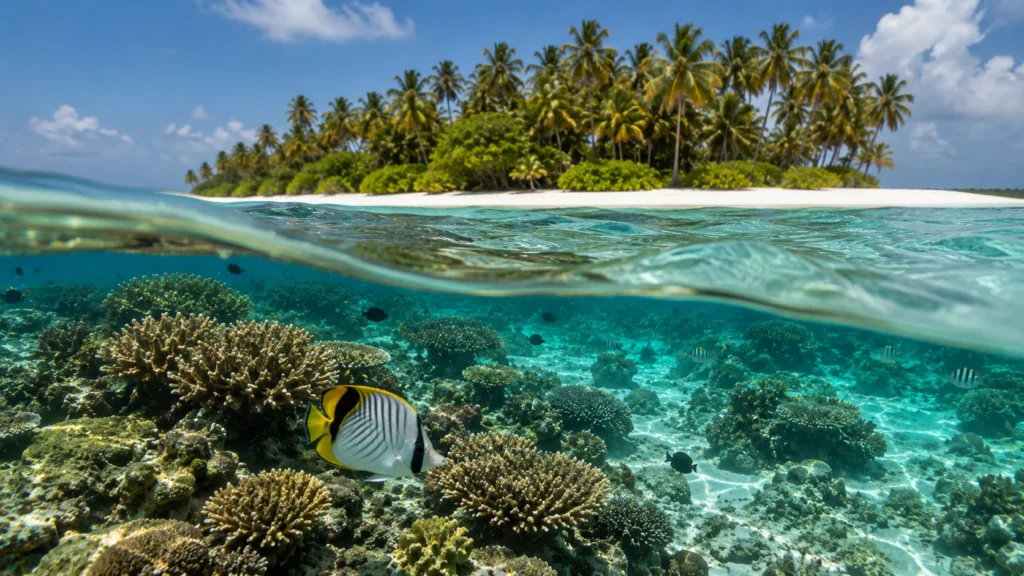
Lakshadweep, translating to “a hundred thousand islands” in Malayalam and Sanskrit, is India’s smallest Union Territory. Situated in the Arabian Sea, this breathtaking archipelago comprises thirty-six islands, including twelve atolls, three reefs, and five submerged banks. Characterised by a tropical maritime climate, the territory’s ecology is defined entirely by its stunning coral reefs, pristine lagoons, and white-sand beaches. While official statistics denote a forest cover exceeding ninety per cent, this predominantly consists of dense, privately owned coconut plantations rather than natural terrestrial wilderness. The true ecological wealth of Lakshadweep lies in its surrounding marine and estuarine ecosystems, which harbour a staggering diversity of pelagic and reef-dwelling fauna.
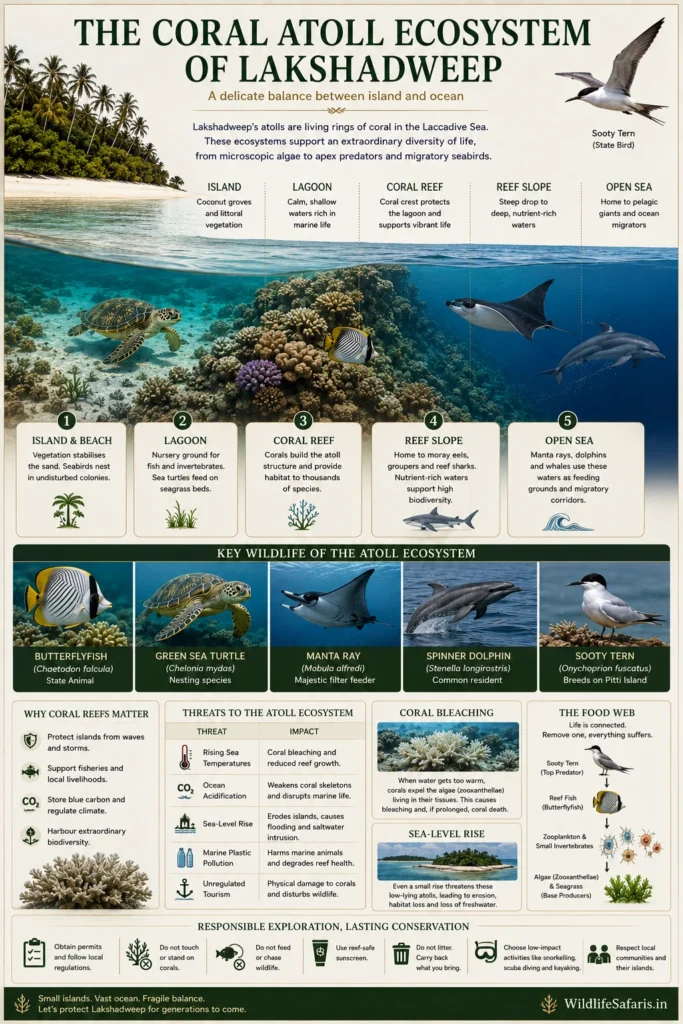
The territory’s wildlife is fundamentally marine and avian. The surrounding Laccadive Sea teems with vibrant coral ecosystems that support the state animal, the butterflyfish, alongside manta rays, moray eels, and apex predators like reef sharks. The islands are also vital nesting grounds for four species of marine turtles, most notably the green sea turtle and the hawksbill. Terrestrial biodiversity is sparse due to the lack of significant landmass, but the territory’s avifauna is highly significant. The uninhabited Pitti Island, a dedicated Wildlife Sanctuary, is an indispensable breeding ground for pelagic birds, including the state bird, the sooty tern, as well as the greater crested tern and the brown noddy.
Conservation in Lakshadweep is inherently complex, battling the immediate existential threats of climate change, ocean acidification, and sea-level rise. Coral bleaching remains a persistent challenge, threatening the very foundation of the atolls. Wildlife tourism here is heavily regulated through strict permitting systems to prevent carrying-capacity breaches, focusing exclusively on low-impact, high-value eco-tourism that promotes scuba diving, snorkelling, and marine observation while fiercely protecting its fragile coral heritage.
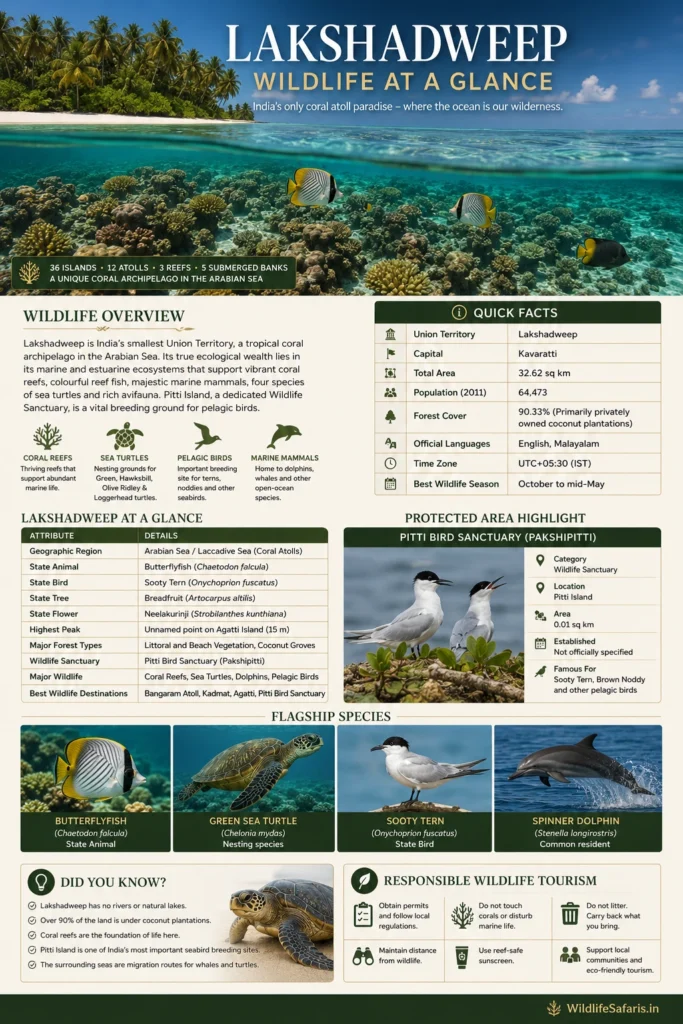
Quick Facts Table
| Category | Details |
| State / Union Territory | Lakshadweep (Union Territory) |
| Capital | Kavaratti |
| Area | 32.62 sq km |
| Population | 64,473 (2011 Census) |
| Forest Cover | 90.33% (Primarily privately owned coconut plantations) |
| Official Language(s) | English, Malayalam |
| Time Zone | UTC+05:30 (IST) |
| Best Wildlife Season | October to mid-May |
State Wildlife Master Table
| Attribute | Details |
| State / Union Territory | Lakshadweep |
| Capital | Kavaratti |
| Geographic Region | Arabian Sea / Laccadive Sea (Coral Atolls) |
| Total Area | 32.62 sq km |
| Forest Cover | 90.33% |
| State Animal | Butterflyfish (Chaetodon falcula) |
| State Bird | Sooty Tern (Onychoprion fuscatus) |
| State Tree | Breadfruit (Artocarpus altilis) |
| State Flower | Neelakurinji (Strobilanthes kunthiana) |
| Highest Peak | Unnamed point on Agatti Island (15 m) |
| Major Rivers | None |
| Major Forest Types | Littoral and Beach Vegetation, Coconut Groves |
| Biodiversity Hotspot | Not officially specified |
| UNESCO Natural Sites | None |
| Biosphere Reserves | None |
| Tiger Reserves | None |
| Elephant Reserves | None |
| National Parks | None |
| Wildlife Sanctuaries | Pitti Bird Sanctuary (Pakshipitti) |
| Conservation Reserves | Not officially specified |
| Community Reserves | Not officially specified |
| Ramsar Sites | None |
| Important Bird Areas (IBAs) | Pitti Island |
| Major Wildlife Corridors | Oceanic Migratory Routes (Cetaceans and Sea Turtles) |
| Flagship Mammals | Spinner Dolphin, Sperm Whale, Indo-Pacific Humpback Dolphin |
| Flagship Birds | Sooty Tern, Brown Noddy, Greater Crested Tern |
| Endemic Wildlife | Not officially specified (Marine life shared with wider Indo-Pacific) |
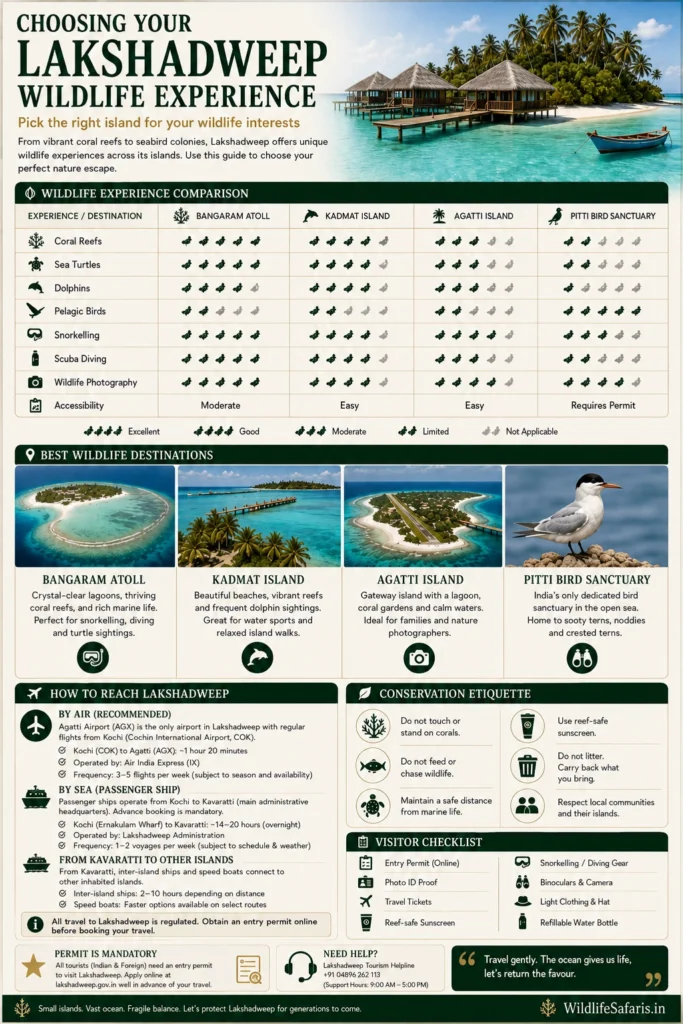
| Best Wildlife Destinations | Bangaram Atoll, Kadmat, Agatti, Pitti Bird Sanctuary |
| Best Time for Wildlife Tourism | October to mid-May |
| Nearest International Airports | Agatti Airport (Domestic), Cochin International Airport (Mainland Kerala) |
| Official Forest Department Website | lakshadweep.gov.in (UT Administration) |
Protected Areas Summary Table
| Protected Area | Category | District | Area (sq km) | Year Established | Famous For |
| Pitti (Pakshipitti) Bird Sanctuary | Wildlife Sanctuary | Lakshadweep District | 0.01 | Not officially specified | Sooty Tern, Brown Noddy, Pelagic Bird Breeding Ground |
Wildlife Highlights
- Top Marine Mammals: Spinner Dolphin, Indo-Pacific Humpback Dolphin, Sperm Whale, Blue Whale, Finless Porpoise.
- Top Birds: Sooty Tern, Brown Noddy, Greater Crested Tern, Lesser Crested Tern, Asian Koel.
- Reptiles: Green Sea Turtle, Hawksbill Sea Turtle, Olive Ridley Turtle.
- Flagship Marine Life: Butterflyfish, Manta Ray, Moray Eel, Giant Clam, Reef Sharks, diverse Hard and Soft Corals.
- Best Wildlife Experiences: Scuba diving through the coral reefs of Kadmat and Bangaram, snorkelling alongside green sea turtles in shallow lagoons, and observing dolphins riding the bow wakes of inter-island ferries.
Conservation Challenges
- Coral Bleaching: Rising sea surface temperatures linked to global climate change and El Niño events cause severe, recurrent coral bleaching, threatening the structural integrity of the atolls.
- Sea-Level Rise: As a low-lying archipelago with a maximum elevation of just 15 metres, the islands face an existential threat from rising sea levels and worsening coastal erosion.
- Marine Plastic Pollution: Accumulation of microplastics and discarded fishing gear (ghost nets) washing ashore from the open ocean poses a lethal ingestion and entanglement hazard to sea turtles and pelagic birds.
- Freshwater Scarcity: Over-extraction of the fragile freshwater lenses beneath the islands stresses the terrestrial vegetation and local human populations.
- Unregulated Fishing: While local pole-and-line tuna fishing is highly sustainable, the illegal exploitation of reef fish and sea cucumbers by foreign vessels remains a significant concern.
- Tourism Pressures: Balancing economic development with ecological limits; exceeding the carrying capacity of the fragile lagoons causes irreversible damage to the reef ecosystems.
Responsible Wildlife Tourism
- Do Not Touch Corals: While snorkelling or scuba diving, maintain perfect buoyancy. Never stand on, touch, or kick coral reefs, as they are fragile living organisms that take decades to grow.
- Use Reef-Safe Sunscreen: Standard sunscreens contain chemicals like oxybenzone that cause coral bleaching. Always apply certified reef-safe, mineral-based sunscreens before entering the water.
- Zero Shell Collecting: Do not collect or purchase seashells, dead corals, or giant clams. They are critical to the natural calcium carbonate cycle of the beaches and are protected under Indian law.
- Adhere to Permitting Laws: Lakshadweep requires a strict entry permit for all visitors. Stick to the authorised islands and respect the restricted access to uninhabited ecological zones like Pitti Island.
- Ethical Turtle Interaction: If you encounter sea turtles while swimming, maintain a respectful distance. Do not chase them or block their path to the surface for breathing.
- Eliminate Single-Use Plastics: The islands have limited waste management infrastructure. Carry a reusable water bottle and ensure no plastics are left on the beaches or dropped in the ocean.
Did You Know?
- Lakshadweep is India’s only coral atoll formation, built entirely upon the submerged volcanic peaks of the Chagos-Laccadive Ridge.
- Despite its name translating to “a hundred thousand islands,” the archipelago consists of only 36 islands, of which merely 10 are inhabited.
- Pitti Island (Pakshipitti) is completely devoid of vegetation and human habitation; it is essentially a sandy, rocky outcrop that serves as one of the most critical pelagic bird breeding grounds in the Arabian Sea.
- The state flower is the Neelakurinji, a flower famously associated with the Western Ghats (where it blooms once every 12 years), highlighting the territory’s close cultural and ecological ties with mainland Kerala.
- The highest elevation point in the entire Union Territory is a mere 15 metres above sea level, located on a sand dune on Agatti Island.
- Lakshadweep boasts the highest recorded forest cover percentage (over 90%) in India according to the ISFR, but this is an anomaly of classification, as the “forest” is almost entirely comprised of privately owned, cultivated coconut palms.
Safari Planning : Topics Cluster
- How to book a wildlife safari in India?
- Park by Park Online Safari Booking Guide
- Tiger Safari India Planning Workbook
- Park by Park Safari Permits Guide
- National Parks Permit Guide – Park by Park Guide
- Tatkal Safari Booking Guide – Last Minute Safari Permits Booking
- Tiger Safari in India Cost
- Indian Wildlife Safari Budget Planner
- Jeep vs Canter Safari
- Best time for Tiger Sightings in India
- How far advanced should you book safari permits?
- Can foreigners book Indian Wildlife Safari online?
- Special Permits Guide for Foreigners and Domestic Visitors
- How to book a Safari Permit online in India? 2026 step by step guide
- Senior Citizens Friendly Safari Planning
- Multi Generation Family Safari Planning
- 50 things to know before your first safari in India
Luxury Safari in India : Topics Cluster