
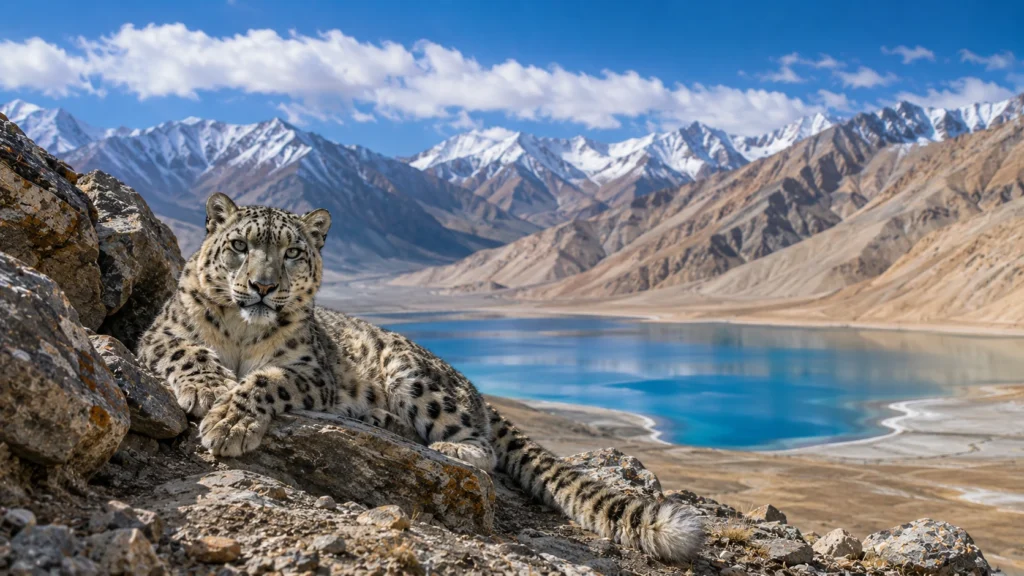
The Union Territory of Ladakh, encompassing the desolate, high-altitude plateaus of the Trans-Himalayas, represents one of the most extreme and fragile ecosystems on Earth. Characterised by a severe cold desert climate, the region is bounded by the towering Karakoram Range to the north and the Great Himalayas to the south. The topography is predominantly a matrix of barren, scree-covered mountains, deep river gorges carved by the Indus and Zanskar rivers, and expansive, wind-swept valleys. Due to negligible rainfall and extreme winter temperatures, Ladakh’s forest cover is exceptionally sparse, restricted to scattered juniper scrub, alpine meadows, and riparian belts of poplar and willow. Despite this barren appearance, the territory supports a highly specialised, cold-adapted faunal assemblage found nowhere else in the Indian subcontinent.
Ladakh is globally celebrated as the premier stronghold for the snow leopard, the designated state animal, which navigates the precipitous ridges of Hemis National Park and the encompassing Sham Valley. The vast, high-altitude Changthang plateau operates as an extension of the Tibetan landscape, harbouring unique megafauna including the wild yak, Tibetan antelope (chiru), Tibetan argali, and the elusive Pallas’s cat. The region’s avifauna is equally remarkable, anchored by the state bird, the near-threatened black-necked crane, which breeds exclusively in the high-altitude bogs of the territory.
The high-altitude wetlands of Ladakh, particularly the Ramsar-designated Tso Moriri and Tso Kar basin, are critical ecological oases. These hypersaline and freshwater lakes serve as indispensable breeding grounds for bar-headed geese, ruddy shelducks, and brown-headed gulls. Conservation in Ladakh must navigate the profound impacts of receding glaciers due to climate change, escalating border militarisation, and the rapid influx of vehicular tourism. Managing these pressures while sustaining traditional nomadic pastoralism is central to preserving this unparalleled Trans-Himalayan sanctuary.
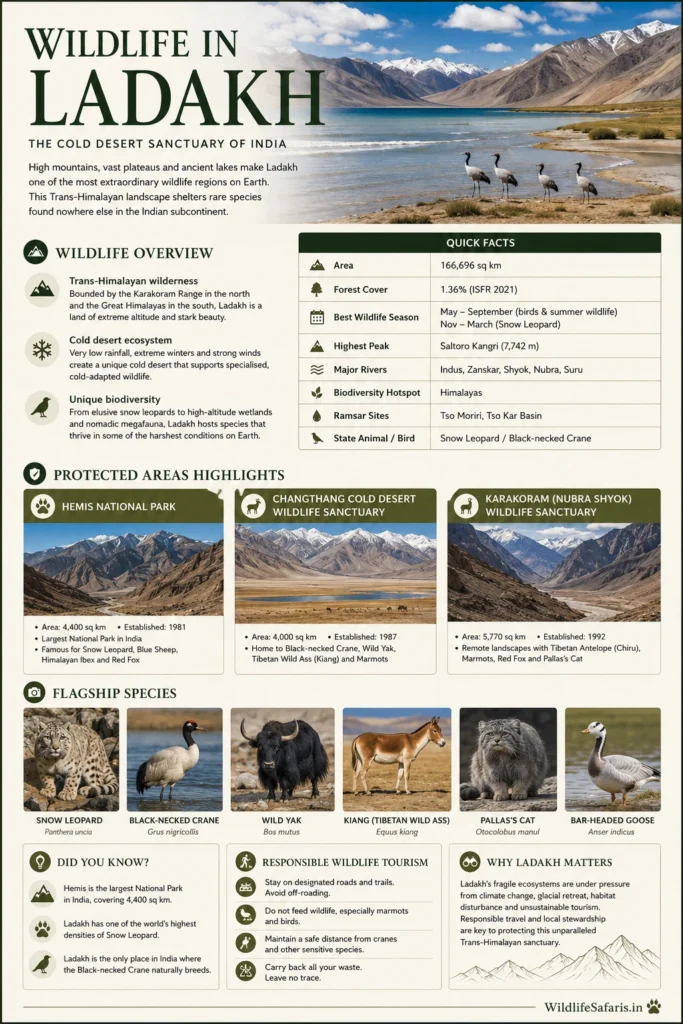
Quick Facts Table
| Category | Details |
| State / Union Territory | Ladakh (Union Territory) |
| Capital | Leh, Kargil |
| Area | 166,696 sq km (Official Geographical Area) |
| Population | 274,000 (2011 Census) |
| Forest Cover | 1.36% (ISFR 2021) |
| Official Language(s) | Hindi, English (Bhoti, Purgi, Balti widely spoken) |
| Time Zone | UTC+05:30 (IST) |
| Best Wildlife Season | May to September (Summer flora/birds) / Nov to March (Snow Leopard) |
State Wildlife Master Table
| Attribute | Details |
| State / Union Territory | Ladakh |
| Capital | Leh, Kargil |
| Geographic Region | Trans-Himalayas, Karakoram |
| Total Area | 166,696 sq km |
| Forest Cover | 1.36% |
| State Animal | Snow Leopard (Panthera uncia) |
| State Bird | Black-necked Crane (Grus nigricollis) |
| State Tree | Not officially specified |
| State Flower | Not officially specified |
| Highest Peak | Saltoro Kangri (7,742 m) |
| Major Rivers | Indus, Zanskar, Shyok, Nubra, Suru |
| Major Forest Types | Alpine Pastures, Dry Alpine Scrub, Riparian |
| Biodiversity Hotspot | Himalayas |
| UNESCO Natural Sites | None |
| Biosphere Reserves | None |
| Tiger Reserves | None |
| Elephant Reserves | None |
| National Parks | Hemis |
| Wildlife Sanctuaries | Changthang Cold Desert, Karakoram (Nubra Shyok) |
| Conservation Reserves | Not officially specified |
| Community Reserves | Not officially specified |
| Ramsar Sites | Tso Moriri, Tso Kar Basin |
| Important Bird Areas (IBAs) | Tso Moriri, Tso Kar, Pangong Tso, Hemis NP, Hanle |
| Major Wildlife Corridors | Hemis-Changthang Corridor |
| Flagship Mammals | Snow Leopard, Wild Yak, Tibetan Antelope, Eurasian Lynx, Pallas’s Cat |
| Flagship Birds | Black-necked Crane, Bar-headed Goose, Tibetan Snowcock, Golden Eagle |
| Endemic Wildlife | Trans-Himalayan sub-species (e.g., Tibetan Wolf) |
| Best Wildlife Destinations | Hemis NP, Changthang WLS, Tso Kar, Nubra Valley |
| Best Time for Wildlife Tourism | May to September / Winter for Snow Leopard expeditions |
| Nearest International Airports | Kushok Bakula Rimpochee Airport (Leh – Domestic), Sheikh ul-Alam International Airport (Srinagar) |
| Official Forest Department Website | ladakh.nic.in (UT Administration) |
Protected Areas Summary Table
| Protected Area | Category | District | Area (sq km) | Year Established | Famous For |
| Hemis National Park | National Park | Leh | 4,400.00 | 1981 | Snow Leopard, Blue Sheep, Largest NP in India |
| Changthang Cold Desert Wildlife Sanctuary | Wildlife Sanctuary | Leh | 4,000.00 | 1987 | Black-necked Crane, Wild Yak, Tibetan Wild Ass (Kiang) |
| Karakoram (Nubra Shyok) Wildlife Sanctuary | Wildlife Sanctuary | Leh | 5,000.00 | 1987 | Tibetan Antelope, Eurasian Lynx, Bactrian Camel (Feral) |
Wildlife Highlights
- Top Mammals: Snow Leopard, Tibetan Wolf, Eurasian Lynx, Pallas’s Cat, Tibetan Wild Ass (Kiang), Wild Yak (Dong), Tibetan Antelope (Chiru), Blue Sheep (Bharal), Asiatic Ibex, Himalayan Brown Bear (Kargil region), Himalayan Marmot.
- Top Birds: Black-necked Crane, Bar-headed Goose, Tibetan Snowcock, Golden Eagle, Lammergeier (Bearded Vulture), Great Crested Grebe, Brown-headed Gull, Eurasian Eagle-Owl.
- Reptiles & Amphibians: Toad Agama, Himalayan Skink (Herpetofauna is minimal due to extreme cold).
- Flagship Flora: Seabuckthorn (Hippophae), Juniper, Caragana scrub, Alpine Asters, Blue Poppy.
- Best Wildlife Experiences: Dedicated winter snow leopard tracking expeditions in Hemis and Sham Valley, observing herds of Kiang on the vast Changthang plateau, and birdwatching for breeding cranes at Tso Kar.
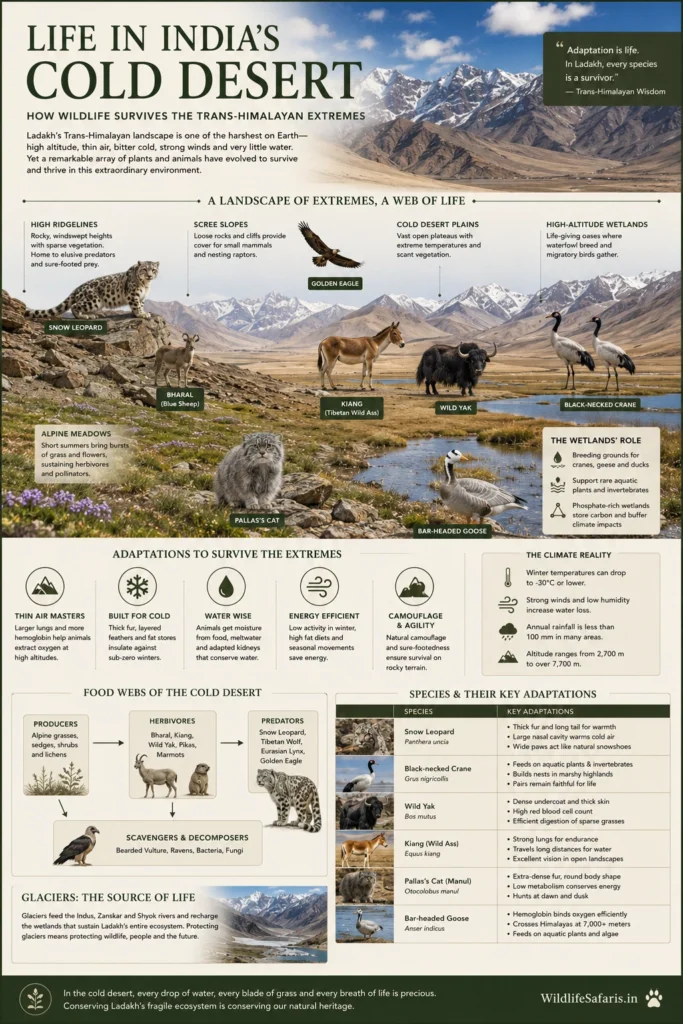
Conservation Challenges
- Feral Dog Menace: A rapidly multiplying population of feral dogs, heavily subsidised by military camps and urban waste, poses the single greatest predatory threat to ground-nesting birds (like the Black-necked Crane) and wild ungulates, and vectors diseases like rabies to the Tibetan Wolf and Snow Leopard.
- Unregulated Tourism: The explosive growth in self-driven tourism has led to rampant off-roading across the fragile cold desert plateaus. Tyre tracks destroy slow-growing alpine flora, crush marmot burrows, and disturb nesting habitats near high-altitude lakes.
- Climate Change: The rapid retreat of Himalayan glaciers and decreasing winter snowfall severely alter the hydrology of the region, threatening the survival of high-altitude wetlands and shrinking the alpine pastures vital for wild herbivores and nomadic livestock.
- Pastoralist Conflict: Changing economic aspirations and the restriction of traditional grazing lands (due to border tensions and protected areas) increase friction between nomadic Changpa herders and wild herbivores (like the Kiang and Argali) over scarce fodder.
- Waste Management: The lack of robust solid waste management infrastructure struggles to process the massive influx of plastic and non-biodegradable waste generated by tourists during the short summer season.
- Infrastructure Expansion: The rapid construction of strategic border roads through previously inaccessible valleys inevitably fragments pristine wildlife habitats.
Responsible Wildlife Tourism
- No Off-Roading: Strictly confine all vehicles, including motorcycles, to designated tarmac or marked dirt roads. The topsoil of the cold desert is highly sensitive and takes decades to recover from tyre damage.
- Do Not Feed Marmots: Avoid the popular tourist practice of feeding biscuits or bread to Himalayan Marmots. It fundamentally alters their foraging behaviour, habituates them to human presence, and causes severe metabolic diseases.
- Maintain Distance from Cranes: When observing the highly sensitive Black-necked Cranes in Changthang, use binoculars and telephoto lenses. Do not approach the bogs, as disturbance easily leads to nest abandonment.
- Acclimatise Properly: High-altitude wildlife tracking, particularly for snow leopards in winter, requires immense physical exertion at low oxygen levels. Ensure proper acclimatisation to prevent Acute Mountain Sickness (AMS).
- Pack Out All Waste: Carry all plastic wrappers, bottles, and batteries back to Leh or your home city. High altitudes inhibit natural decomposition.
- Use Spotting Scopes: During snow leopard expeditions, rely on the expert spotters and their scopes. Never attempt to approach the apex predator on foot.
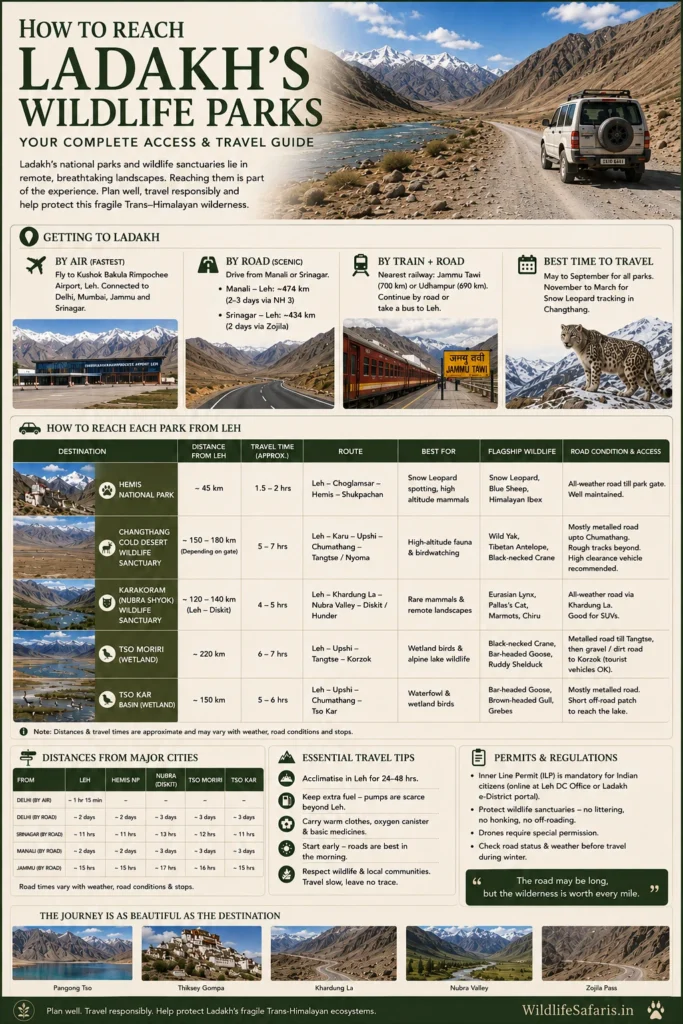
Did You Know?
- Hemis National Park is the largest National Park in India, spanning an immense 4,400 square kilometres, and protects the highest density of snow leopards in any protected area in the world.
- The Union Territory of Ladakh formally adopted the Snow Leopard as its state animal and the Black-necked Crane as its state bird in 2021, following its separation from Jammu and Kashmir.
- The Black-necked Crane is the only alpine species of crane in the world, and Ladakh is its sole breeding ground within India.
- Tso Kar, designated as Ladakh’s second Ramsar site, is a highly unique hypersaline lake surrounded by salt efflorescence, operating as a critical staging ground for the Central Asian Flyway.
- The high-altitude Changthang plateau is the only place in India where the pure-bred wild yak (Dong) and the Tibetan Antelope (Chiru)—famed for its ultra-fine shahtoosh wool—can be found.
- Despite the barren landscape, the Eurasian Lynx—one of the rarest wild cats in India—is a resident of the Nubra Valley and Changthang regions.
Safari Planning : Topics Cluster
- How to book a wildlife safari in India?
- Park by Park Online Safari Booking Guide
- Tiger Safari India Planning Workbook
- Park by Park Safari Permits Guide
- National Parks Permit Guide – Park by Park Guide
- Tatkal Safari Booking Guide – Last Minute Safari Permits Booking
- Tiger Safari in India Cost
- Indian Wildlife Safari Budget Planner
- Jeep vs Canter Safari
- Best time for Tiger Sightings in India
- How far advanced should you book safari permits?
- Can foreigners book Indian Wildlife Safari online?
- Special Permits Guide for Foreigners and Domestic Visitors
- How to book a Safari Permit online in India? 2026 step by step guide
- Senior Citizens Friendly Safari Planning
- Multi Generation Family Safari Planning
- 50 things to know before your first safari in India
Himalayas : Topics Cluster
- Himalayan Wildlife Comprehensive Guide
- Wildlife in Ladakh
- Himalayan Pheasants
- Raptors of Himalayas
- Wildlife in Sikkim
- Wildlife in Arunachal Pradesh
- Wildlife in Uttarakhand
- Wildlife in Himachal Pradesh
- Wildlife in Jammu and Kashmir
- Himalayan Black Bear
- Snow Leopard
- Kibber Wildlife Sanctuary Guide
- Great Himalayan National Park
- Khangchendzonga National Park
- Eastern Himalayas