
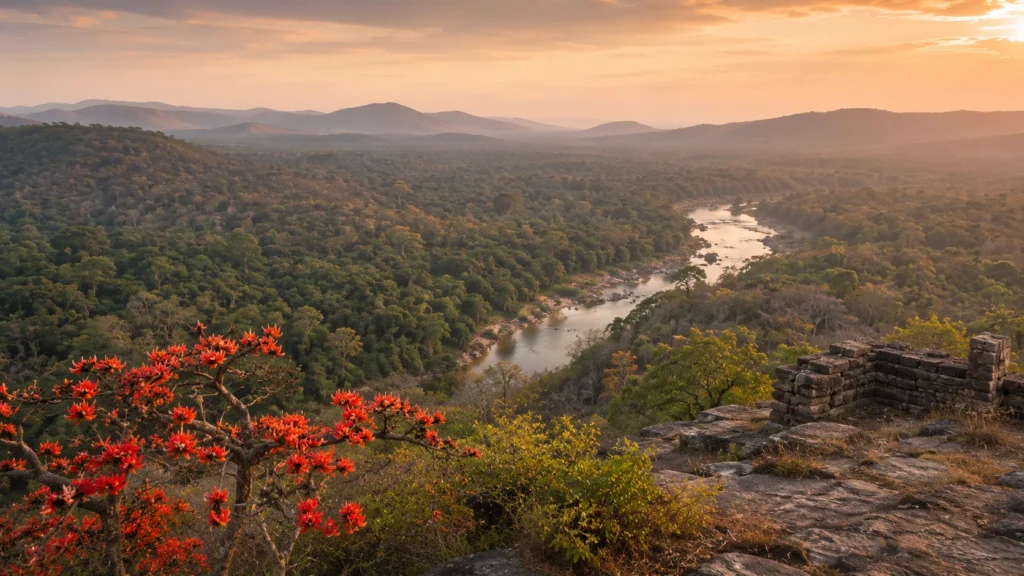
Jharkhand, appropriately translating to the “Land of Forests,” is positioned on the expansive Chota Nagpur Plateau in eastern India. The state’s rugged, undulating topography is characterised by ancient geological formations, cascading waterfalls, and the expansive river basins of the Damodar, Subarnarekha, and Koel. Experiencing a tropical monsoon climate, Jharkhand sustains a substantial forest cover that blankets nearly thirty per cent of its geographical area. These woodlands are predominantly composed of tropical moist deciduous and dry deciduous forests, featuring magnificent, contiguous tracts of sal (Shorea robusta) that form the ecological backbone of the region and hold profound cultural significance for indigenous tribal communities.
The wildlife profile of Jharkhand is intrinsically linked to the Asian elephant, the designated state animal. The state is home to the Singhbhum Elephant Reserve, a sprawling forested landscape that operates as a critical nodal habitat for elephant populations migrating across the Jharkhand-Odisha-West Bengal tri-state corridor. Alongside pachyderms, the state’s protected area network safeguards diverse mammalian fauna. The historical Palamau Tiger Reserve and the contiguous Betla National Park provide sanctuary for the Indian leopard, sloth bear, gaur, and a recovering prey base of sambar and chital. Furthermore, Jharkhand harbours highly specialised habitats, most notably the Mahauadanr Wildlife Sanctuary, which stands uniquely as India’s only protected area specifically dedicated to the conservation of the Indian wolf.
Avian biodiversity in the state is prominent, highlighted by the state bird, the Asian koel, and supported by wetland ecosystems such as the Udhwa Lake Bird Sanctuary, which serves as a vital wintering ground for migratory waterfowl. Conservation in Jharkhand is complex, navigating the intense pressures of large-scale open-cast mining, linear infrastructure expansion, and acute human-elephant conflict. Despite these challenges, the state’s protected areas offer raw, deeply forested wildlife experiences, representing a crucial conservation frontier in central-eastern India.
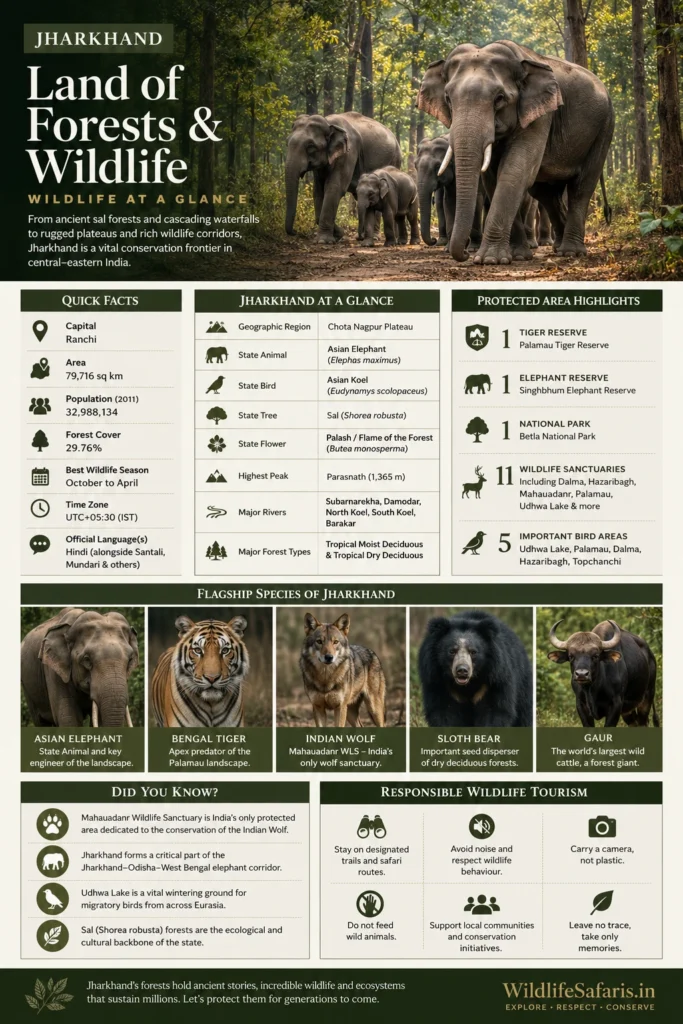
Quick Facts Table
| Category | Details |
| State / Union Territory | Jharkhand |
| Capital | Ranchi |
| Area | 79,716 sq km |
| Population | 32,988,134 (2011 Census) |
| Forest Cover | 29.76% |
| Official Language(s) | Hindi (alongside regional languages like Santali, Mundari) |
| Time Zone | UTC+05:30 (IST) |
| Best Wildlife Season | October to April |
State Wildlife Master Table
| Attribute | Details |
| State / Union Territory | Jharkhand |
| Capital | Ranchi |
| Geographic Region | Chota Nagpur Plateau |
| Total Area | 79,716 sq km |
| Forest Cover | 29.76% |
| State Animal | Asian Elephant (Elephas maximus) |
| State Bird | Asian Koel (Eudynamys scolopaceus) |
| State Tree | Sal (Shorea robusta) |
| State Flower | Palash / Flame of the Forest (Butea monosperma) |
| Highest Peak | Parasnath (1,365 m) |
| Major Rivers | Subarnarekha, Damodar, North Koel, South Koel, Barakar |
| Major Forest Types | Tropical Moist Deciduous, Tropical Dry Deciduous |
| Biodiversity Hotspot | Not officially specified |
| UNESCO Natural Sites | None |
| Biosphere Reserves | None |
| Tiger Reserves | Palamau Tiger Reserve |
| Elephant Reserves | Singhbhum Elephant Reserve |
| National Parks | Betla National Park |
| Wildlife Sanctuaries | 11 Sanctuaries (including Dalma, Hazaribagh, Mahauadanr, Palamau, Udhwa Lake) |
| Conservation Reserves | Not officially specified |
| Community Reserves | Not officially specified |
| Ramsar Sites | None |
| Important Bird Areas (IBAs) | Udhwa Lake, Palamau, Dalma, Hazaribagh, Topchanchi |
| Major Wildlife Corridors | Singhbhum-Mayurbhanj (Odisha) Elephant Corridor, Dalma-Ayodhya Hills (WB) |
| Flagship Mammals | Asian Elephant, Bengal Tiger, Indian Wolf, Sloth Bear, Gaur |
| Flagship Birds | Asian Koel, Indian Peafowl, White-rumped Vulture, Lesser Adjutant |
| Endemic Wildlife | Not officially specified |
| Best Wildlife Destinations | Betla NP, Dalma WLS, Palamau TR, Mahauadanr Wolf Sanctuary |
| Best Time for Wildlife Tourism | October to April |
| Nearest International Airports | Birsa Munda Airport (Ranchi – Domestic), Netaji Subhas Chandra Bose International Airport (Kolkata) |
| Official Forest Department Website | forest.jharkhand.gov.in |
Protected Areas Summary Table
| Protected Area | Category | District | Area (sq km) | Year Established | Famous For |
| Betla National Park | National Park | Latehar | 226.33 | 1986 | Asian Elephant, Gaur, Historical Forts |
| Palamau Tiger Reserve | Tiger Reserve | Latehar, Palamu | 1,129.93 | 1973 | Indian Leopard, Sloth Bear, Sal Forests |
| Dalma Wildlife Sanctuary | Wildlife Sanctuary | East Singhbhum, Seraikela Kharsawan | 193.22 | 1976 | Asian Elephant, Barking Deer, Sloth Bear |
| Gautam Buddha Wildlife Sanctuary | Wildlife Sanctuary | Hazaribagh (and Bihar) | 121.14 (JH portion) | 1976 | Indian Leopard, Dry Deciduous Flora |
| Hazaribagh Wildlife Sanctuary | Wildlife Sanctuary | Hazaribagh | 186.25 | 1955 | Nilgai, Wild Boar, Sloth Bear |
| Lawalong Wildlife Sanctuary | Wildlife Sanctuary | Chatra | 211.03 | 1968 | Indian Leopard, Asian Elephant |
| Mahauadanr Wolf Sanctuary | Wildlife Sanctuary | Latehar | 63.25 | 1976 | Indian Wolf, Indian Fox |
| Palkot Wildlife Sanctuary | Wildlife Sanctuary | Gumla, Simdega | 183.18 | 1990 | Sloth Bear, Pangolin, Rocky Terrain |
| Parasnath Wildlife Sanctuary | Wildlife Sanctuary | Giridih | 49.33 | 1984 | Rhesus Macaque, Avifauna, Pilgrimage Site |
| Topchanchi Wildlife Sanctuary | Wildlife Sanctuary | Dhanbad | 8.75 | 1978 | Artificial Lake, Migratory Birds, Leopard |
| Udhwa Lake Bird Sanctuary | Wildlife Sanctuary | Sahibganj | 5.65 | 1991 | Migratory Waterfowl, Riverine Ecology |
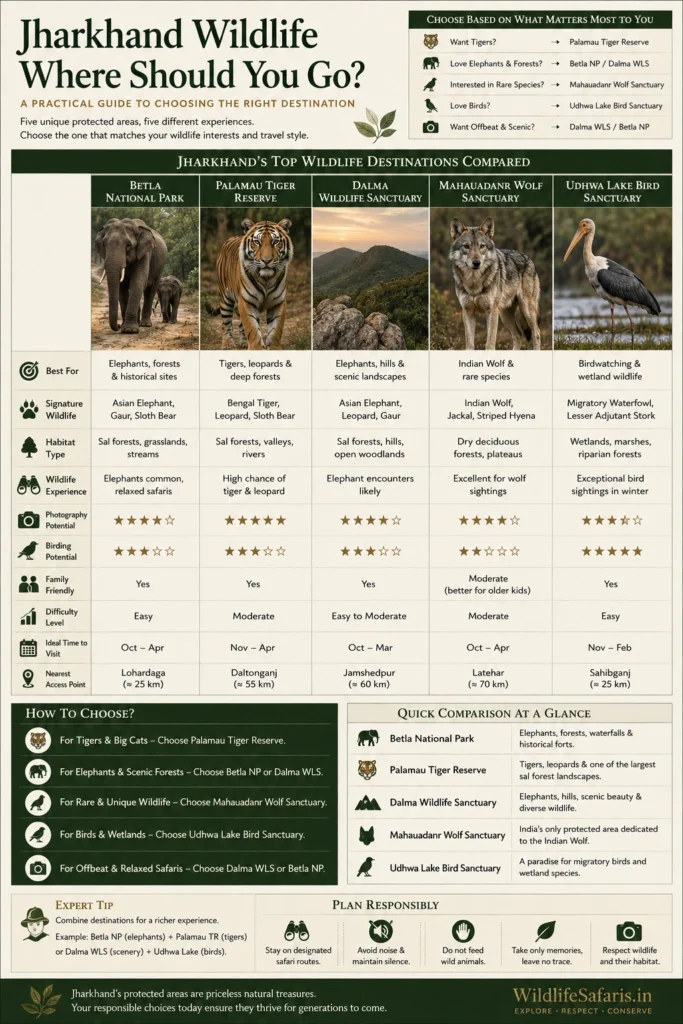
Wildlife Highlights
- Top Mammals: Asian Elephant, Indian Wolf, Indian Leopard, Sloth Bear, Gaur (Indian Bison), Bengal Tiger (historical/rare transients), Dhole (Indian Wild Dog), Indian Pangolin.
- Top Birds: Asian Koel, Indian Peafowl, White-rumped Vulture, Lesser Adjutant, Painted Francolin, Red Junglefowl, Black-headed Ibis.
- Reptiles & Amphibians: Indian Rock Python, Common Krait, Russell’s Viper, Indian Monitor Lizard, Mugger Crocodile.
- Flagship Flora: Sal (Shorea robusta), Palash (Butea monosperma), Mahua (Madhuca longifolia), Bamboo, Asan (Terminalia elliptica).
- Best Wildlife Experiences: Tracking elephant herds in Dalma Wildlife Sanctuary, exploring the historical Betla Forts amidst the dense forests of Betla National Park, and seeking out the elusive Indian Wolf in Mahauadanr.
Conservation Challenges
- Mining Impact: Jharkhand possesses vast mineral reserves; extensive open-cast coal, iron, and uranium mining severely fragment forests, pollute river systems, and disrupt ancient elephant migratory corridors.
- Human-Elephant Conflict: The fragmentation of the Chota Nagpur landscape forces large elephant herds into agricultural fields and villages, resulting in acute conflict, widespread crop damage, and tragic fatalities for both humans and elephants.
- Left-Wing Extremism: Historical insurgency in heavily forested regions, particularly the Palamau landscape, has long impeded forest department patrols, wildlife monitoring, and eco-tourism development.
- Forest Fires: The traditional practice of lighting ground fires to collect Mahua flowers and Sal seeds during the dry summer months often leads to uncontrolled forest fires, damaging undergrowth and wildlife habitats.
- Poaching: Localised bushmeat hunting by tribal communities and the retaliatory poisoning of predators (like wolves and leopards) by pastoralists remain pressing issues.
- Infrastructure Development: The expansion of highways, railway lines, and irrigation canals through the Singhbhum and Dalma regions acts as a barrier to the natural movement of wildlife.
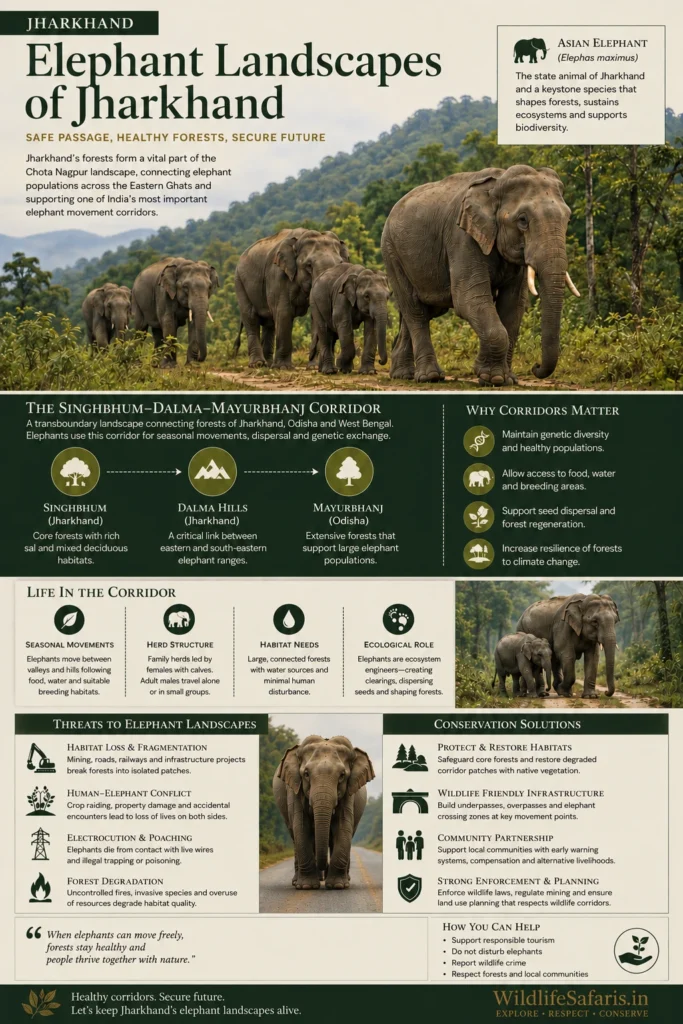
Responsible Wildlife Tourism
- Maintain Distance from Elephants: When encountering wild elephants in Dalma or Betla, keep a significant distance. Never use the vehicle horn to move them, and do not use camera flashes.
- Respect Tribal Culture: The forests of Jharkhand are home to indigenous communities like the Santhal, Munda, and Oraon. Respect their sacred groves (Sarnas) and seek permission before photographing people.
- Zero Fire Tolerance: Never discard cigarette butts or light fires in the forest, particularly during the highly vulnerable dry season (March to June).
- Follow Security Guidelines: In reserves like Palamau, strictly adhere to the routes and timings permitted by the forest department and local administration due to historical security sensitivities.
- Support Local Economy: Purchase locally sourced non-timber forest products, such as honey, lac, or traditional tribal handicrafts, to ensure conservation benefits the local population.
- Silence is Essential: Maintain absolute silence while exploring the Mahauadanr Wolf Sanctuary, as the Indian wolf is highly elusive and sensitive to human disturbance.
Did You Know?
- Established in 2001, the Singhbhum Elephant Reserve was the first elephant reserve created in India under the central government’s Project Elephant initiative.
- Palamau Tiger Reserve was one of the original nine tiger reserves established when Project Tiger was launched in 1973.
- The world’s first tiger census based on pugmark tracking was conducted in the Palamau forests in 1932 by J.W. Nicholson, an active forest official at the time.
- Mahauadanr Wildlife Sanctuary in the Latehar district is uniquely distinguished as the only wildlife sanctuary in India established specifically for the protection of the Indian Wolf.
- Dalma Wildlife Sanctuary, located near the industrial city of Jamshedpur, serves as a crucial summer retreat for elephants migrating from West Bengal and Odisha.
- Udhwa Lake Bird Sanctuary, located near the Ganges, is the only dedicated bird sanctuary in Jharkhand and is named after the saint Uddhava from the Mahabharata.
Safari Planning : Topics Cluster
- How to book a wildlife safari in India?
- Park by Park Online Safari Booking Guide
- Tiger Safari India Planning Workbook
- Park by Park Safari Permits Guide
- National Parks Permit Guide – Park by Park Guide
- Tatkal Safari Booking Guide – Last Minute Safari Permits Booking
- Tiger Safari in India Cost
- Indian Wildlife Safari Budget Planner
- Jeep vs Canter Safari
- Best time for Tiger Sightings in India
- How far advanced should you book safari permits?
- Can foreigners book Indian Wildlife Safari online?
- Special Permits Guide for Foreigners and Domestic Visitors
- How to book a Safari Permit online in India? 2026 step by step guide
- Senior Citizens Friendly Safari Planning
- Multi Generation Family Safari Planning
- 50 things to know before your first safari in India