
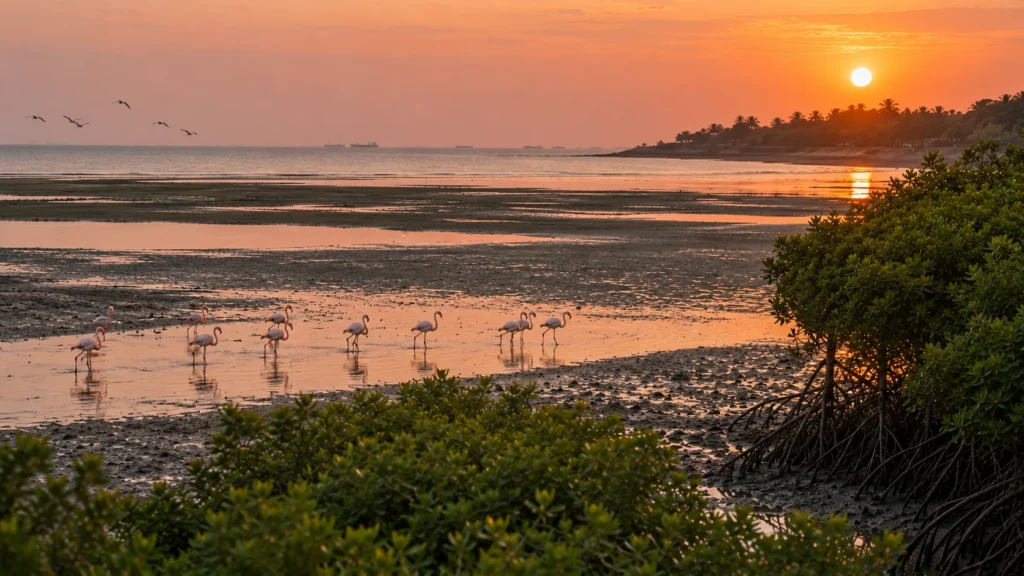
The Union Territory of Dadra and Nagar Haveli and Daman and Diu, formed by the amalgamation of two former distinct territories, presents a highly fragmented but ecologically fascinating geographical profile. Situated along the western coast of India, the territory comprises four separate landmasses: the coastal enclaves of Daman and Diu bordering Gujarat and the Arabian Sea, and the landlocked, undulating terrain of Dadra and Nagar Haveli wedged between Gujarat and Maharashtra. This geographical disparity results in diverse micro-ecosystems, ranging from the arid coastal scrub and mangrove-fringed estuaries of Diu and Daman to the lush foothills of the Western Ghats in Nagar Haveli. The climate is predominantly tropical maritime along the coast, transitioning to a tropical monsoon climate inland.
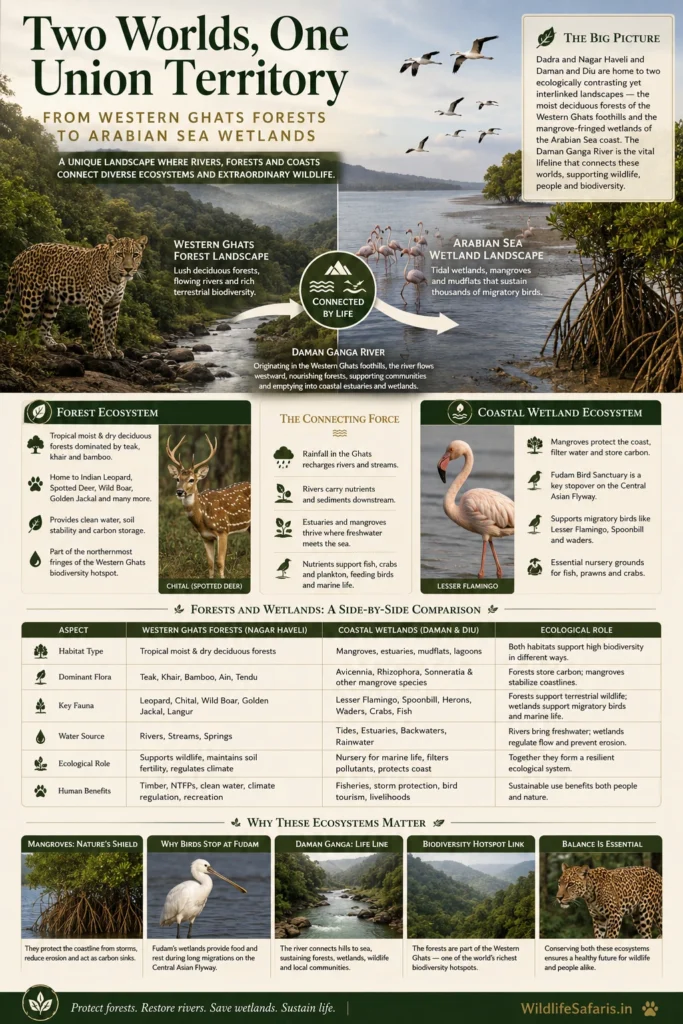
Despite heavy industrialisation, the territory retains nearly thirty-nine per cent of its geographical area under forest cover, primarily concentrated in Nagar Haveli. These woodlands are dominated by tropical moist deciduous and dry deciduous forests, featuring robust stands of teak and khair, which function as crucial green lungs for the region. The coastal tracts of Daman and Diu harbour vital mangrove ecosystems along the estuaries of the Daman Ganga and Kolak rivers, providing essential nurseries for marine life and buffering the coastline against erosion.
Wildlife conservation in the territory is concentrated within two primary protected areas. The Dadra and Nagar Haveli Wildlife Sanctuary protects the forested, hilly tracts that sustain populations of the Indian leopard, wild boar, and spotted deer, serving as a biological extension of the northern Western Ghats. In stark contrast, the Fudam Bird Sanctuary on Diu Island protects a crucial coastal wetland ecosystem. Despite its diminutive size, Fudam acts as a vital stopover on the Central Asian Flyway, attracting significant flocks of migratory waders, including greater and lesser flamingos, during the winter months. Wildlife tourism is primarily geared towards avian observation and nature trails, offering quiet ecological retreats within a rapidly urbanising coastal corridor.
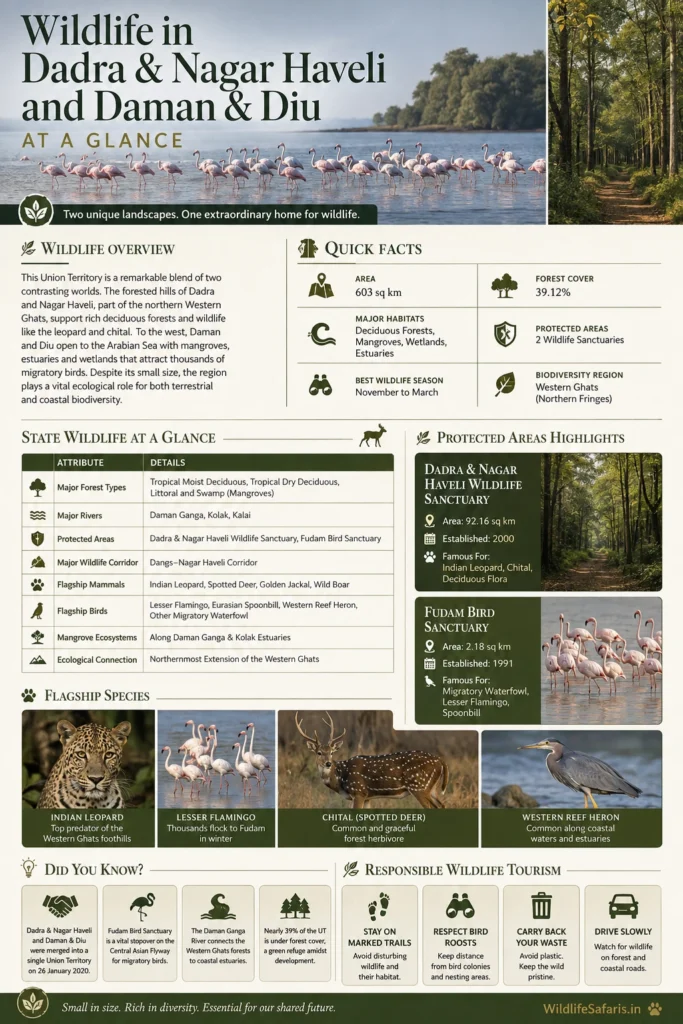
Quick Facts Table
| Category | Details |
| State / Union Territory | Dadra and Nagar Haveli and Daman and Diu (Union Territory) |
| Capital | Daman |
| Area | 603 sq km |
| Population | 585,764 (2011 Census) |
| Forest Cover | 39.12% |
| Official Language(s) | Gujarati, Hindi, Marathi, English |
| Time Zone | UTC+05:30 (IST) |
| Best Wildlife Season | November to March |
State Wildlife Master Table
| Attribute | Details |
| State / Union Territory | Dadra and Nagar Haveli and Daman and Diu |
| Capital | Daman |
| Geographic Region | Western Coast and Western Ghats Foothills |
| Total Area | 603 sq km |
| Forest Cover | 39.12% |
| State Animal | Not officially specified |
| State Bird | Not officially specified |
| State Tree | Not officially specified |
| State Flower | Not officially specified |
| Highest Peak | Not officially specified (Undulating hills in Nagar Haveli reach ~400 m) |
| Major Rivers | Daman Ganga, Kolak, Kalai |
| Major Forest Types | Tropical Moist Deciduous, Tropical Dry Deciduous, Littoral and Swamp (Mangroves) |
| Biodiversity Hotspot | Western Ghats (northernmost fringes in Nagar Haveli) |
| UNESCO Natural Sites | None |
| Biosphere Reserves | None |
| Tiger Reserves | None |
| Elephant Reserves | None |
| National Parks | None |
| Wildlife Sanctuaries | Fudam Bird Sanctuary, Dadra and Nagar Haveli Wildlife Sanctuary |
| Conservation Reserves | Not officially specified |
| Community Reserves | Not officially specified |
| Ramsar Sites | None |
| Important Bird Areas (IBAs) | Not officially specified |
| Major Wildlife Corridors | Dangs-Nagar Haveli Corridor |
| Flagship Mammals | Indian Leopard, Spotted Deer, Golden Jackal |
| Flagship Birds | Lesser Flamingo, Eurasian Spoonbill, Western Reef Heron |
| Endemic Wildlife | Not officially specified |
| Best Wildlife Destinations | Fudam Bird Sanctuary, Dudhni Lake environs |
| Best Time for Wildlife Tourism | November to March |
| Nearest International Airports | Surat International Airport (Gujarat), Chhatrapati Shivaji Maharaj International Airport (Mumbai) |
| Official Forest Department Website | dnhforest.gov.in / fddaman.in |
Protected Areas Summary Table
| Protected Area | Category | District | Area (sq km) | Year Established | Famous For |
| Dadra and Nagar Haveli Wildlife Sanctuary | Wildlife Sanctuary | Dadra and Nagar Haveli | 92.16 | 2000 | Indian Leopard, Chital, Deciduous Flora |
| Fudam Bird Sanctuary | Wildlife Sanctuary | Diu | 2.18 | 1991 | Migratory Waterfowl, Lesser Flamingo, Spoonbill |
Wildlife Highlights
- Top Mammals: Indian Leopard, Chital (Spotted Deer), Wild Boar, Golden Jackal, Indian Hare, Jungle Cat, Small Indian Civet.
- Top Birds: Lesser Flamingo, Greater Flamingo, Eurasian Spoonbill, Western Reef Heron, Painted Stork, Indian Peafowl, Black-winged Stilt.
- Reptiles & Amphibians: Indian Flapshell Turtle, Russell’s Viper, Spectacled Cobra, Indian Rat Snake, Common Skink.
- Flagship Flora: Teak (Tectona grandis), Khair (Senegalia catechu), Mahua (Madhuca longifolia), Mangroves (Avicennia marina in coastal zones).
- Best Wildlife Experiences: Birdwatching in the tidal mudflats of Fudam Bird Sanctuary (Diu), walking the forested nature trails around Dudhni Lake (Nagar Haveli), and exploring the mangrove creeks of the Daman Ganga estuary.
Conservation Challenges
- Industrialisation: The territory is a major industrial hub; uncontrolled industrial expansion and effluence pose severe threats to the Daman Ganga riverine ecosystem and surrounding forested tracts.
- Habitat Fragmentation: The dense network of highways and roads connecting the industrial zones cuts directly through the forested habitats of Nagar Haveli, leading to wildlife casualties and restricted animal movement.
- Coastal Degradation: In Daman and Diu, tourism pressures, coastal erosion, and the reclamation of tidal mudflats threaten the fragile mangrove ecosystems and vital roosting grounds for migratory birds.
- Waste Management: Improper disposal of solid waste and plastic pollution severely impacts the estuarine environments and the Fudam Bird Sanctuary.
- Human-Wildlife Conflict: Occasional instances of leopards straying from the fragmented forests of Nagar Haveli into peripheral villages and agricultural lands, leading to livestock depredation.
Responsible Wildlife Tourism
- Protect the Mudflats: When visiting the Fudam Bird Sanctuary, strictly remain on designated viewing platforms or paths. Walking on tidal mudflats destroys the micro-organisms that flamingos and waders feed upon.
- No Plastic on Coasts: Ensure zero plastic footprint when visiting the mangrove creeks of Daman or the wetlands of Diu to prevent marine and estuarine pollution.
- Respect Avian Roosts: Do not fly drones or make loud noises near the bird sanctuary, as this can easily startle and stress large flocks of migratory birds.
- Stay on Marked Trails: While trekking in the forests of Nagar Haveli, do not venture off-trail. The undergrowth is crucial for ground-nesting birds and small reptiles.
- Observe Speed Limits: Drive cautiously on the roads passing through the forested corridors of Dadra and Nagar Haveli to prevent roadkills of nocturnal mammals and snakes.
Did You Know?
- Dadra and Nagar Haveli and Daman and Diu were distinct Union Territories until their administrative merger in 2020, which is why their wildlife habitats are geographically separated by hundreds of kilometres.
- Fudam Bird Sanctuary on Diu Island covers just 2.18 square kilometres, yet it is one of the most critical wintering grounds for wetland birds on the Saurashtra coast.
- The forests of Nagar Haveli are contiguous with the Dangs forest region of Gujarat, forming an important wildlife corridor at the northernmost edge of the Western Ghats.
- The Daman Ganga River, originating in the Western Ghats, is the ecological lifeline of the territory, passing through Nagar Haveli and Daman before emptying into the Arabian Sea.
- Despite heavy urbanization, Nagar Haveli maintains a commendable forest cover of over 40% of its individual landmass, rich in valuable timber species like Teak and Khair.
- The territory operates the Vasona Lion Safari near Silvassa, an ex-situ conservation and tourism initiative housing Asiatic lions brought from the Gir forests of Gujarat.
Safari Planning : Topics Cluster
- How to book a wildlife safari in India?
- Park by Park Online Safari Booking Guide
- Tiger Safari India Planning Workbook
- Park by Park Safari Permits Guide
- National Parks Permit Guide – Park by Park Guide
- Tatkal Safari Booking Guide – Last Minute Safari Permits Booking
- Tiger Safari in India Cost
- Indian Wildlife Safari Budget Planner
- Jeep vs Canter Safari
- Best time for Tiger Sightings in India
- How far advanced should you book safari permits?
- Can foreigners book Indian Wildlife Safari online?
- Special Permits Guide for Foreigners and Domestic Visitors
- How to book a Safari Permit online in India? 2026 step by step guide
- Senior Citizens Friendly Safari Planning
- Multi Generation Family Safari Planning
- 50 things to know before your first safari in India