
Discover the sloth bear (Melursus ursinus). Learn about its unique insect-eating adaptations, habitats in India, behavior, and vital conservation needs.
Introduction
When planning a safari in India, most travelers focus entirely on the Bengal tiger or the Indian leopard. However, the country’s forests are also home to a highly specialized, evolutionarily distinct mammal that often gets left out of mainstream wildlife conversations: the sloth bear.
Often labeled the “forgotten predator” of the subcontinent, the sloth bear occupies a unique ecological niche. It does not hunt large prey like India’s big cats, yet its aggressive defensive capabilities and unique survival strategies make it one of the most significant mammals in the landscape.
Understanding the sloth bear is essential for anyone tracking Indian wildlife. This guide provides practical insights into the bear’s biology, behavior, and where you can observe it responsibly in its natural environment.
What is a Sloth Bear?
The easiest way to understand the sloth bear is to look past its confusing common name. It is a true bear, not a sloth, and its lifestyle is shaped by a diet centered heavily on insects rather than meat or leaves.
Scientific Classification and the “Sloth” Misnomer
The scientific name of the sloth bear is Melursus ursinus. The animal received its common name from early European naturalists who observed its long, curved claws and ability to hang upside down from trees, mistakenly linking it to the sloths of South America.
Historically, the species was also referred to as the “honey bear” due to its fondness for honeycombs, though this term is largely confined to folklore today.
Field Note
While the sloth bear shares a name with arboreal sloths due to a historical misunderstanding of its claws, it belongs firmly to the Ursidae (bear) family. It is native to the Indian subcontinent, primarily occurring in India and Sri Lanka, with smaller populations tracked in Nepal and Bhutan.
Physical Dimensions and Identification
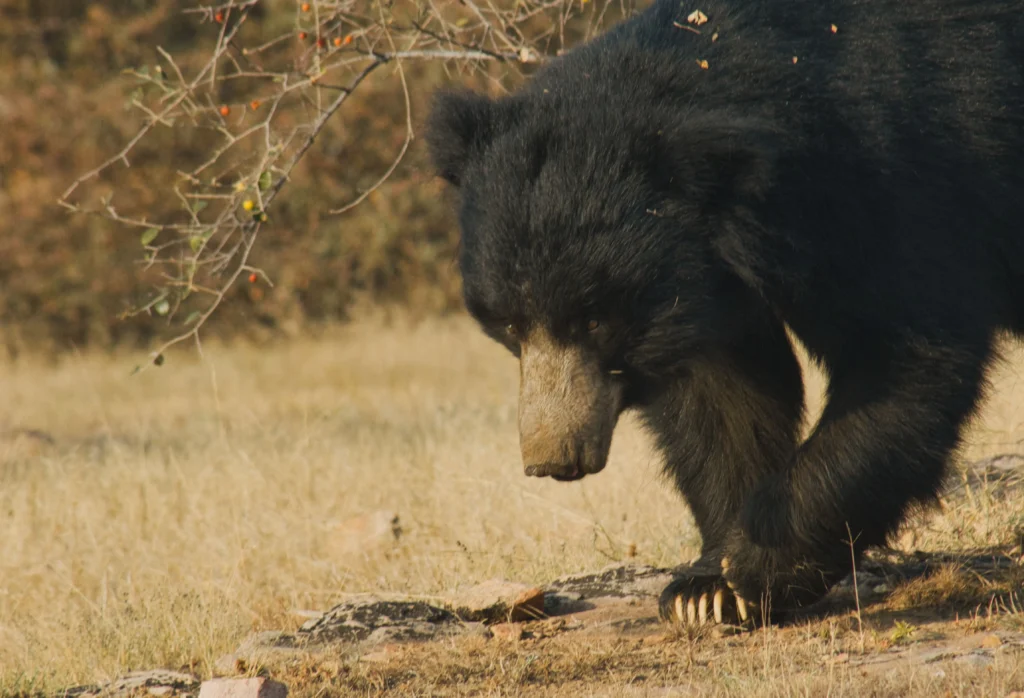
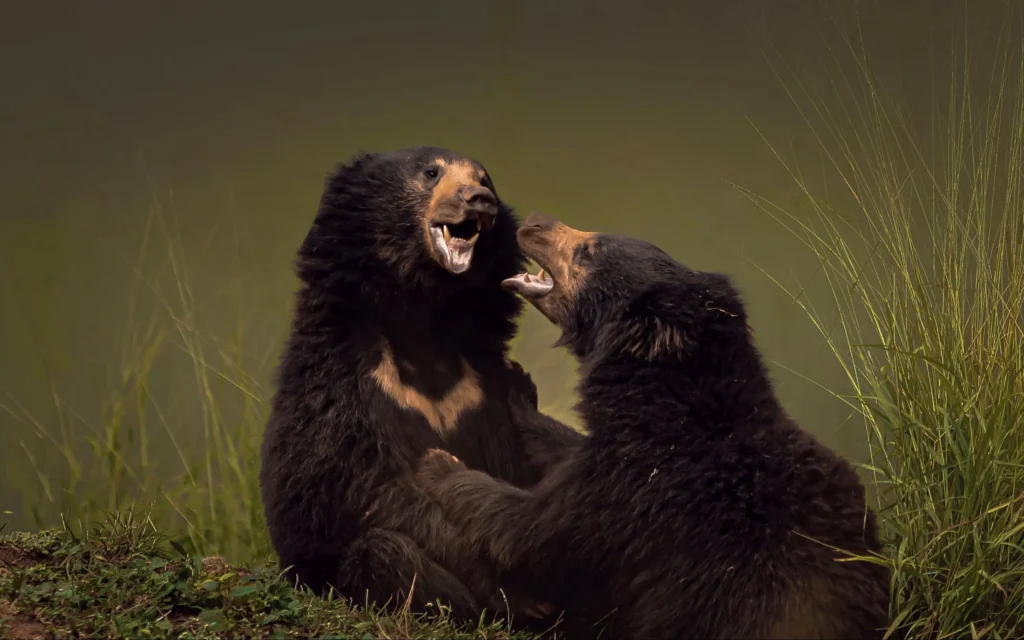
Sloth bears possess a distinct, somewhat shaggy appearance that separates them from other global bear species. They carry a long, coarse black coat with a characteristic white or yellowish V-shaped mark across the chest.
Adult sloth bears typically reach the following dimensions:
- Body Length: Approximately 1.5 metres.
- Shoulder Height: Around 75 centimetres.
- Adult Weight: Roughly 91 to 113 kilograms based on baseline scientific records, though variations occur depending on regional food availability and gender.
| Metric | Baseline Measurement DOCX |
| Scientific Name | Melursus ursinus |
| Average Body Length | 1.5 metres |
| Average Shoulder Height | 75 cm |
| Weight Range | 91–113 kg |
| IUCN Red List Status | Vulnerable |
Their physical structure is explicitly built for digging and foraging rather than speed. The long, pale claws that caused early classification errors are actually highly efficient tools designed to tear open stone-hard insect mounds.
Specialized Anatomy and Adaptations
A sloth bear’s physical structure is entirely dictated by its highly specialized diet. Rather than possessing the anatomy of a classic meat-eating predator, the sloth bear is built specifically to extract insects from hard ground and deep crevices.
The Mechanics of Myrmecophagy
The practice of eating ants and termites is known as myrmecophagy, and sloth bears are highly adapted for this feeding behavior. Their foraging relies on a unique sequence of anatomical tools:
- First, they use their long, powerfully curved claws to rip open rock-hard termite mounds and ant nests.
- Once the nest is breached, they blow away the loose dirt and dust.
- Finally, they use their specialized anatomy—which includes a distinct gap in their front teeth—to suck the insects directly out of the nest like a vacuum.
Field Note
On a quiet safari, it is sometimes possible to hear a foraging sloth bear before you see it. The vacuum-like sucking sound they make while extracting termites can carry surprisingly far through the dry forest.
Why the Sloth Bear is a “Forgotten Predator”
Many travelers and wildlife enthusiasts classify predators strictly as animals that hunt large herbivores. Because sloth bears do not stalk deer or antelope, they are often overlooked in discussions about India’s top predators, earning them the title of the “forgotten predator”.
However, they are aggressive predators of insect colonies, and their intense focus on this food source allows them to occupy an ecological niche largely ignored by tigers, leopards, and wild dogs.
Sloth Bear Behavior and Diet
While insects form the foundation of their diet, sloth bears are opportunistic omnivores whose behavior shifts based on the climate and the season.
Nocturnal Foraging and the Absence of Hibernation
Most sloth bear activity occurs after dark. They are primarily nocturnal, moving through the forests and grasslands at night to forage when temperatures are cooler and human activity is minimal.
Unlike many bear species in North America or Europe, sloth bears live in warm climates. Because their food sources remain accessible year-round and they do not face extreme winter freezing, they do not hibernate.
Seasonal Feeding Shifts
The sloth bear’s diet is highly flexible. While termites and ants are staples, their eating habits shift significantly during fruiting seasons. They readily consume wild fruits as they ripen, completely altering their foraging patterns to take advantage of the seasonal abundance.
Sloth Bear Diet Breakdown
| Food Category | Typical Sources DOCX |
| Primary Insects | Termites and ants |
| Seasonal Forage | Wild fruit and honey |
| Supplemental Diet | Grains and small vertebrates |
Maternal Care and Cub Riding
Female sloth bears typically give birth to litters of one to three cubs after a gestation period of roughly seven months.
Because sloth bears share their habitat with apex predators like tigers and leopards, mothers have developed a unique strategy for protecting their young: maternal cub riding. The cubs climb onto their mother’s shaggy back, clinging tightly to her fur while she travels and forages. This keeps the cubs safely off the ground and allows the mother to defend them more effectively.
Defensive Behavior
One of the most misunderstood aspects of sloth bear behavior is their aggression. When sloth bears charge or attack, it is rarely an act of predation. Instead, these incidents generally stem from surprise encounters, where a startled bear resorts to immediate, aggressive defense to protect itself or its cubs. Because they have poor eyesight and hearing, they are easily startled at close range, which triggers their defensive instincts.
Habitat and Distribution Across India
If you want to observe sloth bears, you must look beyond India’s classic, dense tiger reserves. Sloth bears are adaptable mammals that occupy a diverse range of landscapes across the Indian subcontinent, from the southern peninsula to the northern scrublands.
Forest, Grassland, and Scrub Strongholds
A common misconception among travelers is that sloth bears are exclusively found in deep, closed-canopy forests. While they are primarily recognized as forest-dwelling bears, they also successfully utilize grasslands and scrub habitats.
The determining factors for a sloth bear’s presence are not necessarily the height of the trees, but rather the availability of adequate protective cover and access to primary food sources like insect mounds and fruiting vegetation. Because human land use heavily shapes these environments, bear ecology is directly tied to how these diverse landscapes are managed.
Key Sanctuaries and Regional Distributions
Sloth bears are widely distributed across central and western India, with prominent populations residing in states such as Rajasthan, Karnataka, Jharkhand, and Gujarat. Because their ranges often overlap with human-dominated landscapes, contemporary conservation writing increasingly frames sloth bear management as an issue of landscape connectivity rather than just isolated species protection.
Several protected areas serve as critical strongholds for the species, offering both dedicated habitats for the bears and structured viewing opportunities for visitors.
Key Sloth Bear Sanctuaries and Research Areas
| Sanctuary / Protected Area | State | Habitat and Significance DOCX |
| Daroji Sloth Bear Sanctuary | Karnataka | A dedicated protected area famous for its boulder-strewn scrub landscape and reliable bear activity. |
| Jessore Sloth Bear Sanctuary | Gujarat | A crucial dry forest habitat that supports western India’s bear populations. |
| Palkot Wildlife Sanctuary | Jharkhand | A significant habitat evaluated in a 2025 Wildlife Institute of India report focusing on conservation and conflict concerns. |
| Kumbhalgarh & Phulwari-ki-Nal | Rajasthan | Important regional strongholds highlighted in a 2024–25 study emphasizing the need for wildlife corridors and genetic variability data. |
Photography Tip
In scrub and boulder habitats like Daroji or Jessore, sloth bears frequently seek shelter deep within rocky crevices during the heat of the day. The most productive photography lighting and sighting opportunities occur in the late afternoon when the bears begin to emerge for their nocturnal foraging routines.
Conservation Status and Threats
Despite their widespread distribution across the Indian subcontinent, sloth bears face significant long-term survival challenges. They are formally recognized as a Vulnerable species on the IUCN Red List. Within India, the highest level of legal protection applies to them; they are listed under Schedule I of the Wildlife (Protection) Act and are included in CITES Appendix I, strictly prohibiting hunting and international trade.
Habitat Fragmentation and Human Pressures
While historical threats included poaching and capturing live cubs for the now-banned dancing bear trade, the primary pressures today revolve around land use. Habitat loss, forest degradation, and the expansion of road networks continually fragment the landscapes sloth bears rely on.
Because sloth bears frequently inhabit scrublands and forest edges that directly border rural villages and agricultural zones, they are increasingly forced into human-dominated areas. Conservation experts now emphasize that protecting the species is not just about guarding isolated forest reserves; it requires maintaining wildlife corridors and landscape connectivity so bears can move safely between habitats to forage and breed.
Human-Sloth Bear Conflict and Safety
The reality of shared landscapes inevitably leads to friction. In rural areas bordering bear habitats, human-sloth bear conflict is a pressing conservation and public safety issue.
Understanding Defensive Behavior vs. Predation
When conflict incidents occur, they are rarely predatory. Because sloth bears have relatively poor eyesight and hearing, they are easily startled by humans gathering firewood or walking near forest edges. If a bear feels cornered—especially a mother carrying cubs—its instinct is to launch an immediate, aggressive defense. Many so-called attacks are simply sudden defensive reactions to surprise encounters rather than stalking behavior. Unfortunately, these incidents often result in severe injuries to humans, leading to retaliatory killings of bears by affected communities.
Practical Safety Guidelines for Travelers and Communities
Modern conservation emphasizes conflict mitigation and coexistence. Protecting local livelihoods is just as crucial as protecting the bears.
Responsible Tourism & Safety Tip
For travelers, hikers, and communities sharing this landscape, a few practical steps significantly reduce the risk of an encounter:
- Make noise: When walking in bear habitats, talk loudly or use a bell. Alerting a bear to your presence from a distance gives it time to retreat.
- Avoid walking at dawn or dusk: Sloth bears are primarily nocturnal foragers. Restricting foot travel through scrub and forest edges during these transition hours reduces the chance of crossing paths.
- Do not approach cubs: If you spot a cub, slowly and quietly back away. A fiercely protective mother is almost certainly nearby.
Common Mistakes
Understanding the sloth bear requires unlearning several popular myths:
- Mistaking them for sloths: Despite the name, they are true bears, not South American sloths.
- Assuming they hibernate: Unlike bears in colder climates, sloth bears in warm Indian habitats do not hibernate.
- Viewing them as pure carnivores: They do not hunt large game; they are specialized insect-eaters and opportunistic omnivores.
- Believing they only live in dense jungles: They frequently thrive in scrublands, grasslands, and dry forests, provided there is food and cover.
- Assuming all encounters are predatory attacks: The vast majority of aggressive incidents are defensive responses to being startled.
- Treating conservation as a species-only issue: Protecting the bear requires reducing human-wildlife conflict and protecting local livelihoods.
Frequently Asked Questions
What is a sloth bear? It is a specialized, forest-dwelling bear native to the Indian subcontinent, heavily adapted for eating insects like ants and termites.
Why is it called a sloth bear? Early European naturalists mistakenly linked them to sloths because of their long, curved claws and ability to hang upside down from trees.
What is the scientific name of the sloth bear? The scientific name is Melursus ursinus.
What do sloth bears eat? They are opportunistic omnivores whose core diet consists of termites and ants. They also consume wild fruits, honey, grains, and sometimes small vertebrates depending on the season.
Are sloth bears dangerous to humans? Yes, they can be dangerous. However, their aggression is usually defensive rather than predatory, often triggered when they are surprised at close range.
Do sloth bears hibernate? No. Because they live in warm climates with year-round access to food, they do not undergo winter hibernation.
Where are the best places to see sloth bears in India? Top sanctuaries include the Daroji Sloth Bear Sanctuary in Karnataka, Jessore Sloth Bear Sanctuary in Gujarat, and Palkot Wildlife Sanctuary in Jharkhand, alongside major reserves in Rajasthan and central India.
Conclusion
The sloth bear is far more than an aggressive inhabitant of India’s forests; it is a highly evolved specialist that plays a vital role in controlling insect populations and shaping the ecosystem. Moving beyond the “forgotten predator” stereotype requires recognizing its unique adaptations, from vacuuming termites to maternal cub-riding.
Securing the future of Melursus ursinus relies heavily on a dual approach: preserving fragmented wildlife corridors and actively supporting the local communities that share these complex landscapes. When planning your next Indian wildlife safari, take the time to appreciate the scrublands and dry forests—you might just catch a glimpse of this highly specialized bear emerging into the dusk.
Editor’s Note: Wildlife conservation and conflict management are ongoing efforts. This guide reflects the current understanding of sloth bear ecology and coexistence strategies in India as of 2026.
Safari Planning : Topics Cluster
- How to book a wildlife safari in India?
- Park by Park Online Safari Booking Guide
- Tiger Safari India Planning Workbook
- Park by Park Safari Permits Guide
- National Parks Permit Guide – Park by Park Guide
- Tatkal Safari Booking Guide – Last Minute Safari Permits Booking
- Tiger Safari in India Cost
- Indian Wildlife Safari Budget Planner
- Jeep vs Canter Safari
- Best time for Tiger Sightings in India
- How far advanced should you book safari permits?
- Can foreigners book Indian Wildlife Safari online?
- Special Permits Guide for Foreigners and Domestic Visitors
- How to book a Safari Permit online in India? 2026 step by step guide
- Senior Citizens Friendly Safari Planning
- Multi Generation Family Safari Planning
- 50 things to know before your first safari in India