
Planning a successful safari in India requires looking beyond the tiger. While tigers draw significant attention, understanding the Indian leopard reveals one of the most versatile and resilient predators on the continent.
For wildlife travellers, photographers, and naturalists, tracking leopards demands a sharp eye and an understanding of specific behavioral patterns. Unlike species confined to deep national parks, leopards navigate a complex matrix of protected forests, rocky outcrops, and human-dominated agricultural lands.
This guide provides a practical analysis of leopard biology, behavior, and distribution across India. By understanding how these big cats hunt, travel, and adapt, you can significantly improve your tracking skills and appreciation of India’s wilderness during your next field visit.
Understanding the Indian Leopard: Classification and Physical Traits
Scientific Classification and Legal Status
If you are tracking wildlife or reviewing conservation legislation, clarity on nomenclature and legal status is essential. The Indian leopard is a distinct subspecies of the common leopard.
- Scientific Name: Panthera pardus.
- IUCN Red List Status: Listed globally as Near Threatened.
- National Protection: Protected under Schedule I of India’s Wildlife (Protection) Act, providing it the highest level of legal protection against hunting and trade.
- International Trade: Listed under CITES Appendix I, which strictly prohibits international commercial trade of the species or its parts.
Size, Weight, and Physical Dimensions
Recognizing the physical scale of an animal helps naturalists correctly identify tracks, gauge distance, and understand predatory capabilities in the field. The Indian leopard exhibits clear sexual dimorphism, meaning males are noticeably larger and heavier than females.
- Shoulder Height: Adults typically measure between 45 cm and 80 cm at the shoulder.
- Head-and-Body Length: The body length ranges from 100 cm to 190 cm.
- Tail Length: The tail measures between 70 cm and 95 cm, serving as a critical balancing mechanism during climbing and high-speed pursuits.
- Male Weight: Adult males typically weigh between 30 kg and 70 kg.
- Female Weight: Adult females are lighter, weighing between 28 kg and 60 kg.
Adaptations and Coat Patterns
The leopard’s coat is designed for camouflage rather than display. The fur features a pale yellow to yellowish-brown background covered in dark spots arranged in unique clusters called rosettes.
These rosettes lack the central spots found in jaguars, a common point of confusion for early students of natural history. The patterns act as disruptive coloration, breaking up the animal’s outline in broken sunlight, dry grass, or rocky terrain.
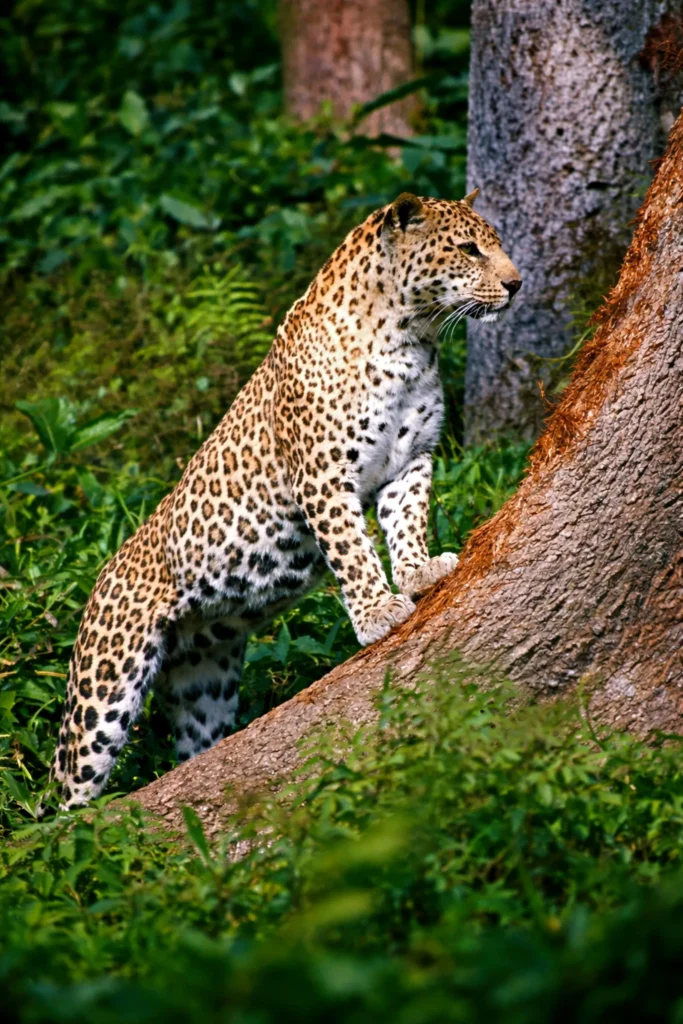
Physically, the leopard features a compact, muscular torso, relatively short legs, and broad paws. These anatomical traits are specifically evolved for strength and agility rather than sustained long-distance running, allowing the cat to tackle prey up to three times its own weight and pull carcasses vertically into trees.
| Physical Parameter | Male Specifications | Female Specifications |
| Weight Range | 30–70 kg | 28–60 kg |
| Shoulder Height | 45–80 cm (upper range) | 45–80 cm (lower range) |
| Head-Body Length | 100–190 cm | 100–190 cm |
| Tail Length | 70–95 cm | 70–95 cm |
| Legal Protection | Schedule I (India WPA) | Schedule I (India WPA) |
Field Note
When observing a leopard in the field, look closely at the tail. If the cat is moving through tall grass, the white underside of the tip of the tail is often held slightly upward. Naturalists believe this serves as a visual follow-me signal for cubs moving through dense cover behind the mother.
Behaviour and Ecology of the Indian Leopard
Nocturnal Hunting Strategies and Diet
The Indian leopard is primarily an elusive, nocturnal predator. This preference for nighttime activity is a primary reason they can successfully navigate a wide variety of habitats, including those near human settlements.
Rather than relying on sustained speed over long distances, leopards use stealth and cover to ambush their prey. Their diet is highly adaptable and shifts based on the environment. Within protected national parks, they routinely hunt small to medium-sized herbivores, with a strong preference for species like chital, hog deer, and wild boar. In fragmented habitats or peripheral zones, they readily adjust their diet to include feral dogs and other available resources, demonstrating their remarkable ecological flexibility.
Arboreal Habits: Tree Climbing and Prey Hoisting
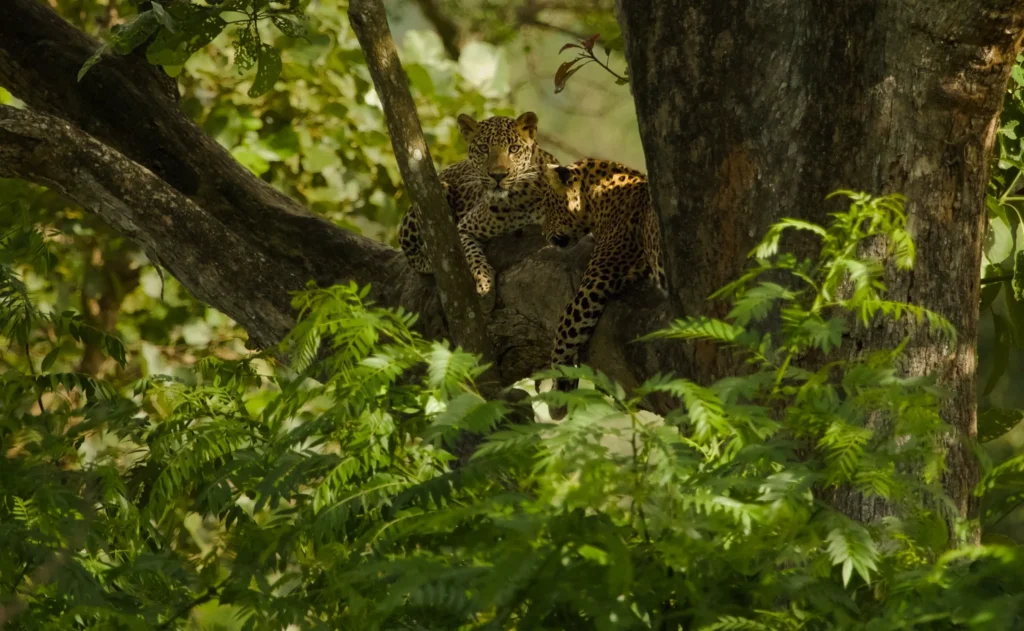
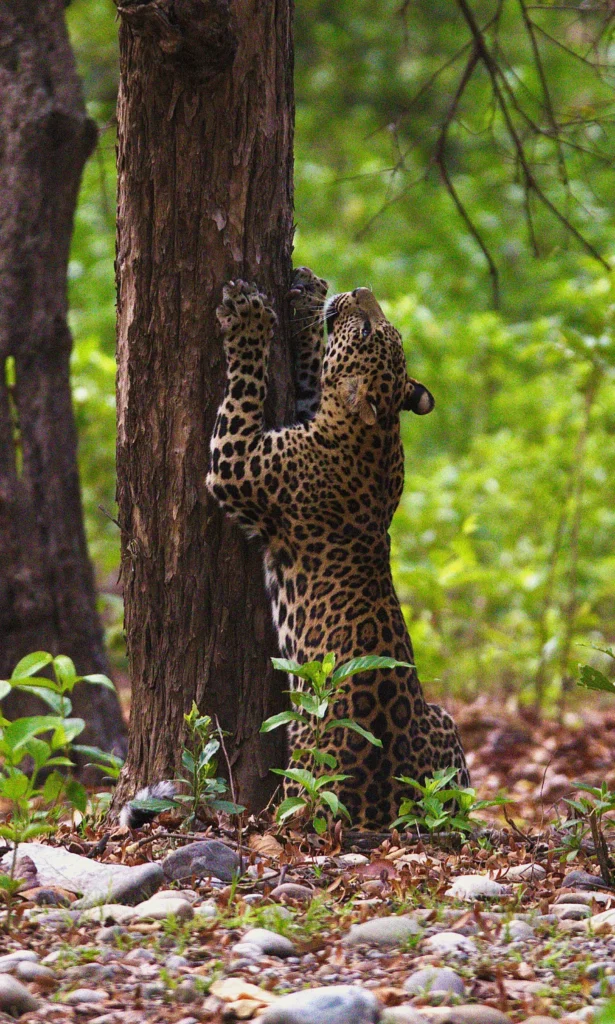
Unlike tigers, Indian leopards are highly arboreal. Their strong shoulder musculature and long tails provide the leverage and balance necessary to scale large, vertical tree trunks with agility.
This climbing ability serves critical survival functions. Trees offer secure vantage points for resting and scanning the landscape for both prey and threats. Furthermore, leopards frequently engage in prey hoisting—the practice of dragging heavy carcasses high into the branches. This tree-caching behavior is a necessary adaptation to protect their food from ground-based scavengers and larger, dominant predators.
Reproduction and Cub Rearing
Raising cubs is an entirely solitary effort for the female leopard. Because young cubs face severe threats from larger predators and male leopards, the mother relies heavily on environmental concealment.
Females seek out secure, hidden den sites in features like deep rocky outcrops, heavy scrublands, or dense thickets. The mother must routinely leave her cubs hidden in these secure locations while she hunts for food. As the cubs mature, they begin trailing her through the territory, slowly learning the necessary stealth, hunting techniques, and climbing skills required to navigate complex habitats.
Behavioral Shifts in Tiger-Occupied Territory
While leopards and tigers frequently share the same geographic regions in India, they do not utilize the habitat in the same way. It is a common misconception that their behavior remains static regardless of the environment. In reality, the presence of tigers dictates a distinct behavioral shift in leopards.
Because a tiger poses a lethal threat, leopards adapt to coexistence by altering their movement patterns to avoid direct overlap. In tiger-dominated landscapes, leopards rely far more heavily on their arboreal abilities, using trees not just for resting, but as critical escape routes and secure dining areas to avoid fatal confrontations.
Big Cat Differentiation: Leopard vs. Tiger
| Behavioral & Physical Trait | Indian Leopard | Tiger |
| Male Weight | 30–70 kg | Significantly heavier |
| Habitat Flexibility | Extremely high; thrives in forests, scrublands, and agricultural mosaics | Generally restricted to contiguous forests and tall grasslands |
| Arboreal Behavior | Frequent tree climber and prey hoister | Ground-dwelling; rarely climbs as an adult |
| Coexistence Strategy | Actively shifts behavior and movement patterns when tigers are present | Apex predator; dominates the immediate territory |
| Activity Pattern | Strongly nocturnal; highly elusive in shared landscapes | Crepuscular and nocturnal, but frequently visible in daylight |
Field Note
When looking for leopards on a safari drive, remember to look up. Do not simply scan the ground cover. Pay close attention to the large lateral branches of mature trees, particularly in zones known for high tiger activity. A leopard resting in the dappled shade of a canopy blends in perfectly with the bark and leaves, so train your eyes to look for the distinct silhouette of a hanging tail.
Habitat Preferences and Distribution Across India
Forest Types and Open Landscapes
A common misconception among wildlife enthusiasts is that leopards are confined strictly to dense, undisturbed forests. While they certainly utilize deep jungle, the Indian leopard is highly adaptable and occupies a vast range of ecosystems.
They successfully inhabit tropical rainforests, temperate deciduous woods, and alpine coniferous forests. However, they are equally at home in dry scrublands, rocky outcrops, and open grasslands. Because of this extraordinary adaptability, WWF India notes that leopards occupy approximately 1,74,066 square kilometres across India’s 17 tiger-bearing states. This range is nearly double the area occupied by tigers.
Fragmented Landscapes, Agricultural Mosaics, and Corridors
Modern India presents a complex environment for large predators. Leopards do not exist solely within the hard boundaries of protected national parks. They routinely utilize scrublands, farmland edges, and agricultural mosaics to move, hunt, and establish territories.
Forest corridors connecting major reserves are vital for their survival. These corridors allow leopards to disperse and maintain genetic diversity. However, this reliance on fragmented habitats and peri-urban areas frequently brings them into close proximity with human settlements. Understanding this landscape ecology is crucial; it explains why leopards can thrive in human-dominated areas where other large predators, like tigers, cannot.
The 2024 National Population Estimate and Regional Trends
When planning a safari or analyzing conservation success, it is important to consult recent, official data. In February 2024, the Government of India released its fifth-cycle leopard population estimation. The report estimated a population of 13,874 leopards, with a statistical range of 12,616 to 15,132 individuals.
Readers should understand that population estimates are scientifically modeled figures with specific sampling limits, not exact counts. The 2024 survey covered approximately 70% of leopard habitat. High-altitude regions in the Himalayas and semi-arid tracts not classified as tiger habitat were not sampled during this exercise.
At the state level, Madhya Pradesh recorded the largest estimated population. However, the national report highlighted distinct regional variations in population health.
Regional Population Trends in India
| Region | Current Population Trend | Key Habitat Characteristics |
| Central India | Stable or slightly growing | Deciduous forests, rocky outcrops, and agricultural mosaics |
| Shivalik Hills and Gangetic Plains | Showing decline | Himalayan foothills, fragmented forest patches, and highly populated agricultural zones |
Decision Guide: Choosing a Safari Destination
If your primary goal is to observe leopards, focus your planning on states with strong, stable populations and favorable terrain. Central Indian states like Madhya Pradesh and Maharashtra, along with southern states like Karnataka and Tamil Nadu, offer excellent opportunities. Look for parks featuring rocky outcrops and dry scrub, as these environments make spotting a well-camouflaged leopard significantly easier than in dense tropical rainforests.
Threats, Coexistence, and the Black Panther Myth
Primary Threats: Habitat Loss, Conflict, and Road Mortality
The Indian leopard’s remarkable ability to adapt often masks the severe conservation challenges it faces. While the IUCN lists the species as Near Threatened, this classification does not imply an absence of conservation concern. Habitat loss and severe fragmentation remain critical issues across the subcontinent.
As contiguous forests are broken apart by human development, leopards are increasingly forced to navigate dangerous terrain to find food, mates, and secure territory. A significant, yet frequently overlooked, threat is road and rail mortality. Linear infrastructure cuts directly through forest corridors and agricultural mosaics, making fatal vehicle collisions a pressing problem for leopards attempting to move between fragmented habitats.
Human-Leopard Coexistence and Conflict Management
Because leopards frequently utilize scrub, farmland edges, and peri-urban landscapes, they live in much closer proximity to humans than most other large predators in India. This geographical overlap inevitably leads to human-leopard conflict, primarily concerning livestock depredation.
However, the narrative that leopards are inherently and consistently dangerous to people is a common misconception. In reality, leopards are primarily elusive and nocturnal, actively avoiding direct encounters with humans whenever possible. Current conservation communication and landscape ecology models increasingly emphasize practical strategies for coexistence rather than merely reacting to conflict. Protecting forest corridors and working alongside local communities on conflict management are now central to securing the leopard’s future in India.
Demystifying the Black Panther Misconception
One of the most persistent myths in wildlife tourism is the belief that a “black panther” is a distinct, separate species of big cat. This is biologically incorrect. In India, a black panther is simply a melanistic Indian leopard (Panthera pardus).
The animal possesses a genetic variation that causes an overproduction of dark pigment in its fur. If you observe a melanistic leopard in bright, direct sunlight, you can still clearly see the characteristic rosettes hidden within the dark coat. Their behavior, diet, and habitat preferences remain identical to those of standard-colored leopards in the same region.
The Black Panther Misconception Clarified
| Trait | Standard Indian Leopard | Black Panther (Melanistic Leopard) |
| Species | Panthera pardus | Panthera pardus |
| Coat Color | Pale yellow or yellowish-brown background | Black or dark brown due to melanism |
| Markings | Dark spots grouped into rosettes | Rosettes are present but obscured by dark pigmentation |
| Classification | Distinct subspecies of the common leopard | Genetic color variation within the exact same subspecies |
Responsible Tourism Tip
When travelling to and from national parks, especially during dawn, dusk, or night hours, instruct your driver to reduce speed. The buffer zones, agricultural mosaics, and roads connecting protected areas are heavily utilized by leopards moving through their territory. Maintaining safe vehicle speeds is a direct, practical way to reduce road mortality.
Practical Guide for Wildlife Travellers
Where to Observe Leopards Responsibly in India
When planning a safari, aligning your destination with leopard habitat preferences significantly improves your chances of a rewarding sighting. Central India currently holds the largest and most stable populations, with Madhya Pradesh recording the highest numbers in the 2024 estimation. States like Maharashtra, Karnataka, and Tamil Nadu also support substantial populations and offer excellent infrastructure for wildlife viewing.
Rather than focusing solely on deep, dense tropical forests, look for parks and reserves characterized by rocky outcrops, dry scrubland, and undulating terrain. These features naturally concentrate leopard activity, provide the high vantage points they prefer, and make spotting them slightly easier. Furthermore, because leopards thrive in fragmented landscapes and buffer zones, pay close attention when travelling through the agricultural mosaics bordering national parks.
Common Mistakes
- Scanning only the ground: Indian leopards are highly arboreal. They routinely use heavy lateral branches for resting, observing, and prey hoisting. Failing to scan the canopy is a primary reason visitors miss sightings.
- Assuming population estimates are exact counts: Treating the 2024 figure of 13,874 as a precise, absolute number. It is a scientifically modeled estimate with a range of 12,616 to 15,132, and it represents only the 70% of leopard habitat that was sampled (excluding high Himalayas and semi-arid tracts not classed as tiger habitat).
- Dismissing the periphery: Putting cameras away the moment the vehicle leaves the core zone. Leopards actively utilize farmland edges and scrublands for movement and hunting.
- Viewing leopards and tigers as ecological equals: Assuming they use the forest identically. Leopards actively alter their behavior, relying heavily on stealth and tree climbing to avoid direct overlap and fatal confrontations with tigers.
Frequently Asked Questions
What is the scientific name of the Indian leopard? The scientific name is Panthera pardus.
How many leopards are there in India? The 2024 government estimation reported 13,874 leopards (ranging from 12,616 to 15,132) within the sampled habitat.
Is the Indian leopard endangered? It is listed as Near Threatened on the IUCN Red List, though it receives the highest level of national protection under Schedule I of India’s Wildlife (Protection) Act.
What do Indian leopards eat? Within protected areas, they primarily hunt small to medium herbivores such as chital, hog deer, and wild boar. In peripheral and human-dominated landscapes, they adapt to hunt feral dogs and smaller available prey.
Why do leopards live near villages? Leopards are remarkably adaptable and routinely utilize agricultural mosaics, scrub, and peri-urban areas. As contiguous forests face fragmentation, leopards use these human-dominated landscapes to move between protected areas, establish territories, and find food.
Is the black panther a separate species? No, a black panther in India is a melanistic Indian leopard (Panthera pardus). It is the exact same subspecies, simply exhibiting a genetic variation that causes dark fur pigmentation.
Conclusion
The Indian leopard’s success lies in its exceptional adaptability. From the dense deciduous forests of Central India to the fragmented agricultural edges of the Shivalik hills, Panthera pardus has proven remarkably capable of navigating a complex and changing landscape.
However, this resilience should not diminish the reality of their conservation needs. While populations in Central India remain stable, declines in other regions highlight the ongoing pressures of habitat loss, human-wildlife conflict, and road mortality. Securing the future of the Indian leopard requires protecting critical forest corridors and prioritizing practical coexistence strategies with local communities. By understanding their behavior, respecting their space, and supporting responsible tourism, we can ensure these elusive predators remain a fixture of India’s wilderness.
Safari Planning : Topics Cluster
- How to book a wildlife safari in India?
- Park by Park Online Safari Booking Guide
- Tiger Safari India Planning Workbook
- Park by Park Safari Permits Guide
- National Parks Permit Guide – Park by Park Guide
- Tatkal Safari Booking Guide – Last Minute Safari Permits Booking
- Tiger Safari in India Cost
- Indian Wildlife Safari Budget Planner
- Jeep vs Canter Safari
- Best time for Tiger Sightings in India
- How far advanced should you book safari permits?
- Can foreigners book Indian Wildlife Safari online?
- Special Permits Guide for Foreigners and Domestic Visitors
- How to book a Safari Permit online in India? 2026 step by step guide
- Senior Citizens Friendly Safari Planning
- Multi Generation Family Safari Planning
- 50 things to know before your first safari in India